
keyword
relational knowledge
Relational knowledge is factual information that describes specific associations, properties, or connections between distinct entities, concepts, or objects. In computer science and knowledge representation, this knowledge is commonly structured as subject-predicate-object triples that link entities through defined relationships, such as connecting a person to their profession or a country to its capital. Unlike purely linguistic or syntactic knowledge, relational knowledge captures real-world facts and semantic dependencies, providing the foundation for structured databases, knowledge graphs, and the factual recall capabilities of artificial intelligence systems.
2 items
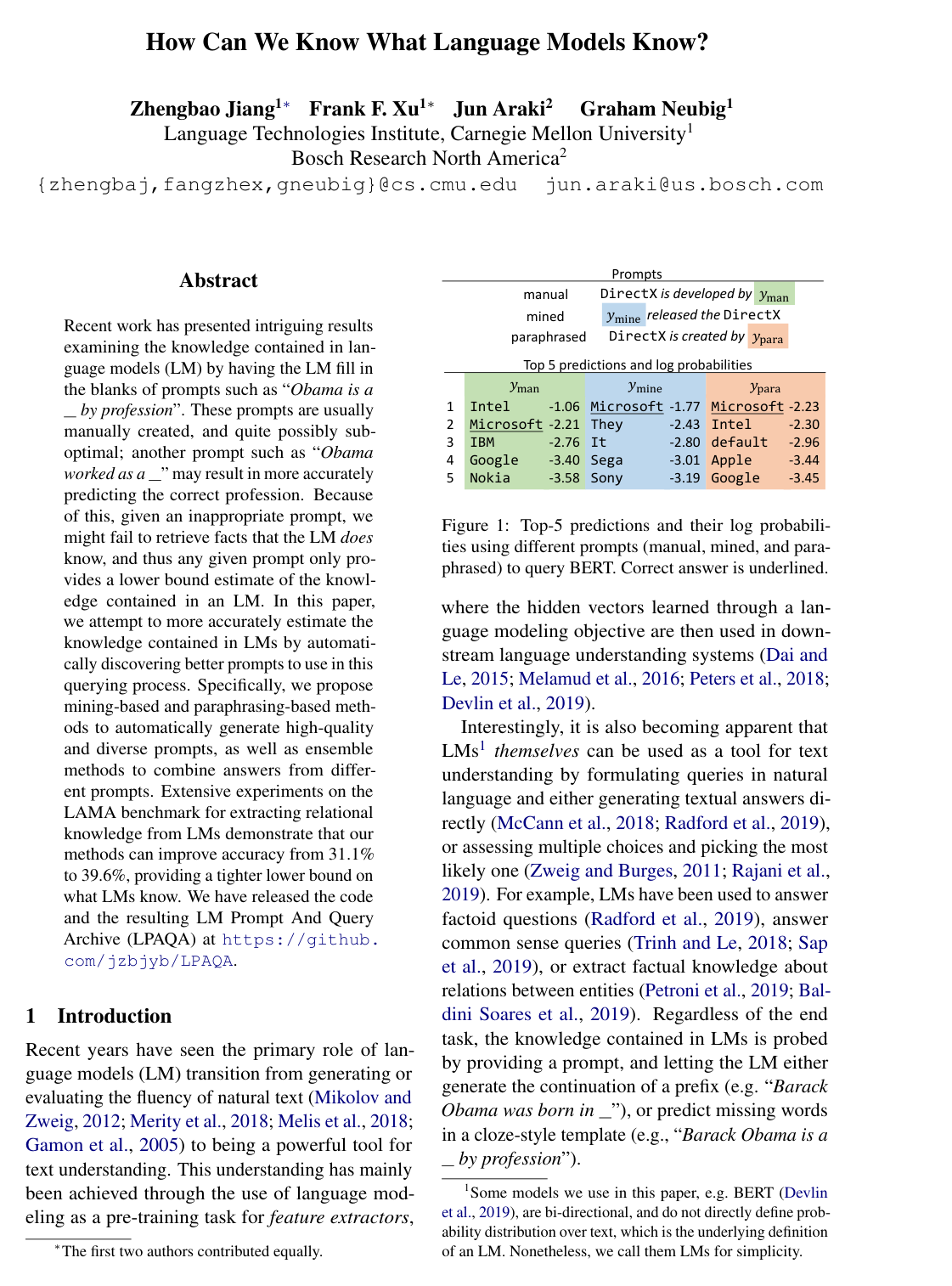
How Can We Know What Language Models Know?
Zhengbao Jiang, Frank F. Xu, Jun Araki, Graham Neubig
Why you should read this
Demonstrates that manual prompts underestimate the factual knowledge stored in language models and introduces automated mining, paraphrasing, and ensembling methods to substantially improve relation extraction accuracy on the LAMA benchmark.
Recent work has presented intriguing results examining the knowledge contained in language models (LM) by having the LM fill in the blanks of prompts such as "Obama is a _ by profession". These prompts are usually manually created, and quite possibly sub-optimal; another prompt such as "Obama worked as a _" may result in more accurately predicting the correct profession. Because of this, given an inappropriate prompt, we might fail to retrieve facts that the LM does know, and thus any given prompt only provides a lower bound estimate of the knowledge contained in an LM. In this paper, we attempt to more accurately estimate the knowledge contained in LMs by automatically discovering better prompts to use in this querying process. Specifically, we propose mining-based and paraphrasing-based methods to automatically generate high-quality and diverse prompts, as well as ensemble methods to combine answers from different prompts. Extensive experiments on the LAMA benchmark for extracting relational knowledge from LMs demonstrate that our methods can improve accuracy from 31.1% to 39.6%, providing a tighter lower bound on what LMs know. We have released the code and the resulting LM Prompt And Query Archive (LPAQA) at this https URL.
Added
2026-09-24
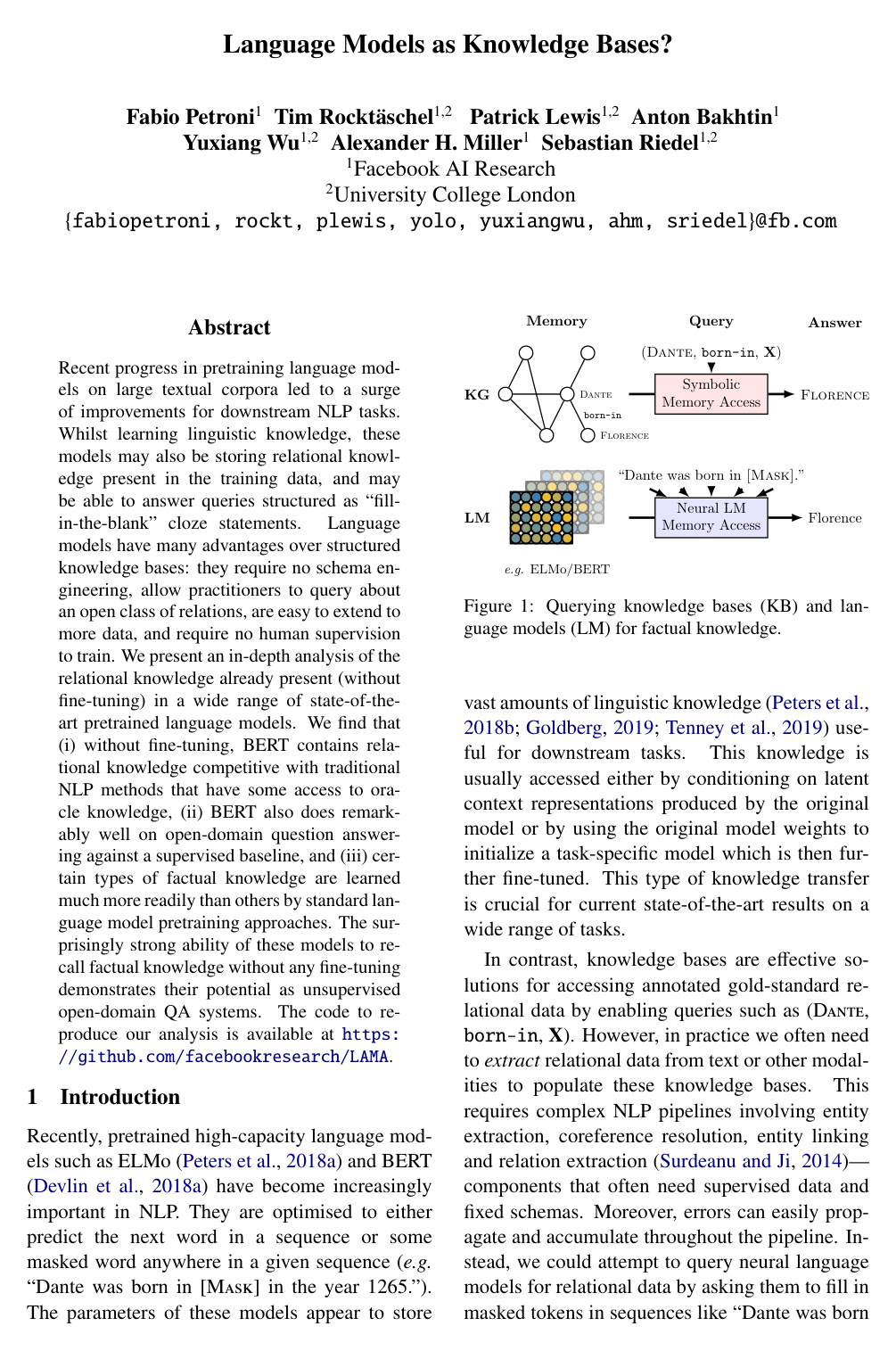
Language Models as Knowledge Bases?
Fabio Petroni, Tim Rocktäschel, Patrick Lewis, Anton Bakhtin, Yuxiang Wu, Alexander H. Miller, Sebastian Riedel
Why you should read this
Demonstrates that pretrained language models store substantial relational facts, enabling them to function as queryable knowledge bases for open-domain question answering without fine-tuning or schema engineering.
Recent progress in pretraining language models on large textual corpora led to a surge of improvements for downstream NLP tasks. Whilst learning linguistic knowledge, these models may also be storing relational knowledge present in the training data, and may be able to answer queries structured as "fill-in-the-blank" cloze statements. Language models have many advantages over structured knowledge bases: they require no schema engineering, allow practitioners to query about an open class of relations, are easy to extend to more data, and require no human supervision to train. We present an in-depth analysis of the relational knowledge already present (without fine-tuning) in a wide range of state-of-the-art pretrained language models. We find that (i) without fine-tuning, BERT contains relational knowledge competitive with traditional NLP methods that have some access to oracle knowledge, (ii) BERT also does remarkably well on open-domain question answering against a supervised baseline, and (iii) certain types of factual knowledge are learned much more readily than others by standard language model pretraining approaches. The surprisingly strong ability of these models to recall factual knowledge without any fine-tuning demonstrates their potential as unsupervised open-domain QA systems. The code to reproduce our analysis is available at this https URL.
Added
2026-09-11