
keyword
recursive learning
Recursive learning is a machine learning technique in which a model iteratively applies shared transformations or updates its parameters and representations in a step-by-step, self-referential manner. In deep neural network design, this method involves reusing identical weight matrices or computational modules across consecutive processing stages, allowing the model to increase its effective depth and receptive field without expanding the total count of trainable parameters. In incremental and analytic learning settings, recursive learning refers to updating a model formulation recursively using current data and prior intermediate states, thereby integrating new knowledge continuously and preventing the loss of past information without requiring the storage or reprocessing of historical datasets.
2 items
ACIL: Analytic Class-Incremental Learning with Absolute Memorization and Privacy Protection
Huiping Zhuang, Zhenyu Weng, Hongxin Wei, Renchunzi Xie, Kar-Ann Toh, Zhiping Lin
Why you should read this
Proposes an analytic class-incremental learning framework that mathematically matches the performance of joint training without storing historical exemplar data, eliminating catastrophic forgetting while protecting data privacy across multi-phase learning tasks.
Class-incremental learning (CIL) learns a classification model with training data of different classes arising progressively. Existing CIL either suffers from serious accuracy loss due to catastrophic forgetting, or invades data privacy by revisiting used exemplars. Inspired by linear learning formulations, we propose an analytic class-incremental learning (ACIL) with absolute memorization of past knowledge while avoiding breaching of data privacy (i.e., without storing historical data). The absolute memorization is demonstrated in the sense that class-incremental learning using ACIL given present data would give identical results to that from its joint-learning counterpart which consumes both present and historical samples. This equality is theoretically validated. Data privacy is ensured since no historical data are involved during the learning process. Empirical validations demonstrate ACIL's competitive accuracy performance with near-identical results for various incremental task settings (e.g., 5-50 phases). This also allows ACIL to outperform the state-of-the-art methods for large-phase scenarios (e.g., 25 and 50 phases).
Added
2026-09-26
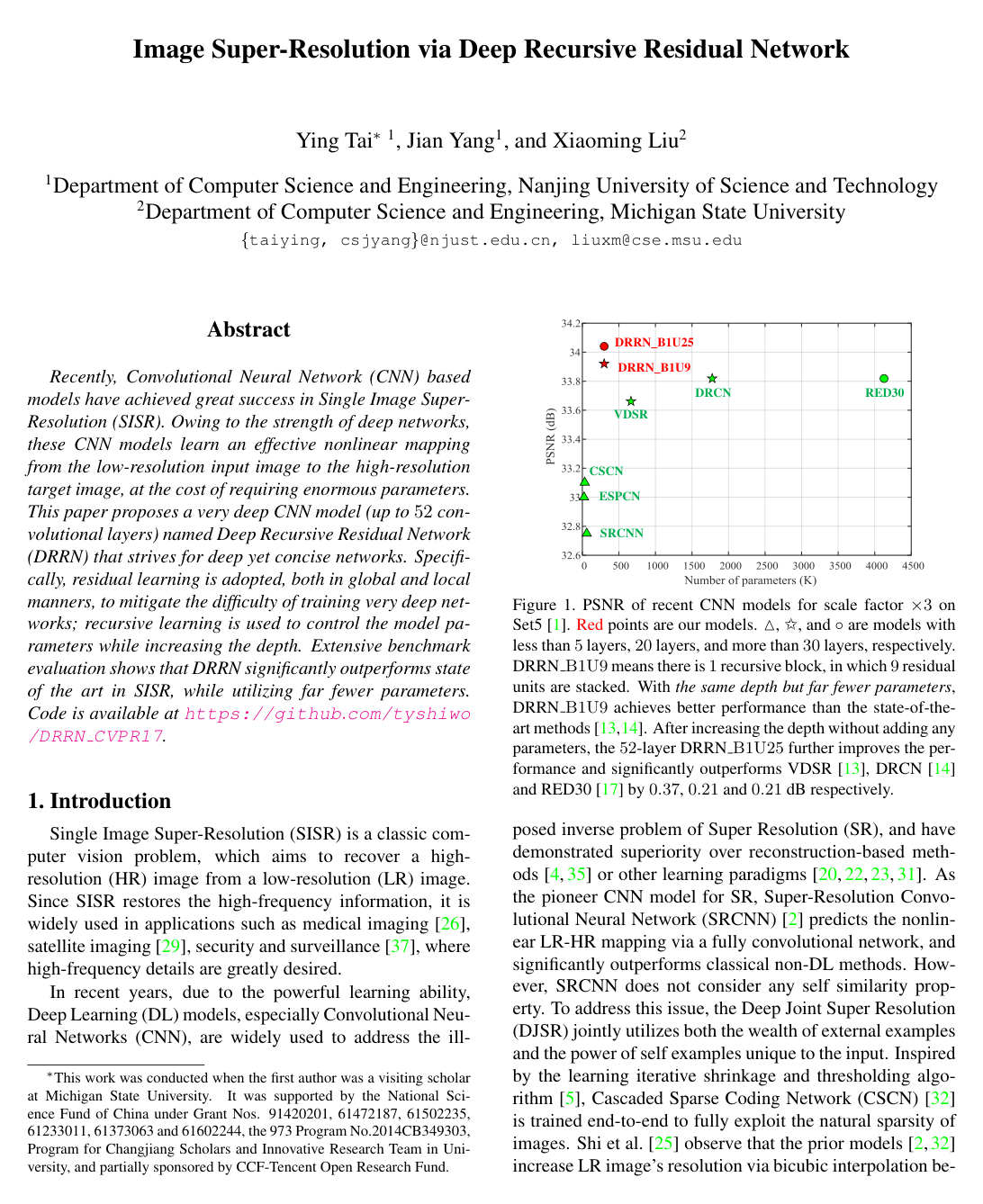
Image Super-Resolution via Deep Recursive Residual Network
Ying Tai, Jian Yang, Xiaoming Liu
Why you should read this
Proposes a compact 52-layer deep recursive residual network that pairs dual-level residual learning with weight-sharing recursive blocks to achieve state-of-the-art single image super-resolution accuracy using a fraction of the parameters required by competing models.
Recently, Convolutional Neural Network (CNN) based models have achieved great success in Single Image Super-Resolution (SISR). Owing to the strength of deep networks, these CNN models learn an effective nonlinear mapping from the low-resolution input image to the high-resolution target image, at the cost of requiring enormous parameters. This paper proposes a very deep CNN model (up to 52 convolutional layers) named Deep Recursive Residual Network (DRRN) that strives for deep yet concise networks. Specifically, residual learning is adopted, both in global and local manners, to mitigate the difficulty of training very deep networks; recursive learning is used to control the model parameters while increasing the depth. Extensive benchmark evaluation shows that DRRN significantly outperforms state of the art in SISR, while utilizing far fewer parameters. Code is available at https://github.com/tyshiwo/DRRN_CVPR17.
Added
2026-09-16