
keyword
reasoning chains
A reasoning chain is an ordered sequence of intermediate logical steps, rationales, or deductions that connects an initial problem or premise to a final conclusion. In artificial intelligence and natural language processing, reasoning chains break down complex multi-step tasks, such as mathematical problem-solving, symbolic planning, and question answering, into explicit and progressive sub-problems. These intermediate steps allow computational models to distribute processing across successive stages of inference, evaluate logical coherence and factual consistency at each link in the sequence, and improve the accuracy, transparency, and interpretability of the resulting output compared to direct, single-step generation.
18 items
Complexity-Based Prompting for Multi-Step Reasoning
Yao Fu, Hao-Chun Peng, Ashish Sabharwal, Peter Clark, Tushar Khot
Why you should read this
Introduces complexity-based prompting, a simple strategy showing that selecting in-context examples and decoding paths with more reasoning steps substantially boosts large language model performance on multi-step mathematical and logical reasoning tasks.
We study the task of prompting large-scale language models to perform multi-step reasoning. Existing work shows that when prompted with a chain of thoughts (CoT), sequences of short sentences describing intermediate reasoning steps towards a final answer, large language models can generate new reasoning chains and predict answers for new inputs. A central question is which reasoning examples make the most effective prompts. In this work, we propose complexity-based prompting, a simple and effective example selection scheme for multi-step reasoning. We show that prompts with higher reasoning complexity, i.e., chains with more reasoning steps, achieve substantially better performance on multi-step reasoning tasks over strong baselines. We further extend our complexity-based criteria from prompting (selecting inputs) to decoding (selecting outputs), where we sample multiple reasoning chains from the model, then choose the majority of generated answers from complex reasoning chains (over simple chains). When used to prompt GPT-3 and Codex, our approach substantially improves multi-step reasoning accuracy and achieves new state-of-the-art (SOTA) performance on three math benchmarks (GSM8K, MultiArith, and MathQA) and two BigBenchHard tasks (Date Understanding and Penguins), with an average +5.3 and up to +18 accuracy improvements. Compared with existing example selection schemes like manual tuning or retrieval-based selection, selection based on reasoning complexity is intuitive, easy to implement, and annotation-efficient. Further results demonstrate the robustness of performance gains from complex prompts under format perturbation and distribution shift.
Added
2026-10-05
Partial Reasoning in Language Models: Search and Refinement Guided by Uncertainty
Murilo da Luz, Bruno Brandão, Luana Martins, Gustavo Oliveira, Bryan de Oliveira, Luckeciano Carvalho Melo, Telma Soares
Why you should read this
Introduces PREGU, an inference method that monitors output entropy during generation to selectively halt decoding and perform targeted latent-space refinement, improving multi-step mathematical and logical reasoning in language models.
The use of Large Language Models (LLMs) for reasoning and planning tasks has drawn increasing attention in Artificial Intelligence research. Despite their remarkable progress, these models still exhibit limitations in multi-step inference scenarios, particularly in mathematical and logical reasoning. We introduce PREGU (Partial Reasoning Guided by Uncertainty). PREGU monitors the entropy of the output distribution during autoregressive generation and halts the process whenever entropy exceeds a defined threshold, signaling uncertainty. From that point, a localized search is performed in the latent space to refine the partial reasoning and select the most coherent answer, using the Soft Reasoning method. Experiments conducted with LLaMA-3-8B, Mistral-7B, and Qwen2-7B across four reasoning benchmarks (GSM8K, GSM-Hard, SVAMP, and StrategyQA) showed performance greater than or similar to Soft Reasoning, indicating that entropy can serve as an effective signal to trigger selective refinement during reasoning.
Added
2026-10-04
A Chain-of-Thought Is as Strong as Its Weakest Link: A Benchmark for Verifiers of Reasoning Chains
Alon Jacovi, Yonatan Bitton, Bernd Bohnet, Jonathan Herzig, Or Honovich, Michael Tseng, Michael Collins, Roee Aharoni, Mor Geva
Why you should read this
Presents REVEAL, a benchmark dataset equipped with step-level annotations for relevance, evidence attribution, and logical correctness to systematically evaluate how well automatic verifiers detect errors in language model reasoning chains.
Prompting language models to provide step-by-step answers (e.g., “Chain-of-Thought”) is the prominent approach for complex reasoning tasks, where more accurate reasoning chains typically improve downstream task performance. Recent literature discusses automatic methods to verify reasoning steps to evaluate and improve their correctness. However, no fine-grained step-level datasets are available to enable thorough evaluation of such verification methods, hindering progress in this direction. We introduce REVEAL: Reasoning Verification Evaluation, a new dataset to benchmark automatic verifiers of complex Chain-of-Thought reasoning in open-domain question answering settings. REVEAL includes comprehensive labels for the relevance, attribution to evidence passages, and logical correctness of each reasoning step in a language model’s answer, across a wide variety of datasets and state-of-the-art language models. Available at reveal-dataset.github.io.
Added
2026-10-03
Audio-Reasoner: Improving Reasoning Capability in Large Audio Language Models
Zhifei Xie, Mingbao Lin, Zihang Liu, Pengcheng Wu, Shuicheng Yan, Chunyan Miao
Why you should read this
Introduces Audio-Reasoner and a 1.2-million-sample reasoning dataset to enable structured chain-of-thought processing in large audio language models, yielding substantial accuracy gains across speech, sound, and music benchmarks.
Added
2026-10-02
Boosting Language Models Reasoning with Chain-of-Knowledge Prompting
Jianing Wang, Qiushi Sun, Xiang Li, Ming Gao
Why you should read this
Proposes Chain-of-Knowledge prompting to reduce hallucinations in large language models by generating structured knowledge triples alongside natural language explanations and using an F²-Verification mechanism to evaluate factuality and faithfulness before triggering iterative correction.
Recently, Chain-of-Thought (CoT) prompting has delivered success on complex reasoning tasks, which aims at designing a simple prompt like “Let’s think step by step” or multiple in-context exemplars with well-designed rationales to elicit Large Language Models (LLMs) to generate intermediate reasoning steps. However, the generated rationales often come with hallucinations, making unfactual and unfaithful reasoning chains. To mitigate this brittleness, we propose a novel Chain-of-Knowledge (CoK) prompting, where we aim at eliciting LLMs to generate explicit pieces of knowledge evidence in the form of structure triple. This is inspired by our human behaviors, i.e., we can draw a mind map or knowledge map as the reasoning evidence in the brain before answering a complex question. Benefiting from CoK, we additionally introduce a F²-Verification method to estimate the reliability of the reasoning chains in terms of factuality and faithfulness. For the unreliable response, the wrong evidence can be indicated to prompt the LLM to rethink. Extensive experiments demonstrate that our method can further improve the performance of commonsense, factual, symbolic, and arithmetic reasoning tasks¹.
Added
2026-10-01
Rethinking the Bounds of LLM Reasoning: Are Multi-Agent Discussions the Key?
Qineng Wang, Zihao Wang, Ying Su, Hanghang Tong, Yangqiu Song
Why you should read this
Demonstrates that single language models with standard few-shot prompts match the reasoning performance of complex multi-agent discussion frameworks, revealing that multi-agent systems only provide advantages in zero-shot settings.
Recent progress in LLMs discussion suggests that multi-agent discussion improves the reasoning abilities of LLMs. In this work, we reevaluate this claim through systematic experiments, where we propose a novel group discussion framework to enrich the set of discussion mechanisms. Interestingly, our results show that a single-agent LLM with strong prompts can achieve almost the same performance as the best existing discussion approach on a wide range of reasoning tasks and backbone LLMs. We observe that the multi-agent discussion performs better than a single agent only when there is no demonstration in the prompt. Further study reveals the common interaction mechanisms of LLMs during the discussion.
Added
2026-09-30
Causal Reasoning Favors Encoders: On The Limits of Decoder-Only Models
Amartya Roy, Iit Sire, Delhi Robert, India Bosch GmbH, Kripabandhu Ghosh, Iiser Kolkata, P. Kumaraguru, Adrian de Wynter
Why you should read this
Demonstrates that smaller fine-tuned encoder-based architectures handle complex causal reasoning and distribution shifts far better than in-context learning with decoder-only models, challenging the prevailing reliance on massive autoregressive language models.
In context learning (ICL) underpins recent advances in large language models (LLMs), although its role and performance in causal reasoning remains unclear. Causal reasoning demands multihop composition and strict conjunctive control, and reliance on spurious lexical relations of the input could provide misleading results. We hypothesize that, due to their ability to project the input into a latent space, encoder and encoder decoder architectures are better suited for said multihop conjunctive reasoning versus decoder only models. To do this, we compare fine-tuned versions of all the aforementioned architectures with zero and few shot ICL in both natural language and non natural language scenarios. We find that ICL alone is insufficient for reliable causal reasoning, often overfocusing on irrelevant input features. In particular, decoder only models are noticeably brittle to distributional shifts, while finetuned encoder and encoder decoder models can generalize more robustly across our tests, including the non natural language split. Both architectures are only matched or surpassed by decoder only architectures at large scales. We conclude by noting that for cost effective, short horizon robust causal reasoning, encoder or encoder decoder architectures with targeted finetuning are preferable.
Added
2026-09-29
VERDICT: Training-Free Step-Wise Verification of Multimodal Reasoning via Disagreement-Aware Consensus
Rohit Sinha, Kunal Tilaganji, Tanuja Ganu, Nagarajan Natarajan, Amit Sharma, Vineeth N Balasubramanian
Why you should read this
Proposes VERDICT, a training-free verification framework that uses a closed-form coordination game equilibrium to exploit disagreement among frozen models, matching the performance of heavily supervised critics across six multimodal reasoning benchmarks.
Multimodal large language models often generate reasoning chains containing subtle errors that lead to incorrect answers. Current verification approaches have notable limitations. Existing approaches either require expensive labelled supervision with inconsistent cross-task performance or aggregate scores from multiple sources by simple aggregations, missing a key insight: when these scores disagree, that disagreement itself carries important information about whether a reasoning step is truly valid or not. We formalise this as a coupled scoring problem among disparate, frozen verifiers, interpretable as a coordination game with a unique closed-form equilibrium where agreement signals valid steps while disagreement reveals instability. Towards this end, we propose a training-free domain-agnostic step-wise verification approach we call VERDICT: VERification via Disagreement-Informed Coupled Thresholding. To our knowledge, VERDICT is the first training-free verifier that makes the structure of cross-modal disagreement explicit and actionable. It computes consensus scores through a closed-form solution, enabling both disagreement-aware filtering and stability-conscious ranking of reasoning steps. Evaluated across six benchmarks, \method consistently improves over the base model by up to +5.95%, and performs competitively with domain-specific critics that demand extensive supervision, demonstrating that cross-modal agreement provides robust verification signals without task-specific adaptation and Training-Free Verification
Added
2026-09-29
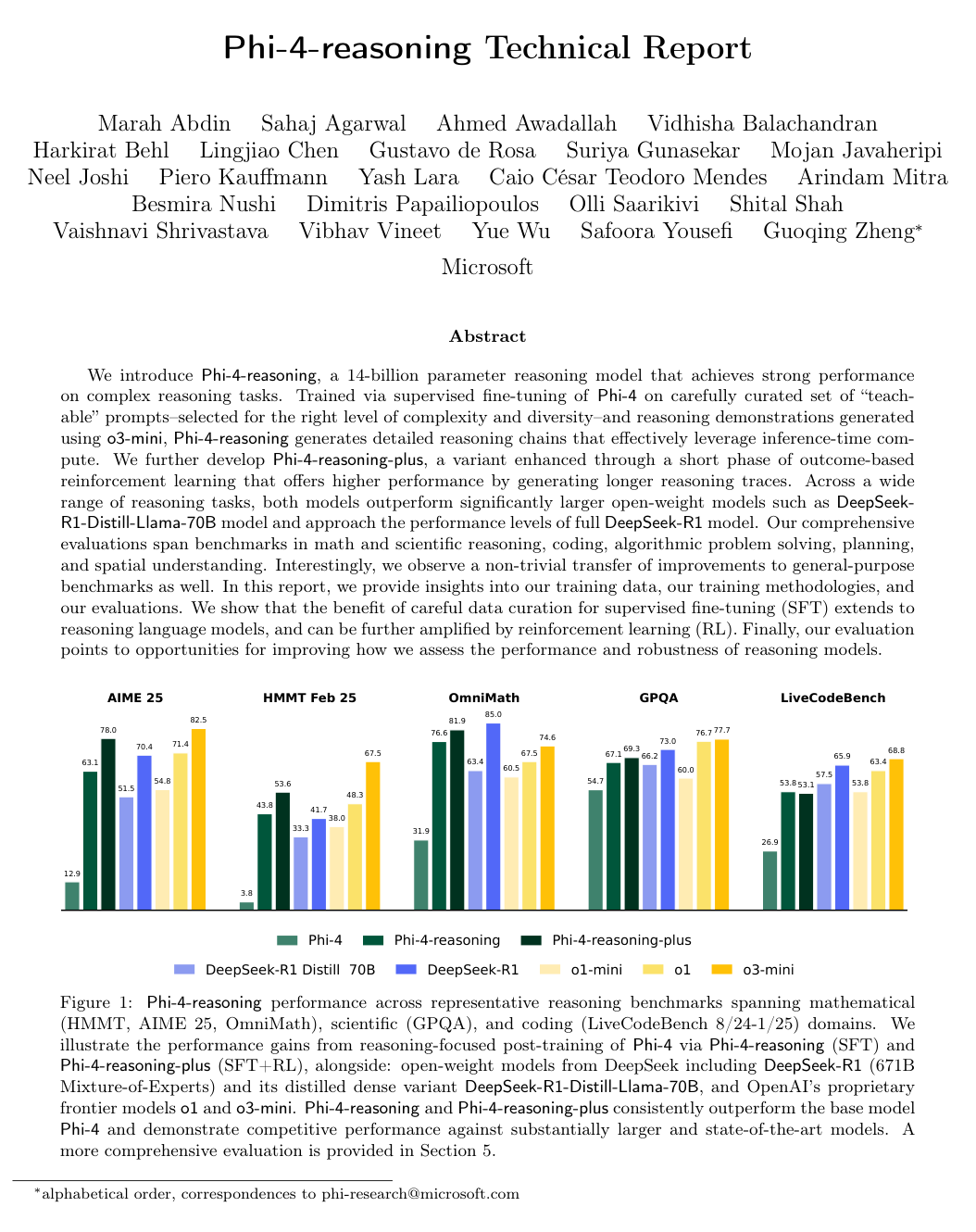
Phi-4-reasoning Technical Report
Marah Abdin, Sahaj Agarwal, Sahaj Agarwal, Ahmed Awadallah, Vidhisha Balachandran, Harkirat Behl, Lingjiao Chen (lingjiaochen), Gustavo de Rosa, Suriya Gunasekar, Mojan Javaheripi, Neel Joshi, Piero Kauffmann, Yash Lara, Caio César Teodoro Mendes, Arindam Mitra, Besmira Nushi, Dimitris Papailiopoulos, Olli Saarikivi, Shital Shah, Vaishnavi Shrivastava, Vibhav Vineet, Yue Wu, Safoora Yousefi, Guoqing Zheng
Why you should read this
Demonstrates how a 14-billion parameter language model trained with targeted distillation and outcome-based reinforcement learning can match or exceed the reasoning performance of significantly larger systems like DeepSeek-R1-Distill-Llama-70B across math, coding, and scientific problem-solving.
We introduce Phi-4-reasoning, a 14-billion parameter reasoning model that achieves strong performance on complex reasoning tasks. Trained via supervised fine-tuning of Phi-4 on carefully curated set of “teachable” prompts–selected for the right level of complexity and diversity–and reasoning demonstrations generated using o3-mini, Phi-4-reasoning generates detailed reasoning chains that effectively leverage inference-time compute. We further develop Phi-4-reasoning-plus, a variant enhanced through a short phase of outcome-based reinforcement learning that offers higher performance by generating longer reasoning traces. Across a wide range of reasoning tasks, both models outperform significantly larger open-weight models such as DeepSeek-R1-Distill-Llama-70B model and approach the performance levels of full DeepSeek-R1 model. Our comprehensive evaluations span benchmarks in math and scientific reasoning, coding, algorithmic problem solving, planning, and spatial understanding. Interestingly, we observe a non-trivial transfer of improvements to general-purpose benchmarks as well. In this report, we provide insights into our training data, our training methodologies, and our evaluations. We show that the benefit of careful data curation for supervised fine-tuning (SFT) extends to reasoning language models, and can be further amplified by reinforcement learning (RL). Finally, our evaluation points to opportunities for improving how we assess the performance and robustness of reasoning models.
Added
2026-09-29
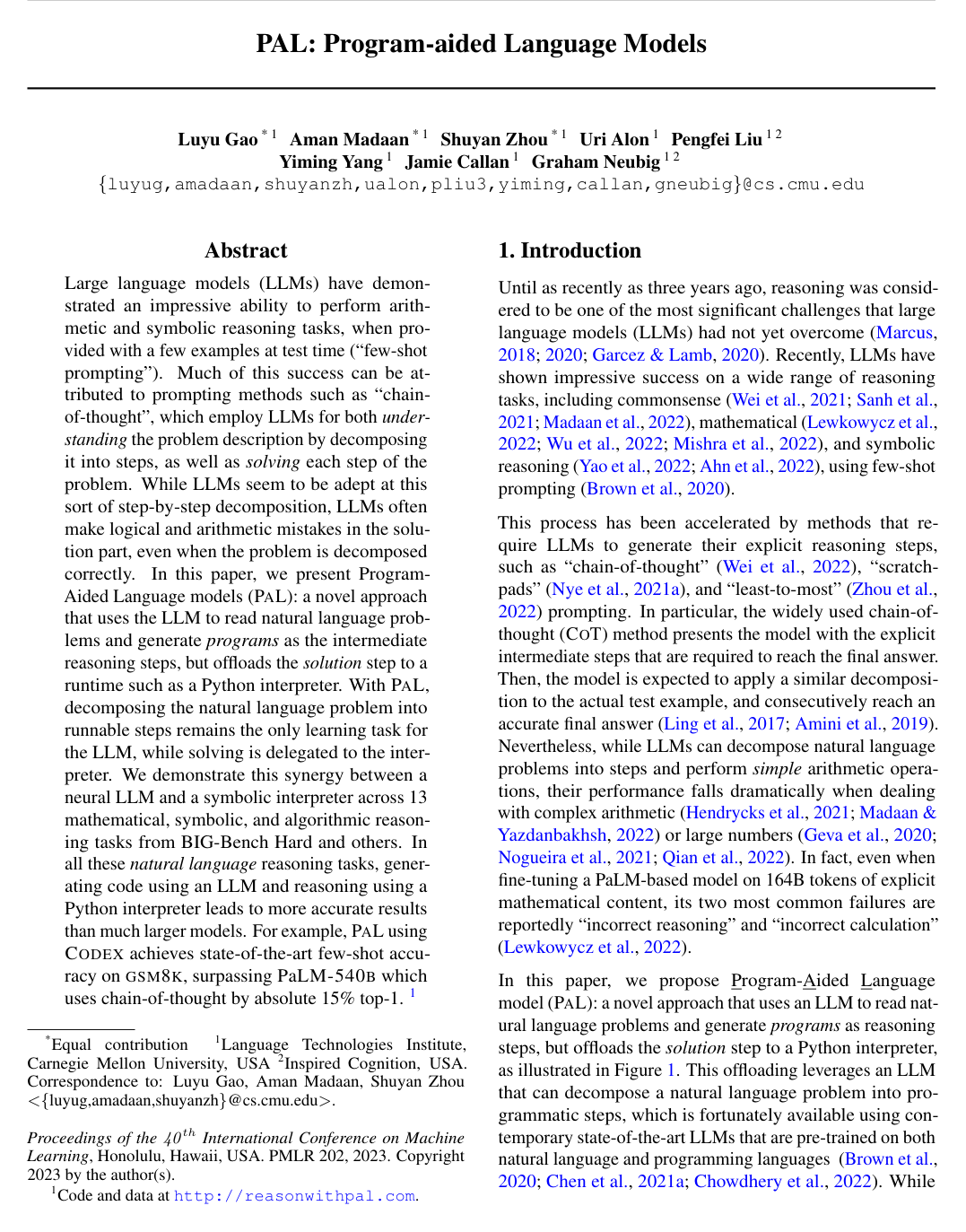
PAL: Program-aided Language Models
Luyu Gao, Aman Madaan, Shuyan Zhou, Uri Alon, Pengfei Liu, Yiming Yang, Jamie Callan, Graham Neubig
Why you should read this
Proposes Program-aided Language models (PAL), a method that prompts language models to generate executable code for intermediate reasoning and offloads computation to a Python interpreter, significantly outperforming standard chain-of-thought approaches on complex mathematical and symbolic benchmarks.
Large language models (LLMs) have demonstrated an impressive ability to perform arithmetic and symbolic reasoning tasks, when provided with a few examples at test time (“few-shot prompting”). Much of this success can be attributed to prompting methods such as “chain-of-thought”, which employ LLMs for both understanding the problem description by decomposing it into steps, as well as solving each step of the problem. While LLMs seem to be adept at this sort of step-by-step decomposition, LLMs often make logical and arithmetic mistakes in the solution part, even when the problem is decomposed correctly. In this paper, we present Program-Aided Language models (PAL): a novel approach that uses the LLM to read natural language problems and generate programs as the intermediate reasoning steps, but offloads the solution step to a runtime such as a Python interpreter. With PAL, decomposing the natural language problem into runnable steps remains the only learning task for the LLM, while solving is delegated to the interpreter. We demonstrate this synergy between a neural LLM and a symbolic interpreter across 13 mathematical, symbolic, and algorithmic reasoning tasks from BIG-Bench Hard and others. In all these natural language reasoning tasks, generating code using an LLM and reasoning using a Python interpreter leads to more accurate results than much larger models. For example, PAL using CODEX achieves state-of-the-art few-shot accuracy on GSM8K, surpassing PaLM-540B which uses chain-of-thought by absolute 15% top-1.
Added
2026-09-28
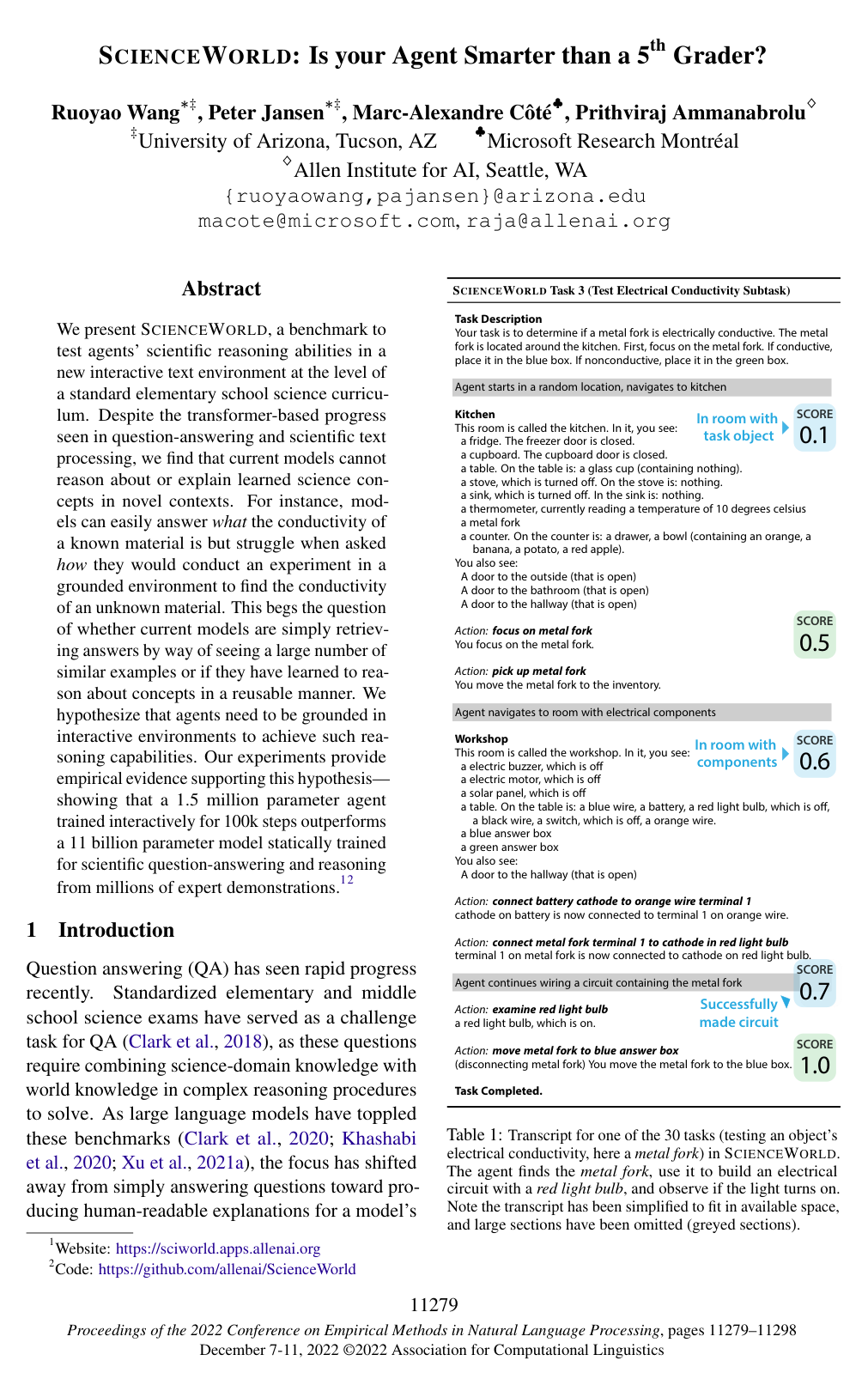
ScienceWorld: Is your Agent Smarter than a 5th Grader?
Ruoyao Wang, Peter A. Jansen, Marc-Alexandre Côté, Prithviraj Ammanabrolu
Why you should read this
Introduces ScienceWorld, an interactive text-based simulation benchmark spanning 30 elementary science tasks, revealing that modern language models fail at grounded procedural reasoning even when they excel at standard static science exams.
We present SCIENCEWORLD, a benchmark to test agents’ scientific reasoning abilities in a new interactive text environment at the level of a standard elementary school science curriculum. Despite the transformer-based progress seen in question-answering and scientific text processing, we find that current models cannot reason about or explain learned science concepts in novel contexts. For instance, models can easily answer what the conductivity of a known material is but struggle when asked how they would conduct an experiment in a grounded environment to find the conductivity of an unknown material. This begs the question of whether current models are simply retrieving answers by way of seeing a large number of similar examples or if they have learned to reason about concepts in a reusable manner. We hypothesize that agents need to be grounded in interactive environments to achieve such reasoning capabilities. Our experiments provide empirical evidence supporting this hypothesis—showing that a 1.5 million parameter agent trained interactively for 100k steps outperforms a 11 billion parameter model statically trained for scientific question-answering and reasoning from millions of expert demonstrations.12
Added
2026-09-26
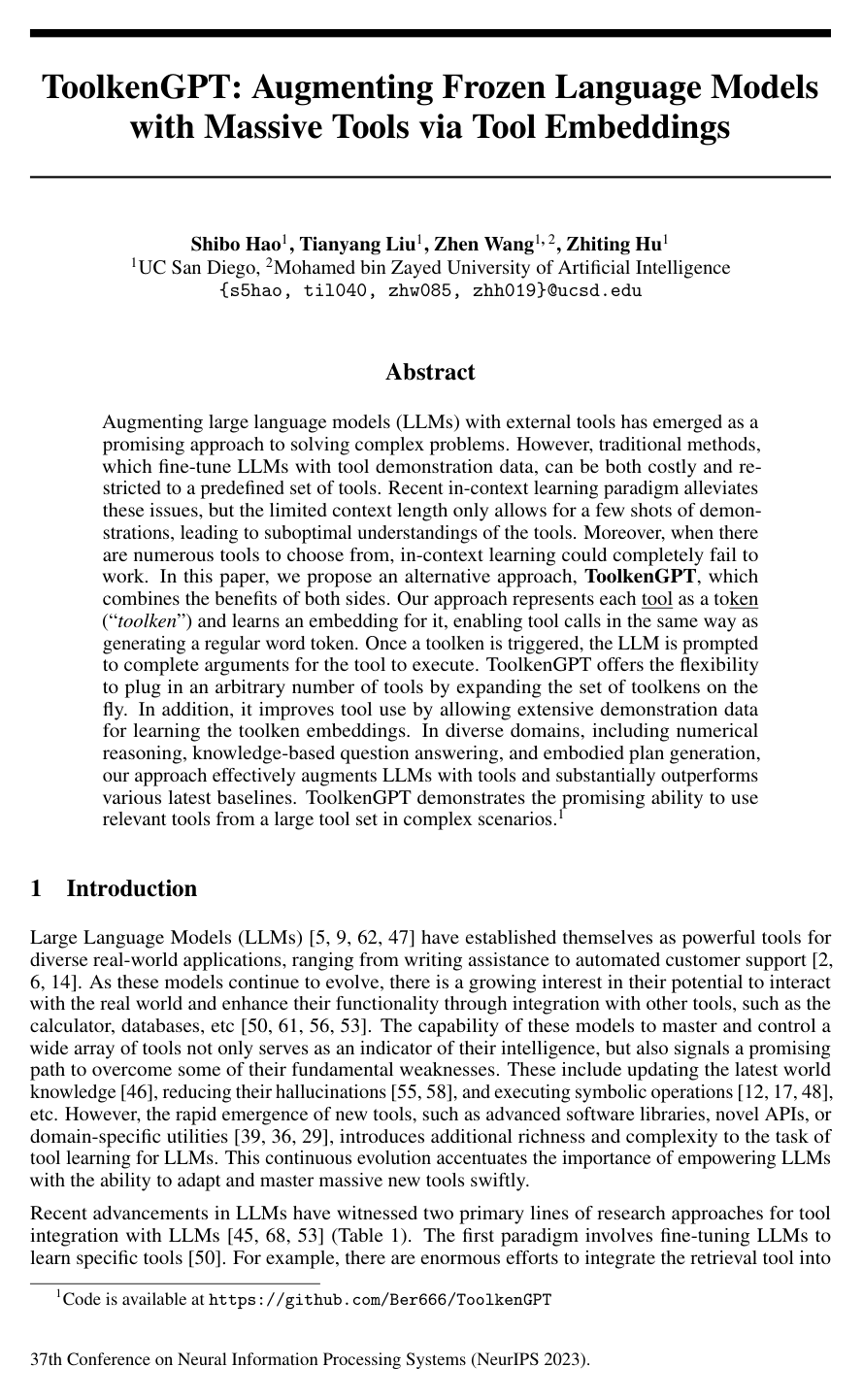
ToolkenGPT: Augmenting Frozen Language Models with Massive Tools via Tool Embeddings
Shibo Hao, Tianyang Liu, Zhen Wang, Zhiting Hu
Why you should read this
Proposes ToolkenGPT, a framework that represents external tools as learned token embeddings within the vocabulary of a frozen language model, enabling plug-and-play selection across massive tool sets without costly fine-tuning or prompt-length constraints.
Augmenting large language models (LLMs) with external tools has emerged as a promising approach to solving complex problems. However, traditional methods, which fine-tune LLMs with tool demonstration data, can be both costly and restricted to a predefined set of tools. Recent in-context learning paradigm alleviates these issues, but the limited context length only allows for a few shots of demonstrations, leading to suboptimal understandings of the tools. Moreover, when there are numerous tools to choose from, in-context learning could completely fail to work. In this paper, we propose an alternative approach, ToolkenGPT, which combines the benefits of both sides. Our approach represents each tool as a token (“toolken”) and learns an embedding for it, enabling tool calls in the same way as generating a regular word token. Once a toolken is triggered, the LLM is prompted to complete arguments for the tool to execute. ToolkenGPT offers the flexibility to plug in an arbitrary number of tools by expanding the set of toolkens on the fly. In addition, it improves tool use by allowing extensive demonstration data for learning the toolken embeddings. In diverse domains, including numerical reasoning, knowledge-based question answering, and embodied plan generation, our approach effectively augments LLMs with tools and substantially outperforms various latest baselines. ToolkenGPT demonstrates the promising ability to use relevant tools from a large tool set in complex scenarios.
Added
2026-09-26
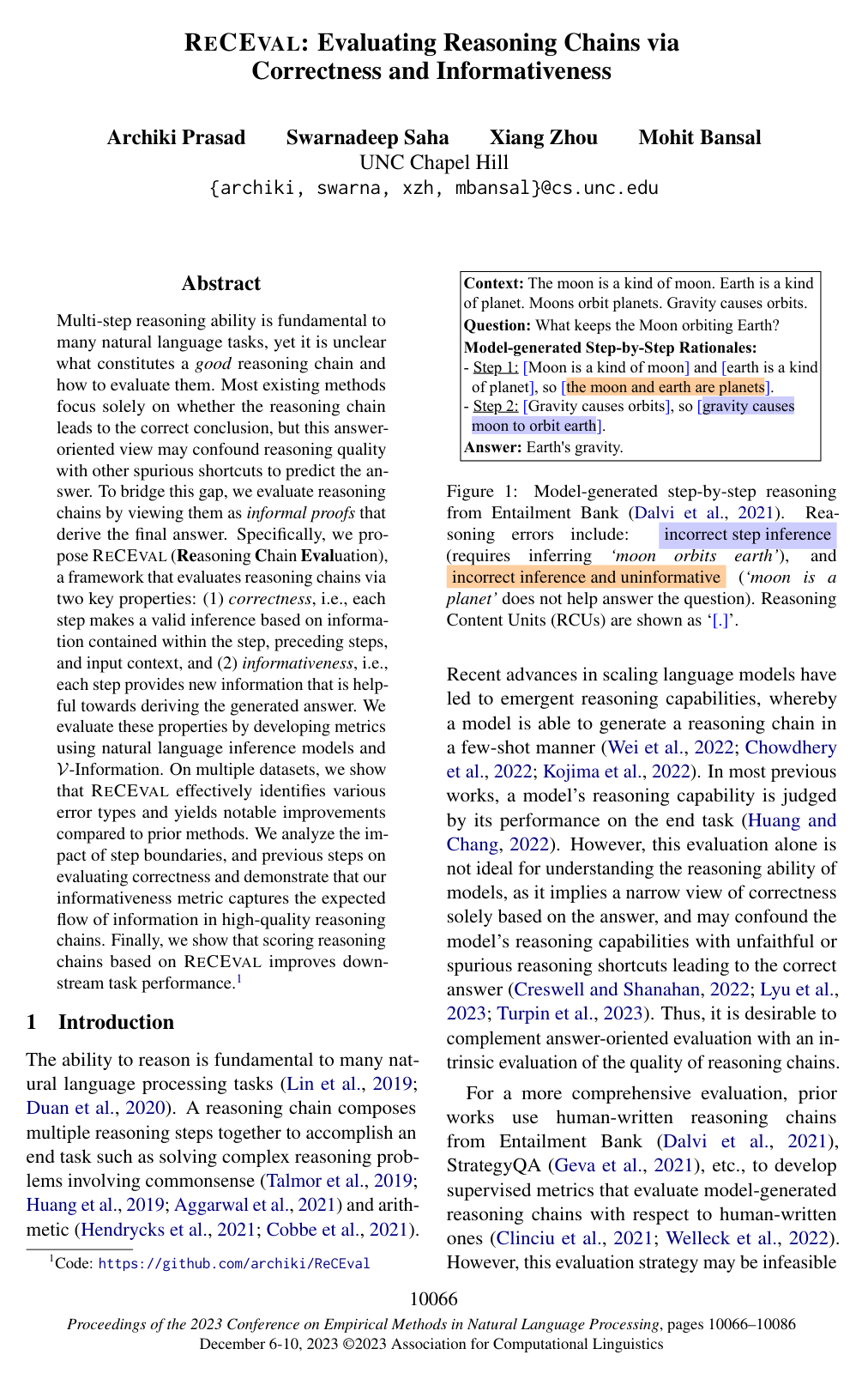
ReCEval: Evaluating Reasoning Chains via Correctness and Informativeness
Archiki Prasad, Swarnadeep Saha, Xiang Zhou, Mohit Bansal
Why you should read this
Introduces RECEVAL, a reference-free evaluation framework that assesses language model reasoning chains by decomposing steps into fine-grained content units to measure logical correctness with natural language inference and step utility with information theory.
Multi-step reasoning ability is fundamental to many natural language tasks, yet it is unclear what constitutes a good reasoning chain and how to evaluate them. Most existing methods focus solely on whether the reasoning chain leads to the correct conclusion, but this answer-oriented view may confound reasoning quality with other spurious shortcuts to predict the answer. To bridge this gap, we evaluate reasoning chains by viewing them as informal proofs that derive the final answer. Specifically, we propose RECEVAL (Reasoning Chain Evaluation), a framework that evaluates reasoning chains via two key properties: (1) correctness, i.e., each step makes a valid inference based on information contained within the step, preceding steps, and input context, and (2) informativeness, i.e., each step provides new information that is helpful towards deriving the generated answer. We evaluate these properties by developing metrics using natural language inference models and V-Information. On multiple datasets, we show that RECEVAL effectively identifies various error types and yields notable improvements compared to prior methods. We analyze the impact of step boundaries, and previous steps on evaluating correctness and demonstrate that our informativeness metric captures the expected flow of information in high-quality reasoning chains. Finally, we show that scoring reasoning chains based on RECEVAL improves downstream task performance.1
Added
2026-09-26
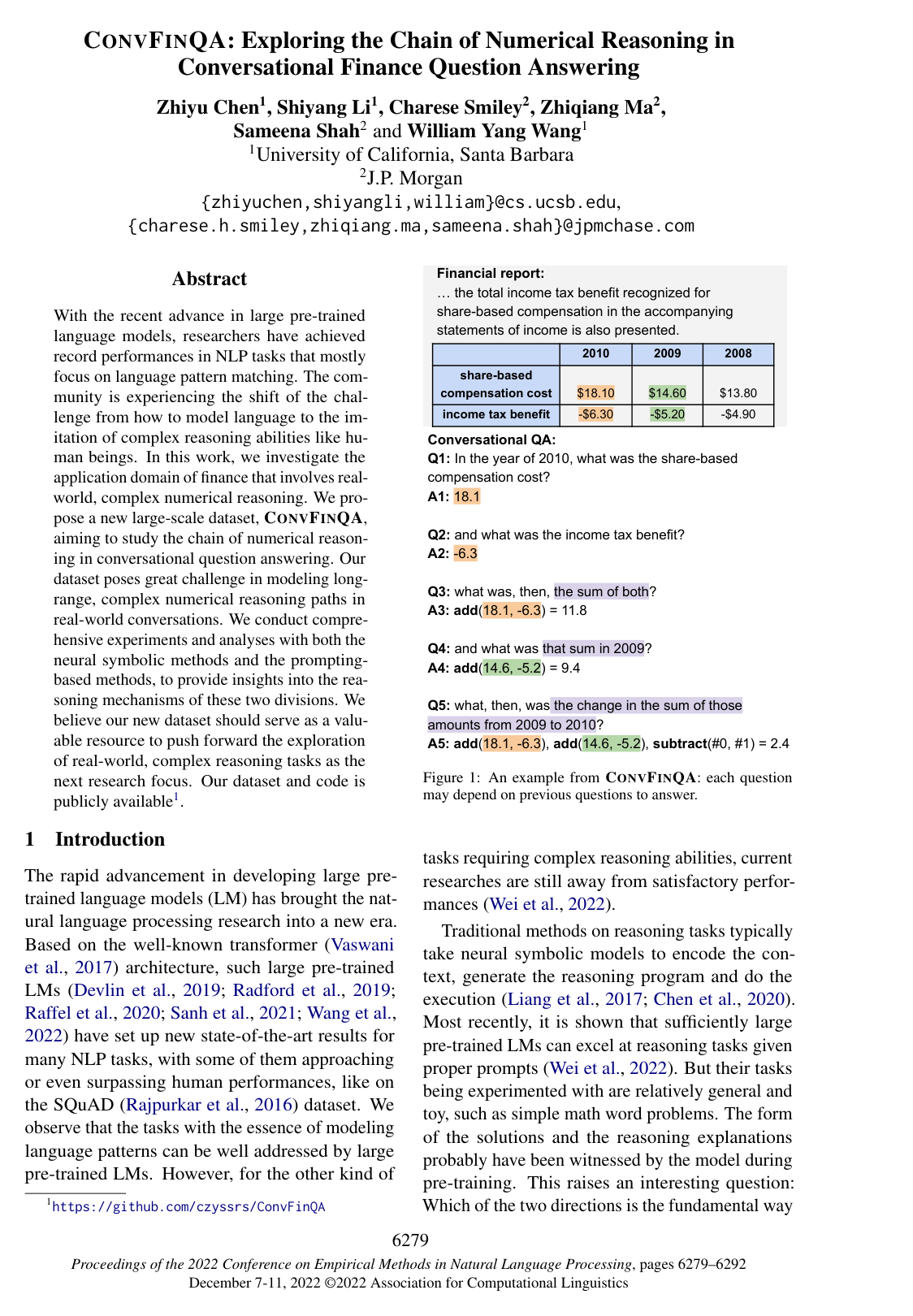
ConvFinQA: Exploring the Chain of Numerical Reasoning in Conversational Finance Question Answering
Zhiyu Chen, Shiyang Li, Charese Smiley, Zhiqiang Ma, Sameena Shah, William Yang Wang
Why you should read this
Introduces a large-scale financial question answering benchmark to evaluate how language models execute multi-turn, chained numerical reasoning over complex financial reports.
With the recent advance in large pre-trained language models, researchers have achieved record performances in NLP tasks that mostly focus on language pattern matching. The community is experiencing the shift of the challenge from how to model language to the imitation of complex reasoning abilities like human beings. In this work, we investigate the application domain of finance that involves real-world, complex numerical reasoning. We propose a new large-scale dataset, CONVFINQA, aiming to study the chain of numerical reasoning in conversational question answering. Our dataset poses great challenge in modeling long-range, complex numerical reasoning paths in real-world conversations. We conduct comprehensive experiments and analyses with both the neural symbolic methods and the prompting-based methods, to provide insights into the reasoning mechanisms of these two divisions. We believe our new dataset should serve as a valuable resource to push forward the exploration of real-world, complex reasoning tasks as the next research focus. Our dataset and code is publicly available¹.
Added
2026-09-26
Learning by Distilling Context
Charlie Snell, Dan Klein, Ruiqi Zhong
Why you should read this
Introduces a novel context distillation method that enables language models to internalize and retain performance gains from prompts and scratchpads, overcoming limitations of context window size and reducing inference costs.
Language models significantly benefit from context tokens, such as prompts or scratchpads. They perform better when prompted with informative instructions, and they acquire new reasoning capabilities by generating a scratch-pad before predicting the final answers. However, they do not \textit{internalize} these performance gains, which disappear when the context tokens are gone. Our work proposes to apply context distillation so that a language model can improve itself by internalizing these gains. Concretely, given a synthetic unlabeled input for the target task, we condition the model on ``[instructions] + [task-input]'' to predict ``[scratch-pad] + [final answer]''; then we fine-tune the same model to predict its own ``[final answer]'' conditioned on the ``[task-input]'', without seeing the ``[instructions]'' or using the ``[scratch-pad]''. We show that context distillation is a general method to train language models, and it can effectively internalize 3 types of training signals. First, it can internalize abstract task instructions and explanations, so we can iteratively update the model parameters with new instructions and overwrite old ones. Second, it can internalize step-by-step reasoning for complex tasks (e.g., 8-digit addition), and such a newly acquired capability proves to be useful for other downstream tasks. Finally, it can internalize concrete training examples, and it outperforms directly learning with gradient descent by 9\% on the SPIDER Text-to-SQL dataset; furthermore, combining context distillation operations can internalize more training examples than the context window size allows.
Added
2026-07-13

Teaching LLMs to Plan: Logical Chain-of-Thought Instruction Tuning for Symbolic Planning
Pulkit Verma, Ngoc La, Anthony Favier, Swaroop Mishra, Julie A. Shah
Large language models (LLMs) have demonstrated impressive capabilities across diverse tasks, yet their ability to perform structured symbolic planning remains limited, particularly in domains requiring formal representations like the Planning Domain Definition Language (PDDL). In this paper, we present a novel instruction tuning framework, PDDL-Instruct, designed to enhance LLMs' symbolic planning capabilities through logical chain-of-thought reasoning. Our approach focuses on teaching models to rigorously reason about action applicability, state transitions, and plan validity using explicit logical inference steps. By developing instruction prompts that guide models through the precise logical reasoning required to determine when actions can be applied in a given state, we enable LLMs to self-correct their planning processes through structured reflection. The framework systematically builds verification skills by decomposing the planning process into explicit reasoning chains about precondition satisfaction, effect application, and invariant preservation. Experimental results on multiple planning domains show that our chain-of-thought reasoning based instruction-tuned models are significantly better at planning, achieving planning accuracy of up to 94% on standard benchmarks, representing a 66% absolute improvement over baseline models. This work bridges the gap between the general reasoning capabilities of LLMs and the logical precision required for automated planning, offering a promising direction for developing better AI planning systems.
Added
2026-06-06
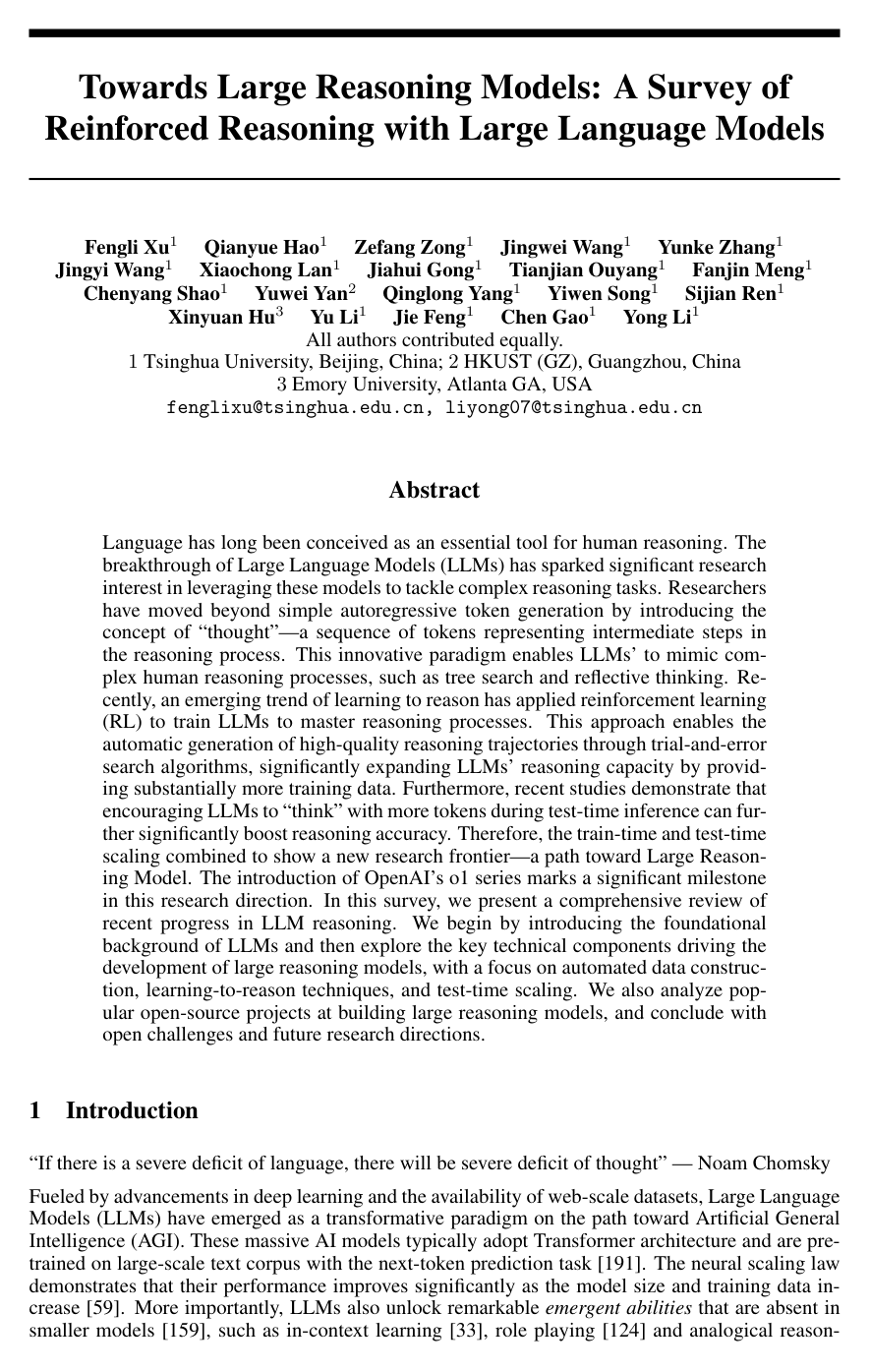
Towards Large Reasoning Models: A Survey of Reinforced Reasoning with Large Language Models
Fengli Xu, Qianyue Hao, Zefang Zong, Jingwei Wang, Yunke Zhang, Jingyi Wang, Xiaochong Lan, Jiahui Gong, Tianjian Ouyang, Fanjin Meng, Chenyang Shao, Yuwei Yan, Qinglong Yang, Yiwen Song, Sijian Ren, Xinyuan Hu, Yu Li, Jie Feng, Chen Gao, Yong Li
Why you should read this
Presents a comprehensive review of reinforced reasoning with Large Language Models, detailing the technical components, automated data construction, learning-to-reason techniques, and test-time scaling that are driving the development of future Large Reasoning Models.
Language has long been conceived as an essential tool for human reasoning. The breakthrough of Large Language Models (LLMs) has sparked significant research interest in leveraging these models to tackle complex reasoning tasks. Researchers have moved beyond simple autoregressive token generation by introducing the concept of "thought" -- a sequence of tokens representing intermediate steps in the reasoning process. This innovative paradigm enables LLMs' to mimic complex human reasoning processes, such as tree search and reflective thinking. Recently, an emerging trend of learning to reason has applied reinforcement learning (RL) to train LLMs to master reasoning processes. This approach enables the automatic generation of high-quality reasoning trajectories through trial-and-error search algorithms, significantly expanding LLMs' reasoning capacity by providing substantially more training data. Furthermore, recent studies demonstrate that encouraging LLMs to "think" with more tokens during test-time inference can further significantly boost reasoning accuracy. Therefore, the train-time and test-time scaling combined to show a new research frontier -- a path toward Large Reasoning Model. The introduction of OpenAI's o1 series marks a significant milestone in this research direction. In this survey, we present a comprehensive review of recent progress in LLM reasoning. We begin by introducing the foundational background of LLMs and then explore the key technical components driving the development of large reasoning models, with a focus on automated data construction, learning-to-reason techniques, and test-time scaling. We also analyze popular open-source projects at building large reasoning models, and conclude with open challenges and future research directions.
Added
2026-04-14
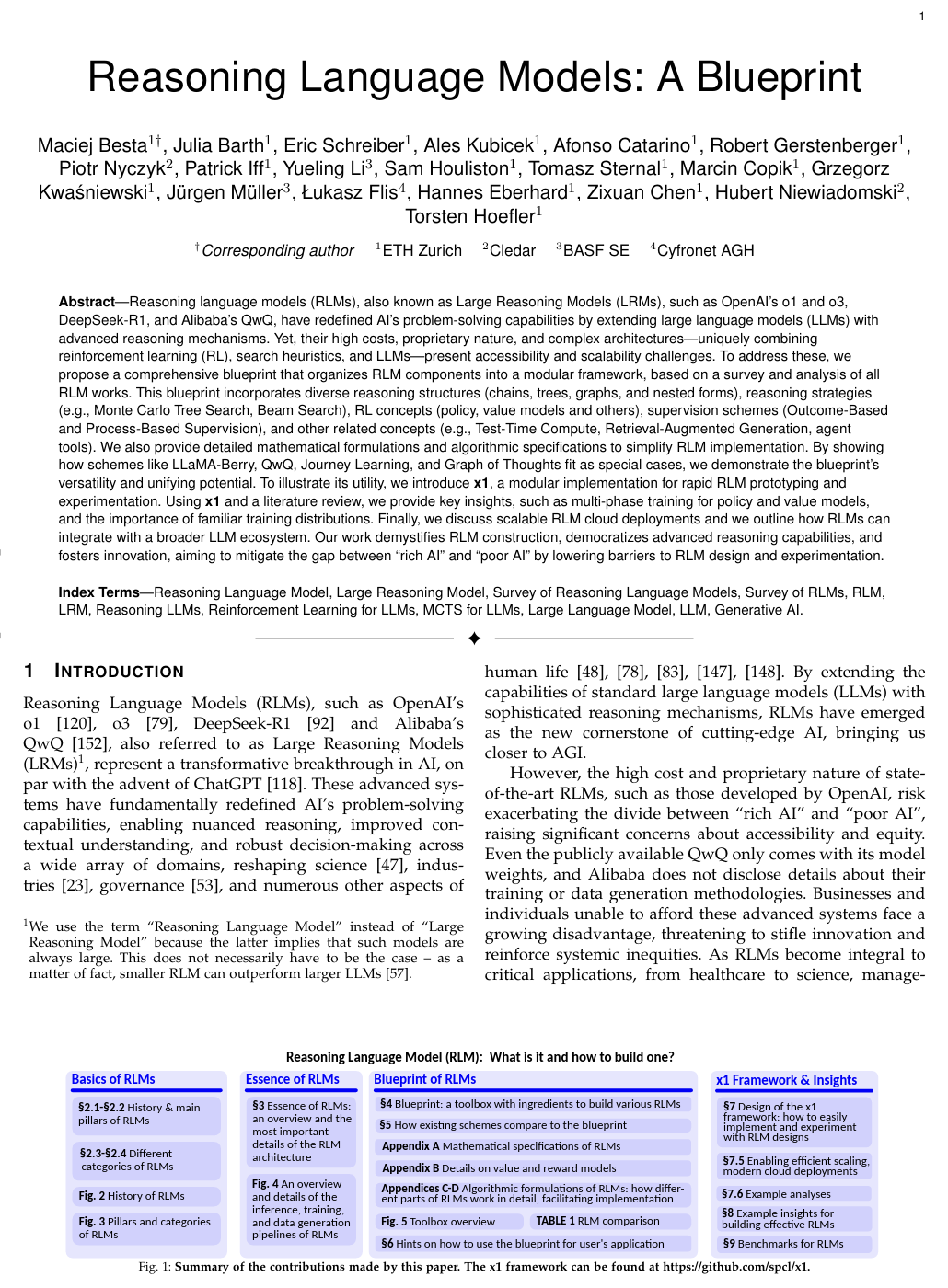
Reasoning Language Models: A Blueprint
Maciej Besta, Julia Barth, Eric Schreiber, Ales Kubicek, Afonso Catarino, Robert Gerstenberger, Piotr Nyczyk, Patrick Iff, Yueling Li, Sam Houliston, Tomasz Sternal, Marcin Copik, Grzegorz Kwaśniewski, Jürgen Müller, Łukasz Flis, Hannes Eberhard, Zixuan Chen, Hubert Niewiadomski, Torsten Hoefler
Why you should read this
Proposes a comprehensive, modular blueprint and an open-source framework (x1) for Reasoning Language Models (RLMs), democratizing their design, implementation, and experimentation by demystifying complex architectures and providing mathematical and algorithmic specifications.
Reasoning language models (RLMs), also known as Large Reasoning Models (LRMs), such as OpenAI's o1 and o3, DeepSeek-R1, and Alibaba's QwQ, have redefined AI's problem-solving capabilities by extending LLMs with advanced reasoning mechanisms. Yet, their high costs, proprietary nature, and complex architectures - uniquely combining reinforcement learning (RL), search heuristics, and LLMs - present accessibility and scalability challenges. To address these, we propose a comprehensive blueprint that organizes RLM components into a modular framework, based on a survey and analysis of all RLM works. This blueprint incorporates diverse reasoning structures (chains, trees, graphs, and nested forms), reasoning strategies (e.g., Monte Carlo Tree Search, Beam Search), RL concepts (policy, value models and others), supervision schemes (Outcome-Based and Process-Based Supervision), and other related concepts (e.g., Test-Time Compute, Retrieval-Augmented Generation, agent tools). We also provide detailed mathematical formulations and algorithmic specifications to simplify RLM implementation. By showing how schemes like LLaMA-Berry, QwQ, Journey Learning, and Graph of Thoughts fit as special cases, we demonstrate the blueprint's versatility and unifying potential. To illustrate its utility, we introduce x1, a modular implementation for rapid RLM prototyping and experimentation. Using x1 and a literature review, we provide key insights, such as multi-phase training for policy and value models, and the importance of familiar training distributions. Finally, we discuss scalable RLM cloud deployments and we outline how RLMs can integrate with a broader LLM ecosystem. Our work demystifies RLM construction, democratizes advanced reasoning capabilities, and fosters innovation, aiming to mitigate the gap between "rich AI" and "poor AI" by lowering barriers to RLM design and experimentation.
Added
2025-11-22
License
Published with permission