
keyword
reasoning benchmarks
Reasoning benchmarks are standardized test suites and datasets designed to evaluate the multi-step problem-solving and logical deduction capabilities of artificial intelligence systems. Unlike conventional evaluations that focus on surface-level pattern recognition, text fluency, or straightforward factual retrieval, reasoning benchmarks assess a model's capacity to navigate complex challenges through structured cognitive processes, such as mathematical calculation, formal logic, algorithmic coding, scientific problem solving, and compositional visual understanding. These evaluations typically measure both the accuracy of final solutions and the coherence of intermediate derivation paths, self-verification steps, and extended inference trajectories. By presenting challenging, verifiable tasks under zero-shot, few-shot, or test-time compute settings, reasoning benchmarks serve as essential instruments for quantifying generalization, robustness, and higher-order analytical capabilities in foundation models.
12 items
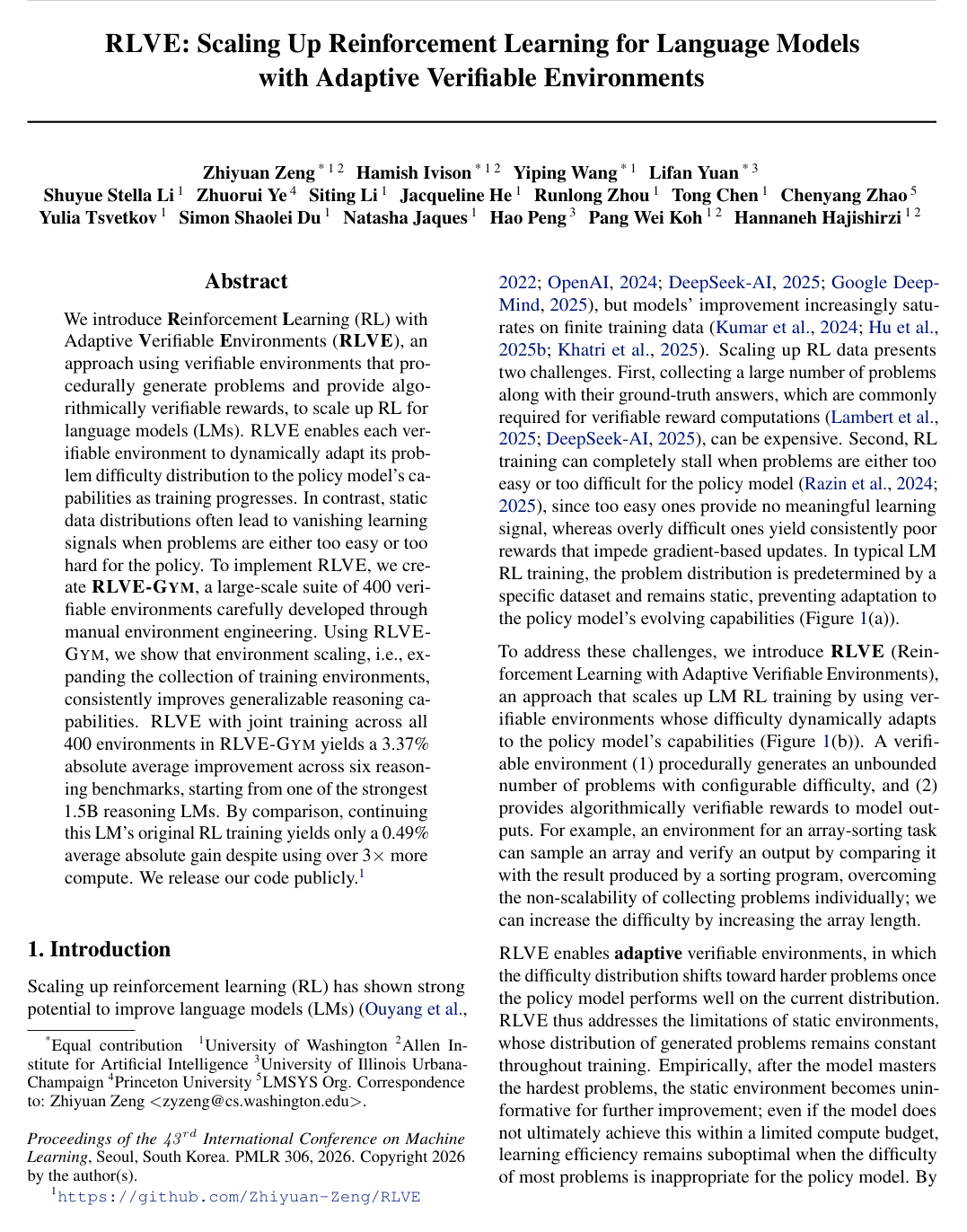
RLVE: Scaling Up Reinforcement Learning for Language Models with Adaptive Verifiable Environments
Zhiyuan Zeng, Hamish Ivison, Yiping Wang, Lifan Yuan, Shuyue Stella Li, Zhuorui Ye, Siting Li, Jacqueline He, Runlong Zhou, Tong Chen, Chenyang Zhao, Yulia Tsvetkov, Simon Shaolei Du, Natasha Jaques, Hao Peng, Pang Wei Koh, Hannaneh Hajishirzi
Why you should read this
Presents an adaptive reinforcement learning framework across 400 procedurally generated environments that dynamically adjusts problem difficulty to model capability, demonstrating that environment scaling yields superior language model reasoning gains with a fraction of standard compute.
We introduce Reinforcement Learning (RL) with Adaptive Verifiable Environments (RLVE), an approach using verifiable environments that procedurally generate problems and provide algorithmically verifiable rewards, to scale up RL for language models (LMs). RLVE enables each verifiable environment to dynamically adapt its problem difficulty distribution to the policy model's capabilities as training progresses. In contrast, static data distributions often lead to vanishing learning signals when problems are either too easy or too hard for the policy. To implement RLVE, we create RLVE-Gym, a large-scale suite of 400 verifiable environments carefully developed through manual environment engineering. Using RLVE-Gym, we show that environment scaling, i.e., expanding the collection of training environments, consistently improves generalizable reasoning capabilities. RLVE with joint training across all 400 environments in RLVE-Gym yields a 3.37% absolute average improvement across six reasoning benchmarks, starting from one of the strongest 1.5B reasoning LMs. By comparison, continuing this LM's original RL training yields only a 0.49% average absolute gain despite using over 3x more compute. We release our code publicly.
Added
2026-10-04
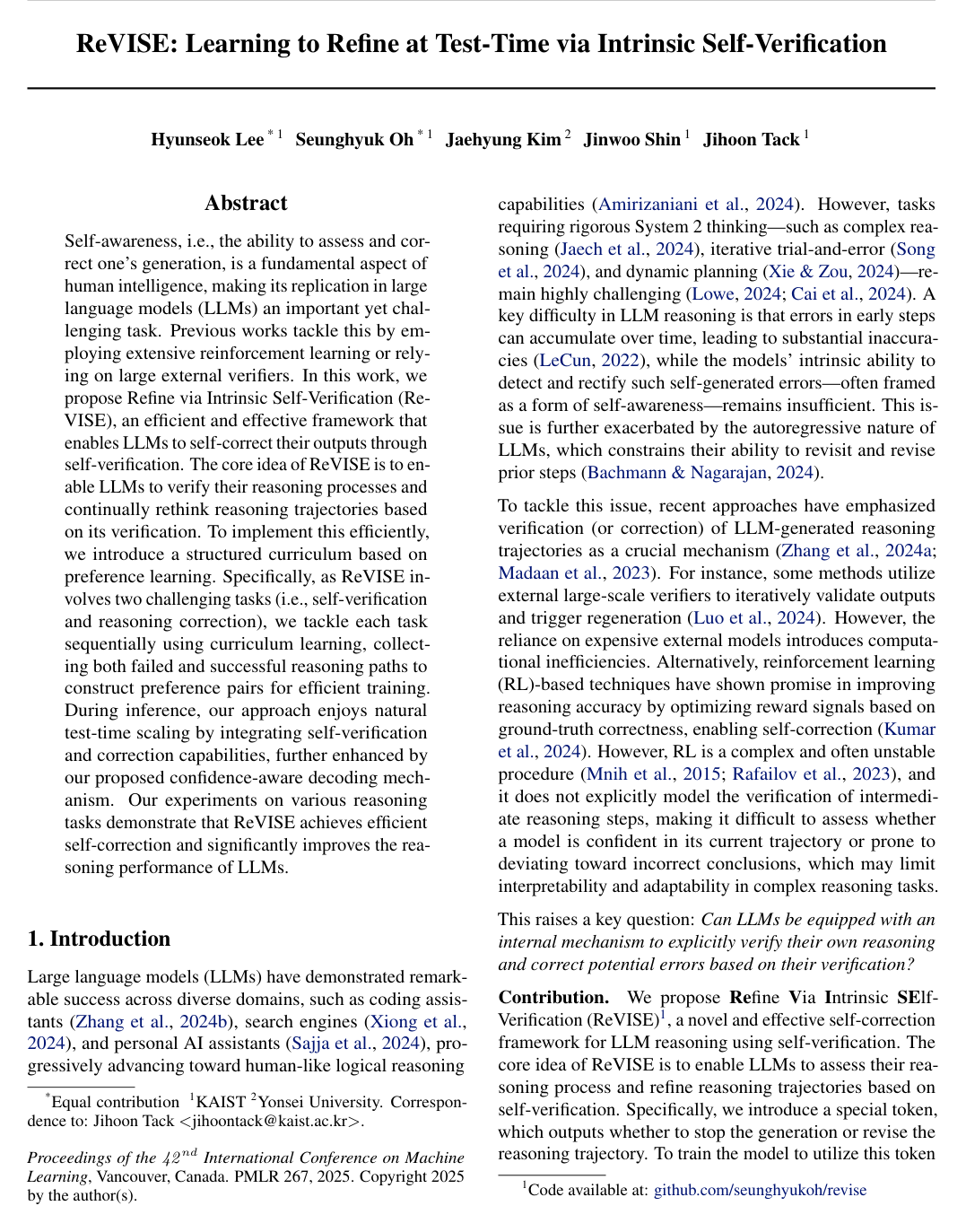
ReVISE: Learning to Refine at Test-Time via Intrinsic Self-Verification
Hyunseok Lee, Seunghyuk Oh, Jaehyung Kim, Jinwoo Shin, Jihoon Tack
Why you should read this
Introduces ReVISE, a curriculum-based preference learning framework that trains large language models to intrinsically verify and self-correct their reasoning steps at test time without relying on external verifiers or heavy reinforcement learning.
Self-awareness, i.e., the ability to assess and correct one's own generation, is a fundamental aspect of human intelligence, making its replication in large language models (LLMs) an important yet challenging task. Previous works tackle this by employing extensive reinforcement learning or rather relying on large external verifiers. In this work, we propose Refine via Intrinsic Self-Verification (ReVISE), an efficient and effective framework that enables LLMs to self-correct their outputs through self-verification. The core idea of ReVISE is to enable LLMs to verify their reasoning processes and continually rethink reasoning trajectories based on its verification. We introduce a structured curriculum based upon online preference learning to implement this efficiently. Specifically, as ReVISE involves two challenging tasks (i.e., self-verification and reasoning correction), we tackle each task sequentially using curriculum learning, collecting both failed and successful reasoning paths to construct preference pairs for efficient training. During inference, our approach enjoys natural test-time scaling by integrating self-verification and correction capabilities, further enhanced by our proposed confidence-aware decoding mechanism. Our experiments on various reasoning tasks demonstrate that ReVISE achieves efficient self-correction and significantly improves reasoning performance.
Added
2026-09-30
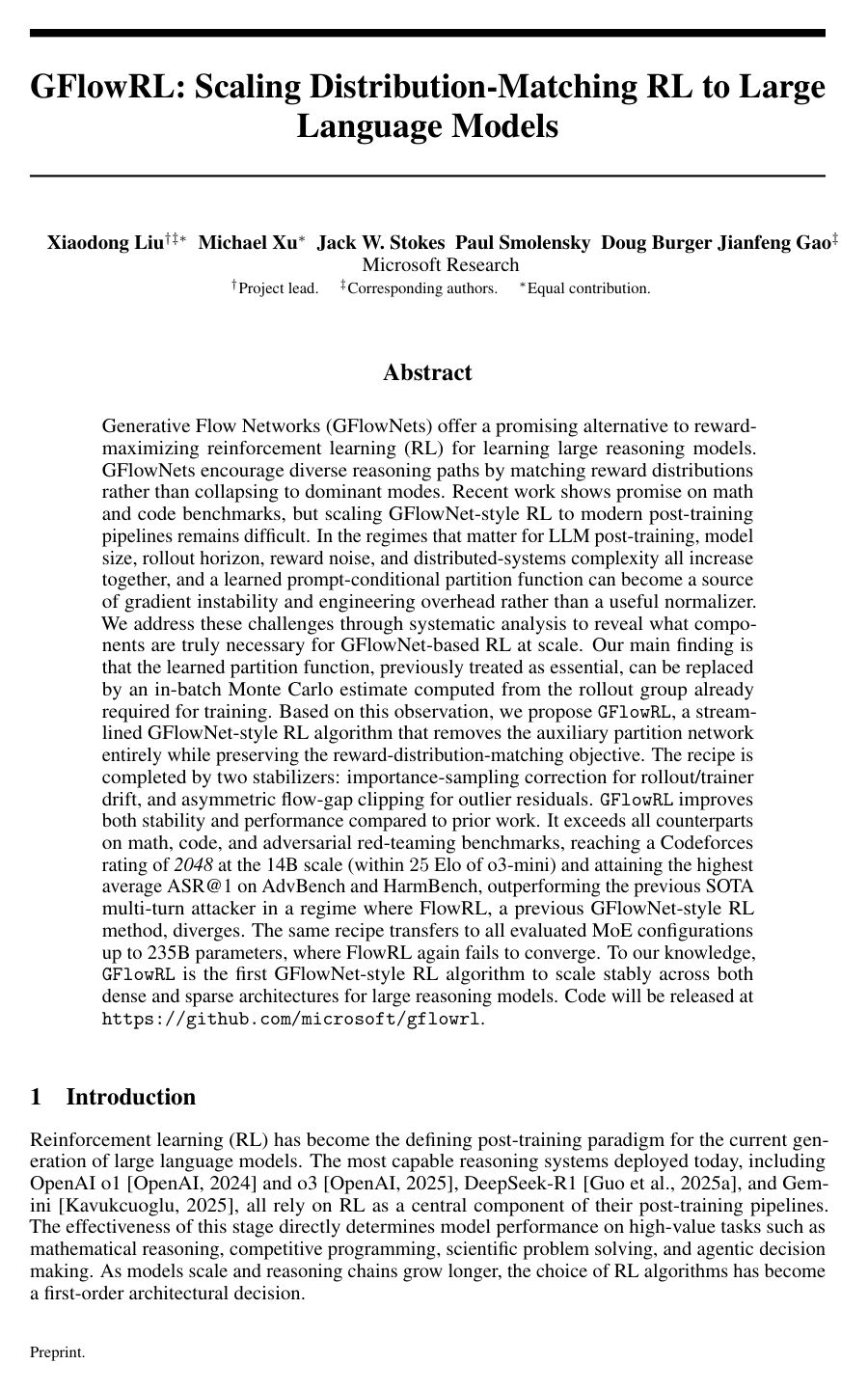
GFlowRL: Scaling Distribution-Matching RL to Large Language Models
Xiaodong Liu, Michael Xu, Jack W. Stokes, Paul Smolensky, Doug Burger, Jianfeng Gao
Why you should read this
Introduces GFlowRL, a reinforcement learning algorithm that eliminates the instability of distribution-matching methods by replacing learned partition functions with in-batch Monte Carlo estimates, enabling GFlowNet-style reasoning to scale across dense and mixture-of-experts models up to 235B parameters.
Generative Flow Networks (GFlowNets) offer a promising alternative to reward-maximizing reinforcement learning (RL) for large reasoning models, encouraging diverse reasoning paths by matching reward distributions rather than collapsing to dominant modes. Recent work shows promise on math and code, but scaling GFlowNet-style RL to modern post-training pipelines remains difficult: as model size, rollout horizon, reward noise, and distributed-systems complexity grow together, a learned prompt-conditional partition function becomes a source of gradient instability and engineering overhead rather than a useful normalizer. Through systematic analysis, we find that the learned partition function, previously treated as essential, can be replaced by an in-batch Monte Carlo estimate computed from the rollout group already required for training. We propose GFlowRL, a streamlined GFlowNet-style RL algorithm that removes the auxiliary partition network entirely while preserving the reward-distribution-matching objective, completed by two stabilizers: importance-sampling correction for rollout/trainer drift and asymmetric flow-gap clipping for outlier residuals. GFlowRL exceeds all counterparts on math, code, and adversarial red-teaming benchmarks, reaching a Codeforces rating of 2048 at the 14B scale (within 25 Elo of o3-mini) and attaining the highest average ASR@1 on AdvBench and HarmBench, outperforming the previous SOTA multi-turn attacker in a regime where FlowRL, a prior GFlowNet-style method, diverges. The same recipe transfers to all evaluated MoE configurations up to 235B parameters, where FlowRL again fails to converge. To our knowledge, GFlowRL is the first GFlowNet-style RL algorithm to scale stably across both dense and sparse architectures. Code will be at: this https URL
Added
2026-09-30
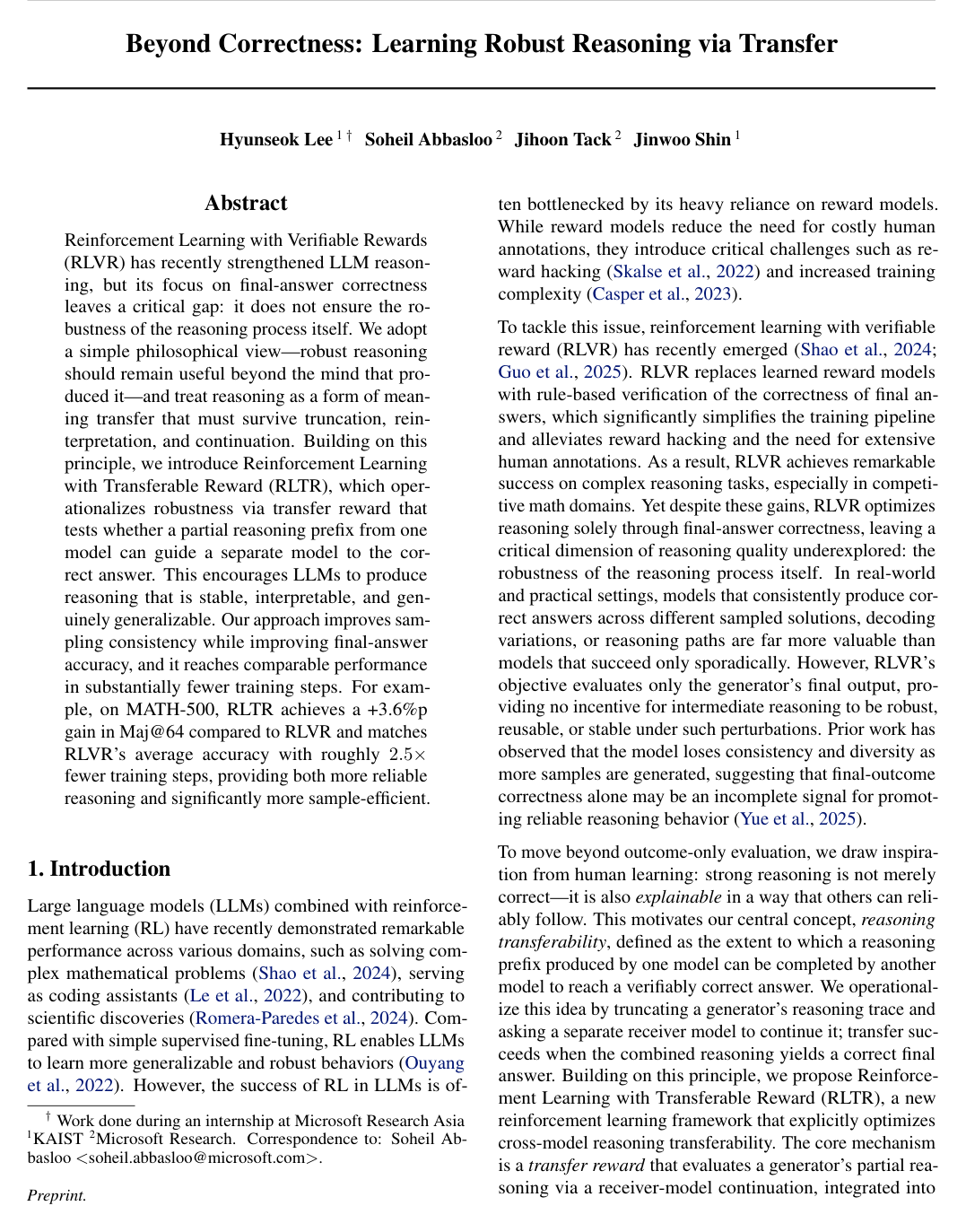
Beyond Correctness: Learning Robust Reasoning via Transfer
Hyunseok Lee, Soheil Abbasloo, Jihoon Tack, Jinwoo Shin
Why you should read this
Proposes Reinforcement Learning with Transferable Reward (RLTR), a framework that trains language models to generate reasoning prefixes capable of guiding independent models to correct solutions, matching standard RLVR performance with roughly 2.5 times fewer training steps.
Reinforcement Learning with Verifiable Rewards (RLVR) has recently strengthened LLM reasoning, but its focus on final answer correctness leaves a critical gap: it does not ensure the robustness of the reasoning process itself. We adopt a simple philosophical view, robust reasoning should remain useful beyond the mind that produced it, and treat reasoning as a form of meaning transfer that must survive truncation, reinterpretation, and continuation. Building on this principle, we introduce Reinforcement Learning with Transferable Reward (RLTR), which operationalizes robustness via transfer reward that tests whether a partial reasoning prefix from one model can guide a separate model to the correct answer. This encourages LLMs to produce reasoning that is stable, interpretable, and genuinely generalizable. Our approach improves sampling consistency while improving final answer accuracy, and it reaches comparable performance in substantially fewer training steps. For example, on MATH500, RLTR achieves a +3.6%p gain in Maj@64 compared to RLVR and matches RLVR's average accuracy with roughly 2.5x fewer training steps, providing both more reliable reasoning and significantly more sample efficient.
Added
2026-09-30

MathVista: Evaluating Mathematical Reasoning of Foundation Models in Visual Contexts
Pan Lu, Hritik Bansal, Tony Xia, Jiacheng Liu, Chun-yue Li, Hannaneh Hajishirzi, Hao Cheng, Kai-Wei Chang, Michel Galley, Jianfeng Gao
Why you should read this
Presents MathVista, a 6,141-example benchmark for assessing mathematical reasoning in visual contexts, revealing that leading multimodal models like GPT-4V still trail human performance on complex visual problem-solving.
Large Language Models (LLMs) and Large Multimodal Models (LMMs) exhibit impressive problem-solving skills in many tasks and domains, but their ability in mathematical reasoning in visual contexts has not been systematically studied. To bridge this gap, we present MathVista, a benchmark designed to combine challenges from diverse mathematical and visual tasks. It consists of 6,141 examples, derived from 28 existing multimodal datasets involving mathematics and 3 newly created datasets (i.e., IQTest, FunctionQA, and PaperQA). Completing these tasks requires fine-grained, deep visual understanding and compositional reasoning, which all state-of-the-art foundation models find challenging. With MathVista, we have conducted a comprehensive, quantitative evaluation of 12 prominent foundation models. The best-performing GPT-4V model achieves an overall accuracy of 49.9%, substantially outperforming Bard, the second-best performer, by 15.1%. Our in-depth analysis reveals that the superiority of GPT-4V is mainly attributed to its enhanced visual perception and mathematical reasoning. However, GPT-4V still falls short of human performance by 10.4%, as it often struggles to understand complex figures and perform rigorous reasoning. This significant gap underscores the critical role that MathVista will play in the development of general-purpose AI agents capable of tackling mathematically intensive and visually rich real-world tasks. We further explore the new ability of self-verification, the application of self-consistency, and the interactive chatbot capabilities of GPT-4V, highlighting its promising potential for future research. The project is available at this https URL.
Added
2026-09-18
Solving Quantitative Reasoning Problems with Language Models
Aitor Lewkowycz, Anders Andreassen, David Dohan, Ethan Dyer, Henryk Michalewski, Vinay V. Ramasesh, Ambrose Slone, Cem Anil, Imanol Schlag, Theo Gutman-Solo, Yuhuai Wu, Behnam Neyshabur, Guy Gur-Ari, Vedant Misra
Why you should read this
Introduces Minerva, a large language model trained on technical content that achieves state-of-the-art performance on quantitative reasoning benchmarks and correctly solves nearly a third of undergraduate-level STEM problems without relying on external tools.
Language models have achieved remarkable performance on a wide range of tasks that require natural language understanding. Nevertheless, state-of-the-art models have generally struggled with tasks that require quantitative reasoning, such as solving mathematics, science, and engineering problems at the college level. To help close this gap, we introduce Minerva, a large language model pretrained on general natural language data and further trained on technical content. The model achieves state-of-the-art performance on technical benchmarks without the use of external tools. We also evaluate our model on over two hundred undergraduate-level problems in physics, biology, chemistry, economics, and other sciences that require quantitative reasoning, and find that the model can correctly answer nearly a third of them.
Added
2026-09-18
Qwen3 Technical Report
An Yang, An-Feng Li, Baosong Yang, Beichen Zhang, Binyuan Hui, Bo Zheng, Bo-Wen Yu, Chang Gao, Chengen Huang, Chenxu Lv, Chujie Zheng, Dayiheng Liu, Fan Zhou, Fei Huang, Feng Hu, Hao Ge, Haoran Wei, Huan Lin, Jialong Tang, Jian Yang, Jianhong Tu, Jianwei Zhang, Jianxin Yang, Jiaxin Yang, Jingren Zhou, Junyan Lin, Kai Dang, Keqin Bao, Ke‐Pei Yang, Le Yu, Li-Chun Deng, Mei Li, Min Xue, Ming-Ze Li, Pei Zhang, Peng Wang, Qin Zhu, Rui Men, Ruize Gao, Shixuan Liu, Shuang Luo, Tianhao Li, Tianyi Tang, Wenbiao Yin, Xingzhang Ren, Xinyu Wang, Xinyu Zhang, Xuancheng Ren, Yang Fan, Yang Su, Yi-Chao Zhang, Ying-Er Zhang, Yu Wan, Yuqiong Liu, Zekun Wang, Zeyu Cui, Zhen-Ru Zhang, Zhipeng Zhou, Zihan Qiu
Why you should read this
Presents an open-source family of dense and mixture-of-experts models spanning 0.6B to 235B parameters that unifies rapid conversational responses and complex reasoning into a single architecture with dynamic compute budgets across 119 languages.
In this work, we present Qwen3, the latest version of the Qwen model family. Qwen3 comprises a series of large language models (LLMs) designed to advance performance, efficiency, and multilingual capabilities. The Qwen3 series includes models of both dense and Mixture-of-Expert (MoE) architectures, with parameter scales ranging from 0.6 to 235 billion. A key innovation in Qwen3 is the integration of thinking mode (for complex, multi-step reasoning) and non-thinking mode (for rapid, context-driven responses) into a unified framework. This eliminates the need to switch between different models--such as chat-optimized models (e.g., GPT-4o) and dedicated reasoning models (e.g., QwQ-32B)--and enables dynamic mode switching based on user queries or chat templates. Meanwhile, Qwen3 introduces a thinking budget mechanism, allowing users to allocate computational resources adaptively during inference, thereby balancing latency and performance based on task complexity. Moreover, by leveraging the knowledge from the flagship models, we significantly reduce the computational resources required to build smaller-scale models, while ensuring their highly competitive performance. Empirical evaluations demonstrate that Qwen3 achieves state-of-the-art results across diverse benchmarks, including tasks in code generation, mathematical reasoning, agent tasks, etc., competitive against larger MoE models and proprietary models. Compared to its predecessor Qwen2.5, Qwen3 expands multilingual support from 29 to 119 languages and dialects, enhancing global accessibility through improved cross-lingual understanding and generation capabilities. To facilitate reproducibility and community-driven research and development, all Qwen3 models are publicly accessible under Apache 2.0.
Added
2026-09-16
Mistral 7B
Albert Q. Jiang, Alexandre Sablayrolles, Arthur Mensch, Chris Bamford, Devendra Singh Chaplot, Diego de las Casas, Florian Bressand, Gianna Lengyel, Guillaume Lample, Lucile Saulnier, Lélio Renard Lavaud, Marie-Anne Lachaux, Pierre Stock, Teven Le Scao, Thibaut Lavril, Thomas Wang, Timothée Lacroix, William El Sayed
Why you should read this
Presents Mistral 7B, a 7-billion-parameter open language model that outperforms Llama 2 13B across all standard benchmarks by integrating grouped-query and sliding window attention for faster inference and efficient long-context processing.
We introduce Mistral 7B v0.1, a 7-billion-parameter language model engineered for superior performance and efficiency. Mistral 7B outperforms Llama 2 13B across all evaluated benchmarks, and Llama 1 34B in reasoning, mathematics, and code generation. Our model leverages grouped-query attention (GQA) for faster inference, coupled with sliding window attention (SWA) to effectively handle sequences of arbitrary length with a reduced inference cost. We also provide a model fine-tuned to follow instructions, Mistral 7B -- Instruct, that surpasses the Llama 2 13B -- Chat model both on human and automated benchmarks. Our models are released under the Apache 2.0 license.
Added
2026-09-13
Sakana Fugu Technical Report
Yujin Tang, Edoardo Cetin, Jinglue Xu, Qi Sun, Stefan Nielsen, Vincent Richard, Haruto Goda, Iaroslav Tymchenko, Nhan Nguyen, Hyunin Lee, Mari Ashiga, Shashank Kotyan, So Kuroki, Tarin Clanuwat
Why you should read this
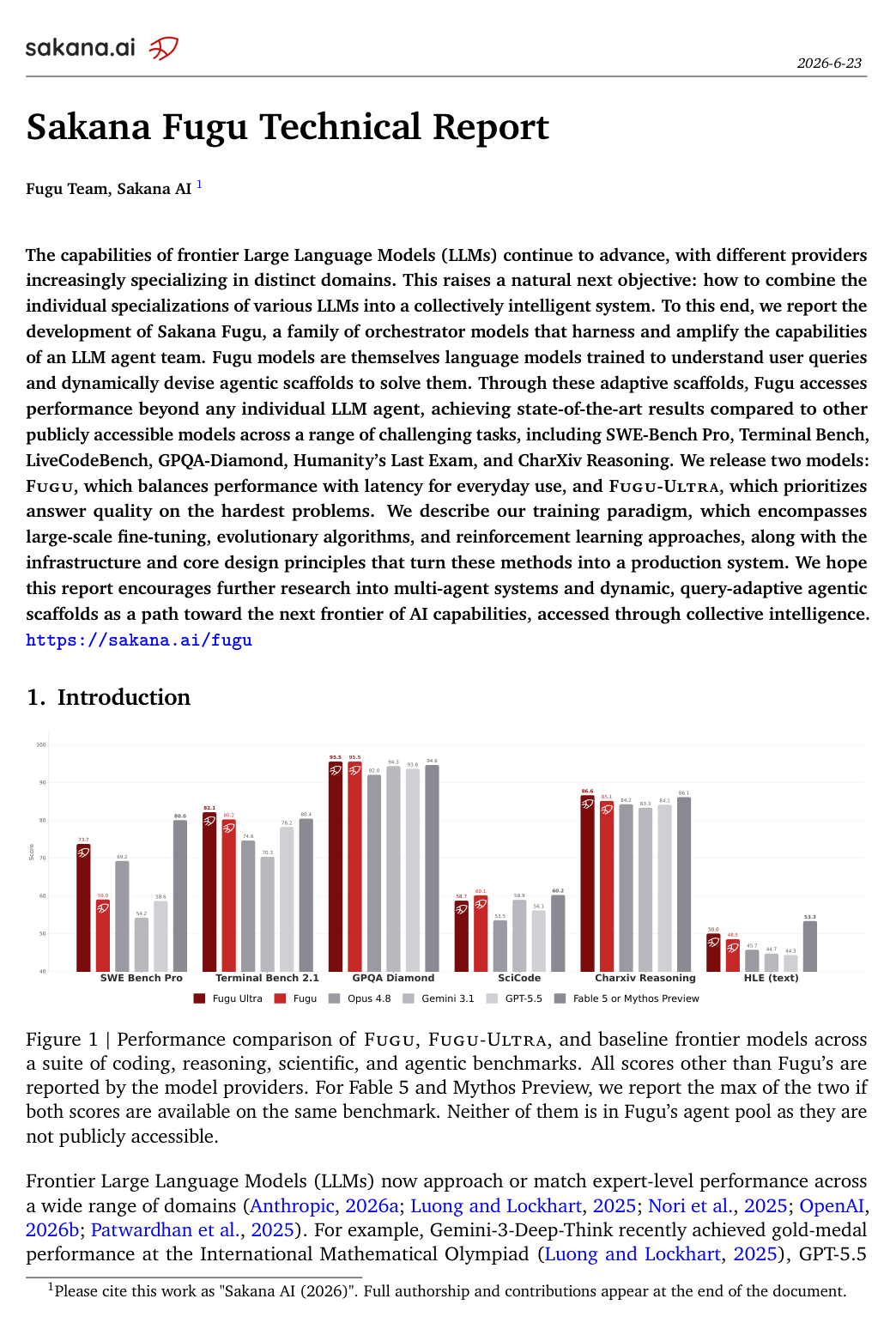
Presents Sakana Fugu, a novel family of orchestrator models that achieve state-of-the-art performance across diverse benchmarks by dynamically combining and amplifying the specialized capabilities of various LLM agents through adaptive scaffolds.
The capabilities of frontier Large Language Models (LLMs) continue to advance, with different providers increasingly specializing in distinct domains. This raises a natural next objective: how to combine the individual specializations of various LLMs into a collectively intelligent system. To this end, we report the development of Sakana Fugu, a family of orchestrator models that harness and amplify the capabilities of an LLM agent team. Fugu models are themselves language models trained to understand user queries and dynamically devise agentic scaffolds to solve them. Through these adaptive scaffolds, Fugu accesses performance beyond any individual LLM agent, achieving state-of-the-art results compared to other publicly accessible models across a range of challenging tasks, including SWE-Bench Pro, Terminal Bench, LiveCodeBench, GPQA-Diamond, Humanity's Last Exam, and CharXiv Reasoning. We release two models: Fugu, which balances performance with latency for everyday use, and Fugu-Ultra, which prioritizes answer quality on the hardest problems. We describe our training paradigm, which encompasses large-scale fine-tuning, evolutionary algorithms, and reinforcement learning approaches, along with the infrastructure and core design principles that turn these methods into a production system. We hope this report encourages further research into multi-agent systems and dynamic, query-adaptive agentic scaffolds as a path toward the next frontier of AI capabilities, accessed through collective intelligence.
Added
2026-06-23
Large Language Models are Zero-Shot Reasoners
Takeshi Kojima, Shixiang Shane Gu, Machel Reid, Yutaka Matsuo, Yusuke Iwasawa
Why you should read this
Demonstrates that large language models are effective zero-shot reasoners across diverse tasks by simply appending "Let's think step by step," significantly improving performance without requiring hand-crafted examples.
Pretrained large language models (LLMs) are widely used in many sub-fields of natural language processing (NLP) and generally known as excellent few-shot learners with task-specific exemplars. Notably, chain of thought (CoT) prompting, a recent technique for eliciting complex multi-step reasoning through step-by-step answer examples, achieved the state-of-the-art performances in arithmetics and symbolic reasoning, difficult system-2 tasks that do not follow the standard scaling laws for LLMs. While these successes are often attributed to LLMs' ability for few-shot learning, we show that LLMs are decent zero-shot reasoners by simply adding "Let's think step by step" before each answer. Experimental results demonstrate that our Zero-shot-CoT, using the same single prompt template, significantly outperforms zero-shot LLM performances on diverse benchmark reasoning tasks including arithmetics (MultiArith, GSM8K, AQUA-RAT, SVAMP), symbolic reasoning (Last Letter, Coin Flip), and other logical reasoning tasks (Date Understanding, Tracking Shuffled Objects), without any hand-crafted few-shot examples, e.g. increasing the accuracy on MultiArith from 17.7% to 78.7% and GSM8K from 10.4% to 40.7% with large InstructGPT model (text-davinci-002), as well as similar magnitudes of improvements with another off-the-shelf large model, 540B parameter PaLM. The versatility of this single prompt across very diverse reasoning tasks hints at untapped and understudied fundamental zero-shot capabilities of LLMs, suggesting high-level, multi-task broad cognitive capabilities may be extracted by simple prompting. We hope our work not only serves as the minimal strongest zero-shot baseline for the challenging reasoning benchmarks, but also highlights the importance of carefully exploring and analyzing the enormous zero-shot knowledge hidden inside LLMs before crafting finetuning datasets or few-shot exemplars.
Added
2026-05-12
License
Published with permission
Towards Large Reasoning Models: A Survey of Reinforced Reasoning with Large Language Models
Fengli Xu, Qianyue Hao, Zefang Zong, Jingwei Wang, Yunke Zhang, Jingyi Wang, Xiaochong Lan, Jiahui Gong, Tianjian Ouyang, Fanjin Meng, Chenyang Shao, Yuwei Yan, Qinglong Yang, Yiwen Song, Sijian Ren, Xinyuan Hu, Yu Li, Jie Feng, Chen Gao, Yong Li
Why you should read this
Presents a comprehensive review of reinforced reasoning with Large Language Models, detailing the technical components, automated data construction, learning-to-reason techniques, and test-time scaling that are driving the development of future Large Reasoning Models.
Language has long been conceived as an essential tool for human reasoning. The breakthrough of Large Language Models (LLMs) has sparked significant research interest in leveraging these models to tackle complex reasoning tasks. Researchers have moved beyond simple autoregressive token generation by introducing the concept of "thought" -- a sequence of tokens representing intermediate steps in the reasoning process. This innovative paradigm enables LLMs' to mimic complex human reasoning processes, such as tree search and reflective thinking. Recently, an emerging trend of learning to reason has applied reinforcement learning (RL) to train LLMs to master reasoning processes. This approach enables the automatic generation of high-quality reasoning trajectories through trial-and-error search algorithms, significantly expanding LLMs' reasoning capacity by providing substantially more training data. Furthermore, recent studies demonstrate that encouraging LLMs to "think" with more tokens during test-time inference can further significantly boost reasoning accuracy. Therefore, the train-time and test-time scaling combined to show a new research frontier -- a path toward Large Reasoning Model. The introduction of OpenAI's o1 series marks a significant milestone in this research direction. In this survey, we present a comprehensive review of recent progress in LLM reasoning. We begin by introducing the foundational background of LLMs and then explore the key technical components driving the development of large reasoning models, with a focus on automated data construction, learning-to-reason techniques, and test-time scaling. We also analyze popular open-source projects at building large reasoning models, and conclude with open challenges and future research directions.
Added
2026-04-14
Reasoning Language Models: A Blueprint
Maciej Besta, Julia Barth, Eric Schreiber, Ales Kubicek, Afonso Catarino, Robert Gerstenberger, Piotr Nyczyk, Patrick Iff, Yueling Li, Sam Houliston, Tomasz Sternal, Marcin Copik, Grzegorz Kwaśniewski, Jürgen Müller, Łukasz Flis, Hannes Eberhard, Zixuan Chen, Hubert Niewiadomski, Torsten Hoefler
Why you should read this
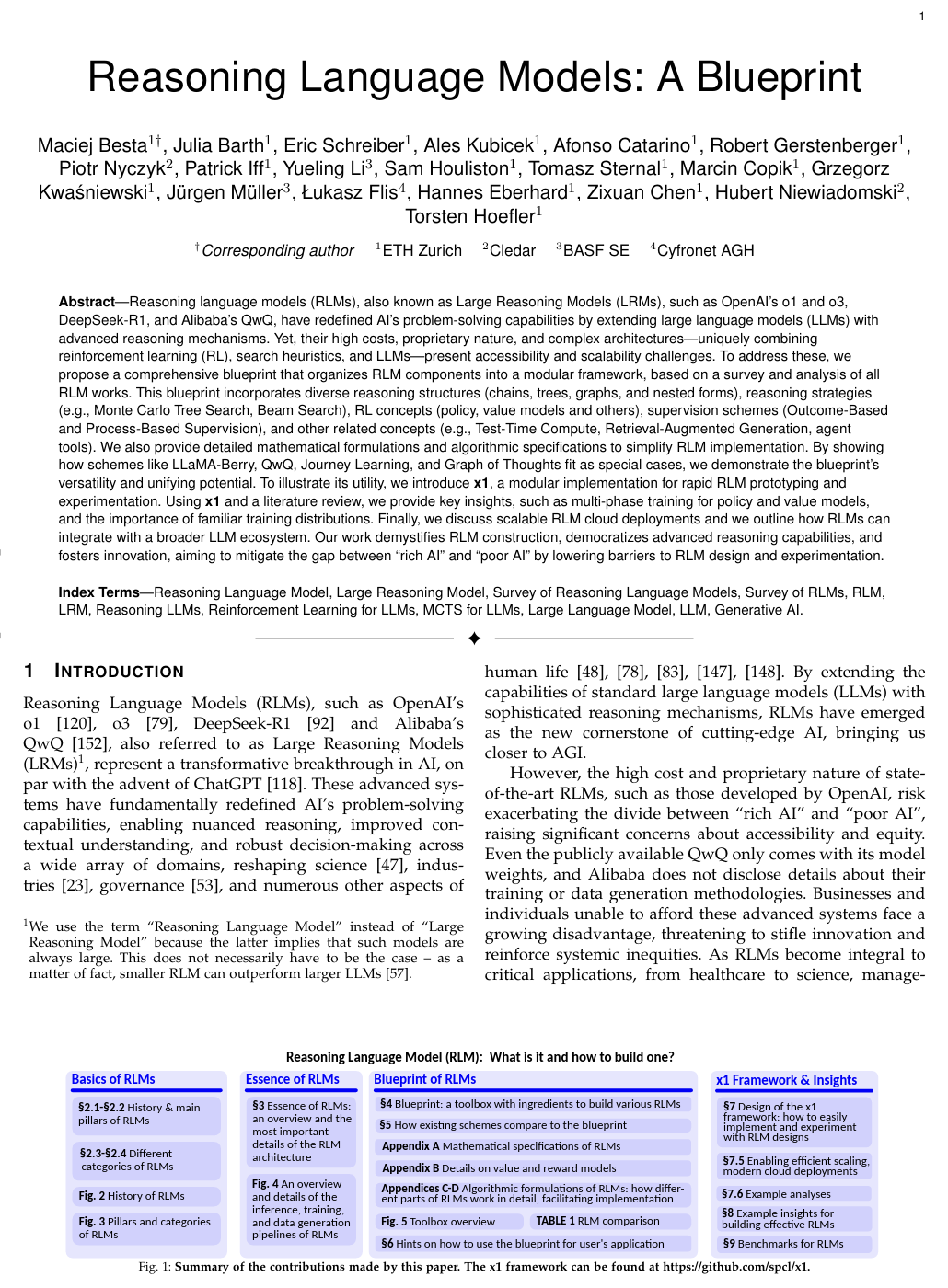
Proposes a comprehensive, modular blueprint and an open-source framework (x1) for Reasoning Language Models (RLMs), democratizing their design, implementation, and experimentation by demystifying complex architectures and providing mathematical and algorithmic specifications.
Reasoning language models (RLMs), also known as Large Reasoning Models (LRMs), such as OpenAI's o1 and o3, DeepSeek-R1, and Alibaba's QwQ, have redefined AI's problem-solving capabilities by extending LLMs with advanced reasoning mechanisms. Yet, their high costs, proprietary nature, and complex architectures - uniquely combining reinforcement learning (RL), search heuristics, and LLMs - present accessibility and scalability challenges. To address these, we propose a comprehensive blueprint that organizes RLM components into a modular framework, based on a survey and analysis of all RLM works. This blueprint incorporates diverse reasoning structures (chains, trees, graphs, and nested forms), reasoning strategies (e.g., Monte Carlo Tree Search, Beam Search), RL concepts (policy, value models and others), supervision schemes (Outcome-Based and Process-Based Supervision), and other related concepts (e.g., Test-Time Compute, Retrieval-Augmented Generation, agent tools). We also provide detailed mathematical formulations and algorithmic specifications to simplify RLM implementation. By showing how schemes like LLaMA-Berry, QwQ, Journey Learning, and Graph of Thoughts fit as special cases, we demonstrate the blueprint's versatility and unifying potential. To illustrate its utility, we introduce x1, a modular implementation for rapid RLM prototyping and experimentation. Using x1 and a literature review, we provide key insights, such as multi-phase training for policy and value models, and the importance of familiar training distributions. Finally, we discuss scalable RLM cloud deployments and we outline how RLMs can integrate with a broader LLM ecosystem. Our work demystifies RLM construction, democratizes advanced reasoning capabilities, and fosters innovation, aiming to mitigate the gap between "rich AI" and "poor AI" by lowering barriers to RLM design and experimentation.
Added
2025-11-22
License
Published with permission