
Built independently by an author, for readers. Read the story and support ChapterPal

keyword

random walk transition matrix

A random walk transition matrix is a square, row-stochastic matrix that represents the probabilities of moving from one state or node to another in a single step of a random walk on a graph. Typically constructed by normalizing an adjacency matrix with the inverse of the degree matrix, each entry defines the conditional probability of traversing from a designated source node to an adjacent target node. Because its entries represent discrete transition probabilities, all values are non-negative and the elements of each row sum to one. Raising this matrix to higher powers yields multi-step transition probabilities, which effectively capture long-range structural connectivity, high-order neighborhood relationships, and global topological affinities across a network.

1 item
Decoupled Contrastive Multi-View Clustering with High-Order Random Walks

Decoupled Contrastive Multi-View Clustering with High-Order Random Walks

Yiding Lu, Yijie Lin, Mouxing Yang, Dezhong Peng, Peng Hu, Xi Peng

OrganizationsSichuan University

Why you should read this

Proposes a decoupled multi-view clustering framework that uses high-order random walks to rectify false positive and false negative pairs globally while preserving view-specific information through cross-view reconstruction.

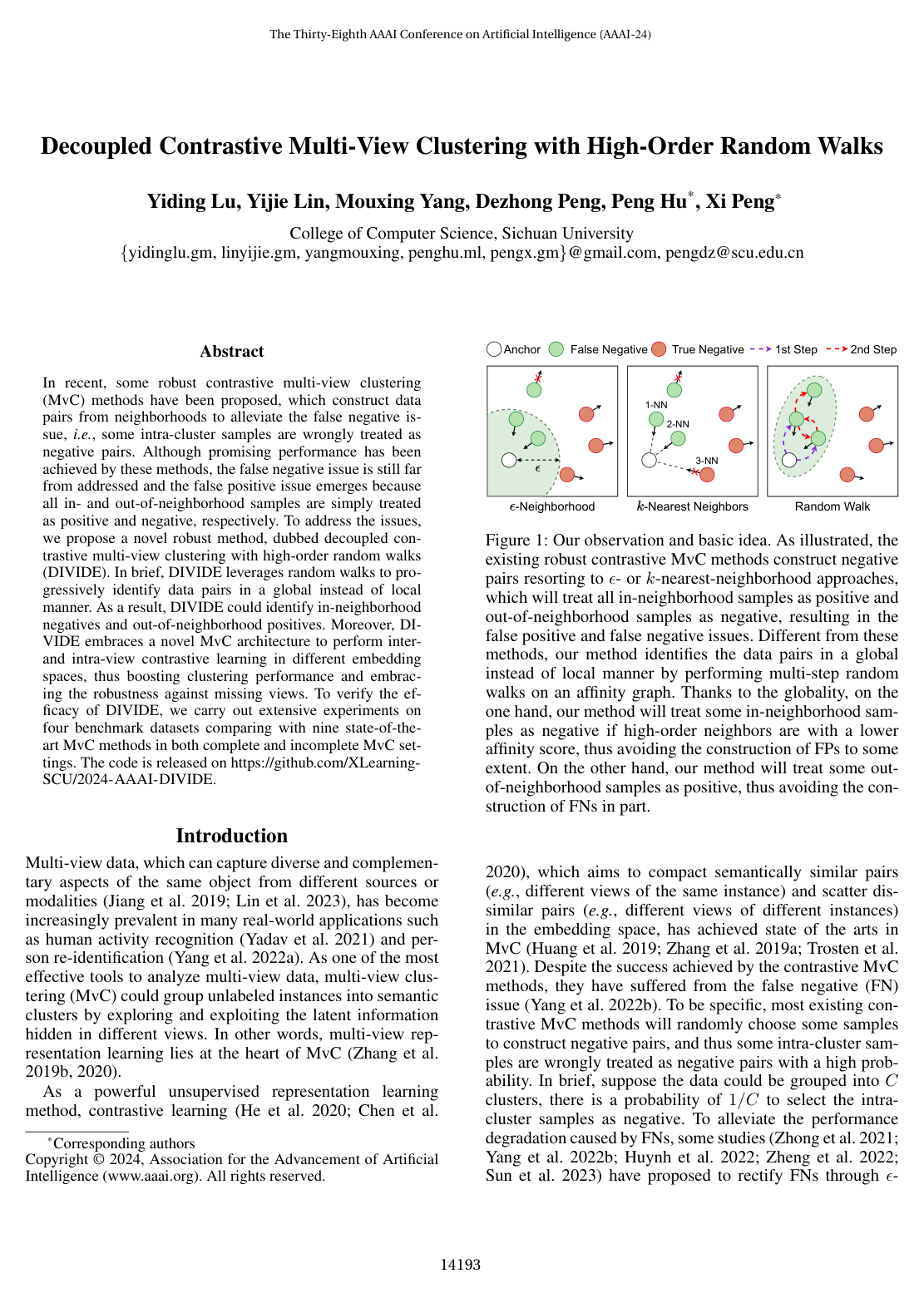
In recent, some robust contrastive multi-view clustering (MvC) methods have been proposed, which construct data pairs from neighborhoods to alleviate the false negative issue, i.e., some intra-cluster samples are wrongly treated as negative pairs. Although promising performance has been achieved by these methods, the false negative issue is still far from addressed and the false positive issue emerges because all in- and out-of-neighborhood samples are simply treated as positive and negative, respectively. To address the issues, we propose a novel robust method, dubbed decoupled contrastive multi-view clustering with high-order random walks (DIVIDE). In brief, DIVIDE leverages random walks to progressively identify data pairs in a global instead of local manner. As a result, DIVIDE could identify in-neighborhood negatives and out-of-neighborhood positives. Moreover, DIVIDE embraces a novel MvC architecture to perform inter- and intra-view contrastive learning in different embedding spaces, thus boosting clustering performance and embracing the robustness against missing views. To verify the efficacy of DIVIDE, we carry out extensive experiments on four benchmark datasets comparing with nine state-of-the-art MvC methods in both complete and incomplete MvC settings. The code is released on https://github.com/XLearning-SCU/2024-AAAI-DIVIDE.

Added

2026-09-26