
keyword
question representation
Question representation is the computational encoding of a natural language question into a structured numerical format, such as a feature vector or matrix of embeddings, that allows machine learning models to process, interpret, and reason about the text. In multimodal artificial intelligence tasks, such as visual question answering, question representations capture lexical, syntactic, and semantic information across word, phrase, and sentence levels using neural network architectures like recurrent networks, convolutional networks, or transformers. These structured numerical forms enable models to identify key linguistic elements, align textual queries with visual data, and perform joint reasoning to generate accurate answers.
2 items
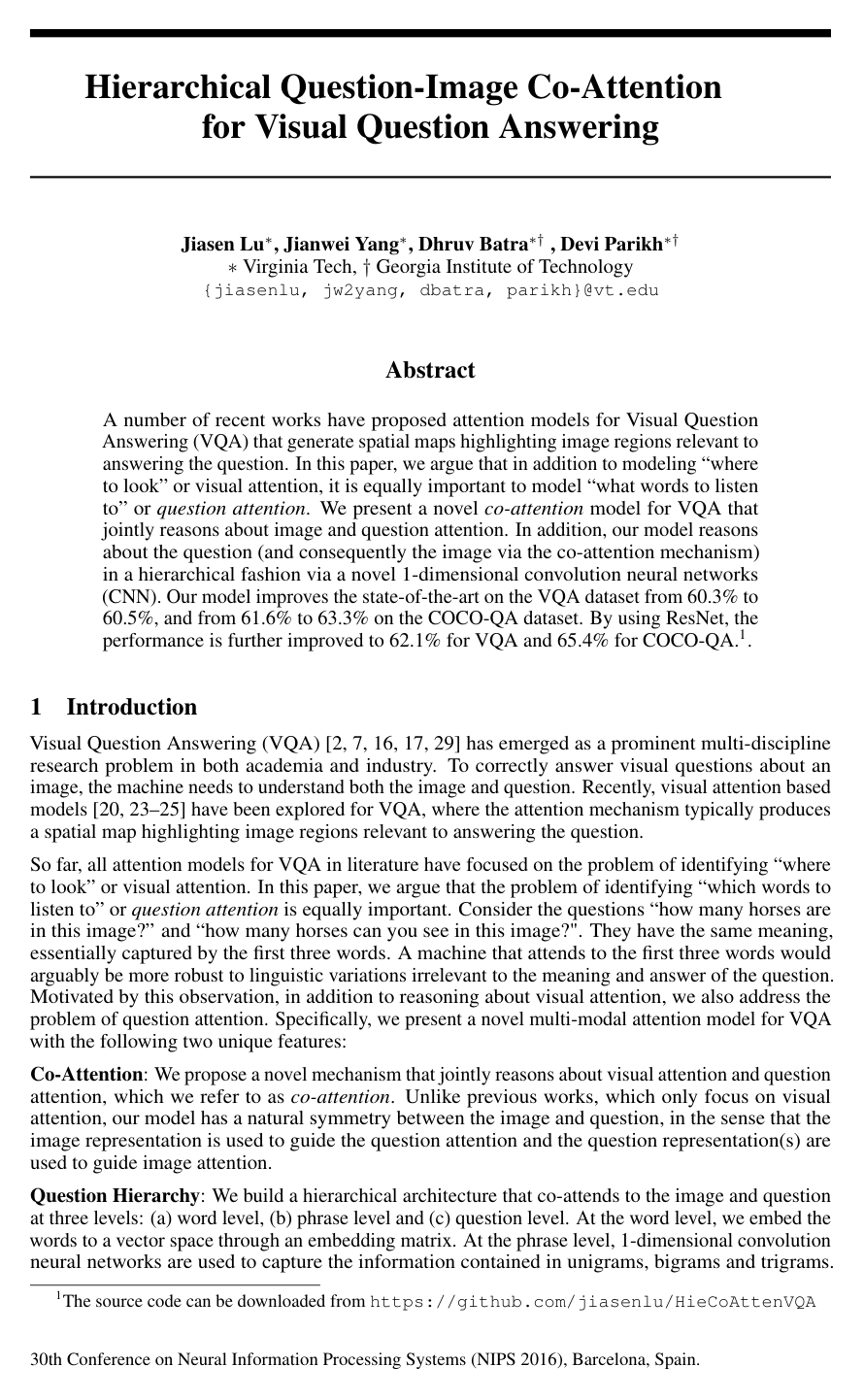
Hierarchical Question-Image Co-Attention for Visual Question Answering
Jiasen Lu, Jianwei Yang, Dhruv Batra, Devi Parikh
Why you should read this
Introduces a hierarchical co-attention model for visual question answering that jointly computes attention over relevant image regions and multi-level language structures across word, phrase, and question representations.
A number of recent works have proposed attention models for Visual Question Answering (VQA) that generate spatial maps highlighting image regions relevant to answering the question. In this paper, we argue that in addition to modeling "where to look" or visual attention, it is equally important to model "what words to listen to" or question attention. We present a novel co-attention model for VQA that jointly reasons about image and question attention. In addition, our model reasons about the question (and consequently the image via the co-attention mechanism) in a hierarchical fashion via a novel 1-dimensional convolution neural networks (CNN). Our model improves the state-of-the-art on the VQA dataset from 60.3% to 60.5%, and from 61.6% to 63.3% on the COCO-QA dataset. By using ResNet, the performance is further improved to 62.1% for VQA and 65.4% for COCO-QA.
Added
2026-09-24
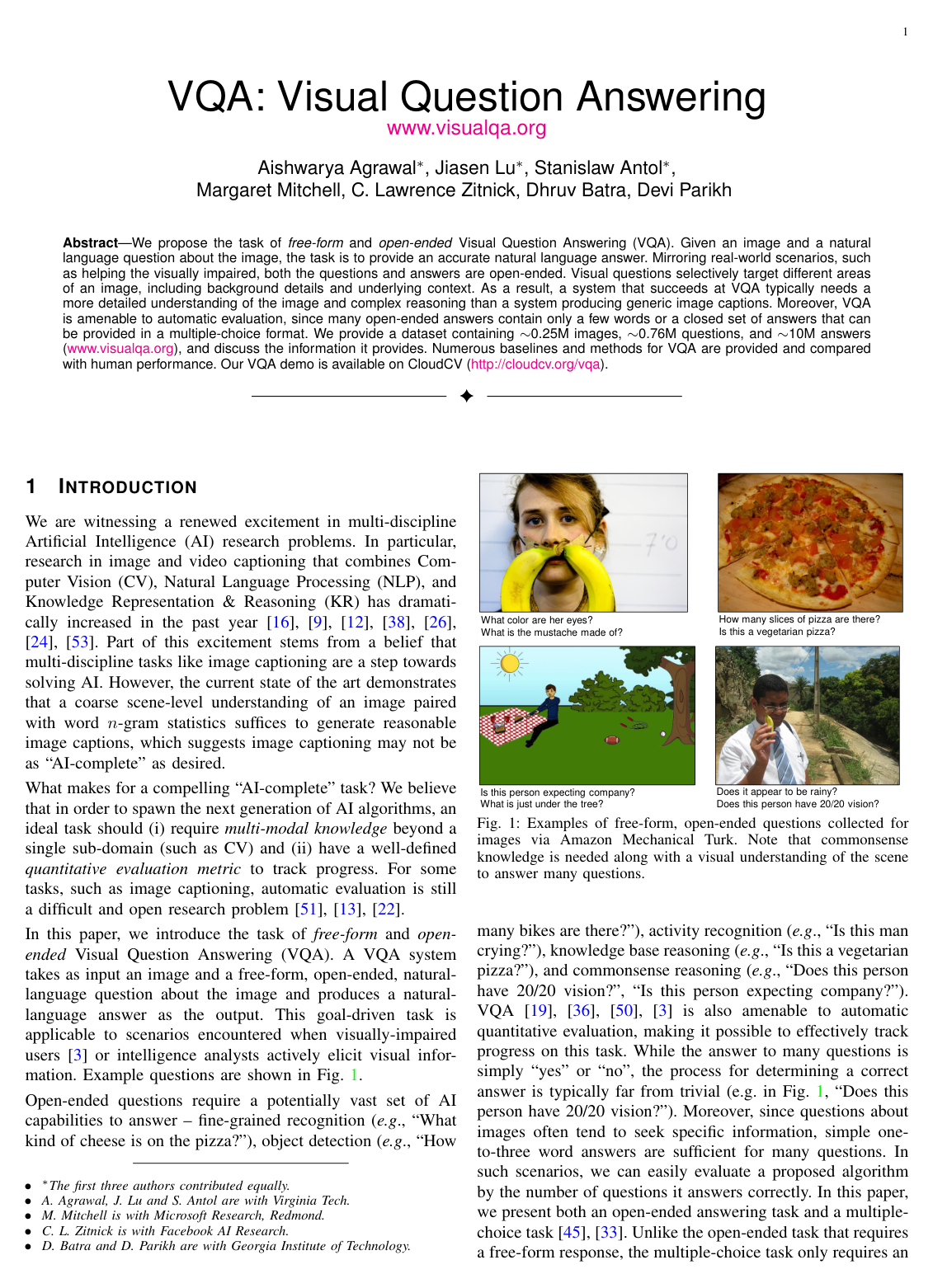
VQA: Visual Question Answering
Stanislaw Antol, Aishwarya Agrawal, Jiasen Lu, Margaret Mitchell, Dhruv Batra, C. Lawrence Zitnick, Devi Parikh
Why you should read this
Defines the Visual Question Answering task and benchmark, formalizing the challenge of reasoning across vision and language boundaries to answer open-ended questions.
We propose the task of free-form and open-ended Visual Question Answering (VQA). Given an image and a natural language question about the image, the task is to provide an accurate natural language answer. Mirroring real-world scenarios, such as helping the visually impaired, both the questions and answers are open-ended. Visual questions selectively target different areas of an image, including background details and underlying context. As a result, a system that succeeds at VQA typically needs a more detailed understanding of the image and complex reasoning than a system producing generic image captions. Moreover, VQA is amenable to automatic evaluation, since many open-ended answers contain only a few words or a closed set of answers that can be provided in a multiple-choice format. We provide a dataset containing ~0.25M images, ~0.76M questions, and ~10M answers (www.visualqa.org), and discuss the information it provides. Numerous baselines for VQA are provided and compared with human performance.
Added
2026-01-28