
keyword
question decomposition
Question decomposition is a natural language processing and reasoning technique that breaks down a complex, multi-step query into a set of simpler, more manageable sub-questions. Instead of attempting to resolve an intricate or multi-hop inquiry in a single step, a system identifies the intermediate components of the problem and generates targeted sub-questions that can be solved sequentially or independently. The answers to these individual sub-problems are then gathered and composed to formulate the final answer to the original question. This strategy is widely used in artificial intelligence, multi-hop question answering, claim verification, and retrieval-augmented systems to facilitate structured reasoning, reduce model hallucinations, and improve accuracy on tasks requiring compositional logic.
8 items
Decomposed Prompting: A Modular Approach for Solving Complex Tasks
Tushar Khot, Harsh Trivedi, Matthew Finlayson, Yao Fu, Kyle Richardson, Peter Clark, Ashish Sabharwal
Why you should read this
Introduces Decomposed Prompting, a modular framework that divides complex multi-step reasoning and long-context tasks into simpler sub-problems delegated to specialized prompts or symbolic tools, substantially outperforming standard few-shot prompting.
Few-shot prompting is a surprisingly powerful way to use Large Language Models (LLMs) to solve various tasks. However, this approach struggles as the task complexity increases or when the individual reasoning steps of the task themselves are hard to learn, especially when embedded in more complex tasks. To address this, we propose Decomposed Prompting, a new approach to solve complex tasks by decomposing them (via prompting) into simpler sub-tasks that can be delegated to a library of prompting-based LLMs dedicated to these sub-tasks. This modular structure allows each prompt to be optimized for its specific sub-task, further decomposed if necessary, and even easily replaced with more effective prompts, trained models, or symbolic functions if desired. We show that the flexibility and modularity of Decomposed Prompting allows it to outperform prior work on few-shot prompting using GPT3. On symbolic reasoning tasks, we can further decompose sub-tasks that are hard for LLMs into even simpler solvable sub-tasks. When the complexity comes from the input length, we can recursively decompose the task into the same task but with smaller inputs. We also evaluate our approach on textual multi-step reasoning tasks: on long-context multi-hop QA task, we can more effectively teach the sub-tasks via our separate sub-tasks prompts; and on open-domain multi-hop QA, we can incorporate a symbolic information retrieval within our decomposition framework, leading to improved performance on both tasks. Datasets, Code and Prompts available at this https URL.
Added
2026-10-05
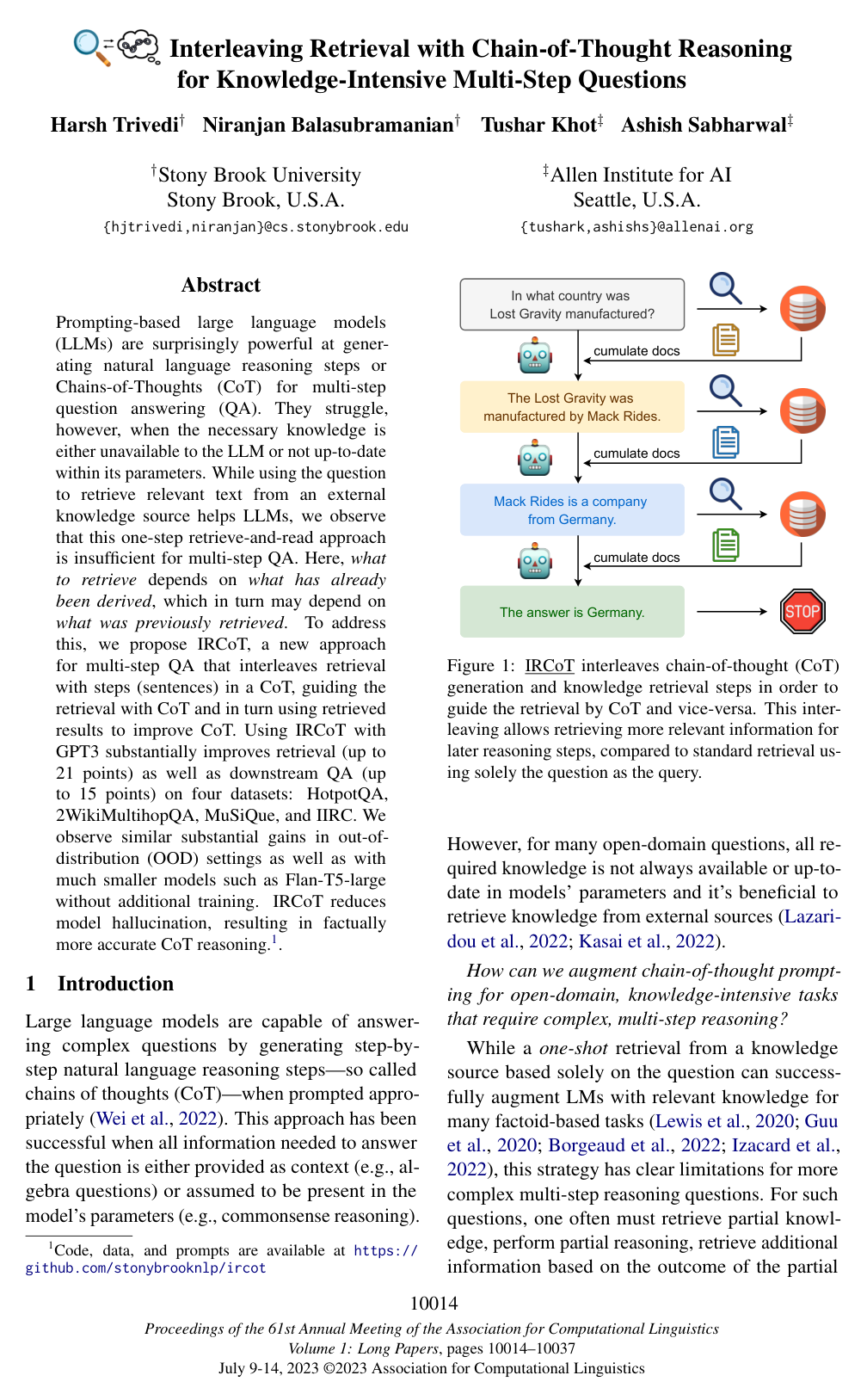
Interleaving Retrieval with Chain-of-Thought Reasoning for Knowledge-Intensive Multi-Step Questions
Harsh Trivedi, Niranjan Balasubramanian, Tushar Khot, Ashish Sabharwal
Why you should read this
Proposes IRCoT, a framework that interleaves chain-of-thought reasoning with step-by-step external retrieval to reduce model hallucinations and improve multi-step open-domain question answering across both large and small language models without extra training.
Prompting-based large language models (LLMs) are surprisingly powerful at generating natural language reasoning steps or Chains-of-Thoughts (CoT) for multi-step question answering (QA). They struggle, however, when the necessary knowledge is either unavailable to the LLM or not up-to-date within its parameters. While using the question to retrieve relevant text from an external knowledge source helps LLMs, we observe that this one-step retrieve-and-read approach is insufficient for multi-step QA. Here, what to retrieve depends on what has already been derived, which in turn may depend on what was previously retrieved. To address this, we propose IRCoT, a new approach for multi-step QA that interleaves retrieval with steps (sentences) in a CoT, guiding the retrieval with CoT and in turn using retrieved results to improve CoT. Using IRCoT with GPT3 substantially improves retrieval (up to 21 points) as well as downstream QA (up to 15 points) on four datasets: HotpotQA, 2WikiMultihopQA, MuSiQue, and IIRC. We observe similar substantial gains in out-of-distribution (OOD) settings as well as with much smaller models such as Flan-T5-large without additional training. IRCoT reduces model hallucination, resulting in factually more accurate CoT reasoning.¹
Added
2026-10-05
Exploring Chain of Thought Style Prompting for Text-to-SQL
Chang-Yu Tai, Ziru Chen, Tianshu Zhang, Xiang Deng, Huan Sun
Why you should read this
Presents a single-pass question-decomposition prompting method for text-to-SQL parsing that reduces error propagation and outperforms multi-turn iterative prompting on the Spider benchmarks without requiring expensive intermediate execution calls.
In-context learning with large language models (LLMs) has recently caught increasing attention due to its superior few-shot performance on various tasks. However, its performance on text-to-SQL parsing still has much room for improvement. In this paper, we hypothesize that a crucial aspect of LLMs to improve for text-to-SQL parsing is their multi-step reasoning ability. Thus, we systematically study how to enhance LLMs’ reasoning ability through chain of thought (CoT) style prompting, including the original chain-of-thought prompting (Wei et al., 2022b) and least-to-most prompting (Zhou et al., 2023). Our experiments demonstrate that iterative prompting as in Zhou et al. (2023) may be unnecessary for text-to-SQL parsing, and using detailed reasoning steps tends to have more error propagation issues. Based on these findings, we propose a new CoT-style prompting method for text-to-SQL parsing. It brings 5.2 and 6.5 point absolute gains on the Spider development set and the Spider Realistic set, respectively, compared to the standard prompting method without reasoning steps; 2.4 and 1.5 point absolute gains, compared to the least-to-most prompting method¹.
Added
2026-10-01
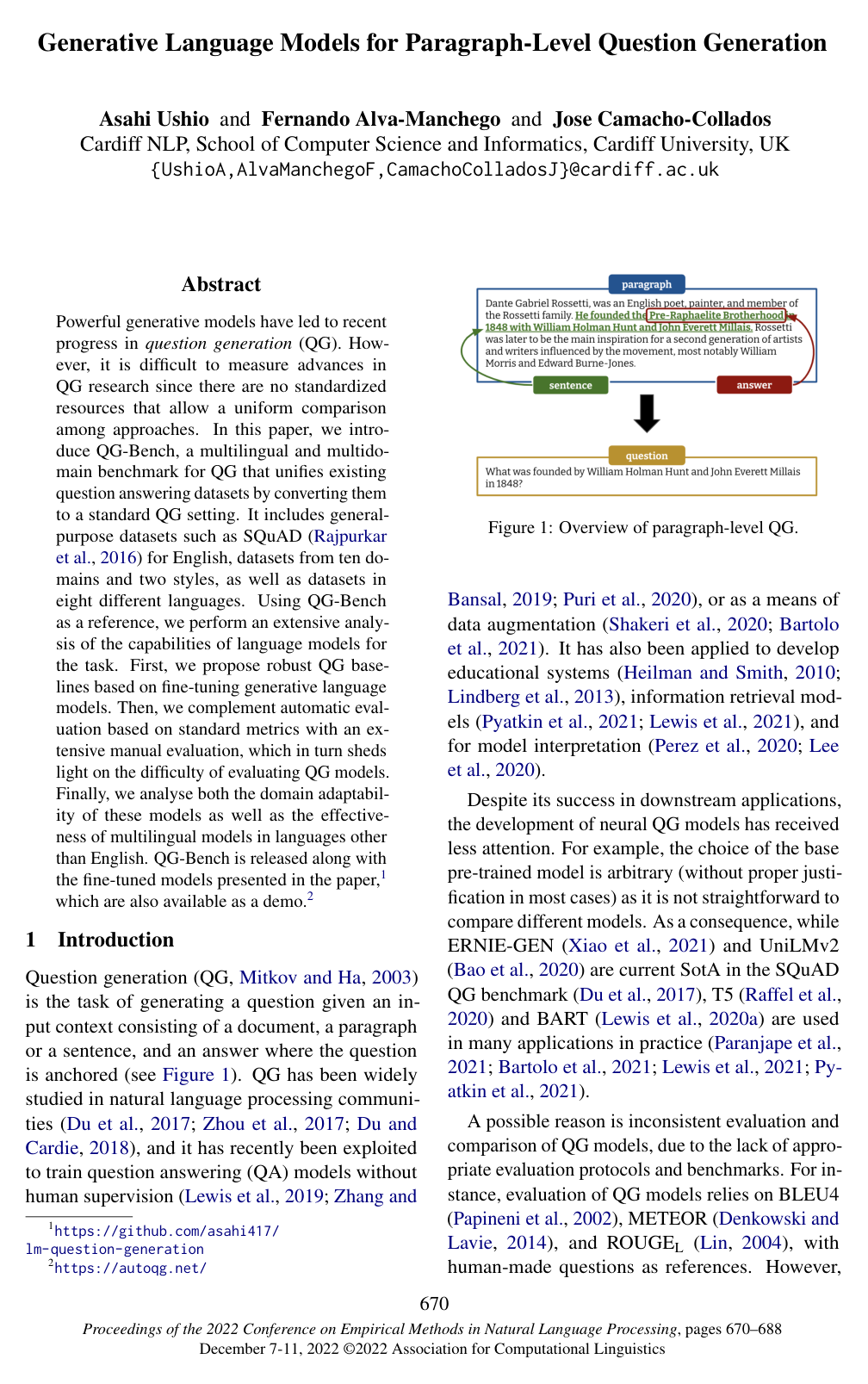
Generative Language Models for Paragraph-Level Question Generation
Asahi Ushio, Fernando Alva-Manchego, José Camacho-Collados
Why you should read this
Introduces QG-Bench, a unified multilingual and multi-domain benchmark that standardizes paragraph-level question generation evaluation across eight languages and multiple domains using sequence-to-sequence language models.
Powerful generative models have led to recent progress in question generation (QG). However, it is difficult to measure advances in QG research since there are no standardized resources that allow a uniform comparison among approaches. In this paper, we introduce QG-Bench, a multilingual and multidomain benchmark for QG that unifies existing question answering datasets by converting them to a standard QG setting. It includes general-purpose datasets such as SQuAD (Rajpurkar et al., 2016) for English, datasets from ten domains and two styles, as well as datasets in eight different languages. Using QG-Bench as a reference, we perform an extensive analysis of the capabilities of language models for the task. First, we propose robust QG baselines based on fine-tuning generative language models. Then, we complement automatic evaluation based on standard metrics with an extensive manual evaluation, which in turn sheds light on the difficulty of evaluating QG models. Finally, we analyse both the domain adaptability of these models as well as the effectiveness of multilingual models in languages other than English. QG-Bench is released along with the fine-tuned models presented in the paper,¹ which are also available as a demo.²
Added
2026-09-26
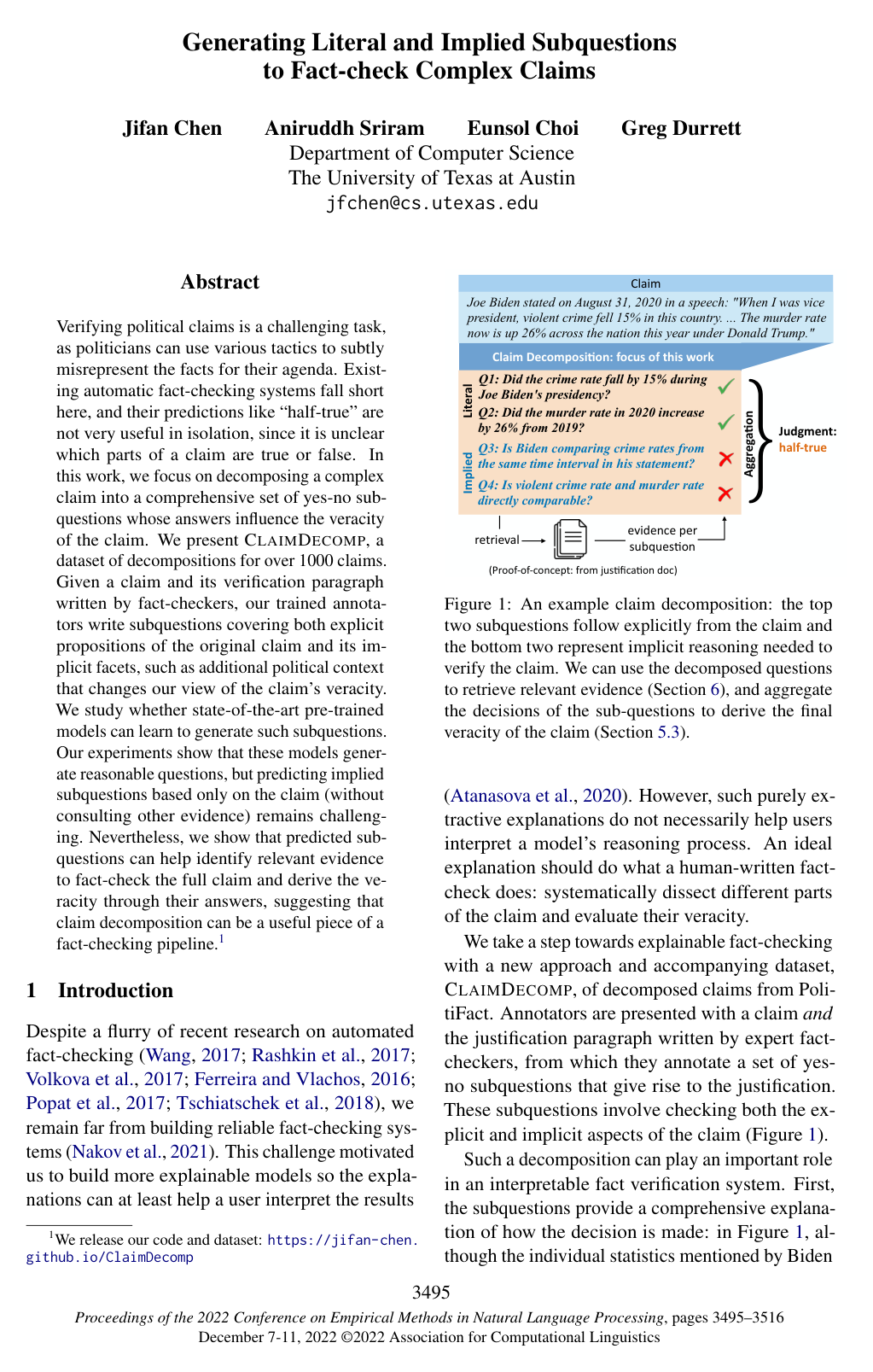
Generating Literal and Implied Subquestions to Fact-check Complex Claims
Jifan Chen, Aniruddh Sriram, Eunsol Choi, Greg Durrett
Why you should read this
Introduces ClaimDecomp, a benchmark for breaking down complex political claims into literal and implied yes-no subquestions, proving that question decomposition improves evidence retrieval and provides explainable step-by-step veracity judgments.
Verifying political claims is a challenging task, as politicians can use various tactics to subtly misrepresent the facts for their agenda. Existing automatic fact-checking systems fall short here, and their predictions like “half-true” are not very useful in isolation, since it is unclear which parts of a claim are true or false. In this work, we focus on decomposing a complex claim into a comprehensive set of yes-no subquestions whose answers influence the veracity of the claim. We present ClaimDecomp, a dataset of decompositions for over 1000 claims. Given a claim and its verification paragraph written by fact-checkers, our trained annotators write subquestions covering both explicit propositions of the original claim and its implicit facets, such as additional political context that changes our view of the claim’s veracity. We study whether state-of-the-art pre-trained models can learn to generate such subquestions. Our experiments show that these models generate reasonable questions, but predicting implied subquestions based only on the claim (without consulting other evidence) remains challenging. Nevertheless, we show that predicted subquestions can help identify relevant evidence to fact-check the full claim and derive the veracity through their answers, suggesting that claim decomposition can be a useful piece of a fact-checking pipeline.¹
Added
2026-09-26
Measuring and Narrowing the Compositionality Gap in Language Models
Ofir Press, Muru Zhang, Sewon Min, Ludwig Schmidt, Noah A. Smith, Mike Lewis
Why you should read this
Reveals that scaling language models fails to close the gap between recalling individual facts and composing them to solve multi-hop questions, and introduces self-ask prompting to bridge this divide by decomposing complex queries and querying external search engines.
We investigate the ability of language models to perform compositional reasoning tasks where the overall solution depends on correctly composing the answers to sub-problems. We measure how often models can correctly answer all sub-problems but not generate the overall solution, a ratio we call the compositionality gap. We evaluate this ratio by asking multi-hop questions with answers that require composing multiple facts unlikely to have been observed together during pretraining. In the GPT-3 family of models, as model size increases we show that the single-hop question answering performance improves faster than the multi-hop performance does, therefore the compositionality gap does not decrease. This surprising result suggests that while more powerful models memorize and recall more factual knowledge, they show no corresponding improvement in their ability to perform this kind of compositional reasoning. We then demonstrate how elicitive prompting (such as chain of thought) narrows the compositionality gap by reasoning explicitly. We present a new method, self-ask, that further improves on chain of thought. In our method, the model explicitly asks itself (and answers) follow-up questions before answering the initial question. We finally show that self-ask's structured prompting lets us easily plug in a search engine to answer the follow-up questions, which additionally improves accuracy.
Added
2026-09-26

Least-to-Most Prompting Enables Complex Reasoning in Large Language Models
Denny Zhou, Nathanael Scharli, Le Hou, Jason Wei, Nathan Scales, Xuezhi Wang, Dale Schuurmans, Olivier Bousquet, Quoc Le, Ed H. Chi
Why you should read this
Introduces least-to-most prompting, a strategy that decomposes complex problems into sequential subproblems to enable large language models to generalize to harder tasks than those in prompt exemplars, boosting SCAN benchmark accuracy from 16% to 99% with only 14 examples.
Chain-of-thought prompting has demonstrated remarkable performance on various natural language reasoning tasks. However, it tends to perform poorly on tasks which requires solving problems harder than the exemplars shown in the prompts. To overcome this challenge of easy-to-hard generalization, we propose a novel prompting strategy, least-to-most prompting. The key idea in this strategy is to break down a complex problem into a series of simpler subproblems and then solve them in sequence. Solving each subproblem is facilitated by the answers to previously solved subproblems. Our experimental results on tasks related to symbolic manipulation, compositional generalization, and math reasoning reveal that least-to-most prompting is capable of generalizing to more difficult problems than those seen in the prompts. A notable finding is that when the GPT-3 code-davinci-002 model is used with least-to-most prompting, it can solve the compositional generalization benchmark SCAN in any split (including length split) with an accuracy of at least 99% using just 14 exemplars, compared to only 16% accuracy with chain-of-thought prompting. This is particularly noteworthy because neural-symbolic models in the literature that specialize in solving SCAN are trained on the entire training set containing over 15,000 examples. We have included prompts for all the tasks in the Appendix.
Added
2026-09-18
Active Retrieval Augmented Generation
Zhengbao Jiang, Frank F. Xu, Luyu Gao, Zhiqing Sun, Qian Liu, Jane Dwivedi-Yu, Yiming Yang, Jamie Callan, Graham Neubig
Why you should read this
Presents an active computation framework that constantly monitors internal token generation confidence to autonomously dictate precisely when the model must query external databases.
Zhengbao Jiang, Frank Xu, Luyu Gao, Zhiqing Sun, Qian Liu, Jane Dwivedi-Yu, Yiming Yang, Jamie Callan, Graham Neubig. Proceedings of the 2023 Conference on Empirical Methods in Natural Language Processing. 2023.
Added
2026-06-08