
keyword
protein fitness prediction
Protein fitness prediction is the task of estimating how well a protein sequence functions, often by predicting how mutations affect its activity or other measured properties. It can be used to compare variant sequences, including combinations of mutations, and to identify sequences likely to perform well in a given experimental or biological context.
3 items
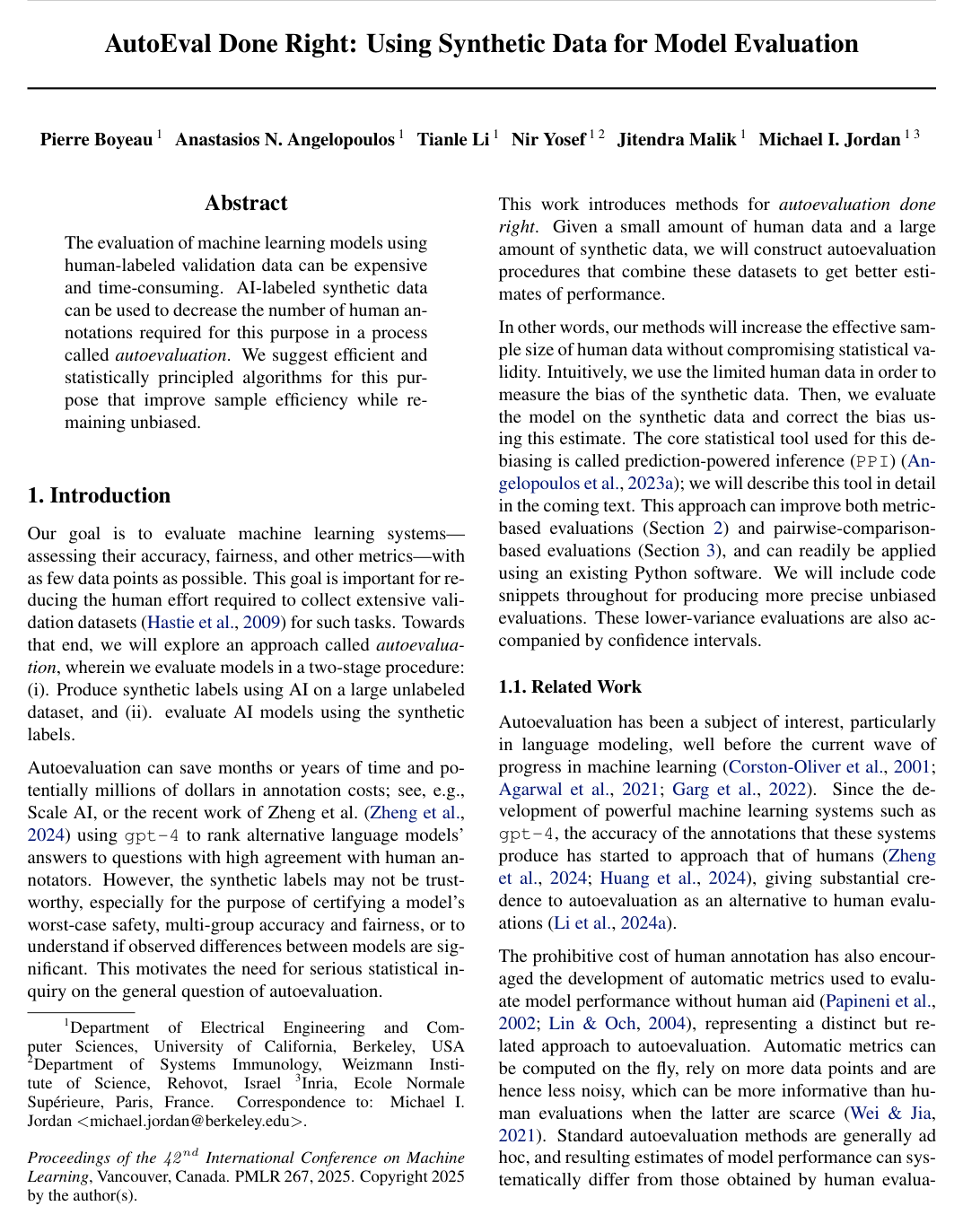
AutoEval Done Right: Using Synthetic Data for Model Evaluation
Pierre Boyeau, Anastasios Nikolas Angelopoulos, Tianle Li, Nir Yosef, Jitendra Malik, Michael I. Jordan
Why you should read this
Develops a statistically rigorous autoevaluation framework using prediction-powered inference to combine limited human annotations with abundant synthetic data, delivering unbiased model performance estimates and tight confidence intervals at a fraction of standard labeling costs.
The evaluation of machine learning models using human-labeled validation data can be expensive and time-consuming. AI-labeled synthetic data can be used to decrease the number of human annotations required for this purpose in a process called autoevaluation. We suggest efficient and statistically principled algorithms for this purpose that improve sample efficiency while remaining unbiased.
Added
2026-10-05
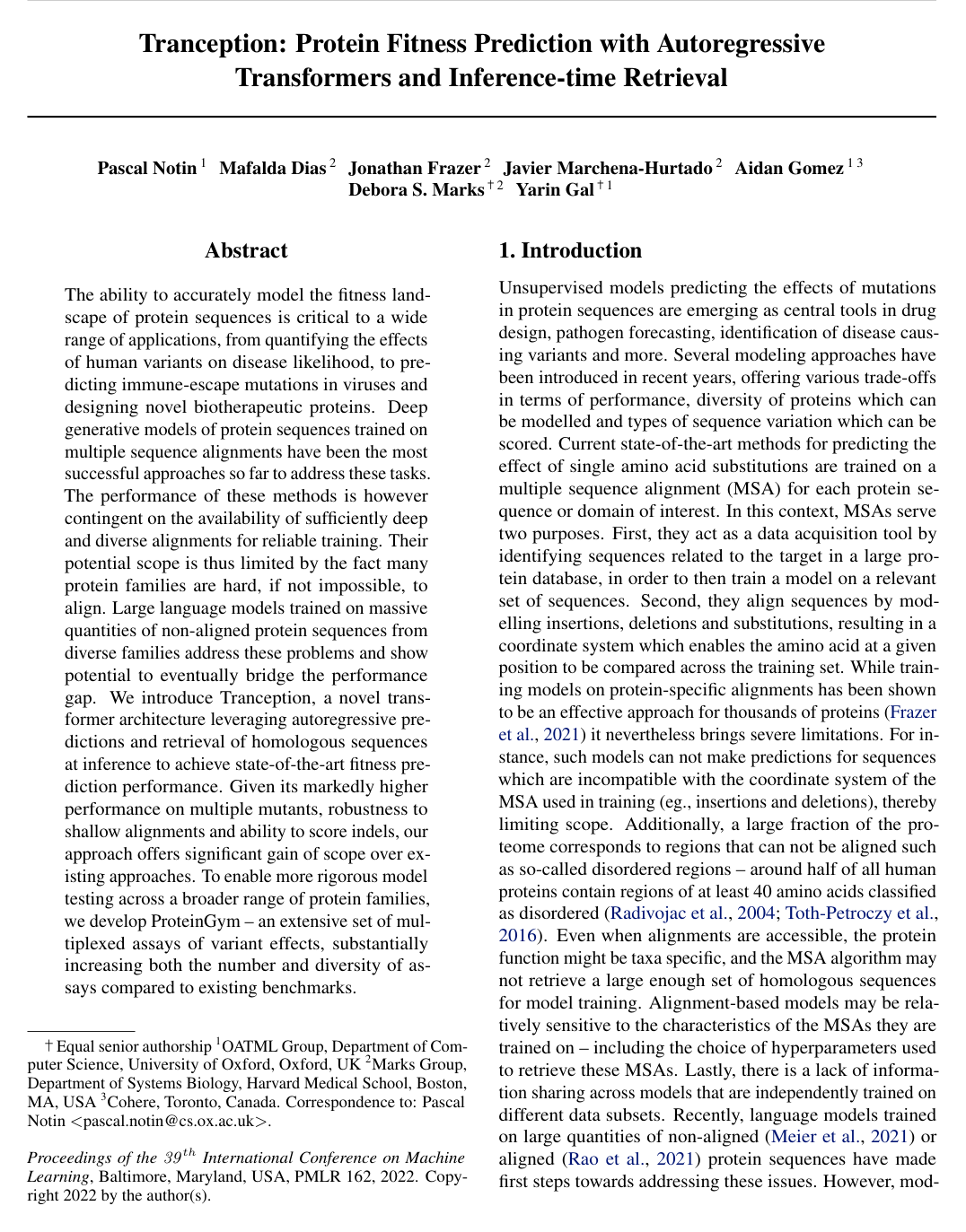
Tranception: Protein Fitness Prediction with Autoregressive Transformers and Inference-time Retrieval
Pascal Notin, Mafalda Dias, Jonathan Frazer, Javier Marchena-Hurtado, Aidan N. Gomez, Debora S. Marks, Yarin Gal
Why you should read this
Introduces an autoregressive transformer architecture that combines multi-scale attention with inference-time homology retrieval to score insertions, deletions, and complex substitutions across diverse protein families without requiring multiple sequence alignments during training.
The ability to accurately model the fitness landscape of protein sequences is critical to a wide range of applications, from quantifying the effects of human variants on disease likelihood, to predicting immune-escape mutations in viruses and designing novel biotherapeutic proteins. Deep generative models of protein sequences trained on multiple sequence alignments have been the most successful approaches so far to address these tasks. The performance of these methods is however contingent on the availability of sufficiently deep and diverse alignments for reliable training. Their potential scope is thus limited by the fact many protein families are hard, if not impossible, to align. Large language models trained on massive quantities of non-aligned protein sequences from diverse families address these problems and show potential to eventually bridge the performance gap. We introduce Tranception, a novel transformer architecture leveraging autoregressive predictions and retrieval of homologous sequences at inference to achieve state-of-the-art fitness prediction performance. Given its markedly higher performance on multiple mutants, robustness to shallow alignments and ability to score indels, our approach offers significant gain of scope over existing approaches. To enable more rigorous model testing across a broader range of protein families, we develop ProteinGym – an extensive set of multiplexed assays of variant effects, substantially increasing both the number and diversity of assays compared to existing benchmarks.
Added
2026-09-28
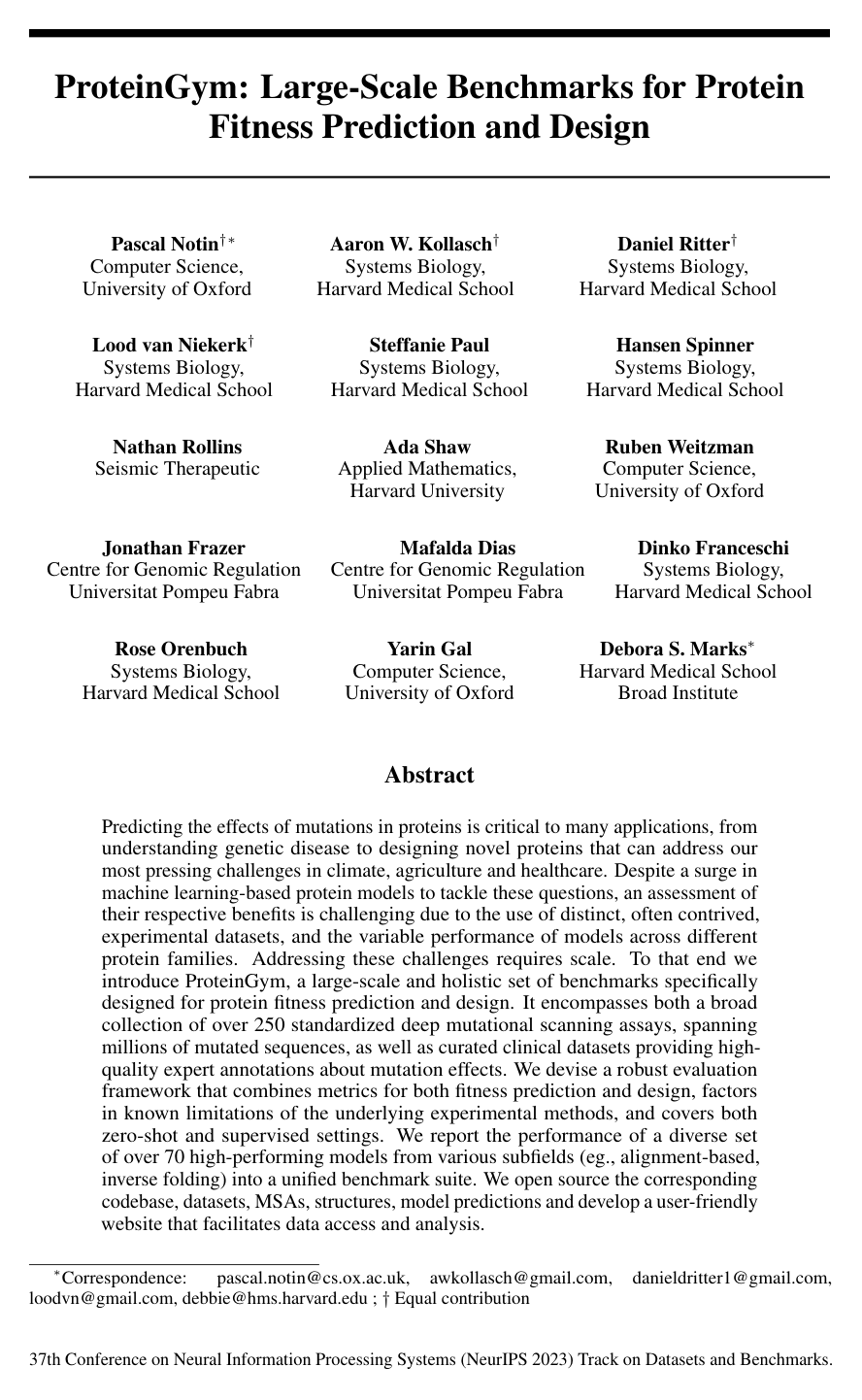
ProteinGym: Large-Scale Benchmarks for Protein Fitness Prediction and Design
Pascal Notin, Aaron Kollasch, Daniel Ritter, Lood van Niekerk, Steffanie Paul, Han Spinner, Nathan J. Rollins, Ada Shaw, Rose Orenbuch, Ruben Weitzman, Jonathan Frazer, Mafalda Dias, Dinko Franceschi, Yarin Gal, Debora S. Marks
Why you should read this
Establishes a standardized, large-scale benchmarking suite of over 250 deep mutational scanning assays and clinical datasets to systematically evaluate more than 70 machine learning models across zero-shot and supervised protein fitness prediction and design tasks.
Predicting the effects of mutations in proteins is critical to many applications, from understanding genetic disease to designing novel proteins that can address our most pressing challenges in climate, agriculture and healthcare. Despite a surge in machine learning-based protein models to tackle these questions, an assessment of their respective benefits is challenging due to the use of distinct, often contrived, experimental datasets, and the variable performance of models across different protein families. Addressing these challenges requires scale. To that end we introduce ProteinGym, a large-scale and holistic set of benchmarks specifically designed for protein fitness prediction and design. It encompasses both a broad collection of over 250 standardized deep mutational scanning assays, spanning millions of mutated sequences, as well as curated clinical datasets providing high-quality expert annotations about mutation effects. We devise a robust evaluation framework that combines metrics for both fitness prediction and design, factors in known limitations of the underlying experimental methods, and covers both zero-shot and supervised settings. We report the performance of a diverse set of over 70 high-performing models from various subfields (eg., alignment-based, inverse folding) into a unified benchmark suite. We open source the corresponding codebase, datasets, MSAs, structures, model predictions and develop a user-friendly website that facilitates data access and analysis.
Added
2026-09-26