
keyword
probability flow
A probability flow is a continuous, deterministic process that transports one probability distribution into another over time according to an ordinary differential equation. In continuous generative modeling and score-based diffusion frameworks, this flow describes a vector field whose deterministic trajectories trace out marginal distributions that precisely match those of a corresponding stochastic diffusion process. By learning and integrating the velocity field or score function driving the flow, generative models can map samples bidirectionally between a simple prior distribution, such as Gaussian noise, and a complex target data distribution. This formulation allows for invertible sampling, deterministic latent representations, and exact likelihood computation using numerical differential equation solvers and the continuous change-of-variables formula.
5 items
Normalizing Flows are Capable Generative Models
Shuangfei Zhai, Ruixiang Zhang, Preetum Nakkiran, David Berthelot, Jiatao Gu, Huangjie Zheng, Tianrong Chen, Miguel ngel Bautista, Navdeep Jaitly, Joshua M. Susskind
Why you should read this
Demonstrates that normalizing flows can rival diffusion models in image generation quality while achieving state-of-the-art exact likelihood estimation through a scalable Transformer-based architecture paired with noise augmentation and guidance.
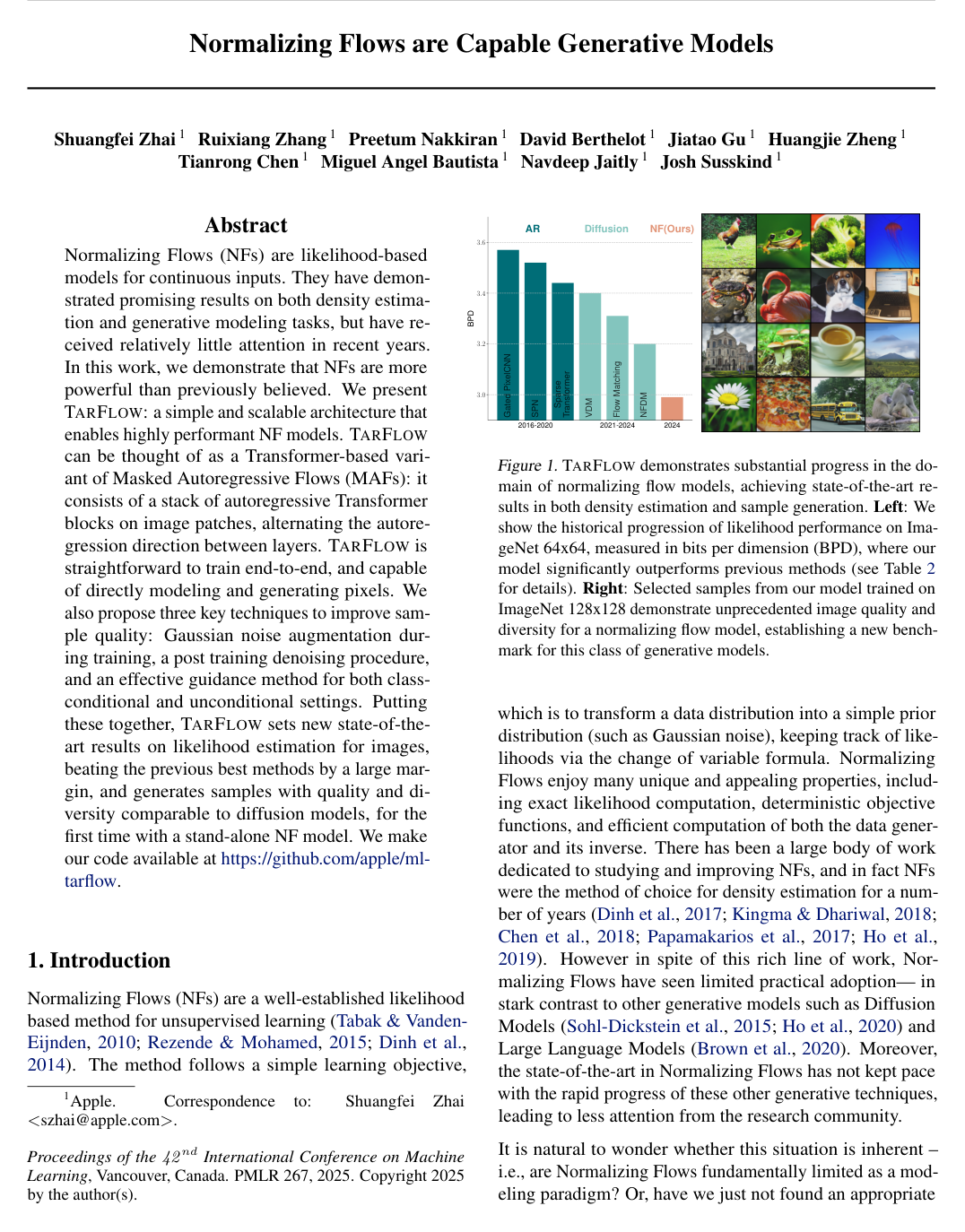
Normalizing Flows (NFs) are likelihood-based models for continuous inputs. They have demonstrated promising results on both density estimation and generative modeling tasks, but have received relatively little attention in recent years. In this work, we demonstrate that NFs are more powerful than previously believed. We present TARFLOW: a simple and scalable architecture that enables highly performant NF models. TARFLOW can be thought of as a Transformer-based variant of Masked Autoregressive Flows (MAFs): it consists of a stack of autoregressive Transformer blocks on image patches, alternating the autoregression direction between layers. TARFLOW is straightforward to train end-to-end, and capable of directly modeling and generating pixels. We also propose three key techniques to improve sample quality: Gaussian noise augmentation during training, a post training denoising procedure, and an effective guidance method for both class-conditional and unconditional settings. Putting these together, TARFLOW sets new state-of-the-art results on likelihood estimation for images, beating the previous best methods by a large margin, and generates samples with quality and diversity comparable to diffusion models, for the first time with a stand-alone NF model. We make our code available at https://github.com/apple/ml-tarflow.
Added
2026-09-26
Thinking with Looped Flows
Ayhan Suleymanzade, Chanhyuk Lee, Floor Eijkelboom, Nicholas M. Boffi, İsmail İlkan Ceylan, Jinwoo Kim
Why you should read this
Introduces looped flows, a framework that trains recurrent architectures through progressive denoising objectives to overcome gradient truncation, enabling dynamic test-time compute scaling via probability flow integration and achieving leading accuracy on ARC-AGI reasoning benchmarks.
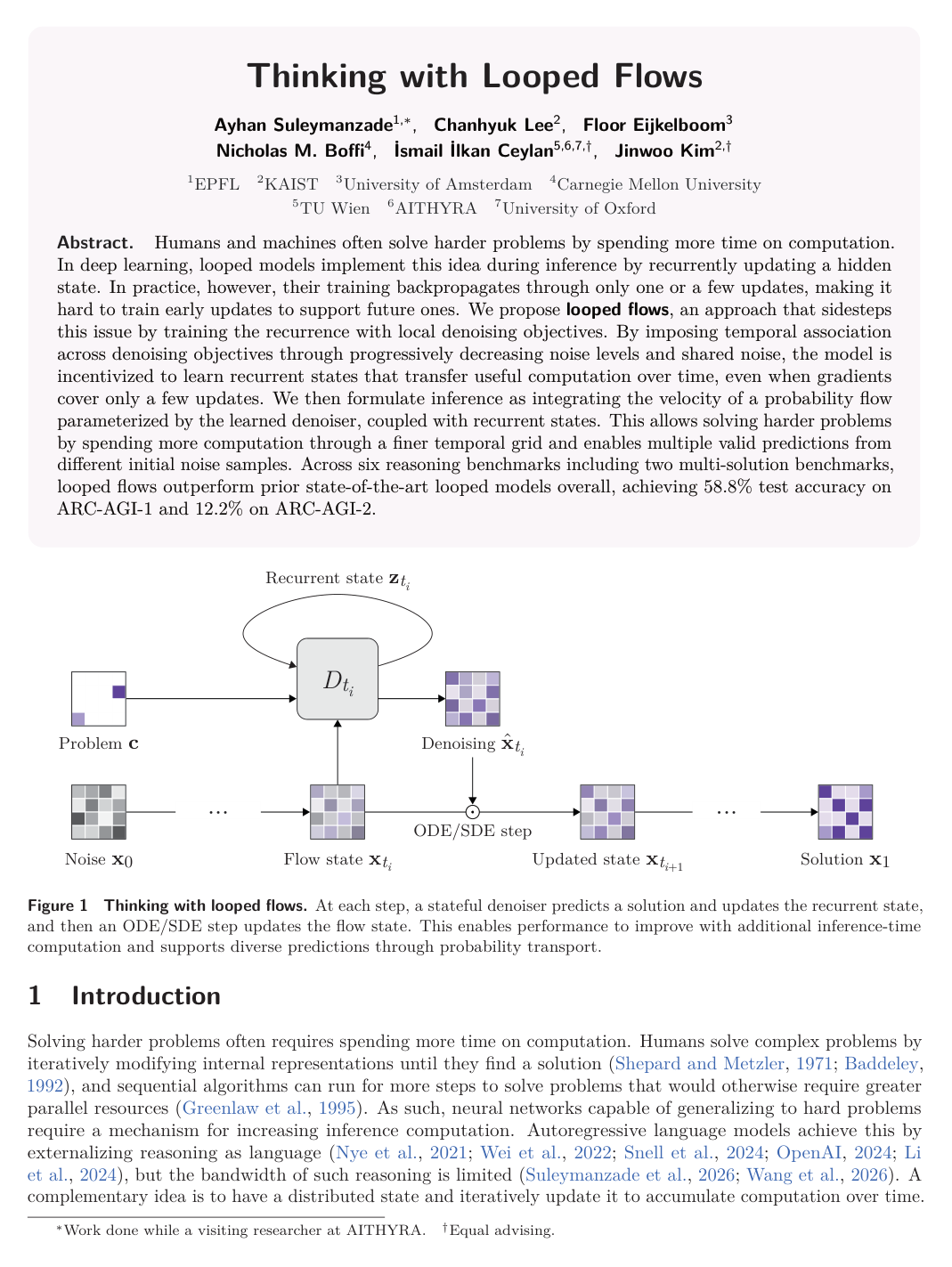
Humans and machines often solve harder problems by spending more time on computation. In deep learning, looped models implement this idea during inference by recurrently updating a hidden state. In practice, however, their training backpropagates through only one or a few updates, making it hard to train early updates to support future ones. We propose looped flows, an approach that sidesteps this issue by training the recurrence with local denoising objectives. By imposing temporal association across denoising objectives through progressively decreasing noise levels and shared noise, the model is incentivized to learn recurrent states that transfer useful computation over time, even when gradients cover only a few updates. We then formulate inference as integrating the velocity of a probability flow parameterized by the learned denoiser, coupled with recurrent states. This allows solving harder problems by spending more computation through a finer temporal grid and enables multiple valid predictions from different initial noise samples. Across six reasoning benchmarks including two multi-solution benchmarks, looped flows outperform prior state-of-the-art looped models overall, achieving 58.8% test accuracy on ARC-AGI-1 and 12.2% on ARC-AGI-2.
Added
2026-09-13

Flow Matching for Generative Modeling
Yaron Lipman, Ricky T. Q. Chen, Heli Ben-Hamu, Maximilian Nickel, Matt Le
Why you should read this
Generalizes diffusion into a Continuous Normalizing Flow (CNF) framework trained with a simulation-free objective.
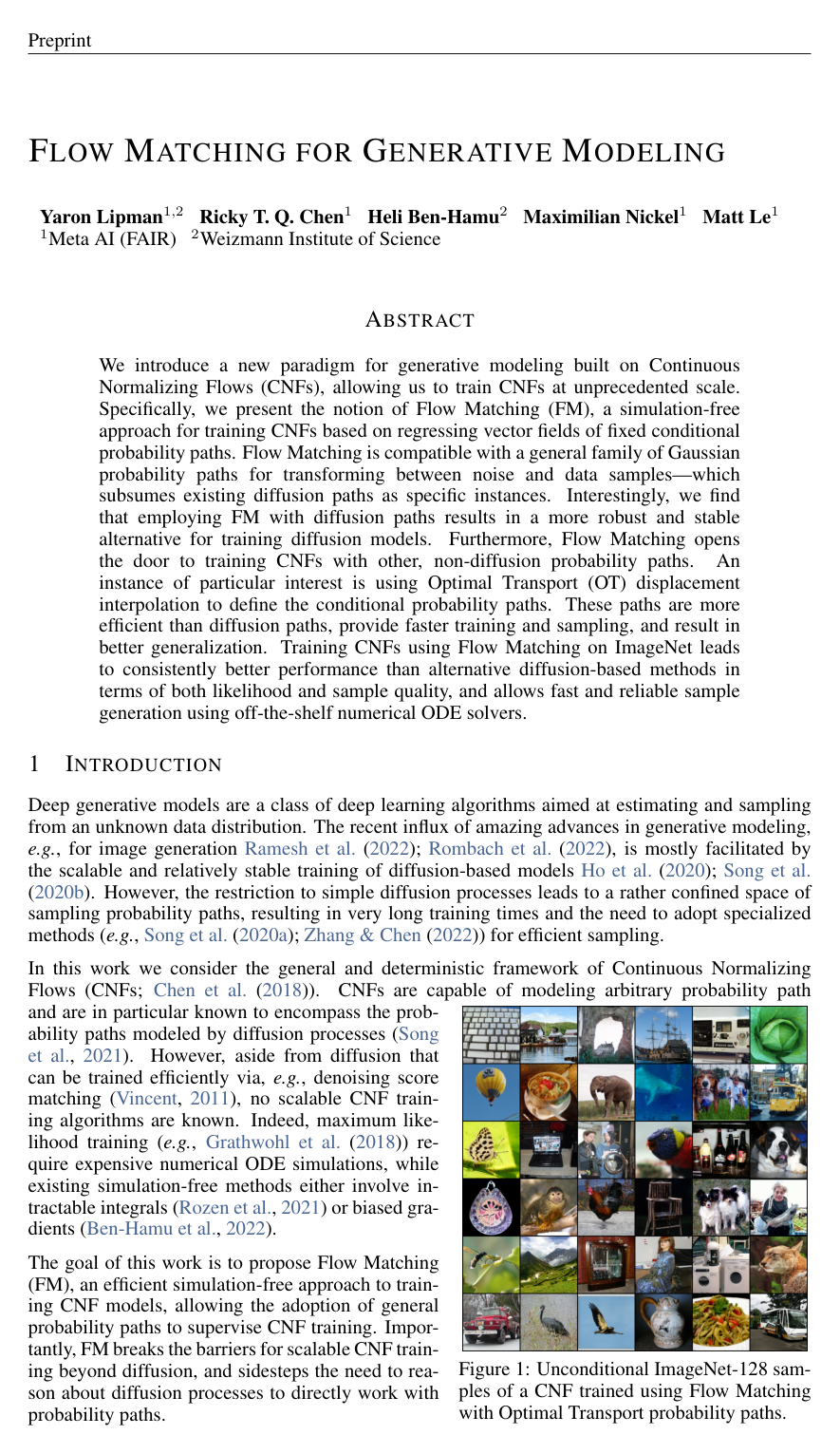
We introduce a new paradigm for generative modeling built on Continuous Normalizing Flows (CNFs), allowing us to train CNFs at unprecedented scale. Specifically, we present the notion of Flow Matching (FM), a simulation-free approach for training CNFs based on regressing vector fields of fixed conditional probability paths. Flow Matching is compatible with a general family of Gaussian probability paths for transforming between noise and data samples -- which subsumes existing diffusion paths as specific instances. Interestingly, we find that employing FM with diffusion paths results in a more robust and stable alternative for training diffusion models. Furthermore, Flow Matching opens the door to training CNFs with other, non-diffusion probability paths. An instance of particular interest is using Optimal Transport (OT) displacement interpolation to define the conditional probability paths. These paths are more efficient than diffusion paths, provide faster training and sampling, and result in better generalization. Training CNFs using Flow Matching on ImageNet leads to consistently better performance than alternative diffusion-based methods in terms of both likelihood and sample quality, and allows fast and reliable sample generation using off-the-shelf numerical ODE solvers.
Added
2026-02-25
Flow Straight and Fast: Learning to Generate and Transfer Data with Rectified Flow
Xingchao Liu, Chengyue Gong, Qiang Liu
Why you should read this
Introduces a "reflow" procedure to straighten the probability flow trajectories, allowing for perfect transmission between distributions with minimal steps.
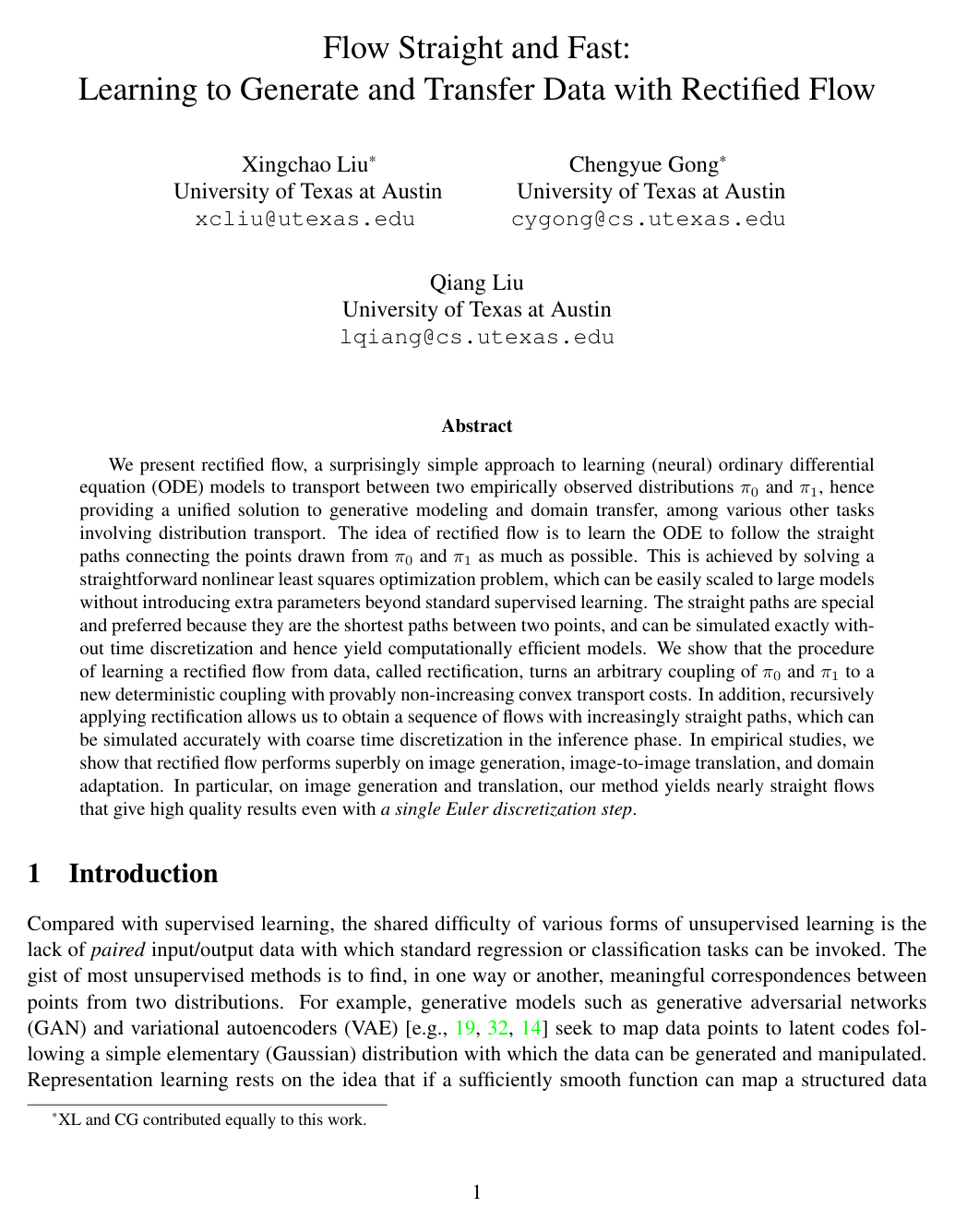
We present rectified flow, a surprisingly simple approach to learning (neural) ordinary differential equation (ODE) models to transport between two empirically observed distributions π_0 and π_1, hence providing a unified solution to generative modeling and domain transfer, among various other tasks involving distribution transport. The idea of rectified flow is to learn the ODE to follow the straight paths connecting the points drawn from π_0 and π_1 as much as possible. This is achieved by solving a straightforward nonlinear least squares optimization problem, which can be easily scaled to large models without introducing extra parameters beyond standard supervised learning. The straight paths are special and preferred because they are the shortest paths between two points, and can be simulated exactly without time discretization and hence yield computationally efficient models. We show that the procedure of learning a rectified flow from data, called rectification, turns an arbitrary coupling of π_0 and π_1 to a new deterministic coupling with provably non-increasing convex transport costs. In addition, recursively applying rectification allows us to obtain a sequence of flows with increasingly straight paths, which can be simulated accurately with coarse time discretization in the inference phase. In empirical studies, we show that rectified flow performs superbly on image generation, image-to-image translation, and domain adaptation. In particular, on image generation and translation, our method yields nearly straight flows that give high quality results even with a single Euler discretization step.
Added
2026-02-25
Elucidating the Design Space of Diffusion-Based Generative Models
Tero Karras, Miika Aittala, Timo Aila, Samuli Laine
Why you should read this
Dissects the components of diffusion models (noise schedules, preconditioning, sampling) to purely empirical principles, creating a standardized "best practice" framework.
We argue that the theory and practice of diffusion-based generative models are currently unnecessarily convoluted and seek to remedy the situation by presenting a design space that clearly separates the concrete design choices. This lets us identify several changes to both the sampling and training processes, as well as preconditioning of the score networks. Together, our improvements yield new state-of-the-art FID of 1.79 for CIFAR-10 in a class-conditional setting and 1.97 in an unconditional setting, with much faster sampling (35 network evaluations per image) than prior designs. To further demonstrate their modular nature, we show that our design changes dramatically improve both the efficiency and quality obtainable with pre-trained score networks from previous work, including improving the FID of a previously trained ImageNet-64 model from 2.07 to near-SOTA 1.55, and after re-training with our proposed improvements to a new SOTA of 1.36.
Added
2026-02-21