
keyword
probabilistic matrix factorization
Probabilistic matrix factorization is a collaborative filtering method used in recommender systems to predict unknown user preferences by modeling user-item interactions through low-dimensional latent factor representations within a probabilistic framework. In this approach, observed entries in a sparse rating matrix are modeled as continuous variables drawn from a Gaussian distribution centered on the inner product of corresponding user and item latent feature vectors. Prior distributions, typically zero-mean spherical Gaussians, are placed over the latent factors to provide natural regularization and prevent overfitting on sparse data. Model training is commonly performed by maximizing the log-posterior probability over the observed interactions, allowing the optimization to scale linearly with the number of observed ratings. This probabilistic foundation also provides flexibility to integrate additional contextual information, such as social connections or item content features, to enhance recommendation accuracy.
5 items
SoRec: social recommendation using probabilistic matrix factorization
Hao Ma, Haixuan Yang, Michael R. Lyu, Irwin King
Why you should read this
Proposes a scalable probabilistic matrix factorization framework that fuses user social network relations with rating matrices to improve recommendation accuracy for users with sparse or missing feedback.
Data sparsity, scalability and prediction quality have been recognized as the three most crucial challenges that every collaborative filtering algorithm or recommender system confronts. Many existing approaches to recommender systems can neither handle very large datasets nor easily deal with users who have made very few ratings or even none at all. Moreover, traditional recommender systems assume that all the users are independent and identically distributed; this assumption ignores the social interactions or connections among users. In view of the exponential growth of information generated by online social networks, social network analysis is becoming important for many Web applications. Following the intuition that a person's social network will affect personal behaviors on the Web, this paper proposes a factor analysis approach based on probabilistic matrix factorization to solve the data sparsity and poor prediction accuracy problems by employing both users' social network information and rating records. The complexity analysis indicates that our approach can be applied to very large datasets since it scales linearly with the number of observations, while the experimental results shows that our method performs much better than the state-of-the-art approaches, especially in the circumstance that users have made few or no ratings.
Added
2026-09-24
Recommender systems with social regularization
Hao Ma, Dengyong Zhou, Chao Liu, Michael R. Lyu, Irwin King
Why you should read this
Proposes a matrix factorization framework that incorporates social network constraints and friend taste diversity as regularizers to improve recommendation accuracy over standard collaborative filtering.
Although Recommender Systems have been comprehensively analyzed in the past decade, the study of social-based recommender systems just started. In this paper, aiming at providing a general method for improving recommender systems by incorporating social network information, we propose a matrix factorization framework with social regularization. The contributions of this paper are four-fold: (1) We elaborate how social network information can benefit recommender systems; (2) We interpret the differences between social-based recommender systems and trust-aware recommender systems; (3) We coin the term Social Regularization to represent the social constraints on recommender systems, and we systematically illustrate how to design a matrix factorization objective function with social regularization; and (4) The proposed method is quite general, which can be easily extended to incorporate other contextual information, like social tags, etc. The empirical analysis on two large datasets demonstrates that our approaches outperform other state-of-the-art methods.
Added
2026-09-24
Collaborative topic modeling for recommending scientific articles
Chong Wang, D. Blei
Why you should read this
Proposes collaborative topic regression to integrate matrix factorization with topic modeling, enabling recommender systems to accurately suggest both established and newly published scientific articles while producing interpretable user and item representations.
Researchers have access to large online archives of scientific articles. As a consequence, finding relevant papers has become more difficult. Newly formed online communities of researchers sharing citations provides a new way to solve this problem. In this paper, we develop an algorithm to recommend scientific articles to users of an online community. Our approach combines the merits of traditional collaborative filtering and probabilistic topic modeling. It provides an interpretable latent structure for users and items, and can form recommendations about both existing and newly published articles. We study a large subset of data from CiteULike, a bibliography sharing service, and show that our algorithm provides a more effective recommender system than traditional collaborative filtering.
Added
2026-09-24
Graph Neural Networks for Social Recommendation
Wenqi Fan, Yao Ma, Qing Li, Yuan He, Eric Zhao, Jiliang Tang, Dawei Yin
Why you should read this
Develops GraphRec, a graph neural network framework that captures user-item interactions, rating opinions, and social ties with varying relationship strengths to improve social recommendation accuracy.
In recent years, Graph Neural Networks (GNNs), which can naturally integrate node information and topological structure, have been demonstrated to be powerful in learning on graph data. These advantages of GNNs provide great potential to advance social recommendation since data in social recommender systems can be represented as user-user social graph and user-item graph; and learning latent factors of users and items is the key. However, building social recommender systems based on GNNs faces challenges. For example, the user-item graph encodes both interactions and their associated opinions; social relations have heterogeneous strengths; users involve in two graphs (e.g., the user-user social graph and the user-item graph). To address the three aforementioned challenges simultaneously, in this paper, we present a novel graph neural network framework (GraphRec) for social recommendations. In particular, we provide a principled approach to jointly capture interactions and opinions in the user-item graph and propose the framework GraphRec, which coherently models two graphs and heterogeneous strengths. Extensive experiments on two real-world datasets demonstrate the effectiveness of the proposed framework GraphRec. Our code is available at \url{this https URL}
Added
2026-09-14
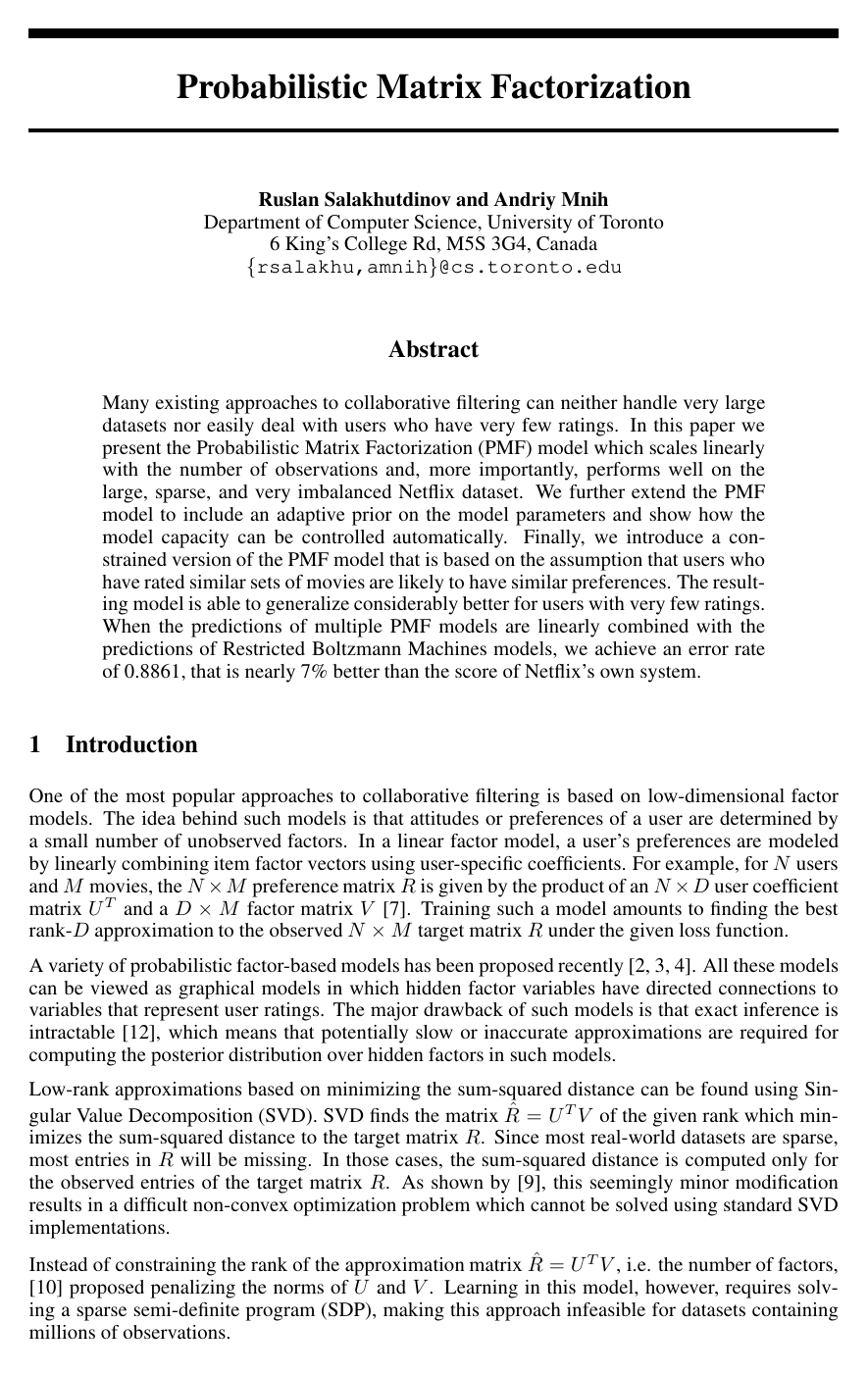
Probabilistic Matrix Factorization
Andriy Mnih, Russ R. Salakhutdinov
Why you should read this
Presents the Probabilistic Matrix Factorization (PMF) model, which offers scalable and high-performing collaborative filtering, significantly outperforming prior methods on the large and sparse Netflix dataset.
Many existing approaches to collaborative filtering can neither handle very large datasets nor easily deal with users who have very few ratings. In this paper we present the Probabilistic Matrix Factorization (PMF) model which scales linearly with the number of observations and, more importantly, performs well on the large, sparse, and very imbalanced Netflix dataset. We further extend the PMF model to include an adaptive prior on the model parameters and show how the model capacity can be controlled automatically. Finally, we introduce a con- strained version of the PMF model that is based on the assumption that users who have rated similar sets of movies are likely to have similar preferences. The result- ing model is able to generalize considerably better for users with very few ratings. When the predictions of multiple PMF models are linearly combined with the predictions of Restricted Boltzmann Machines models, we achieve an error rate of 0.8861, that is nearly 7% better than the score of Netflix’s own system.
Added
2026-01-25
