
Built independently by an author, for readers. Read the story and support ChapterPal

keyword

probabilistic classifier

A probabilistic classifier is a machine learning model that predicts a probability distribution over a set of classes for a given input, rather than outputting only a discrete class label. This output quantifies the degree of certainty or likelihood associated with each potential category, allowing the final classification to be made by selecting the category with the highest predicted probability. In contrast to deterministic classifiers that yield fixed decision boundaries, probabilistic classifiers provide continuous confidence estimates that can be adapted to varying decision thresholds, risk assessments, and cost-sensitive scenarios. Standard examples include logistic regression and naive Bayes classifiers, which estimate conditional class probabilities either directly or through the application of probability theory.

1 item
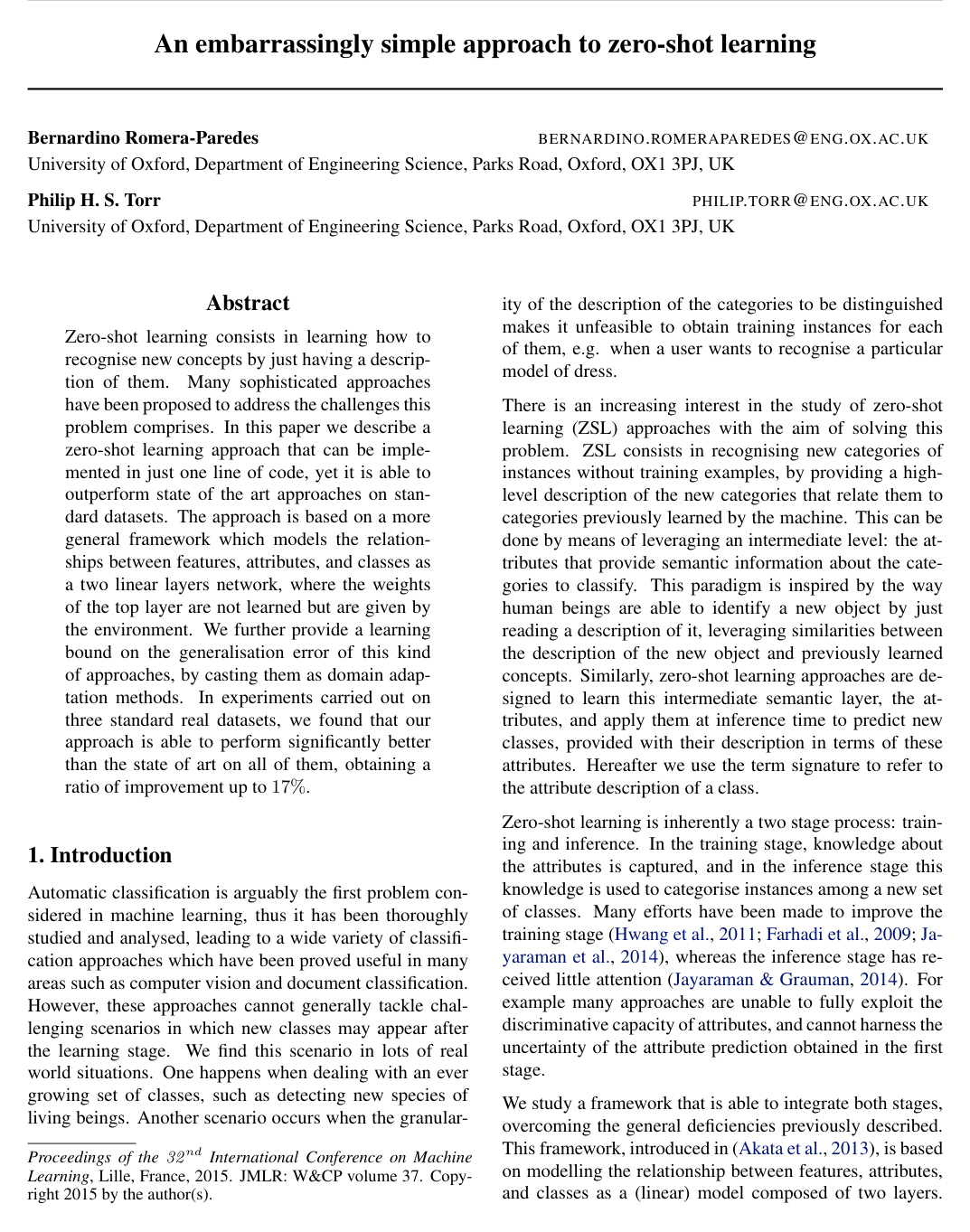
An embarrassingly simple approach to zero-shot learning

An embarrassingly simple approach to zero-shot learning

Bernardino Romera-Paredes, Philip H. S. Torr

OrganizationsUniversity of Oxford

Why you should read this

Proposes a two-layer linear framework for zero-shot learning that is implementable in a single line of code, establishes theoretical generalization bounds through domain adaptation, and surpasses complex state-of-the-art methods across standard benchmarks by up to 17%.

Zero-shot learning consists in learning how to recognise new concepts by just having a description of them. Many sophisticated approaches have been proposed to address the challenges this problem comprises. In this paper we describe a zero-shot learning approach that can be implemented in just one line of code, yet it is able to outperform state of the art approaches on standard datasets. The approach is based on a more general framework which models the relationships between features, attributes, and classes as a two linear layers network, where the weights of the top layer are not learned but are given by the environment. We further provide a learning bound on the generalisation error of this kind of approaches, by casting them as domain adaptation methods. In experiments carried out on three standard real datasets, we found that our approach is able to perform significantly better than the state of art on all of them, obtaining a ratio of improvement up to 17%.

Added

2026-09-25