
keyword
private mean estimation
Private mean estimation is the statistical task of computing or approximating the average value of a dataset or an underlying probability distribution while satisfying rigorous privacy guarantees, most commonly differential privacy. In this framework, an estimation algorithm introduces controlled randomness, such as through data clipping and calibrated noise perturbation, to ensure that the published mean reveals minimal information about any single constituent data point. The problem can be formulated in centralized settings, where a data collector applies privacy mechanisms to an aggregated dataset, or in local settings, where individual participants perturb their own measurements prior to sharing. The objective of private mean estimation is to minimize the error or variance of the estimated mean while maintaining provable mathematical bounds on individual data privacy, even when data is high-dimensional or drawn from heavy-tailed distributions.
3 items
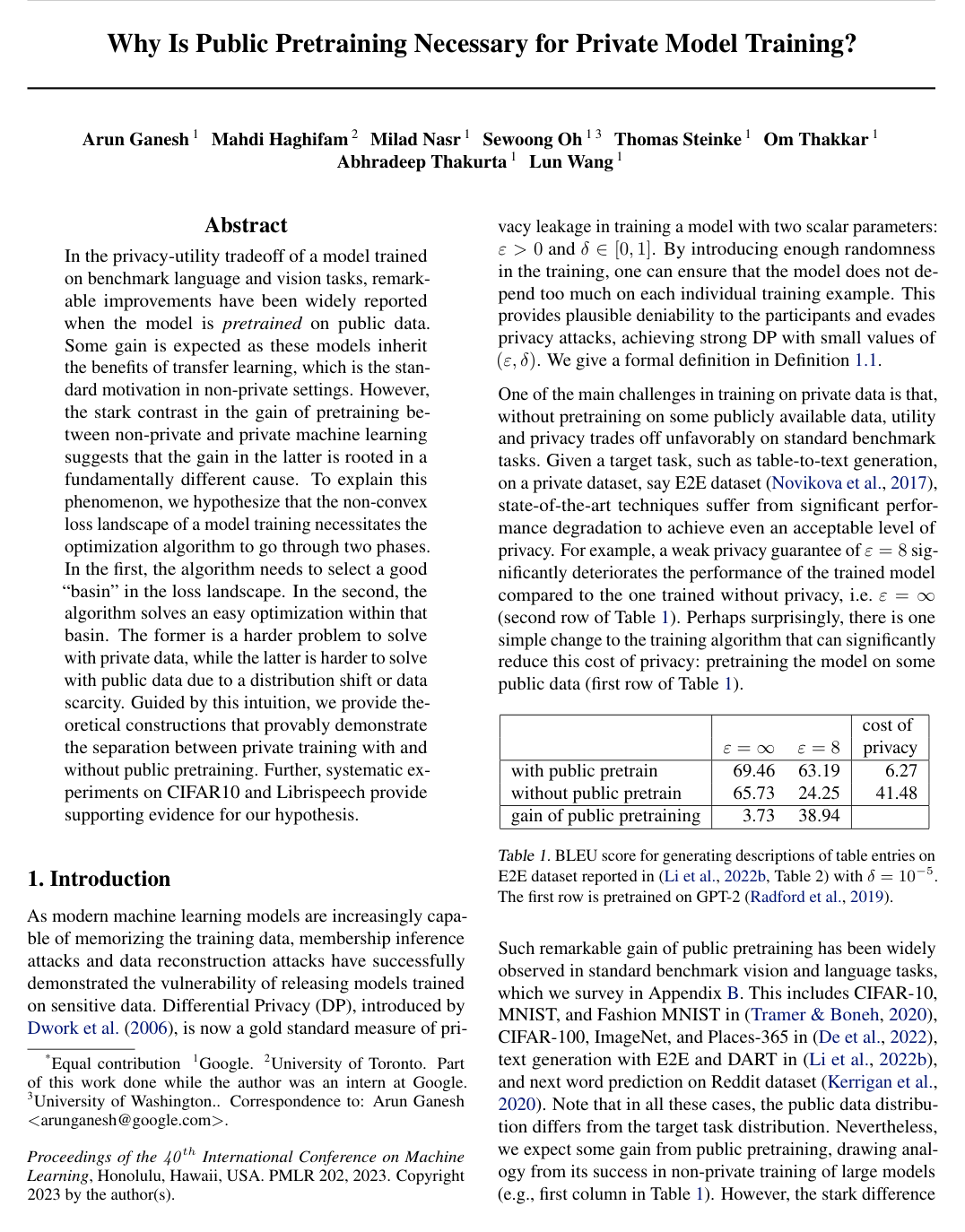
Why Is Public Pretraining Necessary for Private Model Training?
Arun Ganesh, Mahdi Haghifam, Milad Nasr, Sewoong Oh, Thomas Steinke, Om Thakkar, Abhradeep Guha Thakurta, Lun Wang
Why you should read this
Explains why public pretraining is essential for differentially private learning by theoretically proving and empirically demonstrating that noiseless early optimization is required to select viable basins before fine-tuning on sensitive data.
In the privacy-utility tradeoff of a model trained on benchmark language and vision tasks, remarkable improvements have been widely reported when the model is pretrained on public data. Some gain is expected as these models inherit the benefits of transfer learning, which is the standard motivation in non-private settings. However, the stark contrast in the gain of pretraining between non-private and private machine learning suggests that the gain in the latter is rooted in a fundamentally different cause. To explain this phenomenon, we hypothesize that the non-convex loss landscape of a model training necessitates the optimization algorithm to go through two phases. In the first, the algorithm needs to select a good “basin” in the loss landscape. In the second, the algorithm solves an easy optimization within that basin. The former is a harder problem to solve with private data, while the latter is harder to solve with public data due to a distribution shift or data scarcity. Guided by this intuition, we provide theoretical constructions that provably demonstrate the separation between private training with and without public pretraining. Further, systematic experiments on CIFAR10 and Librispeech provide supporting evidence for our hypothesis.
Added
2026-10-04
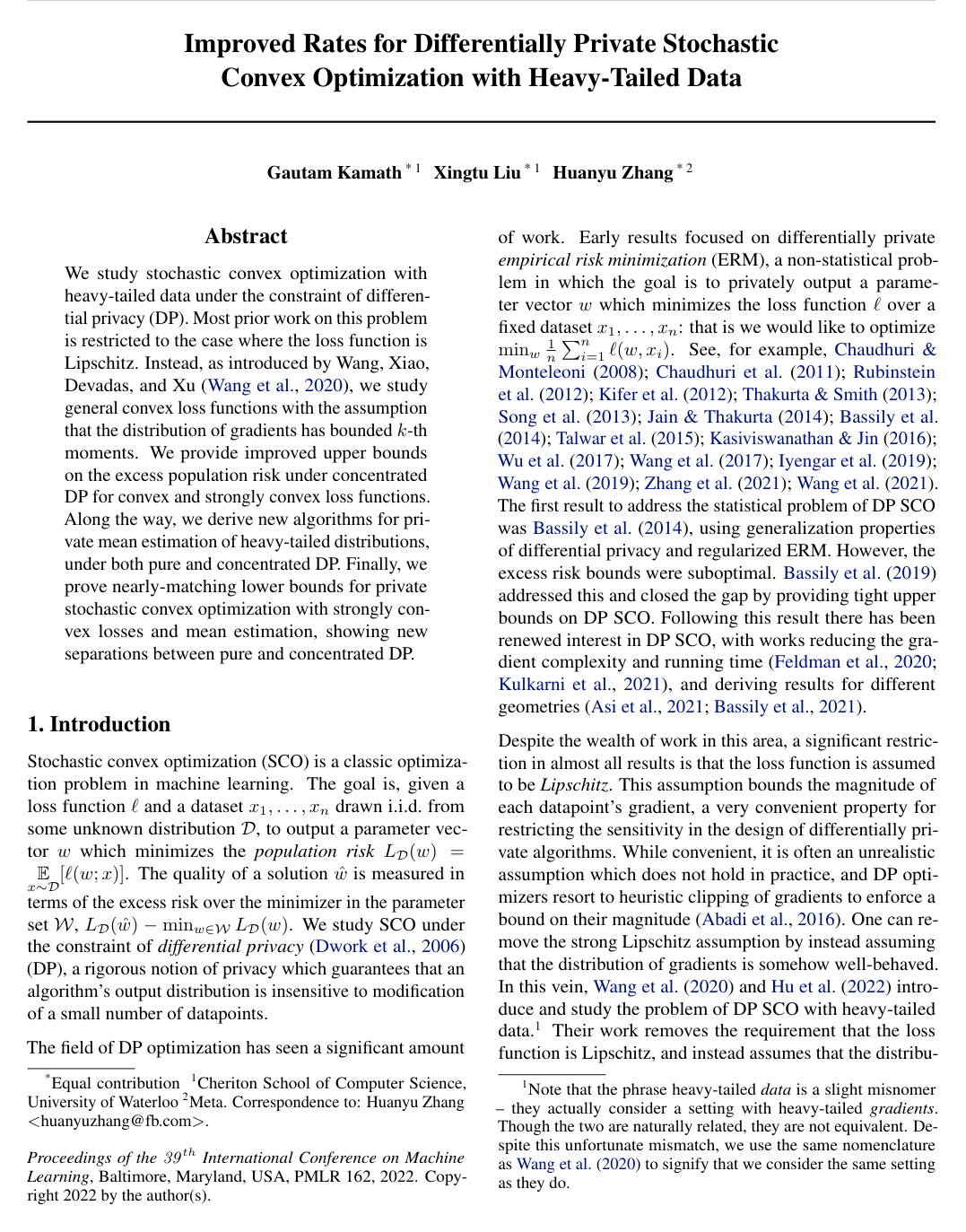
Improved Rates for Differentially Private Stochastic Convex Optimization with Heavy-Tailed Data
Gautam Kamath, Xingtu Liu, Huanyu Zhang
Why you should read this
Establishes improved excess population risk upper bounds and nearly matching lower bounds for differentially private stochastic convex optimization with heavy-tailed gradients under concentrated differential privacy.
We study differentially private stochastic convex optimization (DP-SCO) under heavy-tailed gradient noise, a setting where the gradients have bounded variance but may have unbounded higher moments. We provide improved rates for DP-SCO in this setting, both in the population and empirical risk minimization problems. Our rates are based on a new clipping strategy that adapts to the gradient variance, and a new analysis of the stability of the clipped gradient descent. Our results improve upon the state-of-the-art rates in several regimes, and are optimal in some cases.
Added
2026-10-03
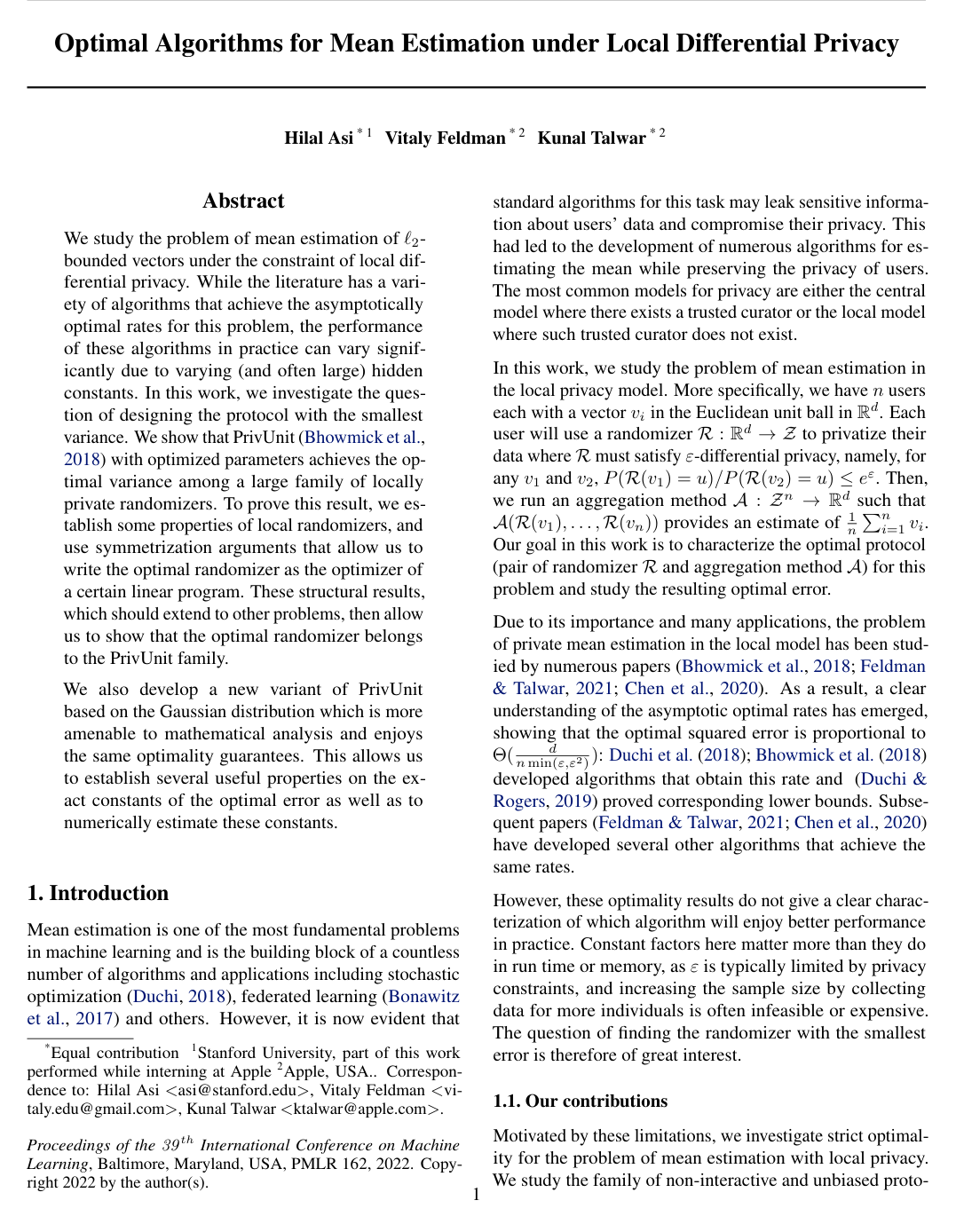
Optimal Algorithms for Mean Estimation under Local Differential Privacy
Hilal Asi, Vitaly Feldman, Kunal Talwar
Why you should read this
Proves that the PrivUnit algorithm achieves optimal variance for unbiased locally differentially private mean estimation and introduces a Gaussian-based variant, PrivUnitG, that enables dimension-independent parameter optimization and precise error analysis.
We study the problem of mean estimation of ℓ2-bounded vectors under the constraint of local differential privacy. While the literature has a variety of algorithms that achieve the asymptotically optimal rates for this problem, the performance of these algorithms in practice can vary significantly due to varying (and often large) hidden constants. In this work, we investigate the question of designing the protocol with the smallest variance. We show that PrivUnit (Bhowmick et al., 2018) with optimized parameters achieves the optimal variance among a large family of locally private randomizers. To prove this result, we establish some properties of local randomizers, and use symmetrization arguments that allow us to write the optimal randomizer as the optimizer of a certain linear program. These structural results, which should extend to other problems, then allow us to show that the optimal randomizer belongs to the PrivUnit family. We also develop a new variant of PrivUnit based on the Gaussian distribution which is more amenable to mathematical analysis and enjoys the same optimality guarantees. This allows us to establish several useful properties on the exact constants of the optimal error as well as to numerically estimate these constants.
Added
2026-09-26