
keyword
privacy protection
Privacy protection refers to the practices, technical measures, and policies designed to safeguard personal data and individual confidentiality from unauthorized access, exposure, retention, or misuse. In computing, data processing, and machine learning, privacy protection involves employing mechanisms such as data obfuscation, anonymization, encryption, access controls, and retention-minimizing algorithms to ensure that sensitive information and personally identifiable features are not inappropriately stored, shared, or reconstructed during analytical tasks. By mitigating the risks of identity disclosure and data breaches, privacy protection enables systems to utilize information, train computational models, and distribute datasets while upholding the confidentiality and legal rights of data subjects.
2 items
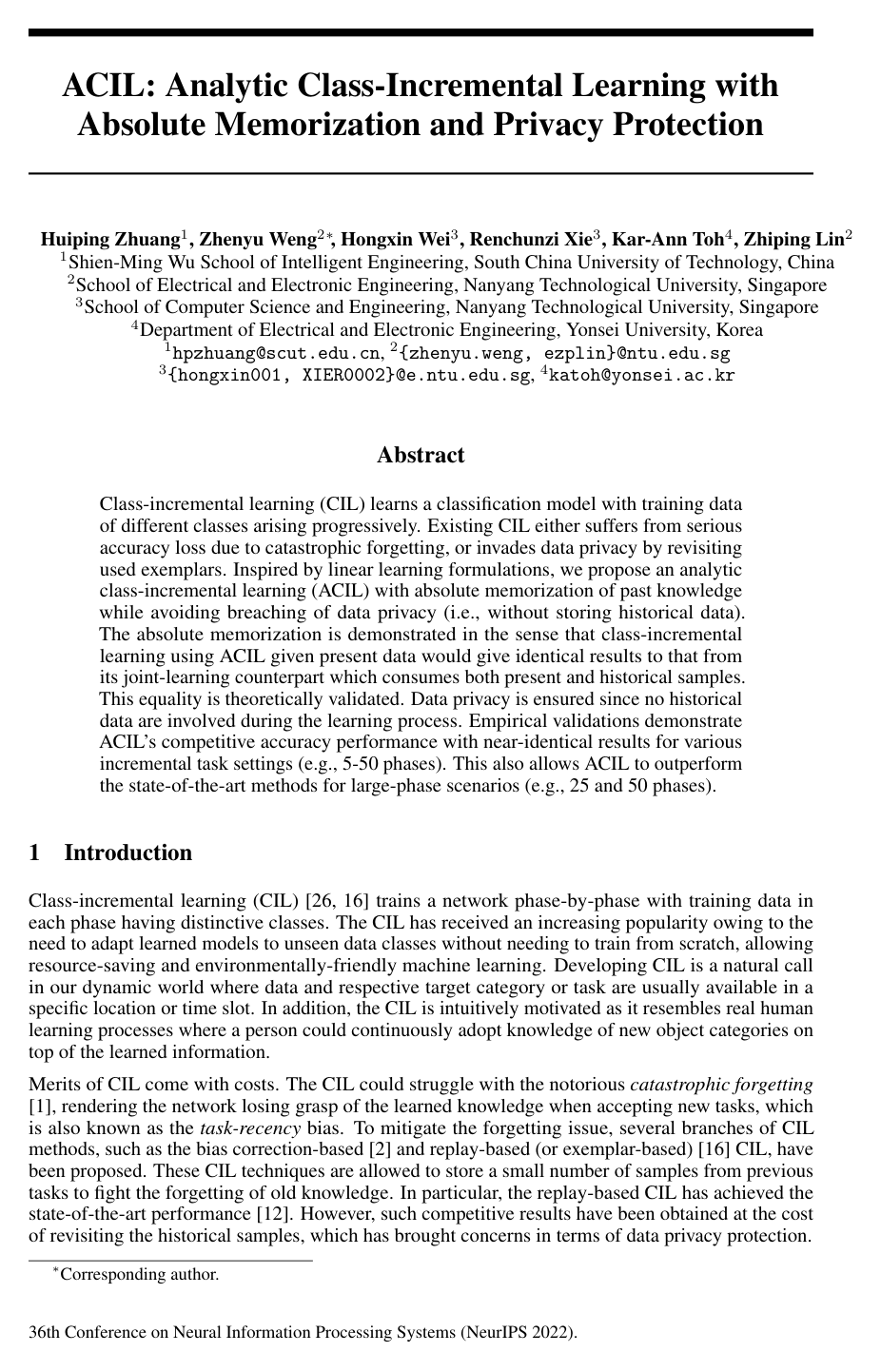
ACIL: Analytic Class-Incremental Learning with Absolute Memorization and Privacy Protection
Huiping Zhuang, Zhenyu Weng, Hongxin Wei, Renchunzi Xie, Kar-Ann Toh, Zhiping Lin
Why you should read this
Proposes an analytic class-incremental learning framework that mathematically matches the performance of joint training without storing historical exemplar data, eliminating catastrophic forgetting while protecting data privacy across multi-phase learning tasks.
Class-incremental learning (CIL) learns a classification model with training data of different classes arising progressively. Existing CIL either suffers from serious accuracy loss due to catastrophic forgetting, or invades data privacy by revisiting used exemplars. Inspired by linear learning formulations, we propose an analytic class-incremental learning (ACIL) with absolute memorization of past knowledge while avoiding breaching of data privacy (i.e., without storing historical data). The absolute memorization is demonstrated in the sense that class-incremental learning using ACIL given present data would give identical results to that from its joint-learning counterpart which consumes both present and historical samples. This equality is theoretically validated. Data privacy is ensured since no historical data are involved during the learning process. Empirical validations demonstrate ACIL's competitive accuracy performance with near-identical results for various incremental task settings (e.g., 5-50 phases). This also allows ACIL to outperform the state-of-the-art methods for large-phase scenarios (e.g., 25 and 50 phases).
Added
2026-09-26
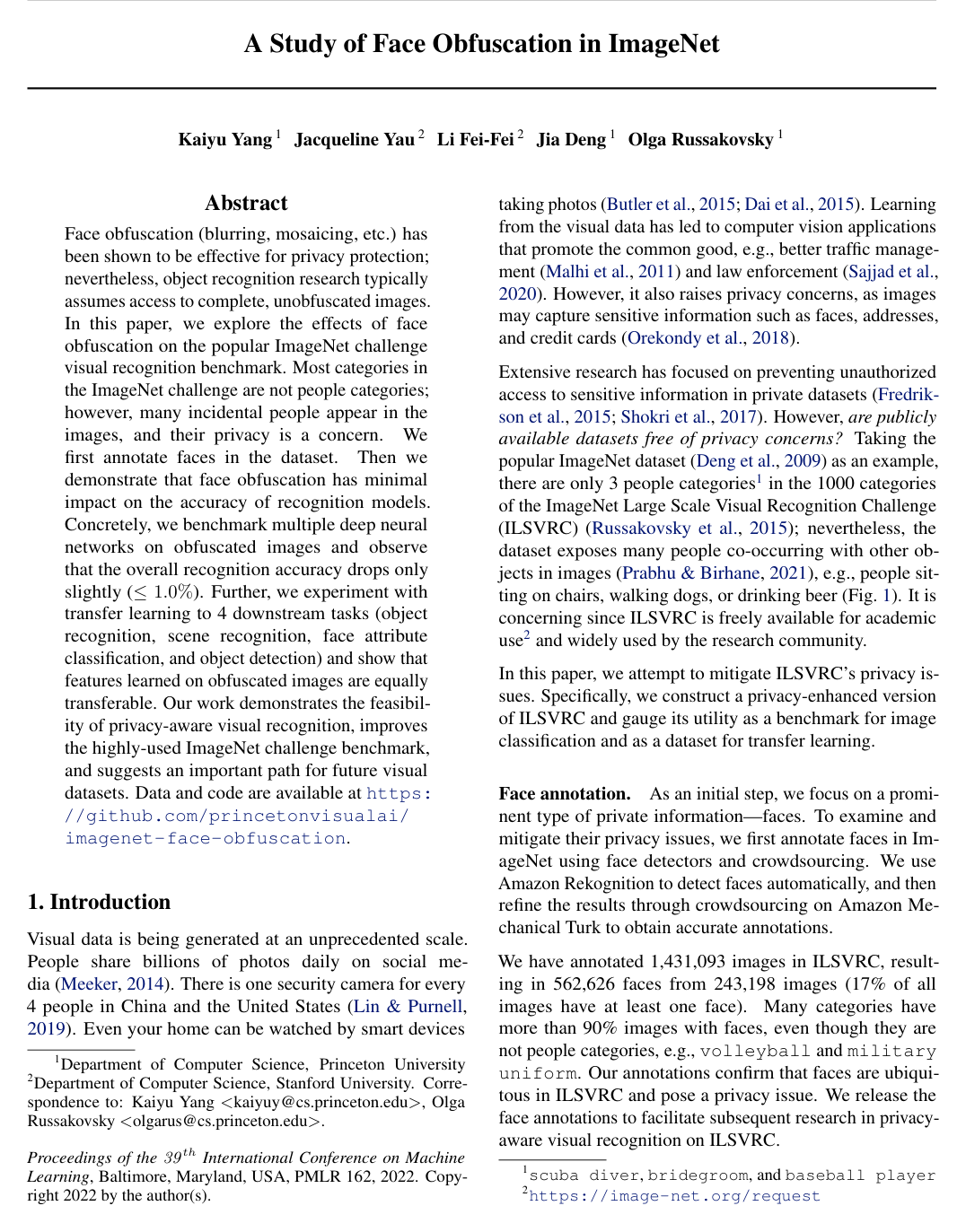
A Study of Face Obfuscation in ImageNet
Kaiyu Yang, Jacqueline H. Yau, Li Fei-Fei, Jia Deng, Olga Russakovsky
Why you should read this
Demonstrates that obfuscating incidental human faces in ImageNet protects individual privacy with virtually no drop in classification accuracy or downstream feature transferability.
Face obfuscation (blurring, mosaicing, etc.) has been shown to be effective for privacy protection; nevertheless, object recognition research typically assumes access to complete, unobfuscated images. In this paper, we explore the effects of face obfuscation on the popular ImageNet challenge visual recognition benchmark. Most categories in the ImageNet challenge are not people categories; however, many incidental people appear in the images, and their privacy is a concern. We first annotate faces in the dataset. Then we demonstrate that face obfuscation has minimal impact on the accuracy of recognition models. Concretely, we benchmark multiple deep neural networks on obfuscated images and observe that the overall recognition accuracy drops only slightly (≤ 1.0%). Further, we experiment with transfer learning to 4 downstream tasks (object recognition, scene recognition, face attribute classification, and object detection) and show that features learned on obfuscated images are equally transferable. Our work demonstrates the feasibility of privacy-aware visual recognition, improves the highly-used ImageNet challenge benchmark, and suggests an important path for future visual datasets. Data and code are available at https://github.com/princetonvisualai/imagenet-face-obfuscation.
Added
2026-09-26