
Built independently by an author, for readers. Read the story and support ChapterPal

keyword

prior robustness

Prior robustness refers to the property of a Bayesian statistical model whereby the resulting posterior distributions, decisions, and inferences remain relatively stable and insensitive to changes, perturbations, or misspecifications in the chosen prior distribution. Because selecting an exact prior can be subjective or challenging in complex modeling scenarios, evaluating prior robustness helps ensure that scientific findings and predictions are driven primarily by the observed data rather than by arbitrary or poorly calibrated prior assumptions. In practice, prior robustness is typically analyzed by conducting sensitivity analyses across neighborhoods of plausible priors, calculating bounds on posterior quantities over specified prior classes, or utilizing generalized inference frameworks designed to minimize the influence of prior misspecification on downstream conclusions.

1 item
An Optimization-centric View on Bayes' Rule: Reviewing and Generalizing Variational Inference

An Optimization-centric View on Bayes' Rule: Reviewing and Generalizing Variational Inference

Jeremias Knoblauch, Jack Jewson, Theodoros Damoulas

OrganizationsThe Alan Turing InstituteUniversity of Warwick

Why you should read this

Presents Generalized Variational Inference, a modular optimization framework that extends standard Bayesian updating to handle misspecified priors, misspecified likelihoods, and computational constraints in deep probabilistic models.

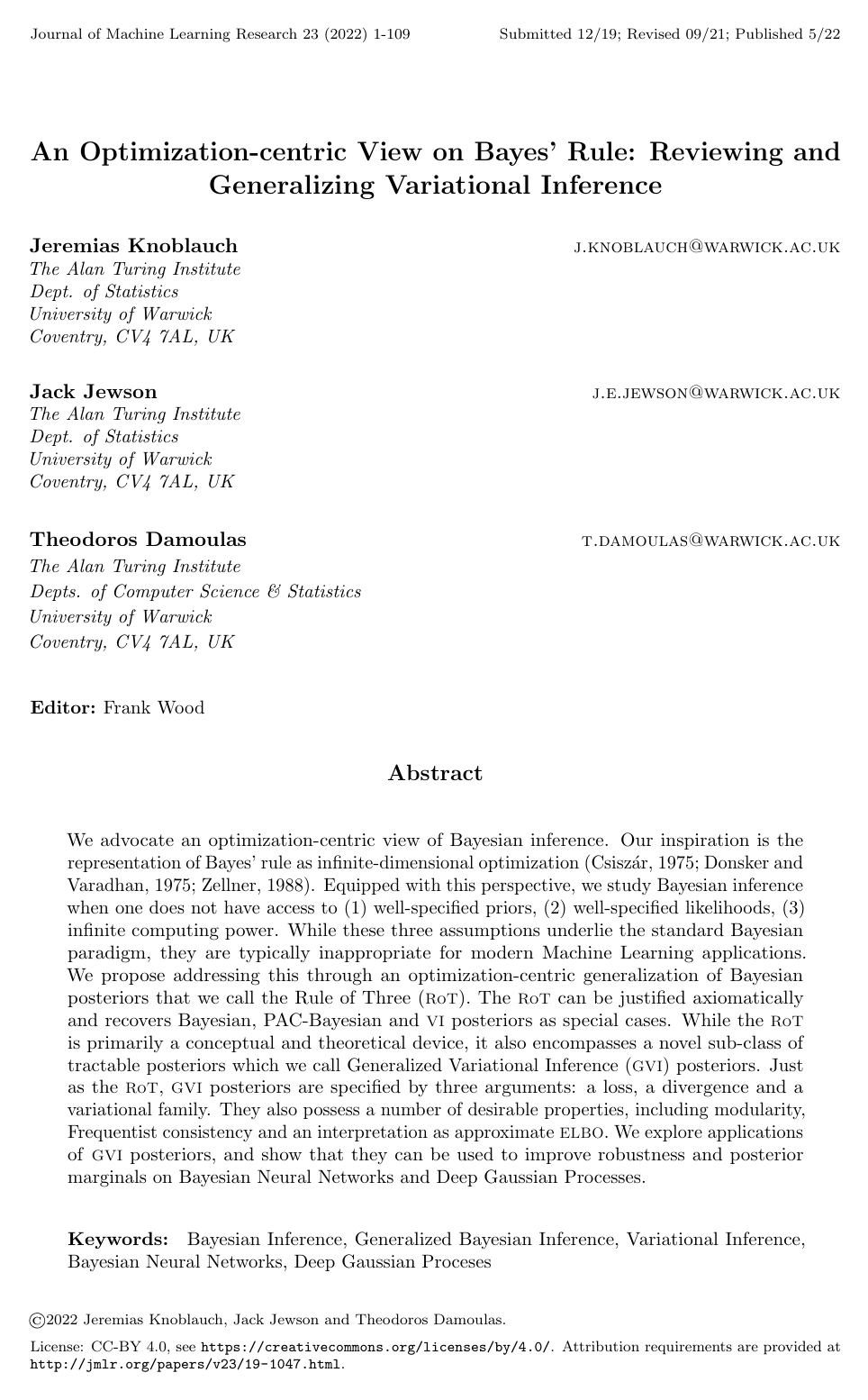
We advocate an optimization-centric view of Bayesian inference. Our inspiration is the representation of Bayes’ rule as infinite-dimensional optimization (Csiszár, 1975; Donsker and Varadhan, 1975; Zellner, 1988). Equipped with this perspective, we study Bayesian inference when one does not have access to (1) well-specified priors, (2) well-specified likelihoods, (3) infinite computing power. While these three assumptions underlie the standard Bayesian paradigm, they are typically inappropriate for modern Machine Learning applications. We propose addressing this through an optimization-centric generalization of Bayesian posteriors that we call the Rule of Three (RoT). The RoT can be justified axiomatically and recovers Bayesian, PAC-Bayesian and VI posteriors as special cases. While the RoT is primarily a conceptual and theoretical device, it also encompasses a novel sub-class of tractable posteriors which we call Generalized Variational Inference (GVI) posteriors. Just as the RoT, GVI posteriors are specified by three arguments: a loss, a divergence and a variational family. They also possess a number of desirable properties, including modularity, Frequentist consistency and an interpretation as approximate ELBO. We explore applications of GVI posteriors, and show that they can be used to improve robustness and posterior marginals on Bayesian Neural Networks and Deep Gaussian Processes.

Added

2026-10-01