
keyword
principal component analysis
Principal component analysis is a classical unsupervised statistical technique used for linear dimensionality reduction and feature extraction in multivariate data. It transforms a dataset of potentially correlated variables into a sequence of linearly uncorrelated variables known as principal components. These components are orthogonal axes ordered so that the first component captures the largest possible variance in the data, and each subsequent component accounts for the maximal remaining variance orthogonal to the preceding ones. Mathematically, this transformation is achieved by computing the eigenvectors and eigenvalues of the data covariance matrix or by performing singular value decomposition on the centered data matrix. By projecting high-dimensional observations onto a lower-dimensional subspace spanned by the leading principal components, the method preserves the dominant global structure and variability of the data while reducing computational complexity, filtering noise, and facilitating data visualization.
18 items
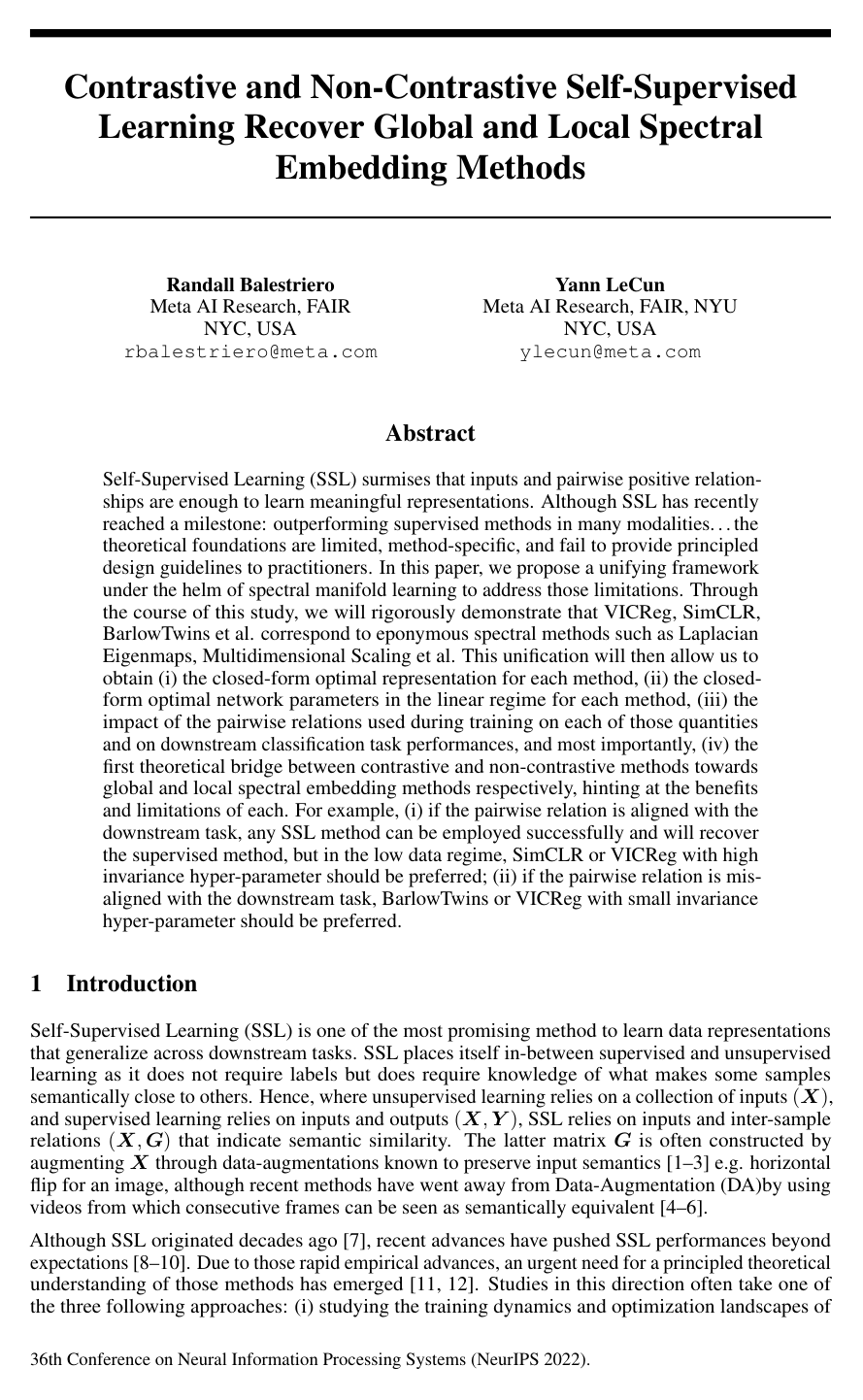
Contrastive and Non-Contrastive Self-Supervised Learning Recover Global and Local Spectral Embedding Methods
Randall Balestriero, Yann LeCun
Why you should read this
Unifies contrastive and non-contrastive self-supervised learning under classical spectral embedding theory, deriving closed-form optimal representations and practical rules for selecting algorithms based on task alignment and dataset size.
Self-Supervised Learning (SSL) surmises that inputs and pairwise positive relations- ships are enough to learn meaningful representations. Although SSL has recently reached a milestone: outperforming supervised methods in many modalities. . . the theoretical foundations are limited, method-specific, and fail to provide principled design guidelines to practitioners. In this paper, we propose a unifying framework under the helm of spectral manifold learning to address those limitations. Through the course of this study, we will rigorously demonstrate that VICReg, SimCLR, BarlowTwins et al. correspond to eponymous spectral methods such as Laplacian Eigenmaps, Multidimensional Scaling et al. This unification will then allow us to obtain (i) the closed-form optimal representation for each method, (ii) the closed- form optimal network parameters in the linear regime for each method, (iii) the impact of the pairwise relations used during training on each of those quantities and on downstream classification task performances, and most importantly, (iv) the first theoretical bridge between contrastive and non-contrastive methods towards global and local spectral embedding methods respectively, hinting at the benefits and limitations of each. For example, (i) if the pairwise relation is aligned with the downstream task, any SSL method can be employed successfully and will recover the supervised method, but in the low data regime, SimCLR or VICReg with high invariance hyper-parameter should be preferred; (ii) if the pairwise relation is mis- aligned with the downstream task, BarlowTwins or VICReg with small invariance hyper-parameter should be preferred.
Added
2026-10-05
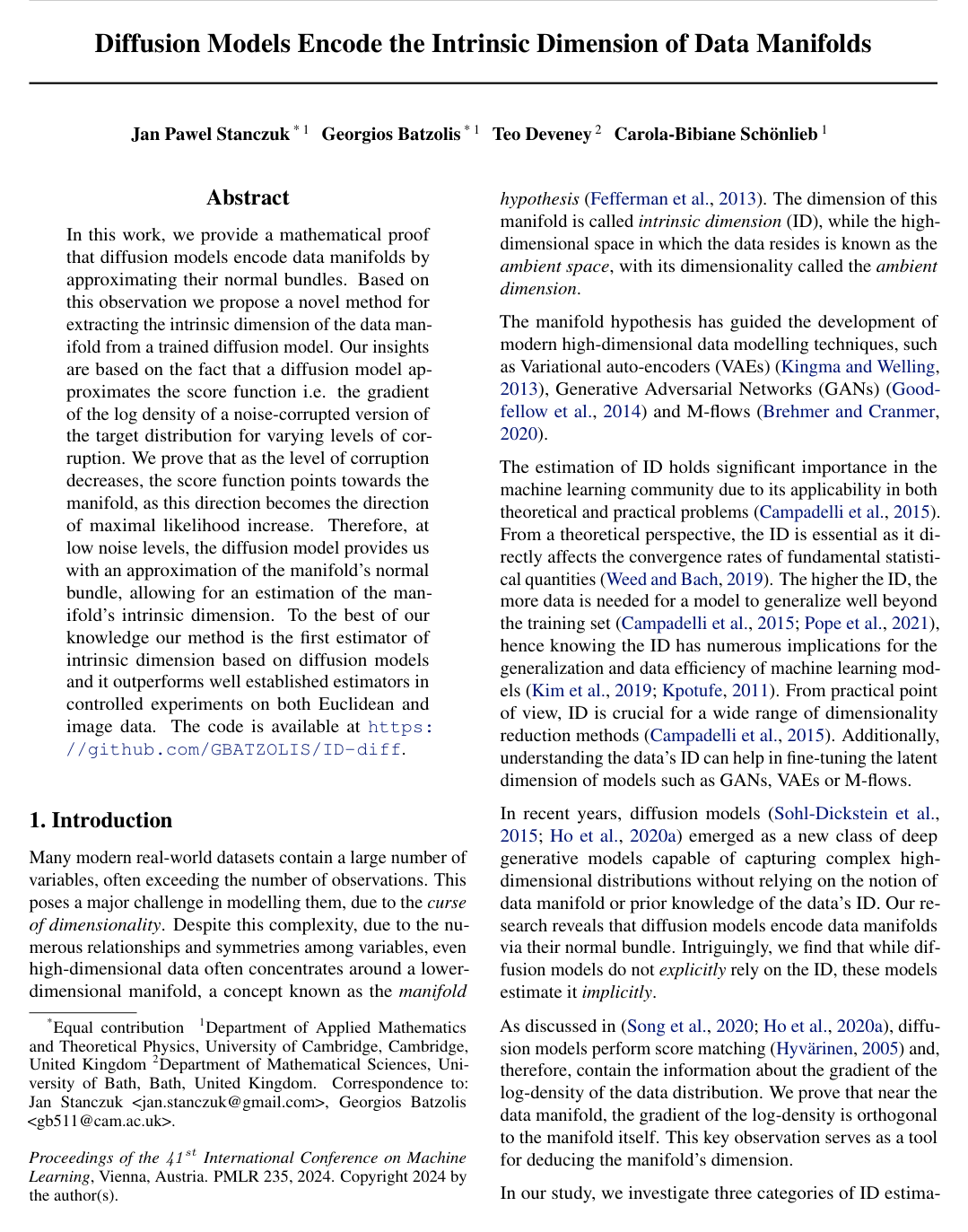
Diffusion Models Encode the Intrinsic Dimension of Data Manifolds
Jan Stanczuk, Georgios Batzolis, Teo Deveney, Carola-Bibiane Schönlieb
Why you should read this
Proves that diffusion models approximate the normal bundles of data distributions at low noise levels and presents the first diffusion-based method to estimate the intrinsic dimensionality of high-dimensional datasets.
In this work, we provide a mathematical proof that diffusion models encode data manifolds by approximating their normal bundles. Based on this observation we propose a novel method for extracting the intrinsic dimension of the data manifold from a trained diffusion model. Our insights are based on the fact that a diffusion model approximates the score function i.e. the gradient of the log density of a noise-corrupted version of the target distribution for varying levels of corruption. We prove that as the level of corruption decreases, the score function points towards the manifold, as this direction becomes the direction of maximal likelihood increase. Therefore, at low noise levels, the diffusion model provides us with an approximation of the manifold's normal bundle, allowing for an estimation of the manifold's intrinsic dimension. To the best of our knowledge our method is the first estimator of intrinsic dimension based on diffusion models and it outperforms well established estimators in controlled experiments on both Euclidean and image data. The code is available at https://github.com/GBATZOLIS/ID-diff.
Added
2026-10-03
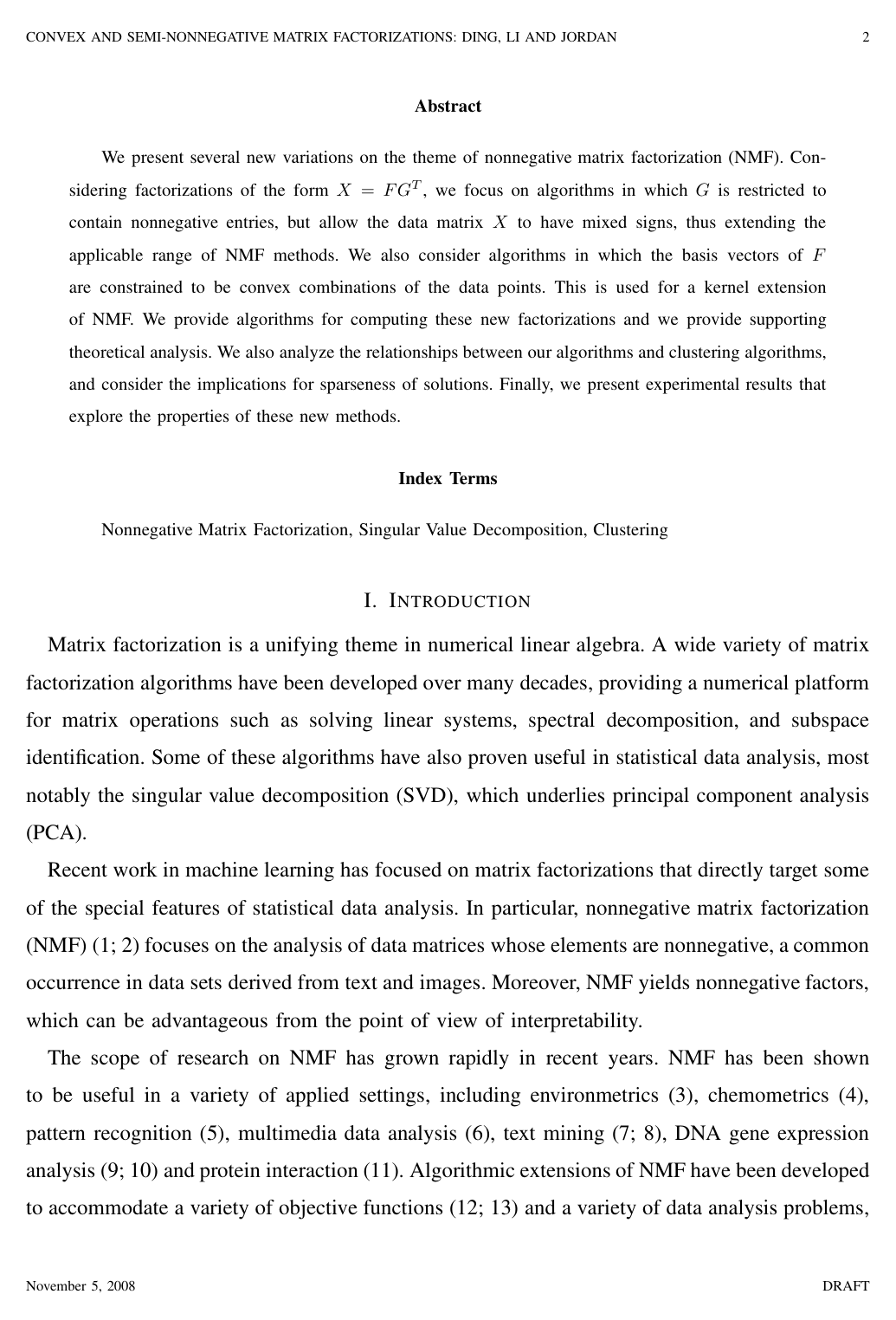
Convex and Semi-Nonnegative Matrix Factorizations
C. Ding, Tao Li, Michael I. Jordan
Why you should read this
Introduces Semi-NMF and Convex-NMF to enable nonnegative matrix factorization on mixed-sign data and kernel spaces while establishing theoretical and practical connections to K-means clustering.
We present several new variations on the theme of nonnegative matrix factorization (NMF). Considering factorizations of the form X = FG^T, we focus on algorithms in which G is restricted to contain nonnegative entries, but allow the data matrix X to have mixed signs, thus extending the applicable range of NMF methods. We also consider algorithms in which the basis vectors of F are constrained to be convex combinations of the data points. This is used for a kernel extension of NMF. We provide algorithms for computing these new factorizations and we provide supporting theoretical analysis. We also analyze the relationships between our algorithms and clustering algorithms, and consider the implications for sparseness of solutions. Finally, we present experimental results that explore the properties of these new methods.
Added
2026-09-25
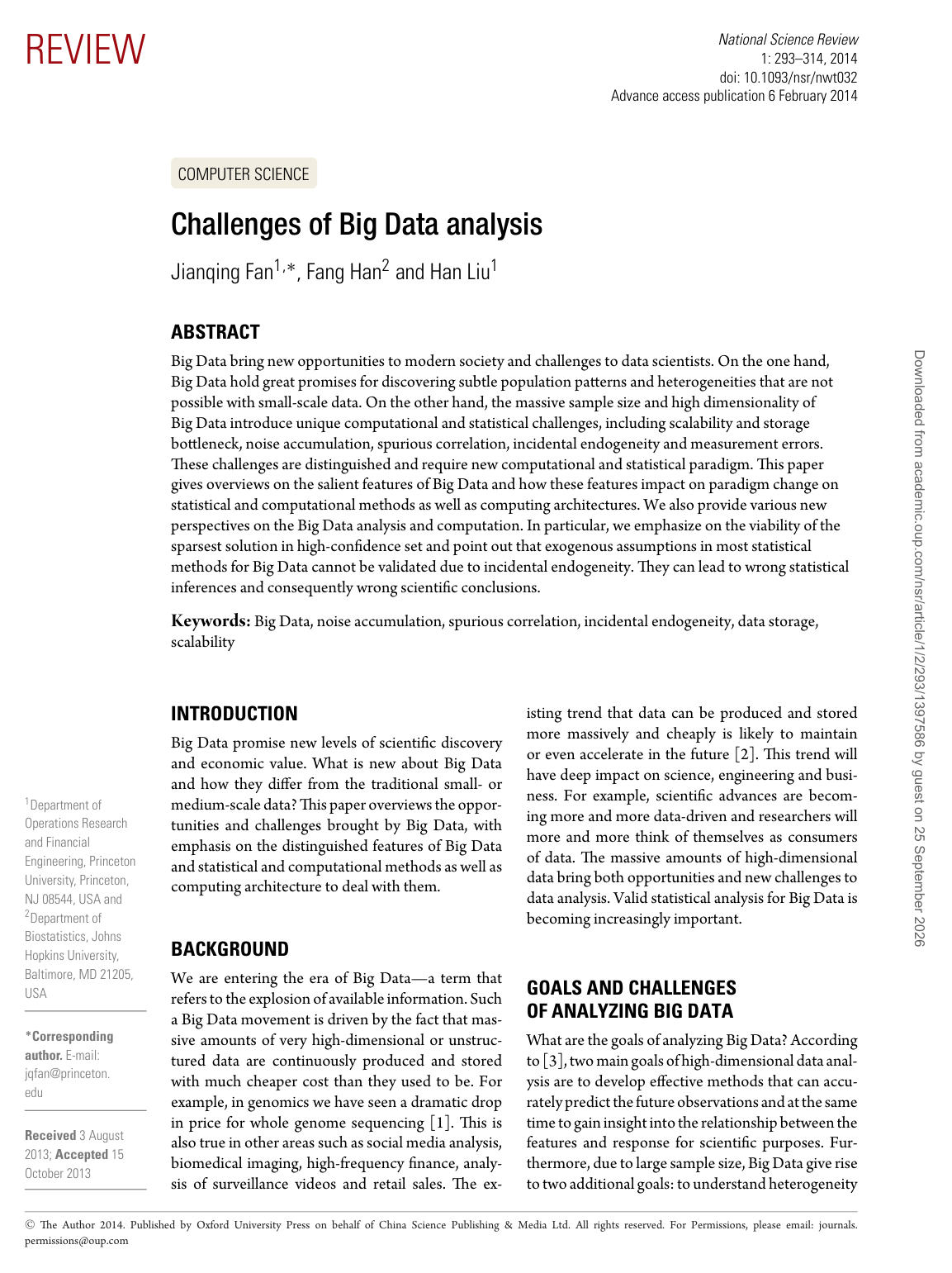
Challenges of Big Data Analysis
Jianqing Fan, Fang Han, Han Liu
Why you should read this
Analyzes critical statistical and computational pitfalls in high-dimensional big data, demonstrating how issues like noise accumulation, spurious correlations, and incidental endogeneity invalidate standard inference methods.
Big Data bring new opportunities to modern society and challenges to data scientists. On one hand, Big Data hold great promises for discovering subtle population patterns and heterogeneities that are not possible with small-scale data. On the other hand, the massive sample size and high dimensionality of Big Data introduce unique computational and statistical challenges, including scalability and storage bottleneck, noise accumulation, spurious correlation, incidental endogeneity, and measurement errors. These challenges are distinguished and require new computational and statistical paradigm. This article give overviews on the salient features of Big Data and how these features impact on paradigm change on statistical and computational methods as well as computing architectures. We also provide various new perspectives on the Big Data analysis and computation. In particular, we emphasis on the viability of the sparsest solution in high-confidence set and point out that exogeneous assumptions in most statistical methods for Big Data can not be validated due to incidental endogeneity. They can lead to wrong statistical inferences and consequently wrong scientific conclusions.
Added
2026-09-25
Anomaly Detection with Robust Deep Autoencoders
Chong Zhou, R. Paffenroth
Why you should read this
Proposes a matrix-splitting framework combining deep autoencoders with sparse and group-sparse regularization to isolate complex noise and detect anomalies without requiring clean training data.
Deep autoencoders, and other deep neural networks, have demonstrated their effectiveness in discovering non-linear features across many problem domains. However, in many real-world problems, large outliers and pervasive noise are commonplace, and one may not have access to clean training data as required by standard deep denoising autoencoders. Herein, we demonstrate novel extensions to deep autoencoders which not only maintain a deep autoencoders’ ability to discover high quality, non-linear features but can also eliminate outliers and noise without access to any clean training data. Our model is inspired by Robust Principal Component Analysis, and we split the input data X into two parts, X = L_D + S, where L_D can be effectively reconstructed by a deep autoencoder and S contains the outliers and noise in the original data X. Since such splitting increases the robustness of standard deep autoencoders, we name our model a “Robust Deep Autoencoder (RDA)”. Further, we present generalizations of our results to grouped sparsity norms which allow one to distinguish random anomalies from other types of structured corruptions, such as a collection of features being corrupted across many instances or a collection of instances having more corruptions than their fellows. Such “Group Robust Deep Autoencoders (GRDA)” give rise to novel anomaly detection approaches whose superior performance we demonstrate on a selection of benchmark problems.
Added
2026-09-24
Think Globally, Fit Locally: Unsupervised Learning of Low Dimensional Manifold
L. Saul, S. Roweis
Why you should read this
Introduces Locally Linear Embedding (LLE), an unsupervised algorithm that recovers the underlying global geometry of high-dimensional data without local minima by solving an efficient sparse eigenvalue problem that preserves local linear relationships.
The problem of dimensionality reduction arises in many fields of information processing, including machine learning, data compression, scientific visualization, pattern recognition, and neural computation. Here we describe locally linear embedding (LLE), an unsupervised learning algorithm that computes low dimensional, neighborhood preserving embeddings of high dimensional data. The data, assumed to be sampled from an underlying manifold, are mapped into a single global coordinate system of lower dimensionality. The mapping is derived from the symmetries of locally linear reconstructions, and the actual computation of the embedding reduces to a sparse eigenvalue problem. Notably, the optimizations in LLE—though capable of generating highly nonlinear embeddings—are simple to implement, and they do not involve local minima. In this paper, we describe the implementation of the algorithm in detail and discuss several extensions that enhance its performance. We present results of the algorithm applied to data sampled from known manifolds, as well as to collections of images of faces, lips, and handwritten digits. These examples are used to provide extensive illustrations of the algorithm's performance—both successes and failures—and to relate the algorithm to previous and ongoing work in nonlinear dimensionality reduction.
Added
2026-09-24
Random projection in dimensionality reduction: applications to image and text data
Ella Bingham, H. Mannila
Why you should read this
Demonstrates through empirical evaluations on image processing and text retrieval that random projection preserves pairwise vector similarities comparably to principal component analysis while dramatically reducing computational cost, especially when using sparse projection matrices.
Random projections have recently emerged as a powerful method for dimensionality reduction. Theoretical results indicate that the method preserves distances quite nicely; however, empirical results are sparse. We present experimental results on using random projection as a dimensionality reduction tool in a number of cases, where the high dimensionality of the data would otherwise lead to burdensome computations. Our application areas are the processing of both noisy and noiseless images, and information retrieval in text documents. We show that projecting the data onto a random lower-dimensional subspace yields results comparable to conventional dimensionality reduction methods such as principal component analysis: the similarity of data vectors is preserved well under random projection. However, using random projections is computationally significantly less expensive than using, e.g., principal component analysis. We also show experimentally that using a sparse random matrix gives additional computational savings in random projection.
Added
2026-09-24
K-means clustering via principal component analysis
C. Ding, Xiaofeng He
Why you should read this
Proves that principal components serve as the continuous relaxations of discrete cluster indicators in K-means clustering, providing a theoretical foundation that links dimensionality reduction directly to unsupervised grouping.
Principal component analysis (PCA) is a widely used statistical technique for unsupervised dimension reduction. K-means clustering is a commonly used data clustering for unsupervised learning tasks. Here we prove that principal components are the continuous solutions to the discrete cluster membership indicators for K-means clustering. Equivalently, we show that the subspace spanned by the cluster centroids are given by spectral expansion of the data covariance matrix truncated at K - 1 terms. These results indicate that unsupervised dimension reduction is closely related to unsupervised learning. On dimension reduction, the result provides new insights to the observed effectiveness of PCA-based data reductions, beyond the conventional noise-reduction explanation. Mapping data points into a higher dimensional space via kernels, we show that solution for Kernel K-means is given by Kernel PCA. On learning, our results suggest effective techniques for K-means clustering. DNA gene expression and Internet newsgroups are analyzed to illustrate the results. Experiments indicate that newly derived lower bounds for K-means objective are within 0.5-1.5% of the optimal values.
Added
2026-09-24
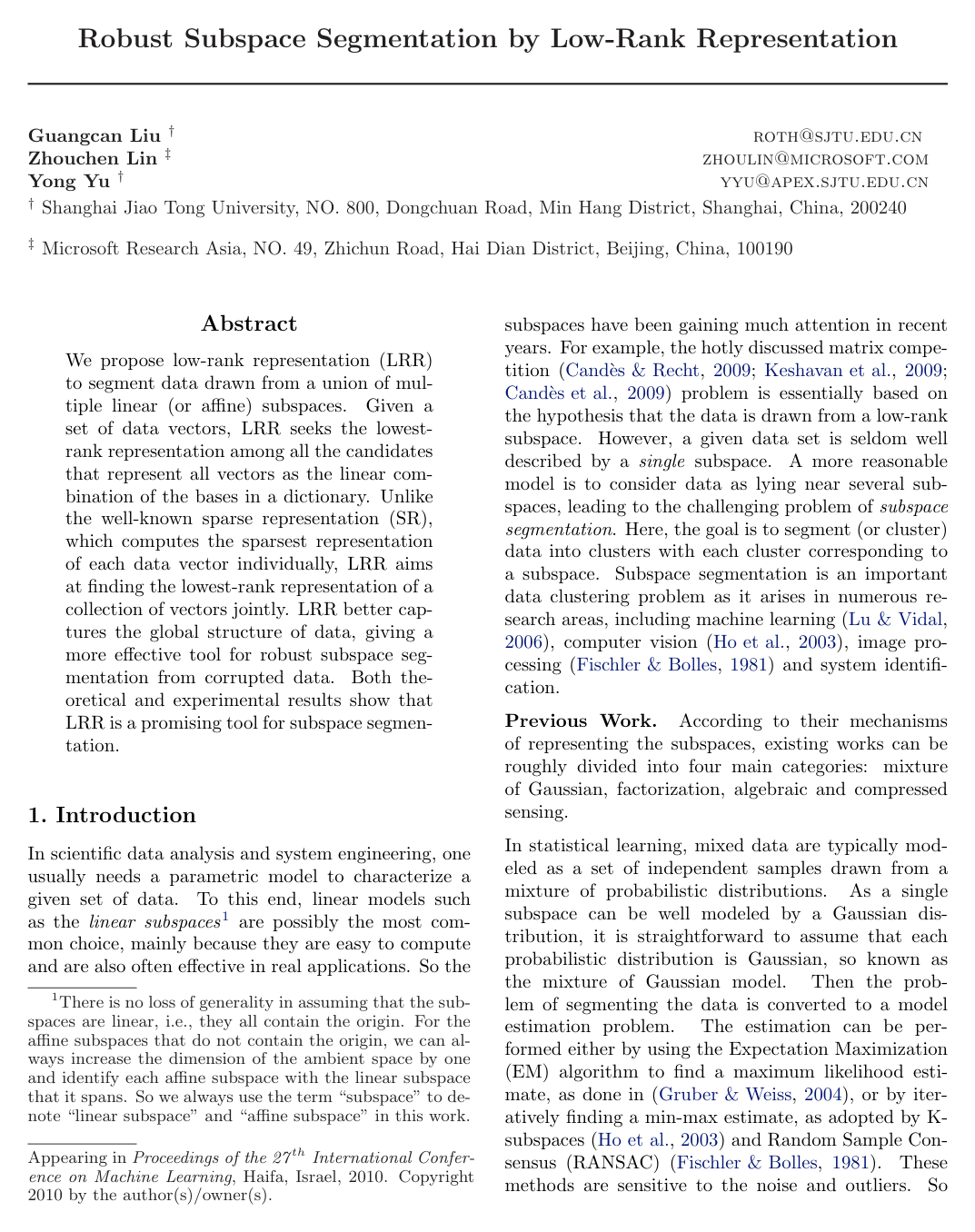
Robust Subspace Segmentation by Low-Rank Representation
Guangcan Liu, Zhouchen Lin, Yong Yu
Why you should read this
Proposes a low-rank representation framework that jointly captures global data structures via nuclear norm minimization to accurately segment data lying across multiple subspaces even when severely corrupted by noise and outliers.
We propose low-rank representation (LRR) to segment data drawn from a union of multiple linear (or affine) subspaces. Given a set of data vectors, LRR seeks the lowest-rank representation among all the candidates that represent all vectors as the linear combination of the bases in a dictionary. Unlike the well-known sparse representation (SR), which computes the sparsest representation of each data vector individually, LRR aims at finding the lowest-rank representation of a collection of vectors jointly. LRR better captures the global structure of data, giving a more effective tool for robust subspace segmentation from corrupted data. Both theoretical and experimental results show that LRR is a promising tool for subspace segmentation.
Added
2026-09-24
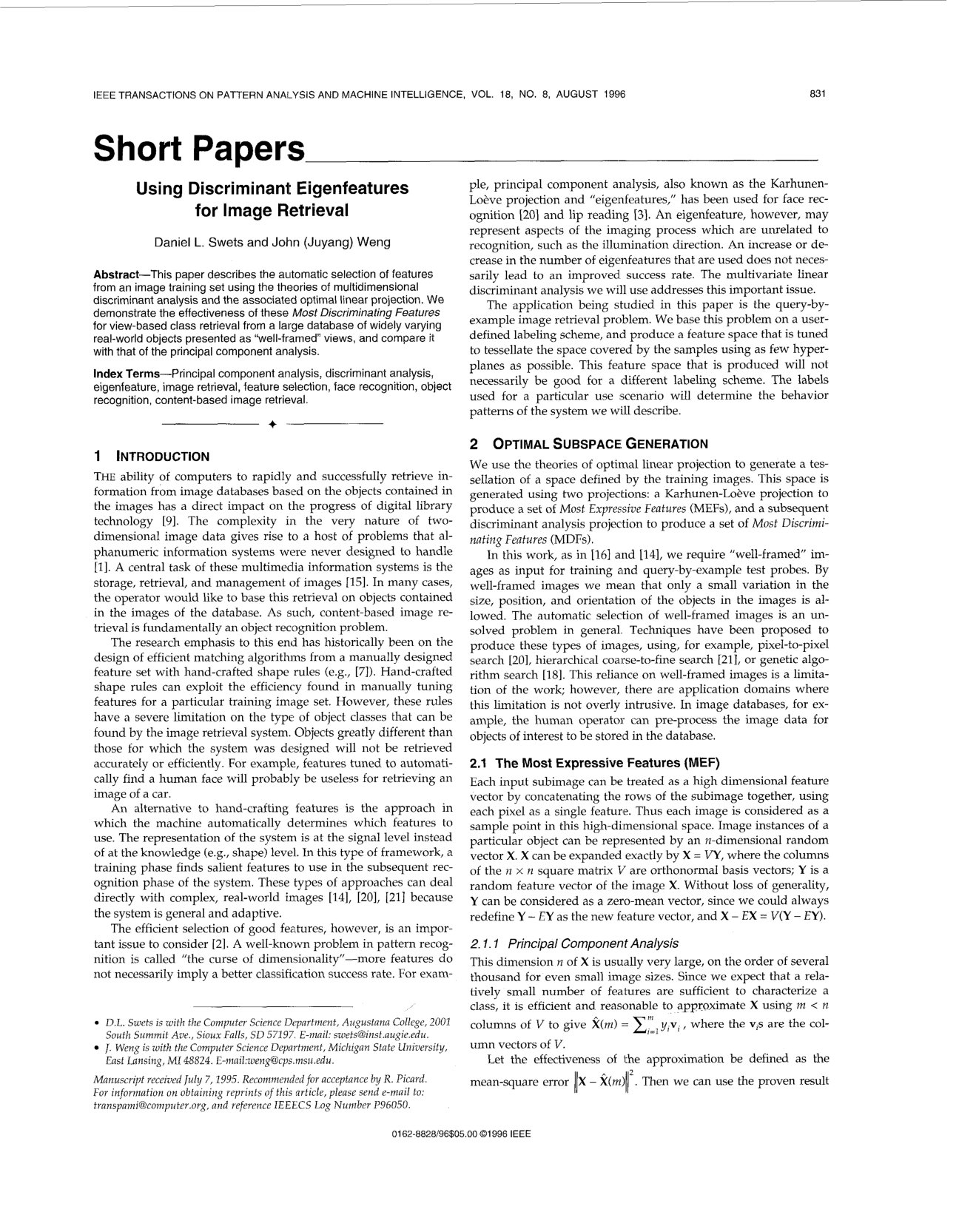
Using Discriminant Eigenfeatures for Image Retrieval
D. Swets, J. Weng
Why you should read this
Proposes a Discriminant Karhunen-Loève projection framework that combines principal component analysis with linear discriminant analysis to eliminate non-informative variations like lighting and substantially improve content-based image retrieval across diverse object classes.
This paper describes the automatic selection of features from an image training set using the theories of multidimensional discriminant analysis and the associated optimal linear projection. We demonstrate the effectiveness of these Most Discriminating Features for view-based class retrieval from a large database of widely varying real-world objects presented as “well-framed” views, and compare it with that of the principal component analysis.
Added
2026-09-18
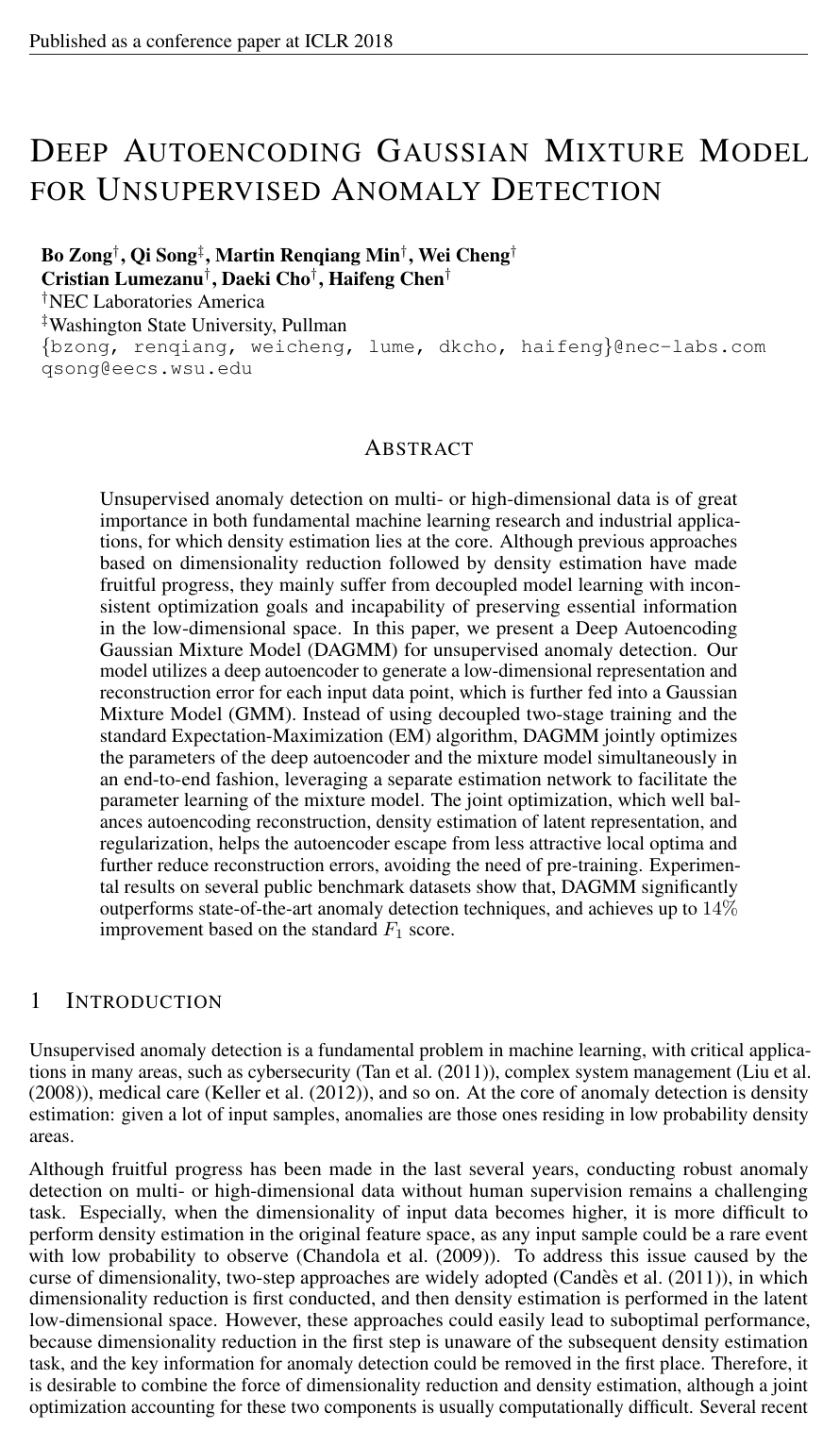
Deep Autoencoding Gaussian Mixture Model for Unsupervised Anomaly Detection
Bo Zong, Qi Song, Martin Renqiang Min, Wei Cheng, Cristian Lumezanu, Daeki Cho, Haifeng Chen
Why you should read this
Proposes an end-to-end unsupervised anomaly detection framework that jointly optimizes deep autoencoding reconstruction and Gaussian mixture density estimation, eliminating decoupled two-stage training to significantly improve detection accuracy on high-dimensional data.
Unsupervised anomaly detection on multi- or high-dimensional data is of great importance in both fundamental machine learning research and industrial applications, for which density estimation lies at the core. Although previous approaches based on dimensionality reduction followed by density estimation have made fruitful progress, they mainly suffer from decoupled model learning with inconsistent optimization goals and incapability of preserving essential information in the low-dimensional space. In this paper, we present a Deep Autoencoding Gaussian Mixture Model (DAGMM) for unsupervised anomaly detection. Our model utilizes a deep autoencoder to generate a low-dimensional representation and reconstruction error for each input data point, which is further fed into a Gaussian Mixture Model (GMM). Instead of using decoupled two-stage training and the standard Expectation-Maximization (EM) algorithm, DAGMM jointly optimizes the parameters of the deep autoencoder and the mixture model simultaneously in an end-to-end fashion, leveraging a separate estimation network to facilitate the parameter learning of the mixture model. The joint optimization, which well balances autoencoding reconstruction, density estimation of latent representation, and regularization, helps the autoencoder escape from less attractive local optima and further reduce reconstruction errors, avoiding the need of pre-training. Experimental results on several public benchmark datasets show that, DAGMM significantly outperforms state-of-the-art anomaly detection techniques, and achieves up to 14% improvement based on the standard F1 score.
Added
2026-09-16
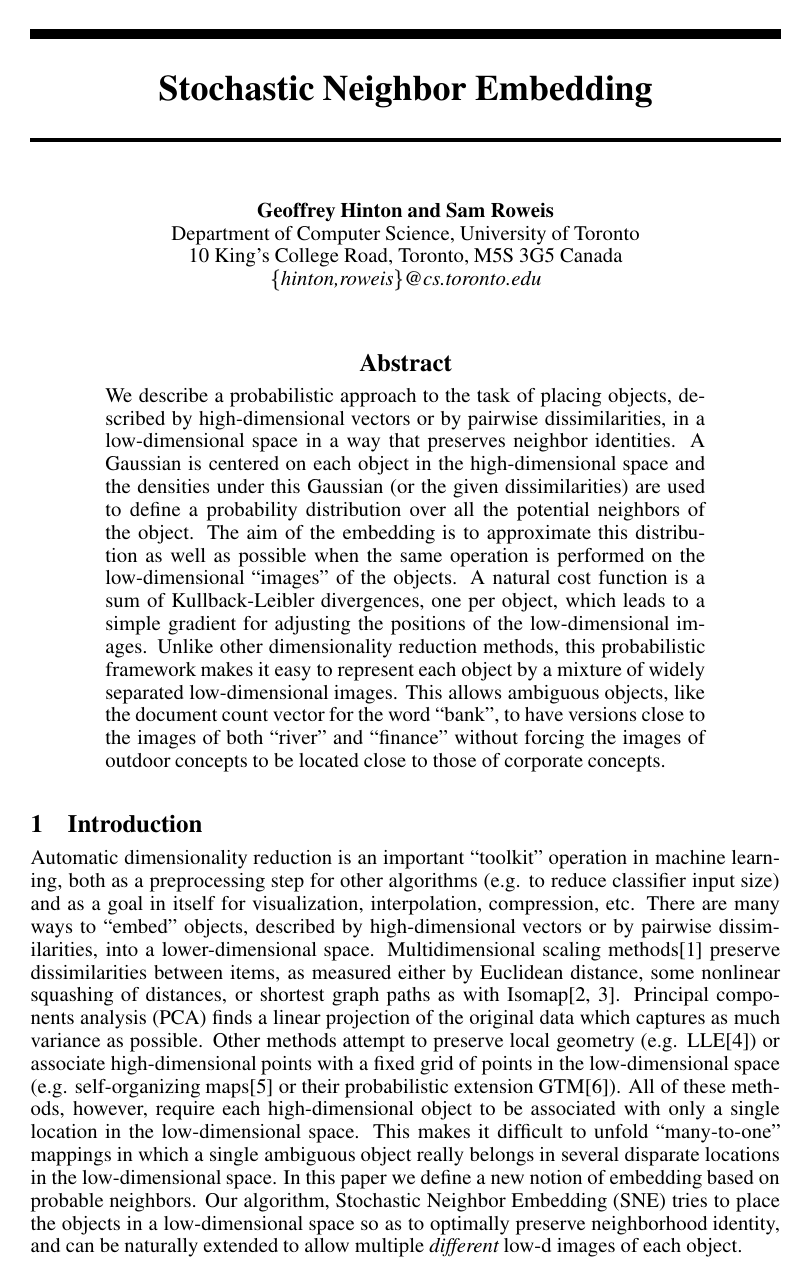
Stochastic Neighbor Embedding
Geoffrey E. Hinton, S. Roweis
Why you should read this
Introduces Stochastic Neighbor Embedding, a probabilistic dimensionality reduction technique that matches neighborhood probability distributions via Kullback-Leibler divergence to preserve local data structure and naturally accommodate multi-modal or ambiguous objects.
We describe a probabilistic approach to the task of placing objects, described by high-dimensional vectors or by pairwise dissimilarities, in a low-dimensional space in a way that preserves neighbor identities. A Gaussian is centered on each object in the high-dimensional space and the densities under this Gaussian (or the given dissimilarities) are used to define a probability distribution over all the potential neighbors of the object. The aim of the embedding is to approximate this distribution as well as possible when the same operation is performed on the low-dimensional “images” of the objects. A natural cost function is a sum of Kullback-Leibler divergences, one per object, which leads to a simple gradient for adjusting the positions of the low-dimensional images. Unlike other dimensionality reduction methods, this probabilistic framework makes it easy to represent each object by a mixture of widely separated low-dimensional images. This allows ambiguous objects, like the document count vector for the word “bank”, to have versions close to the images of both “river” and “finance” without forcing the images of outdoor concepts to be located close to those of corporate concepts.
Added
2026-09-15
Acquiring linear subspaces for face recognition under variable lighting
Kuang-chih Lee, J. Ho, D. Kriegman
Why you should read this
Shows that low-dimensional linear subspaces for face recognition under variable lighting can be constructed directly from five to nine real images taken under specific point-source directions, eliminating the need for 3D reconstruction or large training datasets.
Previous work has demonstrated that the image variation of many objects (human faces in particular) under variable lighting can be effectively modeled by low-dimensional linear spaces, even when there are multiple light sources and shadowing. Basis images spanning this space are usually obtained in one of three ways: A large set of images of the object under different lighting conditions is acquired, and principal component analysis (PCA) is used to estimate a subspace. Alternatively, synthetic images are rendered from a 3D model (perhaps reconstructed from images) under point sources and, again, PCA is used to estimate a subspace. Finally, images rendered from a 3D model under diffuse lighting based on spherical harmonics are directly used as basis images. In this paper, we show how to arrange physical lighting so that the acquired images of each object can be directly used as the basis vectors of a low-dimensional linear space and that this subspace is close to those acquired by the other methods. More specifically, there exist configurations of k point light source directions, with k typically ranging from 5 to 9, such that, by taking k images of an object under these single sources, the resulting subspace is an effective representation for recognition under a wide range of lighting conditions. Since the subspace is generated directly from real images, potentially complex and/or brittle intermediate steps such as 3D reconstruction can be completely avoided; nor is it necessary to acquire large numbers of training images or to physically construct complex diffuse (harmonic) light fields. We validate the use of subspaces constructed in this fashion within the context of face recognition.
Added
2026-09-14
A Tutorial on Principal Component Analysis
Jonathon Shlens
Why you should read this
Demystifies principal component analysis by connecting geometric intuition to foundational linear algebra derivations, showing practitioners exactly how the algorithm works and when to apply it.
Principal component analysis (PCA) is a mainstay of modern data analysis - a black box that is widely used but (sometimes) poorly understood. The goal of this paper is to dispel the magic behind this black box. This manuscript focuses on building a solid intuition for how and why principal component analysis works. This manuscript crystallizes this knowledge by deriving from simple intuitions, the mathematics behind PCA. This tutorial does not shy away from explaining the ideas informally, nor does it shy away from the mathematics. The hope is that by addressing both aspects, readers of all levels will be able to gain a better understanding of PCA as well as the when, the how and the why of applying this technique.
Added
2026-09-14
Graph Embedding and Extensions: A General Framework for Dimensionality Reduction
Shuicheng Yan, Dong Xu, Benyu Zhang, HongJiang Zhang, Qiang Yang, Stephen Lin
Why you should read this
Develops a unified graph embedding framework that connects diverse dimensionality reduction algorithms across linear, kernel, and tensor extensions while introducing Marginal Fisher Analysis to overcome the projection and distribution limitations of Linear Discriminant Analysis.
Over the past few decades, a large family of algorithms—supervised or unsupervised; stemming from statistics or geometry theory—has been designed to provide different solutions to the problem of dimensionality reduction. Despite the different motivations of these algorithms, we present in this paper a general formulation known as graph embedding to unify them within a common framework. In graph embedding, each algorithm can be considered as the direct graph embedding or its linear/kernel/tensor extension of a specific intrinsic graph that describes certain desired statistical or geometric properties of a data set, with constraints from scale normalization or a penalty graph that characterizes a statistical or geometric property that should be avoided. Furthermore, the graph embedding framework can be used as a general platform for developing new dimensionality reduction algorithms. By utilizing this framework as a tool, we propose a new supervised dimensionality reduction algorithm called Marginal Fisher Analysis in which the intrinsic graph characterizes the intraclass compactness and connects each data point with its neighboring points of the same class, while the penalty graph connects the marginal points and characterizes the interclass separability. We show that MFA effectively overcomes the limitations of the traditional Linear Discriminant Analysis algorithm due to data distribution assumptions and available projection directions. Real face recognition experiments show the superiority of our proposed MFA in comparison to LDA, also for corresponding kernel and tensor extensions.
Added
2026-09-14
Non-negative Matrix Factorization with Sparseness Constraints
Patrik O. Hoyer
Why you should read this
Develops a non-negative matrix factorization framework with explicit sparseness constraints to reliably generate true parts-based linear representations of non-negative data.
Non-negative matrix factorization (NMF) is a recently developed technique for finding parts-based, linear representations of non-negative data. Although it has successfully been applied in several applications, it does not always result in parts-based representations. In this paper, we show how explicitly incorporating the notion of `sparseness' improves the found decompositions. Additionally, we provide complete MATLAB code both for standard NMF and for our extension. Our hope is that this will further the application of these methods to solving novel data-analysis problems.
Added
2026-09-13

Locality Preserving Projections
Xiaofei He, Partha Niyogi
Why you should read this
Proposes Locality Preserving Projections, a linear dimensionality reduction method that preserves local neighborhood structure to combine the computational efficiency of linear projections with the geometric fidelity of nonlinear techniques like Laplacian Eigenmaps.
Many problems in information processing involve some form of dimensionality reduction. In this paper, we introduce Locality Preserving Projections (LPP). These are linear projective maps that arise by solving a variational problem that optimally preserves the neighborhood structure of the data set. LPP should be seen as an alternative to principal component analysis (PCA) – a classical linear technique that projects the data along the directions of maximal variance. When the high dimensional data lies on a low dimensional manifold embedded in the ambient space, the Locality Preserving Projections are obtained by finding the optimal linear approximations to the eigenfunctions of the Laplace Beltrami operator on the manifold. As a result, LPP shares many of the data representation properties of non linear techniques such as Laplacian Eigenmap [4] or Locally Linear Embedding [5]. This is borne out by illustrative examples on a couple of high dimensional image data sets.
Added
2026-09-10
Dimensionality Reduction by Learning an Invariant Mapping
Raia Hadsell, Sumit Chopra, Yann LeCun
Why you should read this
Proposes Dimensionality Reduction by Learning an Invariant Mapping (DrLIM), a contrastive learning framework that maps high-dimensional data into low-dimensional spaces while generalizing to unseen samples and remaining invariant to transformations without requiring predefined distance metrics.
Dimensionality reduction involves mapping a set of high dimensional input points onto a low dimensional manifold so that “similar” points in input space are mapped to nearby points on the manifold. Most existing techniques for solving the problem suffer from two drawbacks. First, most of them depend on a meaningful and computable distance metric in input space. Second, they do not compute a “function” that can accurately map new input samples whose relationship to the training data is unknown. We present a method - called Dimensionality Reduction by Learning an Invariant Mapping (DrLIM) - for learning a globally coherent non-linear function that maps the data evenly to the output manifold. The learning relies solely on neighborhood relationships and does not require any distance measure in the input space. The method can learn mappings that are invariant to certain transformations of the inputs, as is demonstrated with a number of experiments. Comparisons are made to other techniques, in particular LLE.
Added
2026-09-09