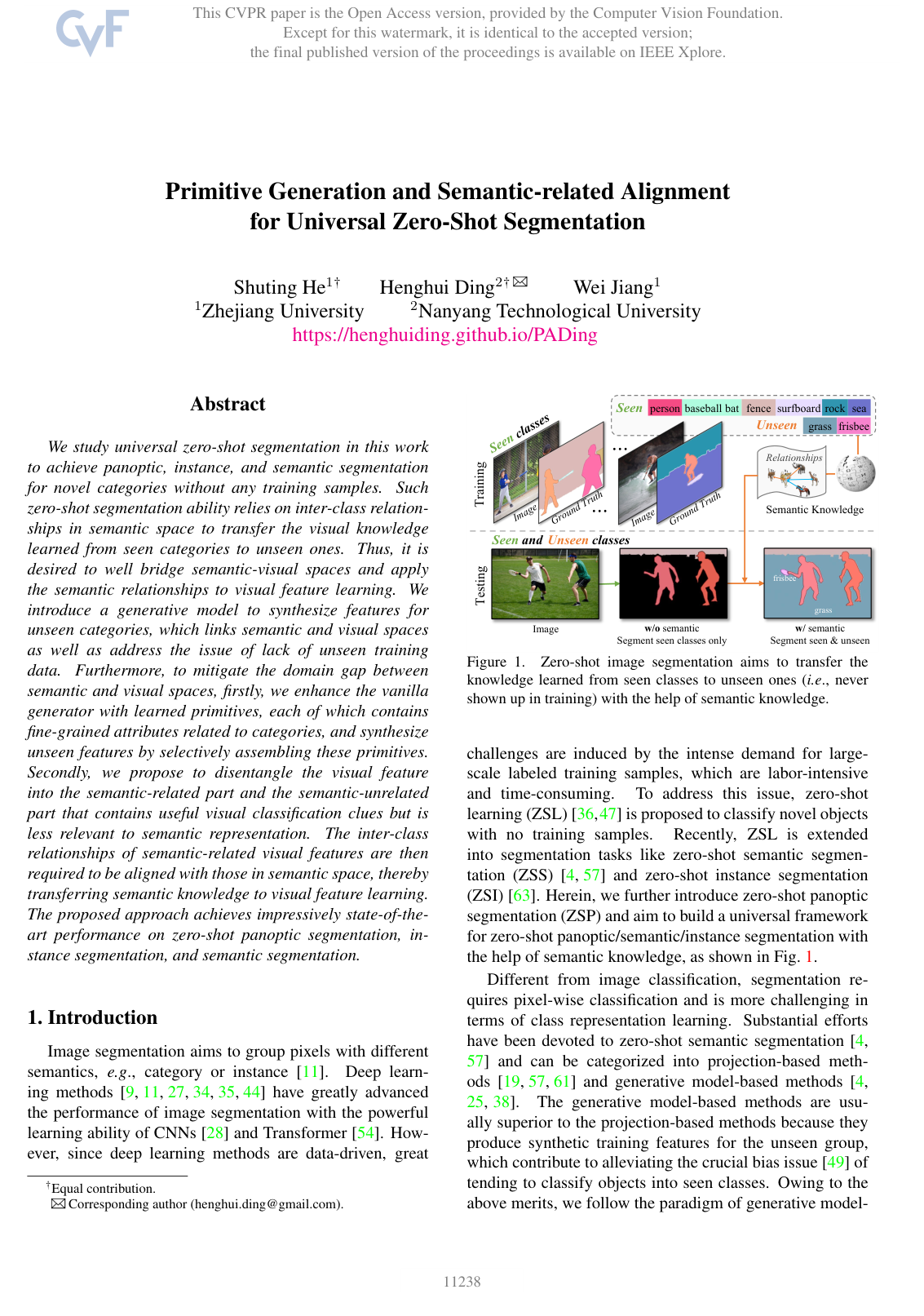
Primitive generation is a machine learning technique in which a generative model synthesizes data representations or features for target categories by learning and selectively combining fine-grained, reusable attribute building blocks known as primitives. Rather than generating complex features directly in a single holistic step, this approach decomposes concepts into shared fundamental components that capture specific visual or semantic characteristics. In applications such as zero-shot learning and visual segmentation, primitive generation helps bridge the discrepancy between semantic and visual feature spaces, enabling models to accurately simulate representations for novel or unseen classes by assembling learned parts derived from observed training data.