Built independently by an author, for readers. Read the story and support ChapterPal

keyword

pre-trained time series models

Pre-trained time series models are machine learning models that are trained on large volumes of sequential data to learn general temporal patterns and representations before being adapted to specific downstream applications. Instead of requiring a specialized architecture to be trained from scratch on an isolated dataset, these models leverage broad pre-training across diverse time-oriented data to capture universal temporal dynamics such as seasonality, trends, and cross-variable dependencies. Once pre-trained, they can be deployed directly in zero-shot settings or fine-tuned on limited target data to perform various analytical tasks, including time series forecasting, anomaly detection, classification, and missing value imputation across diverse domains.

1 item

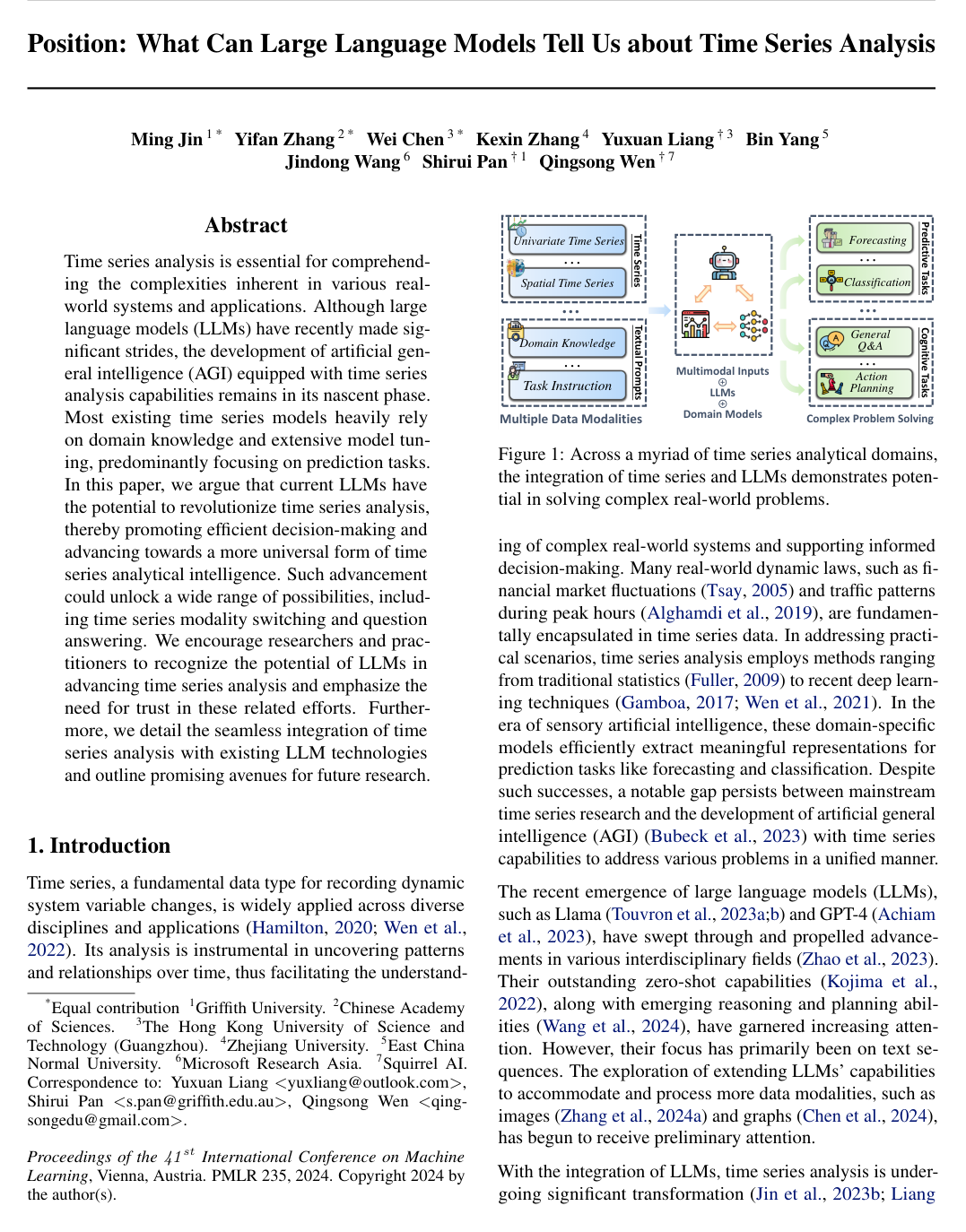
Position: What Can Large Language Models Tell Us about Time Series Analysis

Position: What Can Large Language Models Tell Us about Time Series Analysis

Ming Jin, Yifan Zhang, Wei Chen, Kexin Zhang, Yuxuan Liang, Bin Yang, Jindong Wang, Shirui Pan, Qingsong Wen

OrganizationsChinese Academy of SciencesEast China Normal UniversityGriffith UniversityMicrosoftSquirrel AIThe Hong Kong University of Science and TechnologyZhejiang University

Why you should read this

Categorizes the emerging roles of large language models in time series analysis as data enhancers, predictors, and autonomous agents while identifying concrete integration strategies and open research opportunities for building universal time series intelligence.

Time series analysis is essential for comprehending the complexities inherent in various real-world systems and applications. Although large language models (LLMs) have recently made significant strides, the development of artificial general intelligence (AGI) equipped with time series analysis capabilities remains in its nascent phase. Most existing time series models heavily rely on domain knowledge and extensive model tuning, predominantly focusing on prediction tasks. In this paper, we argue that current LLMs have the potential to revolutionize time series analysis, thereby promoting efficient decision-making and advancing towards a more universal form of time series analytical intelligence. Such advancement could unlock a wide range of possibilities, including time series modality switching and question answering. We encourage researchers and practitioners to recognize the potential of LLMs in advancing time series analysis and emphasize the need for trust in these related efforts. Furthermore, we detail the seamless integration of time series analysis with existing LLM technologies and outline promising avenues for future research.

Added

2026-09-26