Built independently by an author, for readers. Read the story and support ChapterPal

keyword

post-hoc attribution

Post-hoc attribution is the process of identifying, retrieving, and attaching verifiable supporting sources or citations to specific claims in a computer-generated text after that text has already been produced. Unlike retrieval-augmented systems that consult reference documents before or during text generation, post-hoc attribution evaluates completed model outputs by decomposing them into distinct factual statements and mapping each claim back to supporting external evidence. This technique is used to verify the factual accuracy of generated content, mitigate unsupported statements or hallucinations, and provide an auditable trail of evidence that enhances transparency and trust in artificial intelligence systems.

1 item

ExpertQA: Expert-Curated Questions and Attributed Answers

ExpertQA: Expert-Curated Questions and Attributed Answers

Chaitanya Malaviya, Subin Lee, Sihao Chen, Elizabeth Sieber, Mark Yatskar, Dan Roth

OrganizationsUniversity of PennsylvaniaUniversity of Washington

Why you should read this

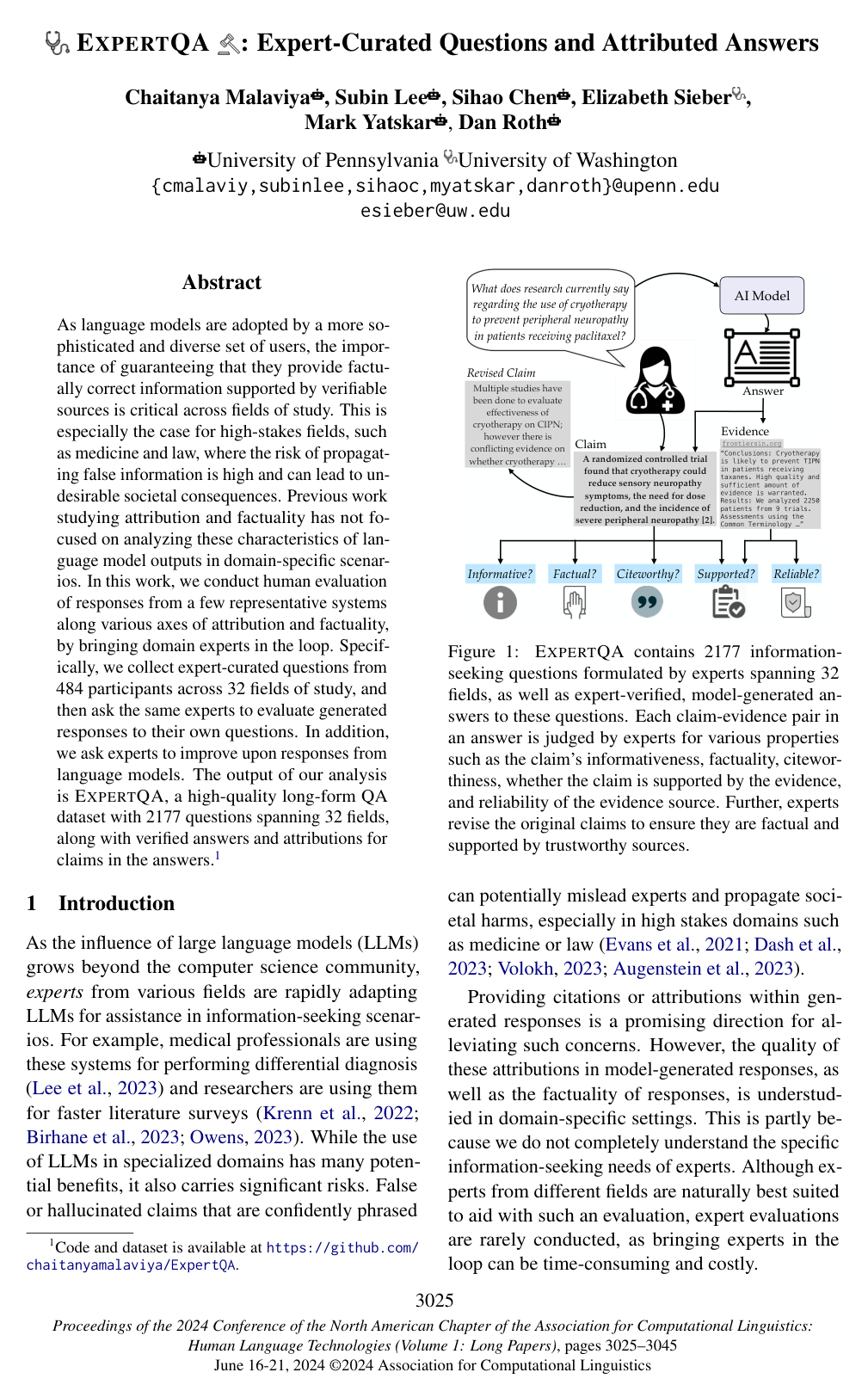
Presents a high-quality benchmark of 2,177 domain-specific questions across 32 fields to evaluate the factuality and citation quality of language model responses through direct assessment and revision by verified domain experts.

As language models are adopted by a more sophisticated and diverse set of users, the importance of guaranteeing that they provide factually correct information supported by verifiable sources is critical across fields of study. This is especially the case for high-stakes fields, such as medicine and law, where the risk of propagating false information is high and can lead to undesirable societal consequences. Previous work studying attribution and factuality has not focused on analyzing these characteristics of language model outputs in domain-specific scenarios. In this work, we conduct human evaluation of responses from a few representative systems along various axes of attribution and factuality, by bringing domain experts in the loop. Specifically, we collect expert-curated questions from 484 participants across 32 fields of study, and then ask the same experts to evaluate generated responses to their own questions. In addition, we ask experts to improve upon responses from language models. The output of our analysis is ExpertQA, a high-quality long-form QA dataset with 2177 questions spanning 32 fields, along with verified answers and attributions for claims in the answers.1

Added

2026-09-26