
Built independently by an author, for readers. Read the story and support ChapterPal

keyword

positive data augmentation

Positive data augmentation is a machine learning technique that applies semantic-preserving transformations to a data sample to generate altered views that retain the original instance's fundamental meaning or class identity. Widely utilized in self-supervised representation learning and contrastive frameworks, these transformations—such as geometric manipulations, color jittering, noise addition, or token substitutions—produce positive pairs or correlated views from an anchor sample. The resulting synthetic views allow algorithms to learn invariant and generalized feature representations by encouraging the model to pull representations of matching positive pairs closer together in the latent embedding space while distinguishing them from dissimilar or negative instances.

1 item
Debiased Contrastive Learning of Unsupervised Sentence Representations

Debiased Contrastive Learning of Unsupervised Sentence Representations

Kun Zhou, Beichen Zhang, Wayne Xin Zhao, Ji-Rong Wen

OrganizationsRenmin University of China

Why you should read this

Proposes a debiased contrastive learning framework that improves unsupervised sentence embeddings by downweighting false negatives and generating optimized noise-based negative samples to overcome representation anisotropy.

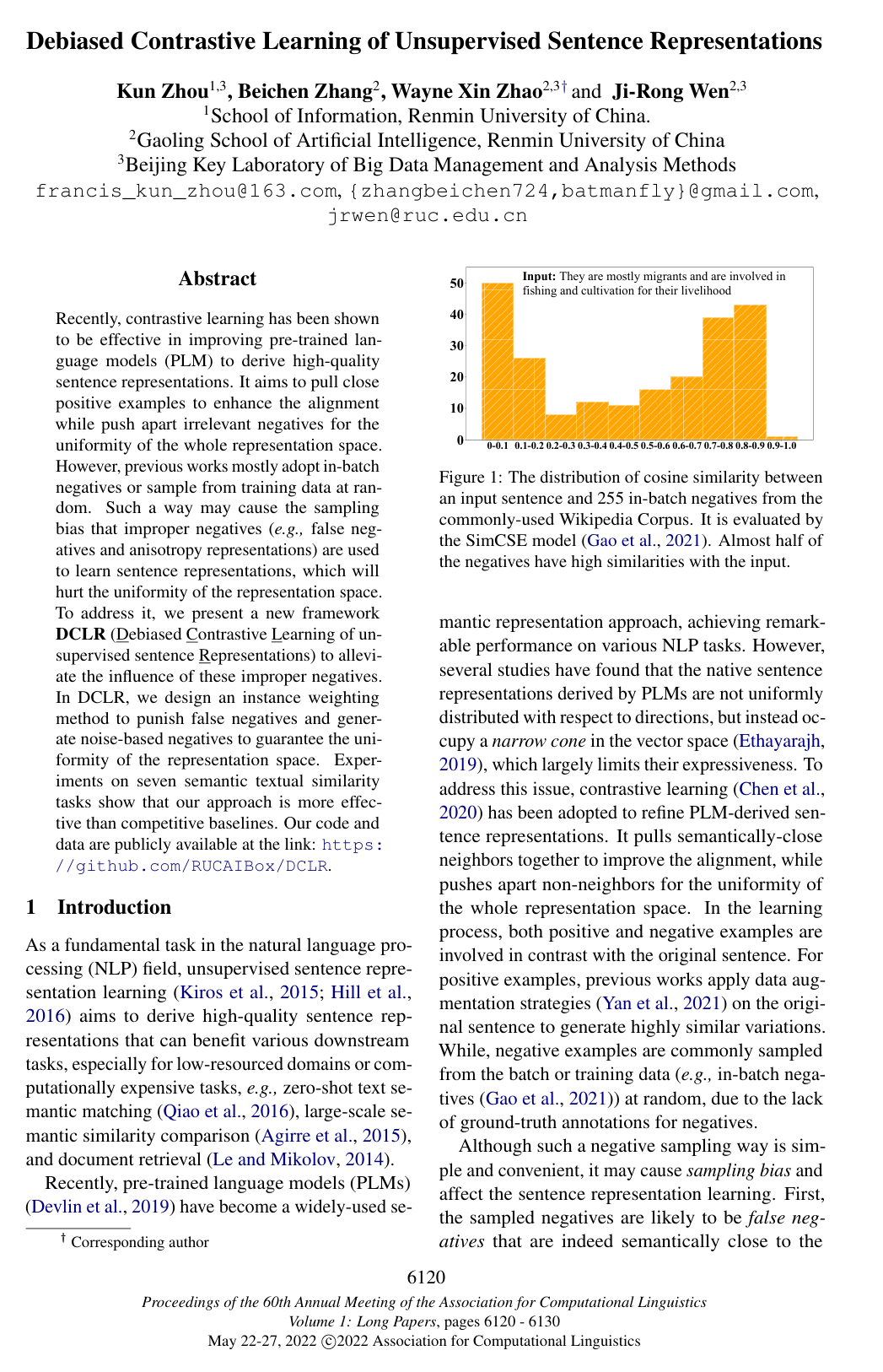
Recently, contrastive learning has been shown to be effective in improving pre-trained language models (PLM) to derive high-quality sentence representations. It aims to pull close positive examples to enhance the alignment while push apart irrelevant negatives for the uniformity of the whole representation space. However, previous works mostly adopt in-batch negatives or sample from training data at random. Such a way may cause the sampling bias that improper negatives (e.g., false negatives and anisotropy representations) are used to learn sentence representations, which will hurt the uniformity of the representation space. To address it, we present a new framework DCLR (Debiased Contrastive Learning of unsupervised sentence Representations) to alleviate the influence of these improper negatives. In DCLR, we design an instance weighting method to punish false negatives and generate noise-based negatives to guarantee the uniformity of the representation space. Experiments on seven semantic textual similarity tasks show that our approach is more effective than competitive baselines. Our code and data are publicly available at the link: https://github.com/RUCAIBox/DCLR.

Added

2026-09-26