
keyword
position bias
Position bias is the systematic tendency of an algorithm, computational model, or human user to evaluate, select, or pay disproportionate attention to an item, option, or piece of information based primarily on its sequential placement or order of presentation rather than its intrinsic merit or relevance. In information retrieval and ranking systems, it commonly manifests when users preferentially examine and click items displayed near the top of a list regardless of their actual relevance. In natural language processing and machine learning, position bias occurs when models demonstrate skewed predictions, preferential scoring, or degraded comprehension depending on where specific tokens, multiple-choice candidates, or context documents appear within an input sequence.
8 items
On the Emergence of Position Bias in Transformers
Xinyi Wu, Yifei Wang, Stefanie Jegelka, Ali Jadbabaie
Why you should read this
Develops a graph-theoretic framework that mathematically explains how multi-layer causal masking and relative positional encodings interact across depth to produce systematic position biases such as attention sinks and the lost-in-the-middle effect in transformers.
Recent studies have revealed various manifestations of position bias in transformer architectures, from the “lost-in-the-middle” phenomenon to attention sinks, yet a comprehensive theoretical understanding of how attention masks and positional encodings shape these biases remains elusive. This paper presents a graph-theoretic framework for analyzing position bias in multi-layer attention. Modeling attention masks as directed graphs, we quantify how tokens interact with contextual information based on their sequential positions. We uncover two key insights: First, causal masking inherently biases attention toward earlier positions, as tokens in deeper layers attend to increasingly more contextualized representations of earlier tokens. Second, we characterize the competing effects of the causal mask and relative positional encodings, such as the decay mask and rotary positional encoding (RoPE): while both mechanisms introduce distance-based decay within individual attention maps, their aggregate effect across multiple attention layers—coupled with the causal mask—leads to a trade-off between the long-term decay effects and the cumulative importance of early sequence positions. Through controlled numerical experiments, we not only validate our theoretical findings but also reproduce position biases observed in real-world LLMs. Our framework offers a principled foundation for understanding positional biases in transformers, shedding light on the complex interplay of attention mechanism components and guiding more informed architectural design.
Added
2026-10-05
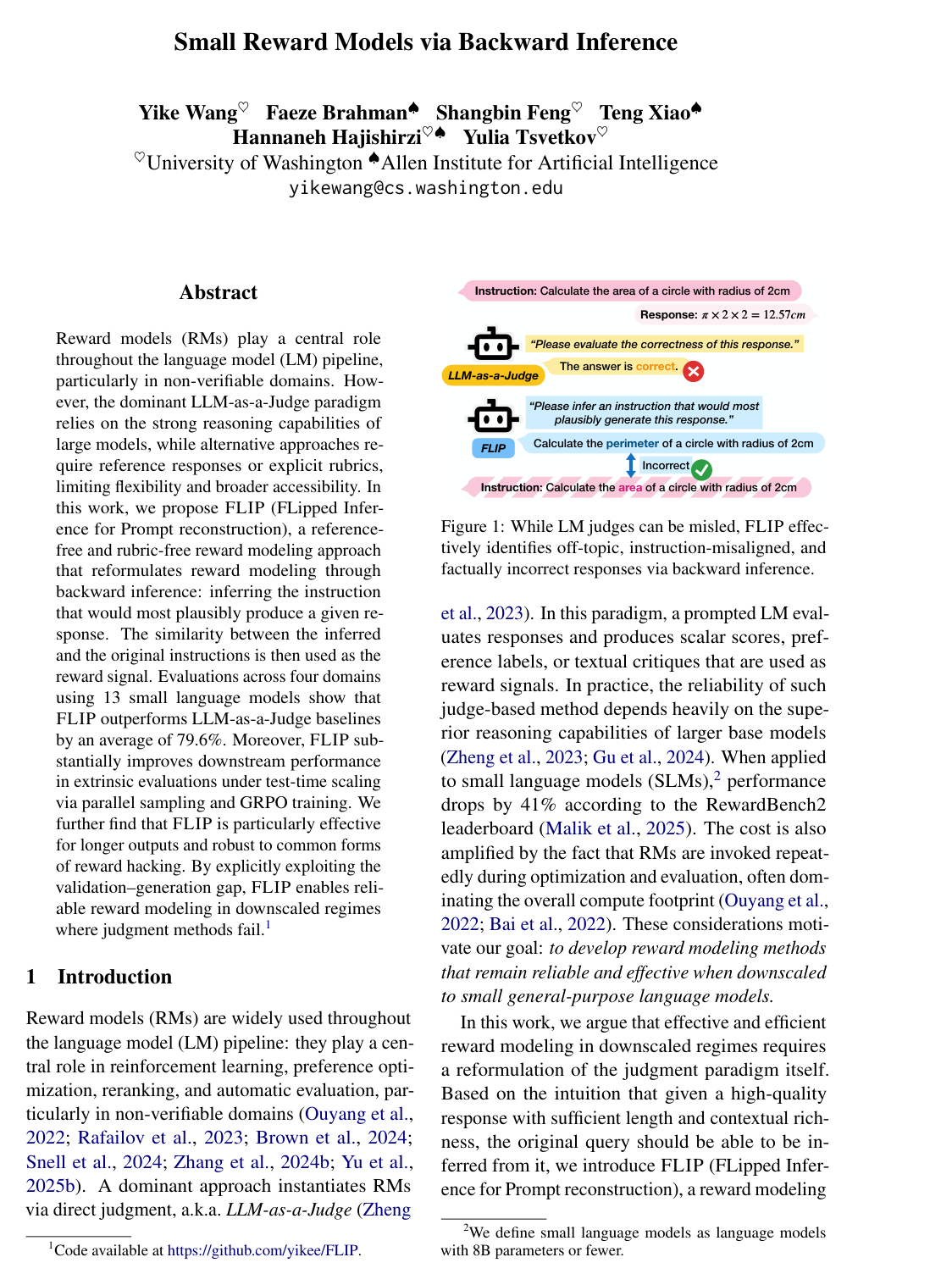
Small Reward Models via Backward Inference
Yike Wang, Faeze Brahman, Shangbin Feng, Teng Xiao, Hannaneh Hajishirzi, Yulia Tsvetkov
Why you should read this
Introduces FLIP, a reference-free framework that enables small language models to serve as accurate reward models by reconstructing original prompts from responses, substantially outperforming standard LLM-as-a-Judge methods and resisting reward hacking.
Reward models (RMs) play a central role throughout the language model (LM) pipeline, particularly in non-verifiable domains. However, the dominant LLM-as-a-Judge paradigm relies on the strong reasoning capabilities of large models, while alternative approaches require reference responses or explicit rubrics, limiting flexibility and broader accessibility. In this work, we propose FLIP (FLipped Inference for Prompt reconstruction), a reference-free and rubric-free reward modeling approach that reformulates reward modeling through backward inference: inferring the instruction that would most plausibly produce a given response. The similarity between the inferred and the original instructions is then used as the reward signal. Evaluations across four domains using 13 small language models show that FLIP outperforms LLM-as-a-Judge baselines by an average of 79.6%. Moreover, FLIP substantially improves downstream performance in extrinsic evaluations under test-time scaling via parallel sampling and GRPO training. We further find that FLIP is particularly effective for longer outputs and robust to common forms of reward hacking. By explicitly exploiting the validation-generation gap, FLIP enables reliable reward modeling in downscaled regimes where judgment methods fail. Code available at this https URL.
Added
2026-10-04
When Benchmarks are Targets: Revealing the Sensitivity of Large Language Model Leaderboards
Norah A. Alzahrani, Hisham Abdullah Alyahya, Yazeed Alnumay, Sultan Alrashed, Shaykhah Alsubaie, Yousef Almushayqih, Faisal Mirza, Nouf Alotaibi, Nora Al-Twairesh, Areeb Alowisheq, M. Saiful Bari, Haidar Khan
Why you should read this
Demonstrates that minor prompt perturbations and scoring variations in multiple-choice benchmarks like MMLU can drastically shift language model rankings by up to eight positions, exposing widespread evaluation biases and establishing practical guidelines for reliable model comparison.
Large Language Model (LLM) leaderboards based on benchmark rankings are regularly used to guide practitioners in model selection. Often, the published leaderboard rankings are taken at face value — we show this is a (potentially costly) mistake. Under existing leaderboards, the relative performance of LLMs is highly sensitive to (often minute) details. We show that for popular multiple-choice question benchmarks (e.g., MMLU), minor perturbations to the benchmark, such as changing the order of choices or the method of answer selection, result in changes in rankings up to 8 positions. We explain this phenomenon by conducting systematic experiments over three broad categories of benchmark perturbations and identifying the sources of this behavior. Our analysis results in several best-practice recommendations, including the advantage of a hybrid scoring method for answer selection. Our study highlights the dangers of relying on simple benchmark evaluations and charts the path for more robust evaluation schemes on the existing benchmarks. The code for this paper is available at https://github.com/National-Center-for-AI-Saudi-Arabia/lm-evaluation-harness.
Added
2026-10-01
Split and Merge: Aligning Position Biases in LLM-based Evaluators
Zongjie Li, Chaozheng Wang, Pingchuan Ma, Daoyuan Wu, Shuai Wang, Cuiyun Gao, Yang Liu
Why you should read this
Proposes PORTIA, a split-and-merge prompting framework that mitigates pairwise position bias in large language model evaluators by segmenting and aligning candidate answers, enabling cost-effective models like GPT-3.5 to rival or exceed standalone GPT-4 in human agreement.
Large language models (LLMs) have shown promise as automated evaluators for assessing the quality of answers generated by AI systems. However, LLM-based evaluators exhibit position bias, or inconsistency, when used to evaluate candidate answers in pairwise comparisons, favoring either the first or second answer regardless of content. To address this limitation, we propose PORTIA, an alignment-based system designed to mimic human comparison strategies to calibrate position bias in a lightweight yet effective manner. Specifically, PORTIA splits the answers into multiple segments, taking into account both length and semantics, and merges them back into a single prompt for evaluation by LLMs. Extensive experiments with six LLMs on 11,520 answer pairs demonstrate that PORTIA markedly enhances the consistency rates for all models and forms of comparison tested, achieving an average relative improvement of 47.46%. It also enables PORTIA-enhanced GPT-3.5 to achieve agreement rates with humans comparable to GPT-4 and elevates GPT-4’s consistency rate up to 98%. Subsequent human evaluations indicate that the PORTIA-enhanced GPT-3.5 model can even surpass standalone GPT-4 in terms of alignment with human evaluators, highlighting PORTIA’s ability to correct position bias, improve LLM consistency, and boost performance while keeping cost efficiency. can quantify token-level overlap with reference texts but fall short in evaluating semantic quality. While human evaluators provide more accurate and valuable feedback, often considered the “gold standards,” their scalability is generally low, given that they are costly and time-consuming. As a result, there emerges a growing need for automated evaluation methods that reliably align with human yet remain efficient and cost-effective.
Added
2026-09-26
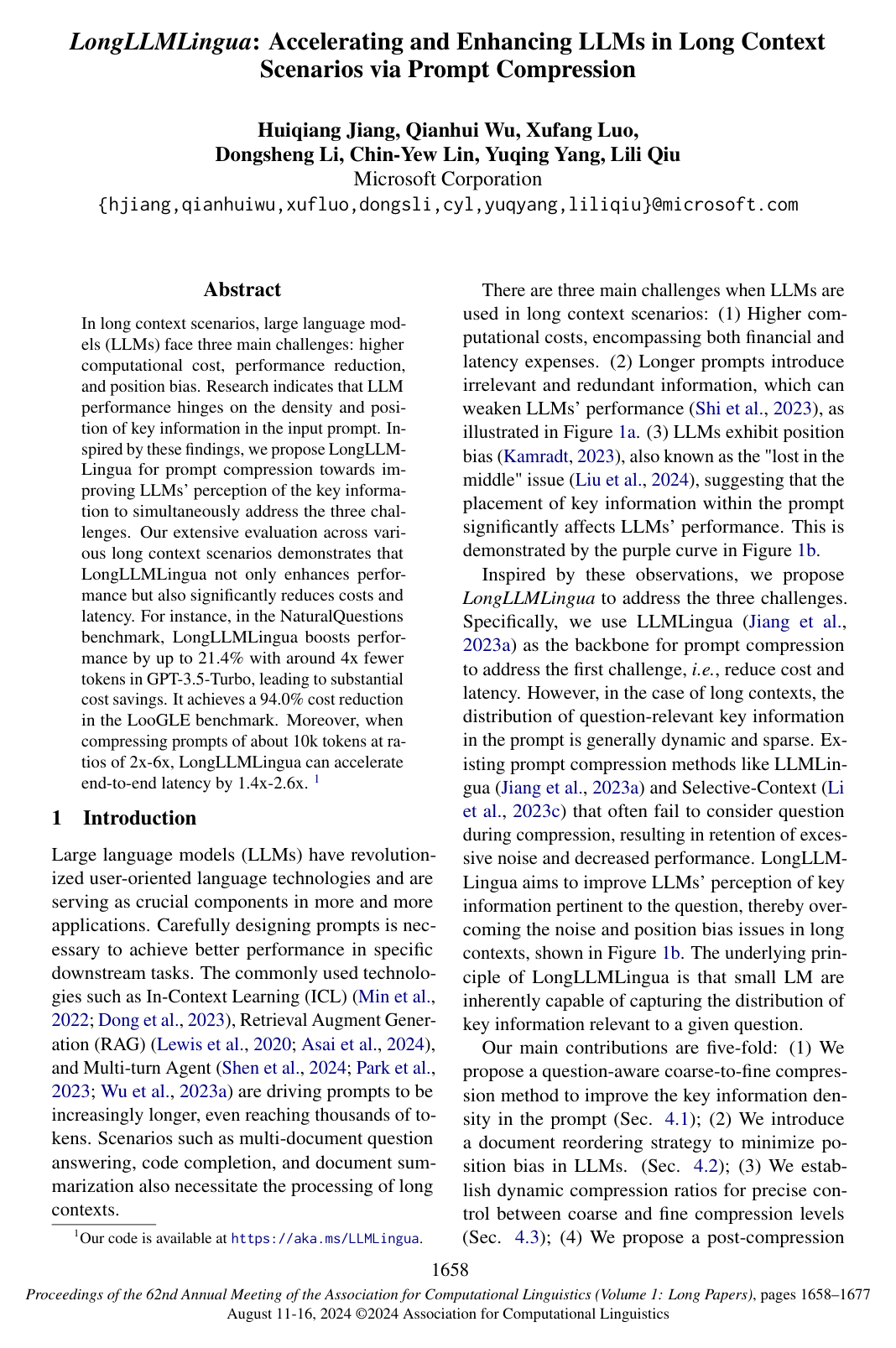
LongLLMLingua: Accelerating and Enhancing LLMs in Long Context Scenarios via Prompt Compression
Huiqiang Jiang, Qianhui Wu, Xufang Luo, Dongsheng Li, Chin-Yew Lin, Yuqing Yang, Lili Qiu
Why you should read this
Proposes a question-aware prompt compression method that improves large language model performance by up to 21.4% while reducing token counts by up to four times and mitigating position bias in long-context processing.
In long context scenarios, large language models (LLMs) face three main challenges: higher computational cost, performance reduction, and position bias. Research indicates that LLM performance hinges on the density and position of key information in the input prompt. Inspired by these findings, we propose LongLLMLingua for prompt compression towards improving LLMs' perception of the key information to simultaneously address the three challenges. Our extensive evaluation across various long context scenarios demonstrates that LongLLMLingua not only enhances performance but also significantly reduces costs and latency. For instance, in the NaturalQuestions benchmark, LongLLMLingua boosts performance by up to 21.4% with around 4x fewer tokens in GPT-3.5-Turbo, leading to substantial cost savings. It achieves a 94.0% cost reduction in the LooGLE benchmark. Moreover, when compressing prompts of about 10k tokens at ratios of 2x-6x, LongLLMLingua can accelerate end-to-end latency by 1.4x-2.6x.
Added
2026-09-26
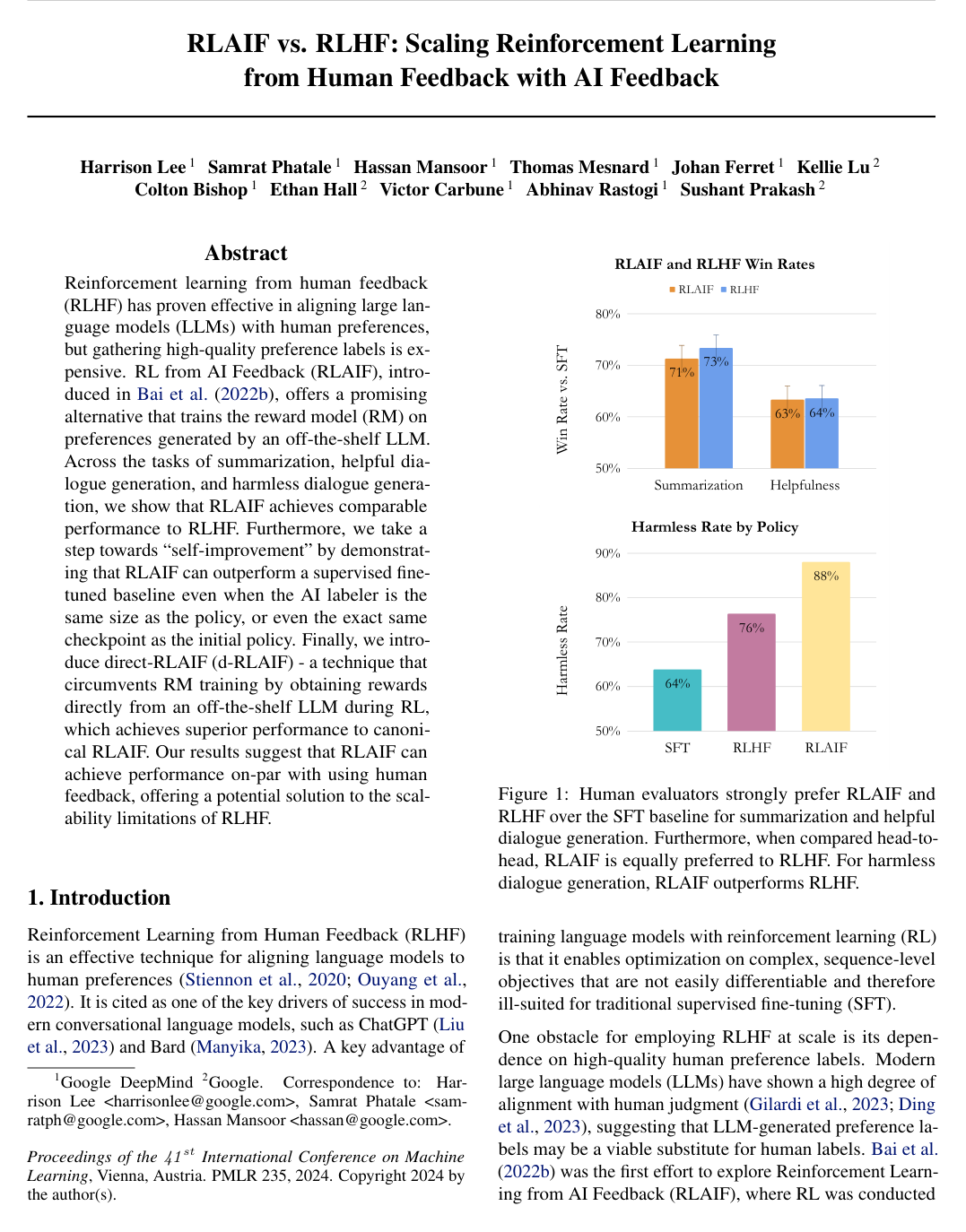
RLAIF vs. RLHF: Scaling Reinforcement Learning from Human Feedback with AI Feedback
Harrison Lee, Samrat Phatale, Hassan Mansoor, Thomas Mesnard, Johan Ferret, Kellie Lu, Colton Bishop, Ethan Hall, Victor Carbune, Abhinav Rastogi, Sushant Prakash
Why you should read this
Demonstrates that reinforcement learning from AI feedback achieves alignment performance comparable to human feedback across dialogue and summarization tasks, showing that language models can self-improve without costly human annotations and introducing direct-RLAIF to bypass reward model training.
Reinforcement learning from human feedback (RLHF) has proven effective in aligning large language models (LLMs) with human preferences, but gathering high-quality preference labels is expensive. RL from AI Feedback (RLAIF), introduced in Bai et al., offers a promising alternative that trains the reward model (RM) on preferences generated by an off-the-shelf LLM. Across the tasks of summarization, helpful dialogue generation, and harmless dialogue generation, we show that RLAIF achieves comparable performance to RLHF. Furthermore, we take a step towards "self-improvement" by demonstrating that RLAIF can outperform a supervised fine-tuned baseline even when the AI labeler is the same size as the policy, or even the exact same checkpoint as the initial policy. Finally, we introduce direct-RLAIF (d-RLAIF) - a technique that circumvents RM training by obtaining rewards directly from an off-the-shelf LLM during RL, which achieves superior performance to canonical RLAIF. Our results suggest that RLAIF can achieve performance on-par with using human feedback, offering a potential solution to the scalability limitations of RLHF.
Added
2026-09-22

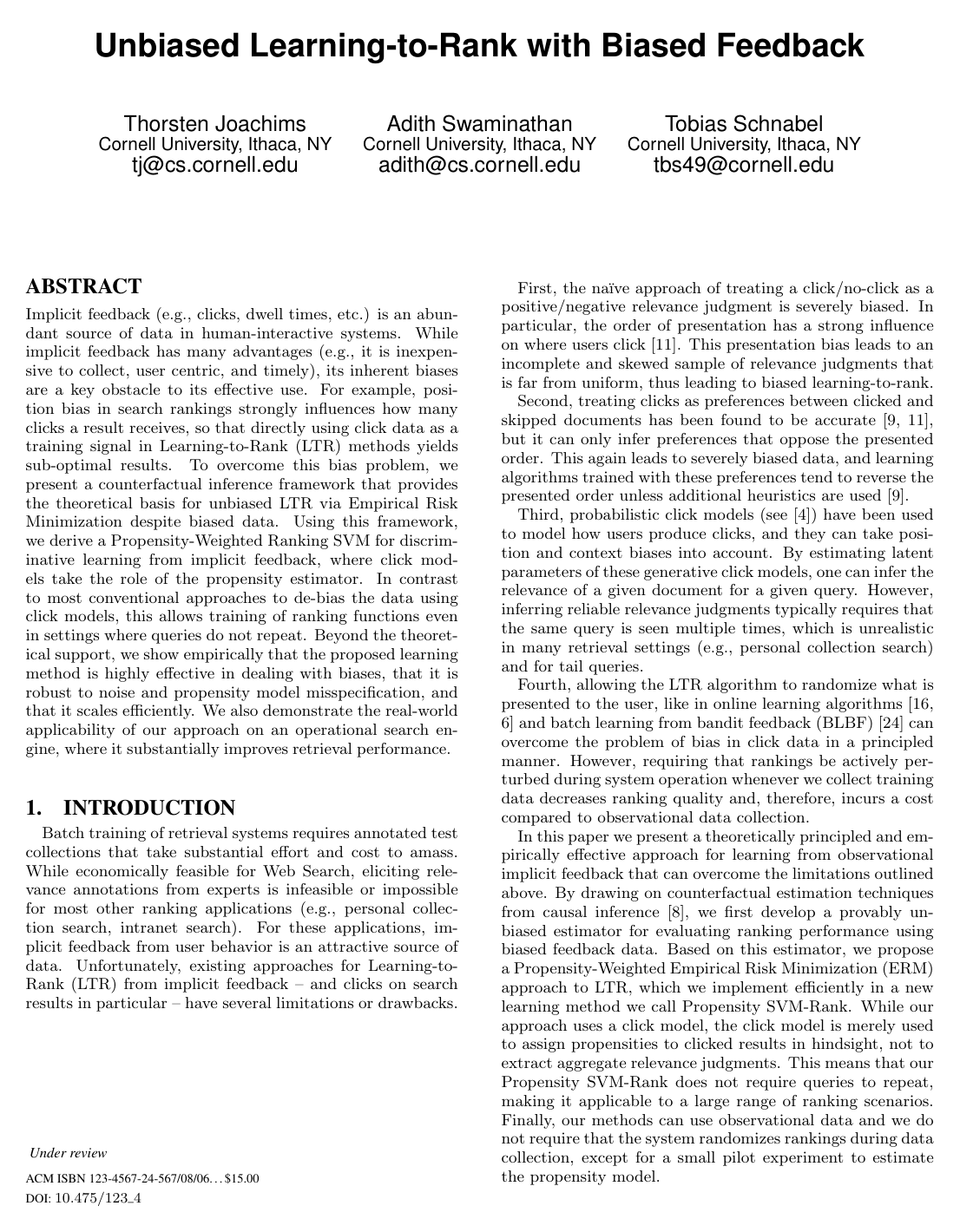
Unbiased Learning-to-Rank with Biased Feedback
Thorsten Joachims, Adith Swaminathan, Tobias Schnabel
Why you should read this
Develops a counterfactual learning framework applying inverse propensity scoring to cleanly decouple true ad relevance from inherent user interface position bias.
Implicit feedback (e.g., clicks, dwell times, etc.) is an abundant source of data in human-interactive systems. While implicit feedback has many advantages (e.g., it is inexpensive to collect, user centric, and timely), its inherent biases are a key obstacle to its effective use. For example, position bias in search rankings strongly influences how many clicks a result receives, so that directly using click data as a training signal in Learning-to-Rank (LTR) methods yields sub-optimal results. To overcome this bias problem, we present a counterfactual inference framework that provides the theoretical basis for unbiased LTR via Empirical Risk Minimization despite biased data. Using this framework, we derive a Propensity-Weighted Ranking SVM for discriminative learning from implicit feedback, where click models take the role of the propensity estimator. In contrast to most conventional approaches to de-biasing the data using click models, this allows training of ranking functions even in settings where queries do not repeat. Beyond the theoretical support, we show empirically that the proposed learning method is highly effective in dealing with biases, that it is robust to noise and propensity model misspecification, and that it scales efficiently. We also demonstrate the real-world applicability of our approach on an operational search engine, where it substantially improves retrieval performance.
Added
2026-05-31
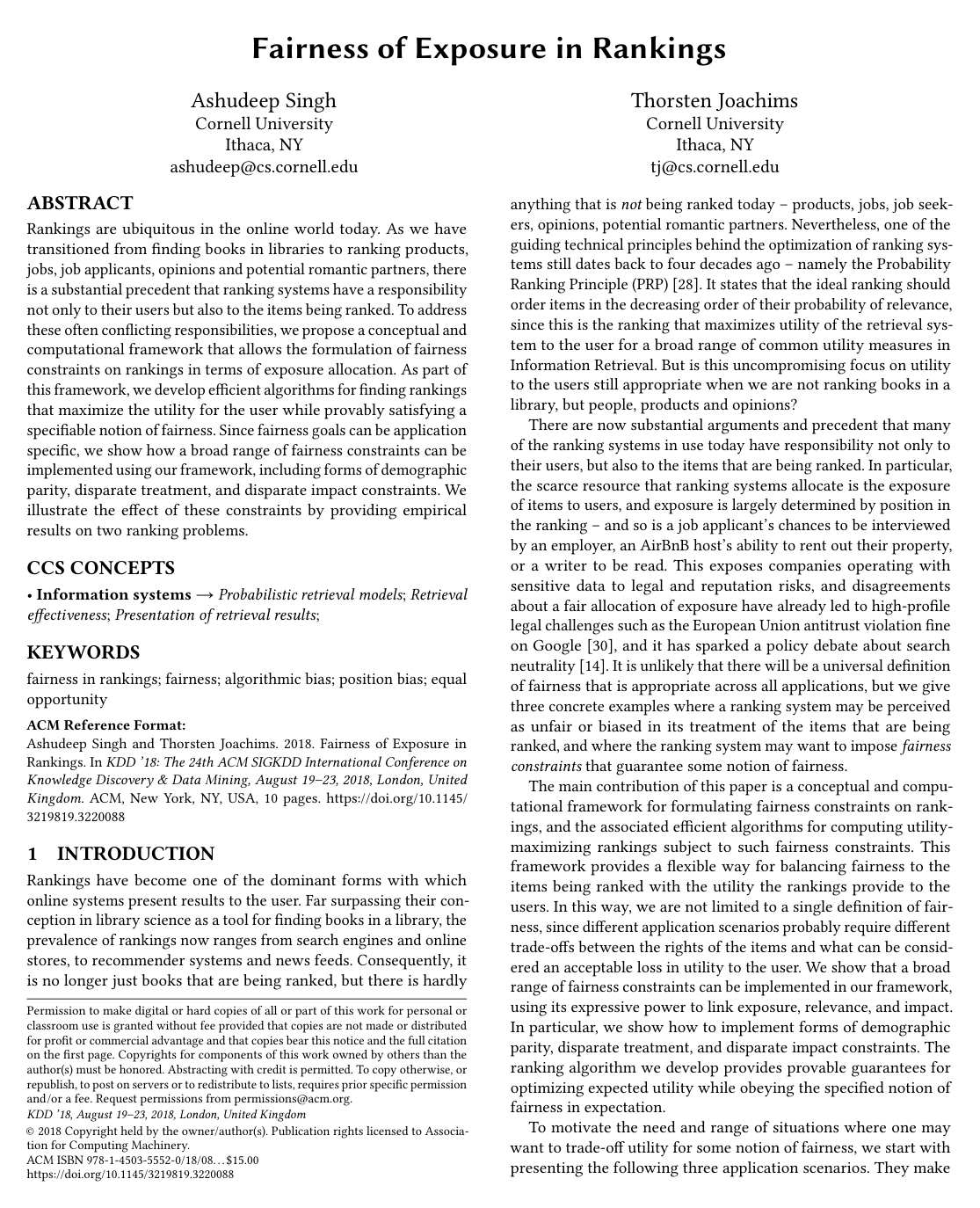
Fairness of Exposure in Rankings
Ashudeep Singh, Thorsten Joachims
Why you should read this
Formalizes fairness as a constrained optimization problem, ensuring that items or authors receive exposure proportional to their relevance.
Rankings are ubiquitous in the online world today. As we have transitioned from finding books in libraries to ranking products, jobs, job applicants, opinions and potential romantic partners, there is a substantial precedent that ranking systems have a responsibility not only to their users but also to the items being ranked. To address these often conflicting responsibilities, we propose a conceptual and computational framework that allows the formulation of fairness constraints on rankings in terms of exposure allocation. As part of this framework, we develop efficient algorithms for finding rankings that maximize the utility for the user while provably satisfying a specifiable notion of fairness. Since fairness goals can be application specific, we show how a broad range of fairness constraints can be implemented using our framework, including forms of demographic parity, disparate treatment, and disparate impact constraints. We illustrate the effect of these constraints by providing empirical results on two ranking problems.
Added
2026-01-25