
keyword
Policy smoothing
Policy smoothing is a regularization technique in reinforcement learning that promotes stability and continuity in an agent decision-making by ensuring that similar states or actions produce consistent policy behaviors and value estimates. Commonly implemented in continuous control domains and actor-critic algorithms, the approach introduces controlled noise or explicit mathematical penalties during training to suppress abrupt, erratic changes in policy outputs. By preventing the learning algorithm from overfitting to sharp, narrow peaks in the estimated value landscape caused by function approximation errors, policy smoothing mitigates overestimation bias, stabilizes training dynamics, and improves the robustness of the learned policy against observation deviations, sensor noise, and distribution shifts.
2 items
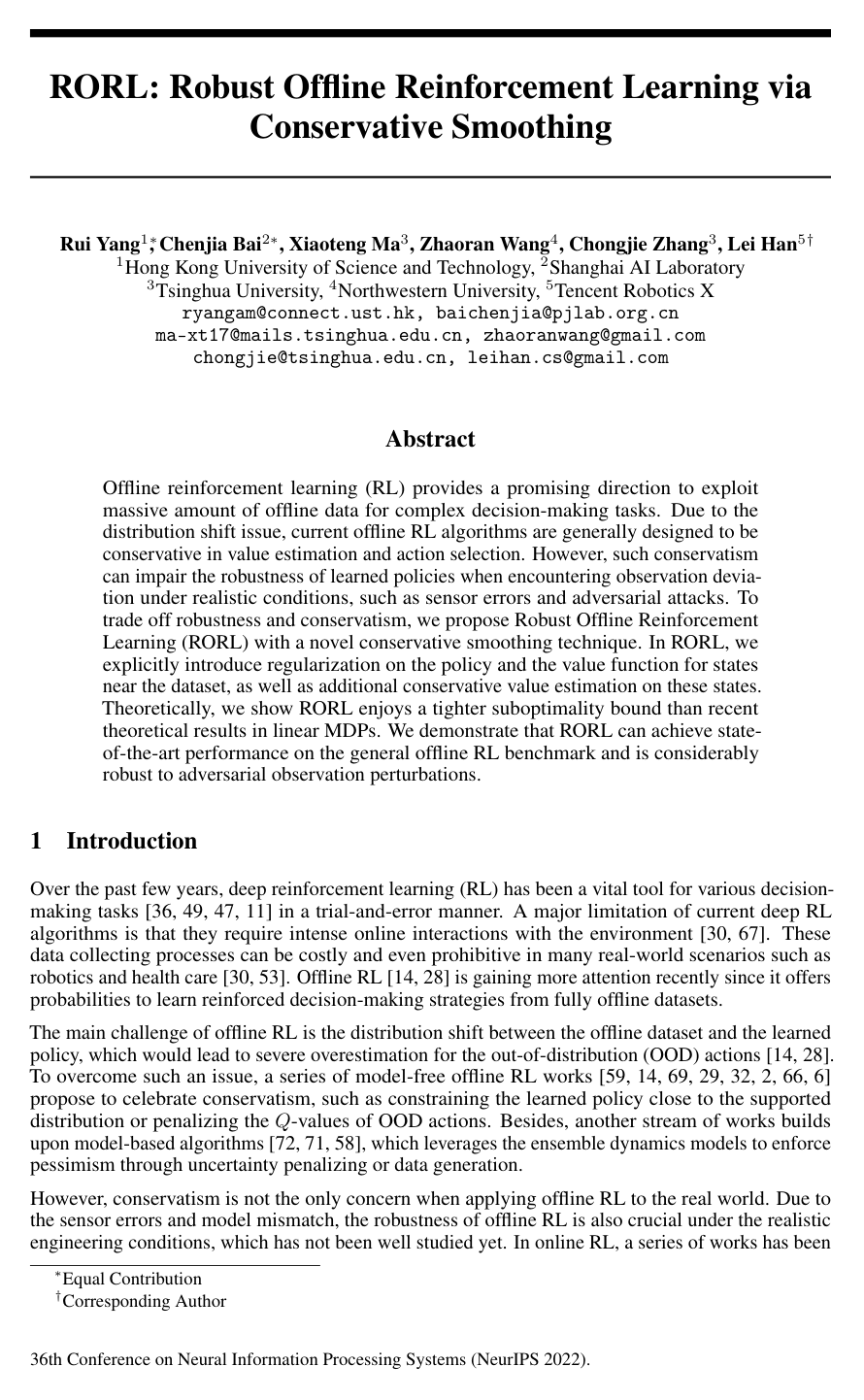
RORL: Robust Offline Reinforcement Learning via Conservative Smoothing
Rui Yang, Chenjia Bai, Xiaoteng Ma, Zhaoran Wang, Chongjie Zhang, Lei Han
Why you should read this
Proposes a conservative smoothing technique for offline reinforcement learning that simultaneously regularizes policy and value functions near the dataset support, achieving state-of-the-art D4RL benchmark performance while defending against adversarial observation perturbations.
Offline reinforcement learning (RL) provides a promising direction to exploit massive amount of offline data for complex decision-making tasks. Due to the distribution shift issue, current offline RL algorithms are generally designed to be conservative in value estimation and action selection. However, such conservatism can impair the robustness of learned policies when encountering observation deviation under realistic conditions, such as sensor errors and adversarial attacks. To trade off robustness and conservatism, we propose Robust Offline Reinforcement Learning (RORL) with a novel conservative smoothing technique. In RORL, we explicitly introduce regularization on the policy and the value function for states near the dataset, as well as additional conservative value estimation on these states. Theoretically, we show RORL enjoys a tighter suboptimality bound than recent theoretical results in linear MDPs. We demonstrate that RORL can achieve state-of-the-art performance on the general offline RL benchmark and is considerably robust to adversarial observation perturbations.
Added
2026-09-26
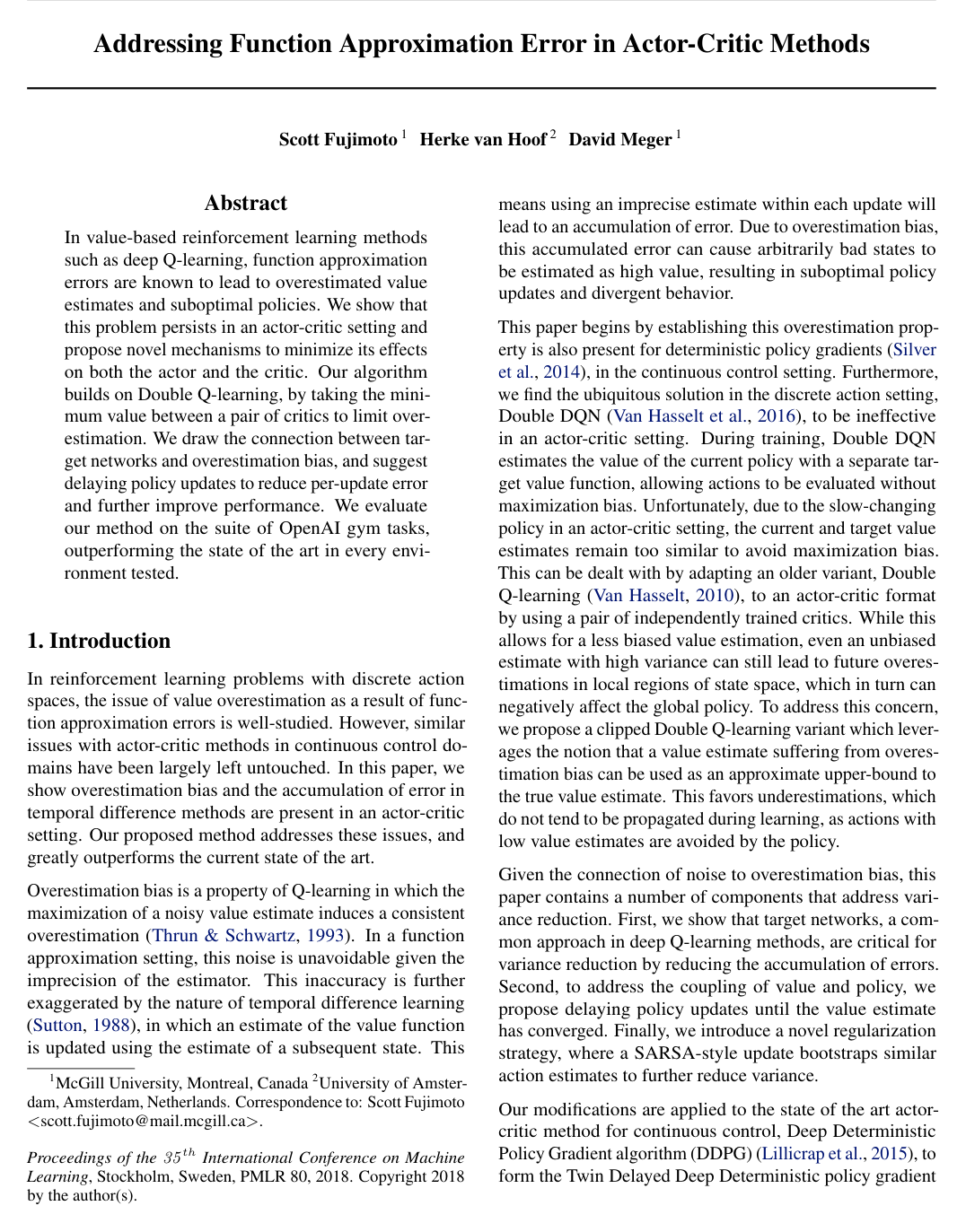
Addressing Function Approximation Error in Actor-Critic Methods
Scott Fujimoto, Herke van Hoof, David Meger
Why you should read this
Introduces TD3, a reinforcement learning algorithm that curbs value overestimation in continuous actor-critic methods by pairing critic networks with delayed policy updates to surpass state-of-the-art continuous control baselines.
In value-based reinforcement learning methods such as deep Q-learning, function approximation errors are known to lead to overestimated value estimates and suboptimal policies. We show that this problem persists in an actor-critic setting and propose novel mechanisms to minimize its effects on both the actor and the critic. Our algorithm builds on Double Q-learning, by taking the minimum value between a pair of critics to limit overestimation. We draw the connection between target networks and overestimation bias, and suggest delaying policy updates to reduce per-update error and further improve performance. We evaluate our method on the suite of OpenAI gym tasks, outperforming the state of the art in every environment tested.
Added
2026-09-08