
keyword
pivot language
A pivot language is an intermediary language used to help communicate or process information between other languages. In multilingual language-model tasks, the model may use a high-resource pivot language to understand an instruction, then generate its response in the requested target language.
2 items
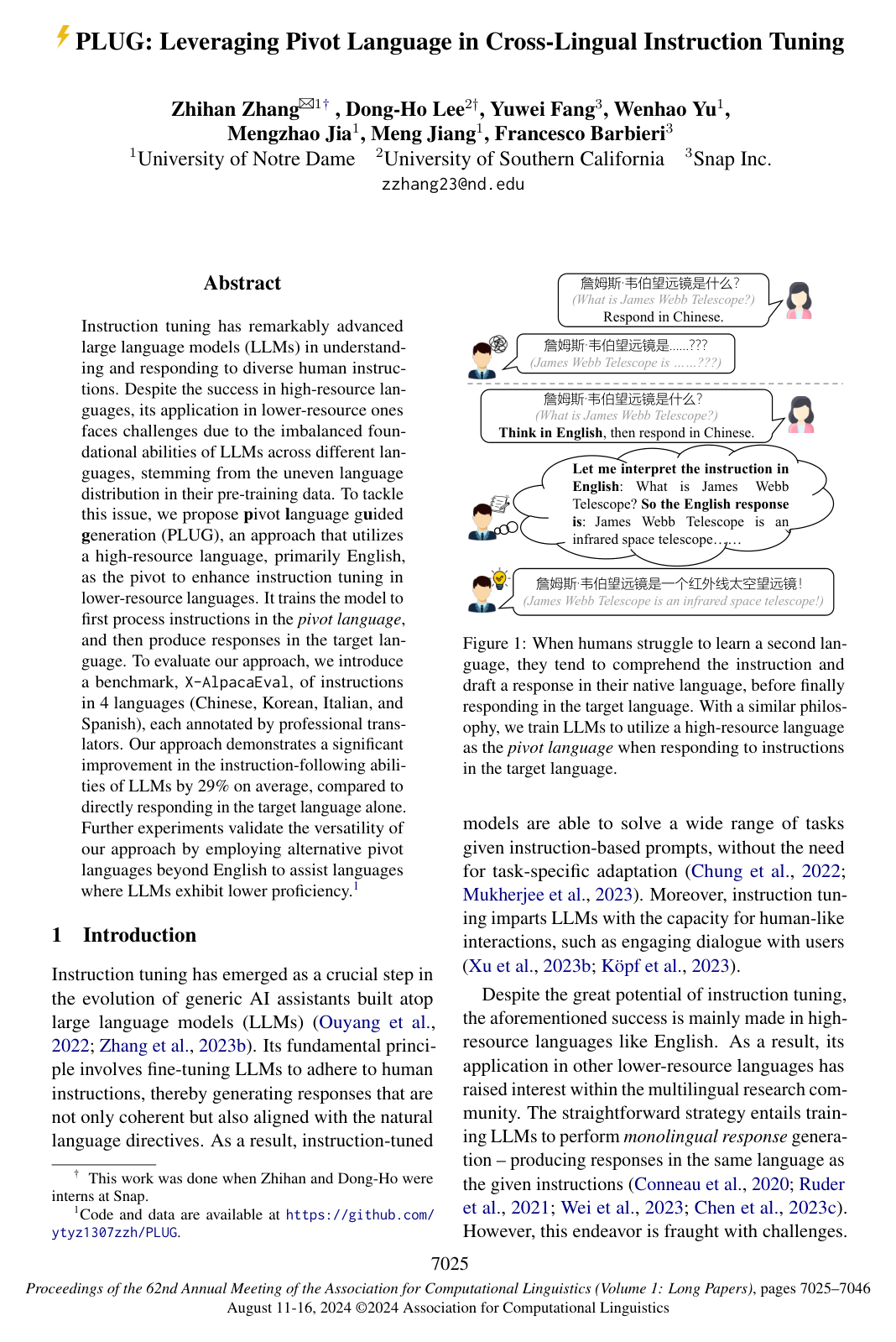
PLUG: Leveraging Pivot Language in Cross-Lingual Instruction Tuning
Zhihan Zhang, Dong-Ho Lee, Yuwei Fang, Wenhao Yu, Mengzhao Jia, Meng Jiang, Francesco Barbieri
Why you should read this
Proposes a cross-lingual instruction tuning framework that processes queries and drafts intermediate responses in a high-resource pivot language before outputting in the target language, boosting lower-resource language performance by an average of 29%.
Instruction tuning has remarkably advanced large language models (LLMs) in understanding and responding to diverse human instructions. Despite the success in high-resource languages, its application in lower-resource ones faces challenges due to the imbalanced foundational abilities of LLMs across different languages, stemming from the uneven language distribution in their pre-training data. To tackle this issue, we propose pivot language guided generation (PLUG), an approach that utilizes a high-resource language, primarily English, as the pivot to enhance instruction tuning in lower-resource languages. It trains the model to first process instructions in the pivot language, and then produce responses in the target language. To evaluate our approach, we introduce a benchmark, X-AlpacaEval, of instructions in 4 languages (Chinese, Korean, Italian, and Spanish), each annotated by professional translators. Our approach demonstrates a significant improvement in the instruction-following abilities of LLMs by 29% on average, compared to directly responding in the target language alone. Further experiments validate the versatility of our approach by employing alternative pivot languages beyond English to assist languages where LLMs exhibit lower proficiency.
Added
2026-10-04
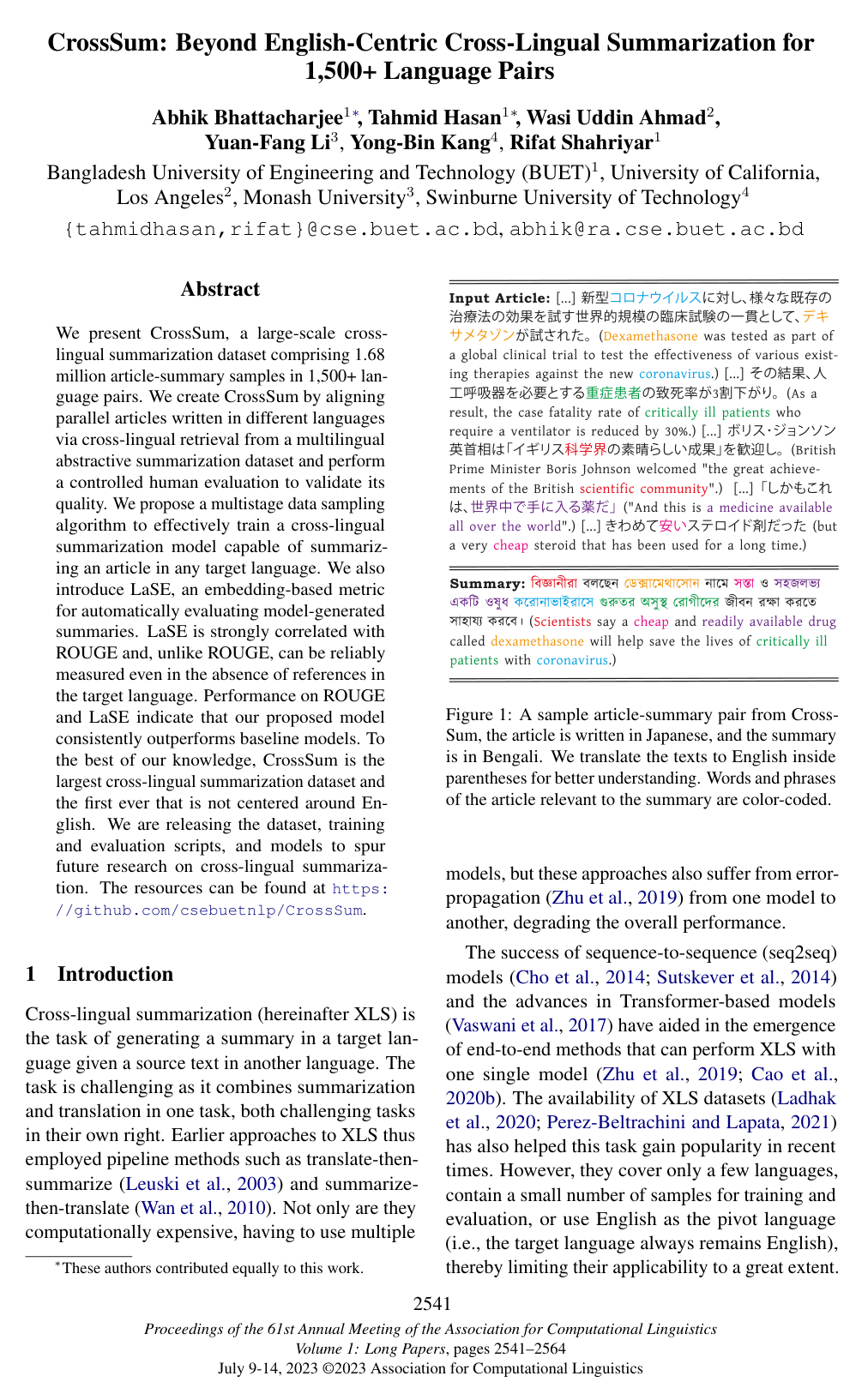
CrossSum: Beyond English-Centric Cross-Lingual Summarization for 1, 500+ Language Pairs
Abhik Bhattacharjee, Tahmid Hasan, Wasi Uddin Ahmad, Yuan-Fang Li, Yong-Bin Kang, Rifat Shahriyar
Why you should read this
Presents a large-scale dataset of 1.68 million article-summary pairs across more than 1,500 language pairs alongside a multistage sampling algorithm and an embedding-based evaluation metric to advance non-English-centric cross-lingual summarization.
We present CrossSum, a large-scale cross-lingual summarization dataset comprising 1.68 million article-summary samples in 1,500+ language pairs. We create CrossSum by aligning parallel articles written in different languages via cross-lingual retrieval from a multilingual abstractive summarization dataset and perform a controlled human evaluation to validate its quality. We propose a multistage data sampling algorithm to effectively train a cross-lingual summarization model capable of summarizing an article in any target language. We also introduce LaSE, an embedding-based metric for automatically evaluating model-generated summaries. LaSE is strongly correlated with ROUGE and, unlike ROUGE, can be reliably measured even in the absence of references in the target language. Performance on ROUGE and LaSE indicate that our proposed model consistently outperforms baseline models. To the best of our knowledge, CrossSum is the largest cross-lingual summarization dataset and the first ever that is not centered around English. We are releasing the dataset, training and evaluation scripts, and models to spur future research on cross-lingual summarization. The resources can be found at https://github.com/csebuetnlp/CrossSum.
Added
2026-09-26