
keyword
person reidentification
Person re-identification is a computer vision task focused on identifying and matching images or video sequences of the same individual across different non-overlapping camera views or across different time intervals. Unlike facial recognition systems that depend on clear facial features, person re-identification extracts and compares holistic visual attributes such as clothing colors, body shape, texture, and carried accessories. This process enables automated tracking and surveillance systems to monitor an individual across wide physical environments, overcoming practical visual challenges such as viewpoint differences, illumination changes, pose variations, and partial occlusions.
2 items
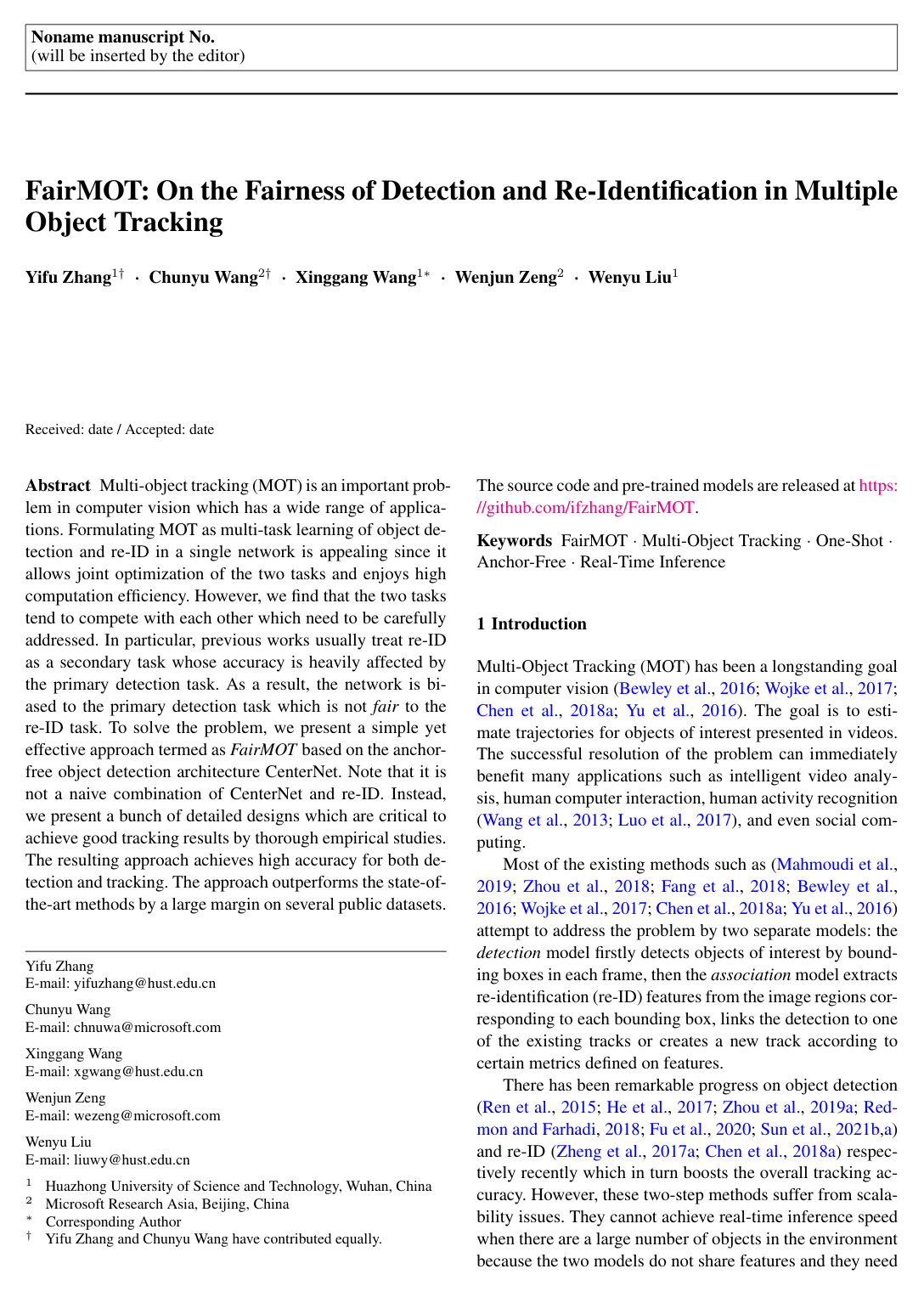
FairMOT: On the Fairness of Detection and Re-identification in Multiple Object Tracking
Yifu Zhang, Chunyu Wang, Xinggang Wang, Wenjun Zeng, Wenyu Liu
Why you should read this
Proposes FairMOT, an anchor-free tracking framework that balances object detection and re-identification within a single network to eliminate task competition and achieve state-of-the-art multi-object tracking performance.
Multi-object tracking (MOT) is an important problem in computer vision which has a wide range of applications. Formulating MOT as multi-task learning of object detection and re-ID in a single network is appealing since it allows joint optimization of the two tasks and enjoys high computation efficiency. However, we find that the two tasks tend to compete with each other which need to be carefully addressed. In particular, previous works usually treat re-ID as a secondary task whose accuracy is heavily affected by the primary detection task. As a result, the network is biased to the primary detection task which is not fair to the re-ID task. To solve the problem, we present a simple yet effective approach termed as FairMOT based on the anchor-free object detection architecture CenterNet. Note that it is not a naive combination of CenterNet and re-ID. Instead, we present a bunch of detailed designs which are critical to achieve good tracking results by thorough empirical studies. The resulting approach achieves high accuracy for both detection and tracking. The approach outperforms the state-of-the-art methods by a large margin on several public datasets. The source code and pre-trained models are released at this https URL.
Added
2026-09-18
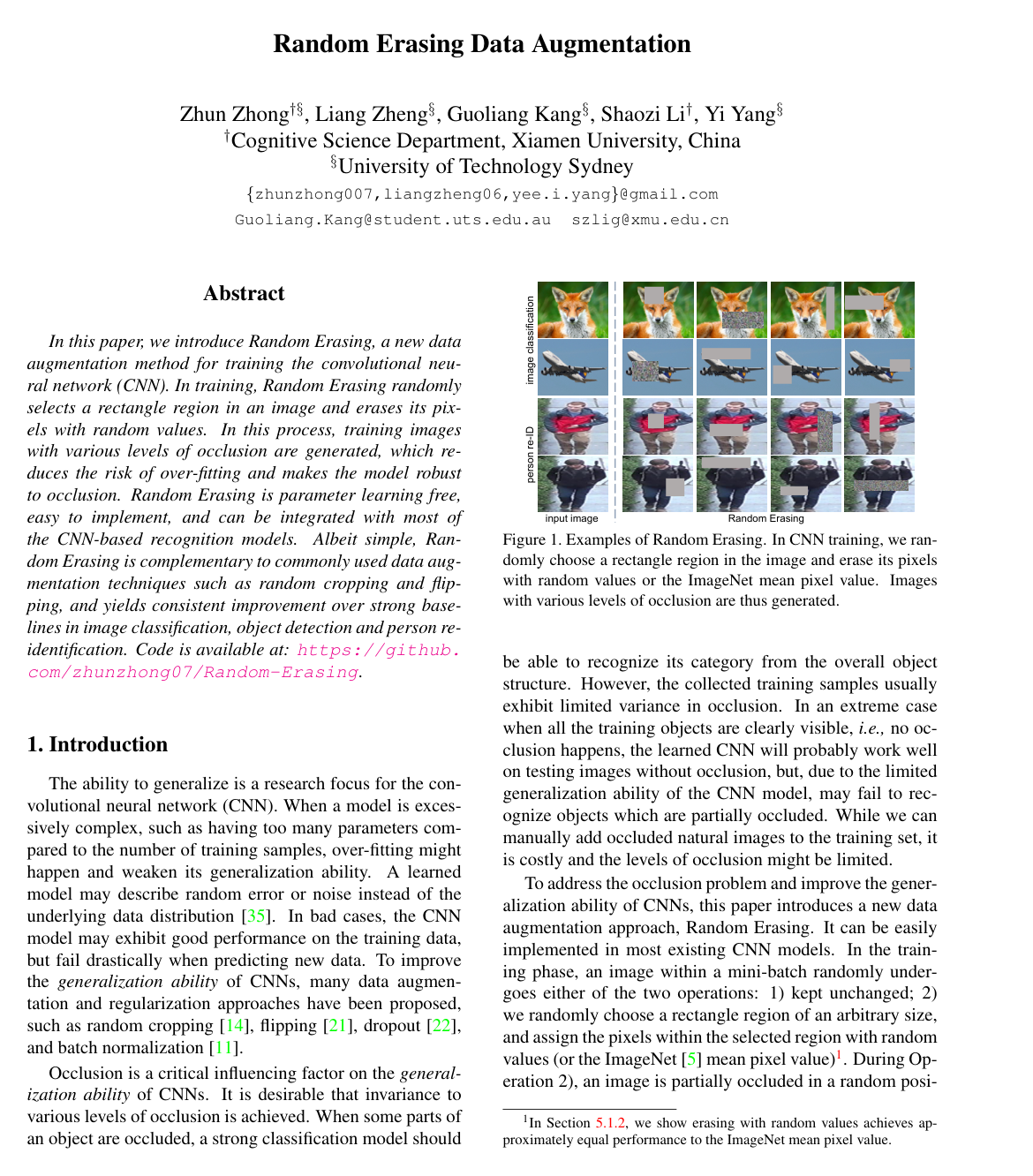
Random Erasing Data Augmentation
Zhun Zhong, Liang Zheng, Guoliang Kang, Shaozi Li, Yi Yang
Why you should read this
Introduces Random Erasing, a parameter-free data augmentation method that simulates occlusion by masking random image patches to reduce overfitting and boost model performance across image classification, object detection, and person re-identification.
In this paper, we introduce Random Erasing, a new data augmentation method for training the convolutional neural network (CNN). In training, Random Erasing randomly selects a rectangle region in an image and erases its pixels with random values. In this process, training images with various levels of occlusion are generated, which reduces the risk of over-fitting and makes the model robust to occlusion. Random Erasing is parameter learning free, easy to implement, and can be integrated with most of the CNN-based recognition models. Albeit simple, Random Erasing is complementary to commonly used data augmentation techniques such as random cropping and flipping, and yields consistent improvement over strong baselines in image classification, object detection and person re-identification. Code is available at: this https URL.
Added
2026-09-11