Built independently by an author, for readers. Read the story and support ChapterPal

keyword

paraphrasing-based methods

Paraphrasing-based methods are automated computational techniques that generate semantically equivalent variations of an initial text, query, or prompt to produce diverse alternative formulations. In natural language processing and prompt engineering, these approaches take an existing seed phrase or template and systematically reword it using mechanisms such as round-trip translation, neural text generation models, or rule-based transformations while preserving the core meaning. By creating multiple distinct phrasings of an input, these methods help identify more effective query templates, reduce model sensitivity to arbitrary lexical choices, and enable more reliable extraction and evaluation of knowledge stored within language models.

1 item

How Can We Know What Language Models Know?

How Can We Know What Language Models Know?

Zhengbao Jiang, Frank F. Xu, Jun Araki, Graham Neubig

OrganizationsCarnegie Mellon UniversityRobert Bosch Research and Technology Center

Why you should read this

Demonstrates that manual prompts underestimate the factual knowledge stored in language models and introduces automated mining, paraphrasing, and ensembling methods to substantially improve relation extraction accuracy on the LAMA benchmark.

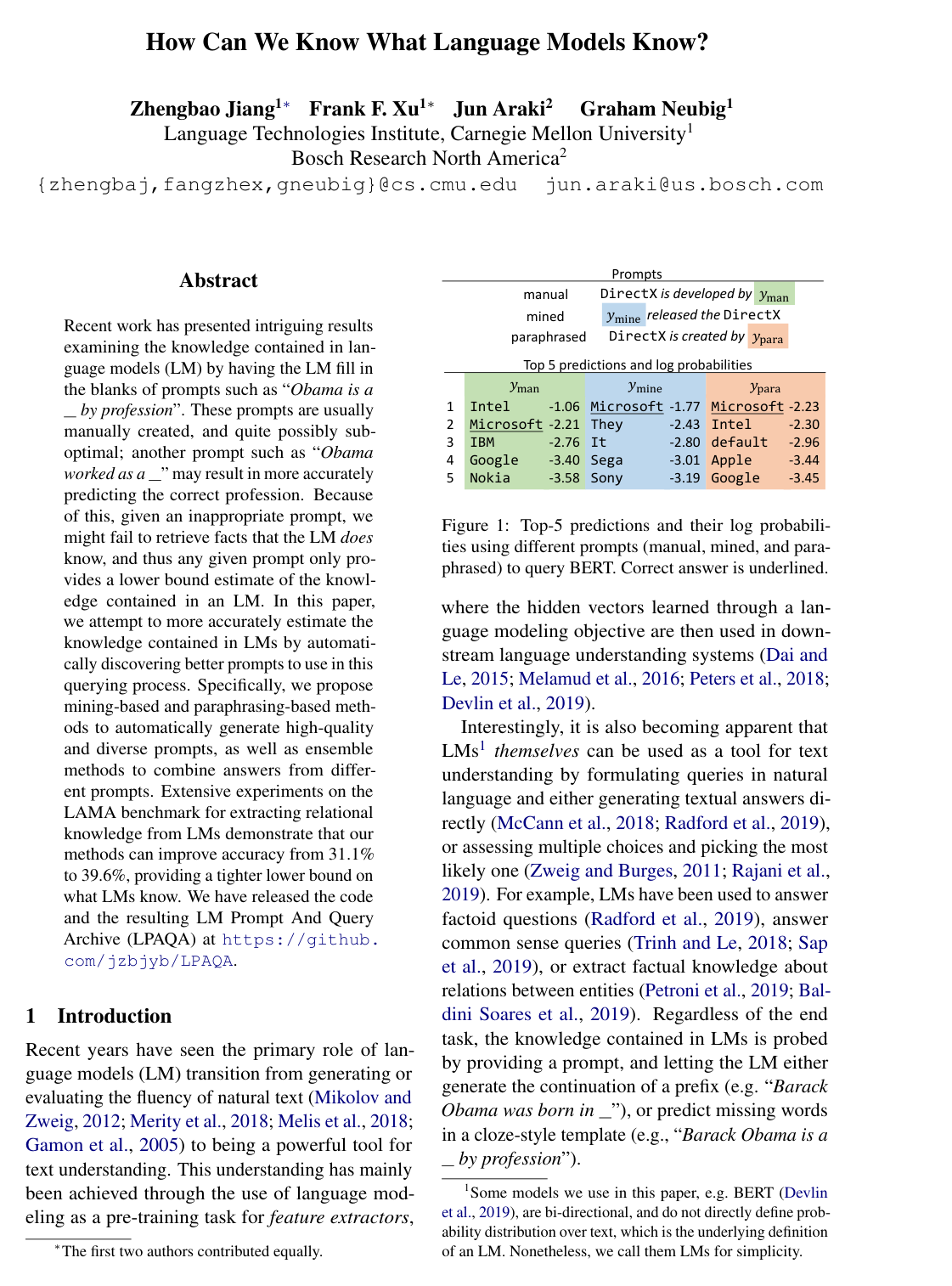
Recent work has presented intriguing results examining the knowledge contained in language models (LM) by having the LM fill in the blanks of prompts such as "Obama is a _ by profession". These prompts are usually manually created, and quite possibly sub-optimal; another prompt such as "Obama worked as a _" may result in more accurately predicting the correct profession. Because of this, given an inappropriate prompt, we might fail to retrieve facts that the LM does know, and thus any given prompt only provides a lower bound estimate of the knowledge contained in an LM. In this paper, we attempt to more accurately estimate the knowledge contained in LMs by automatically discovering better prompts to use in this querying process. Specifically, we propose mining-based and paraphrasing-based methods to automatically generate high-quality and diverse prompts, as well as ensemble methods to combine answers from different prompts. Extensive experiments on the LAMA benchmark for extracting relational knowledge from LMs demonstrate that our methods can improve accuracy from 31.1% to 39.6%, providing a tighter lower bound on what LMs know. We have released the code and the resulting LM Prompt And Query Archive (LPAQA) at this https URL.

Added

2026-09-24