
keyword
parallel corpus
A parallel corpus is a structured collection of texts accompanied by their direct translations in one or more other languages. Within such a corpus, corresponding texts are typically aligned at the document, paragraph, or sentence level to establish direct equivalents across language pairs. Parallel corpora serve as critical training and evaluation resources in natural language processing and computational linguistics, where they are used to develop machine translation models, align cross-lingual representations, and support multilingual language modeling tasks.
8 items
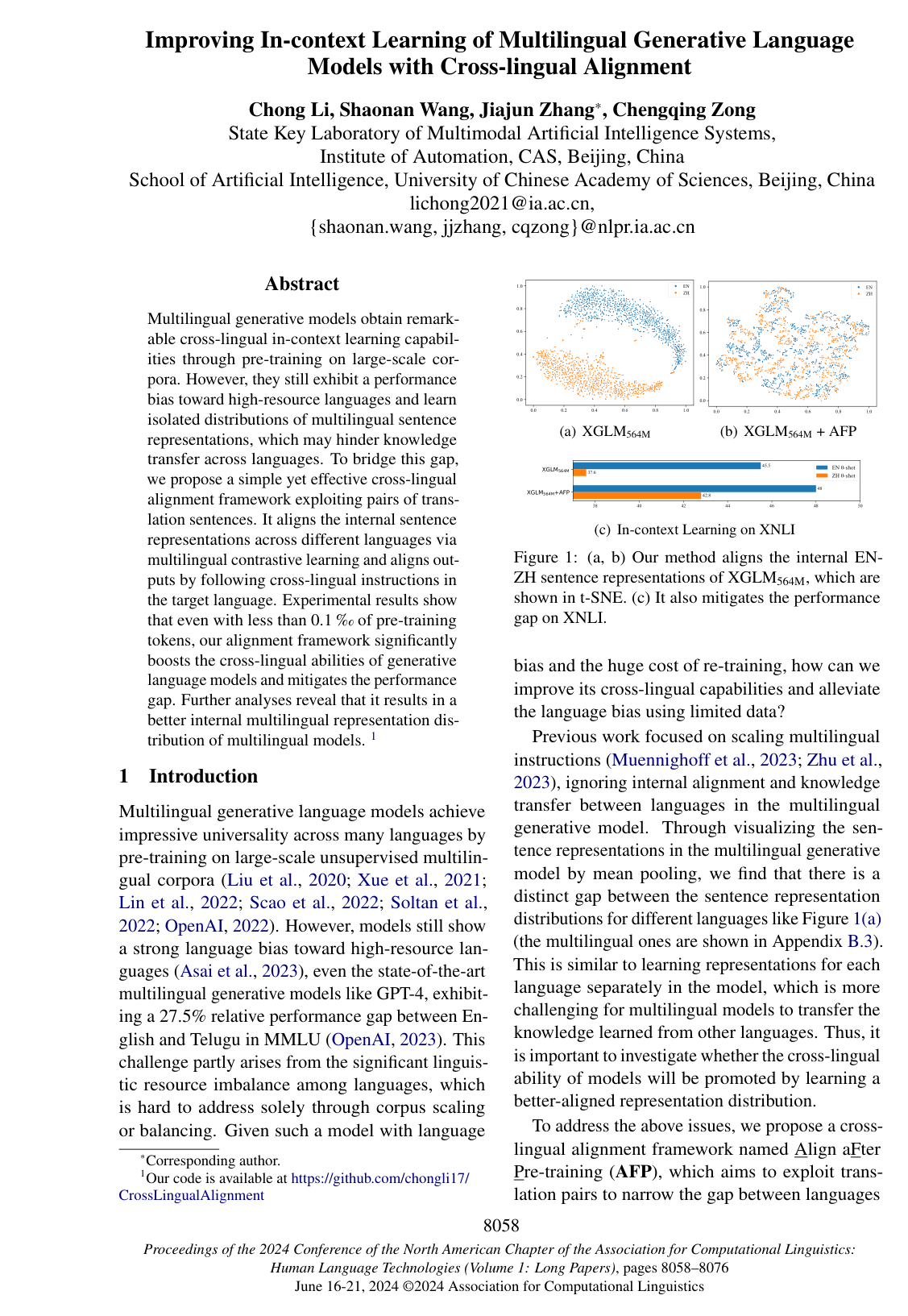
Improving In-context Learning of Multilingual Generative Language Models with Cross-lingual Alignment
Chong Li, Shaonan Wang, Jiajun Zhang, Chengqing Zong
Why you should read this
Proposes an efficient post-training alignment framework combining multilingual contrastive learning and cross-lingual instruction following to bridge the performance gap between high- and low-resource languages using fewer than one million parallel samples.
Multilingual generative models obtain remarkable cross-lingual in-context learning capabilities through pre-training on large-scale corpora. However, they still exhibit a performance bias toward high-resource languages and learn isolated distributions of multilingual sentence representations, which may hinder knowledge transfer across languages. To bridge this gap, we propose a simple yet effective cross-lingual alignment framework exploiting pairs of translation sentences. It aligns the internal sentence representations across different languages via multilingual contrastive learning and aligns outputs by following cross-lingual instructions in the target language. Experimental results show that even with less than 0.1 ‰ of pre-training tokens, our alignment framework significantly boosts the cross-lingual abilities of generative language models and mitigates the performance gap. Further analyses reveal that it results in a better internal multilingual representation distribution of multilingual models.
Added
2026-10-04
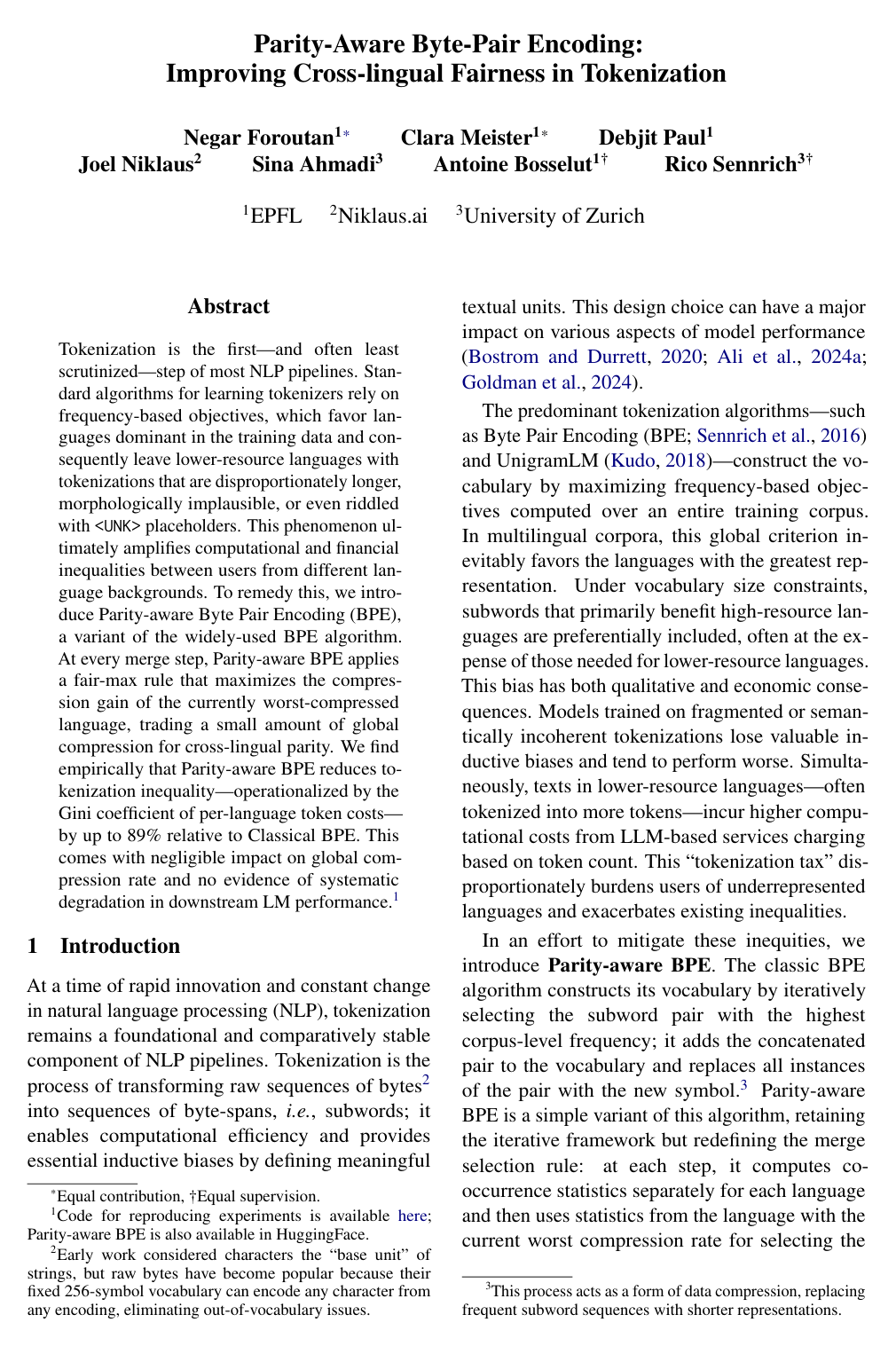
Parity-Aware Byte-Pair Encoding: Improving Cross-lingual Fairness in Tokenization
Negar Foroutan, Clara Meister, Debjit Paul, Joel Niklaus, Sina Ahmadi, Antoine Bosselut, Rico Sennrich
Why you should read this
Introduces Parity-aware Byte Pair Encoding, an algorithm that applies a fair-max merge rule to reduce cross-lingual tokenization disparity by up to 89% without compromising global compression rates or downstream language model performance.
Tokenization is the first -- and often least scrutinized -- step of most NLP pipelines. Standard algorithms for learning tokenizers rely on frequency-based objectives, which favor languages dominant in the training data and consequently leave lower-resource languages with tokenizations that are disproportionately longer, morphologically implausible, or even riddled with placeholders. This phenomenon ultimately amplifies computational and financial inequalities between users from different language backgrounds. To remedy this, we introduce Parity-aware Byte Pair Encoding (BPE), a variant of the widely-used BPE algorithm. At every merge step, Parity-aware BPE applies a fair-max rule that maximizes the compression gain of the currently worst-compressed language, trading a small amount of global compression for cross-lingual parity. We find empirically that Parity-aware BPE reduces tokenization inequality -- operationalized by the Gini coefficient of per-language token costs -- by up to 89% relative to Classical BPE. This comes with negligible impact on global compression rate and no evidence of systematic degradation in downstream LM performance.
Added
2026-10-04
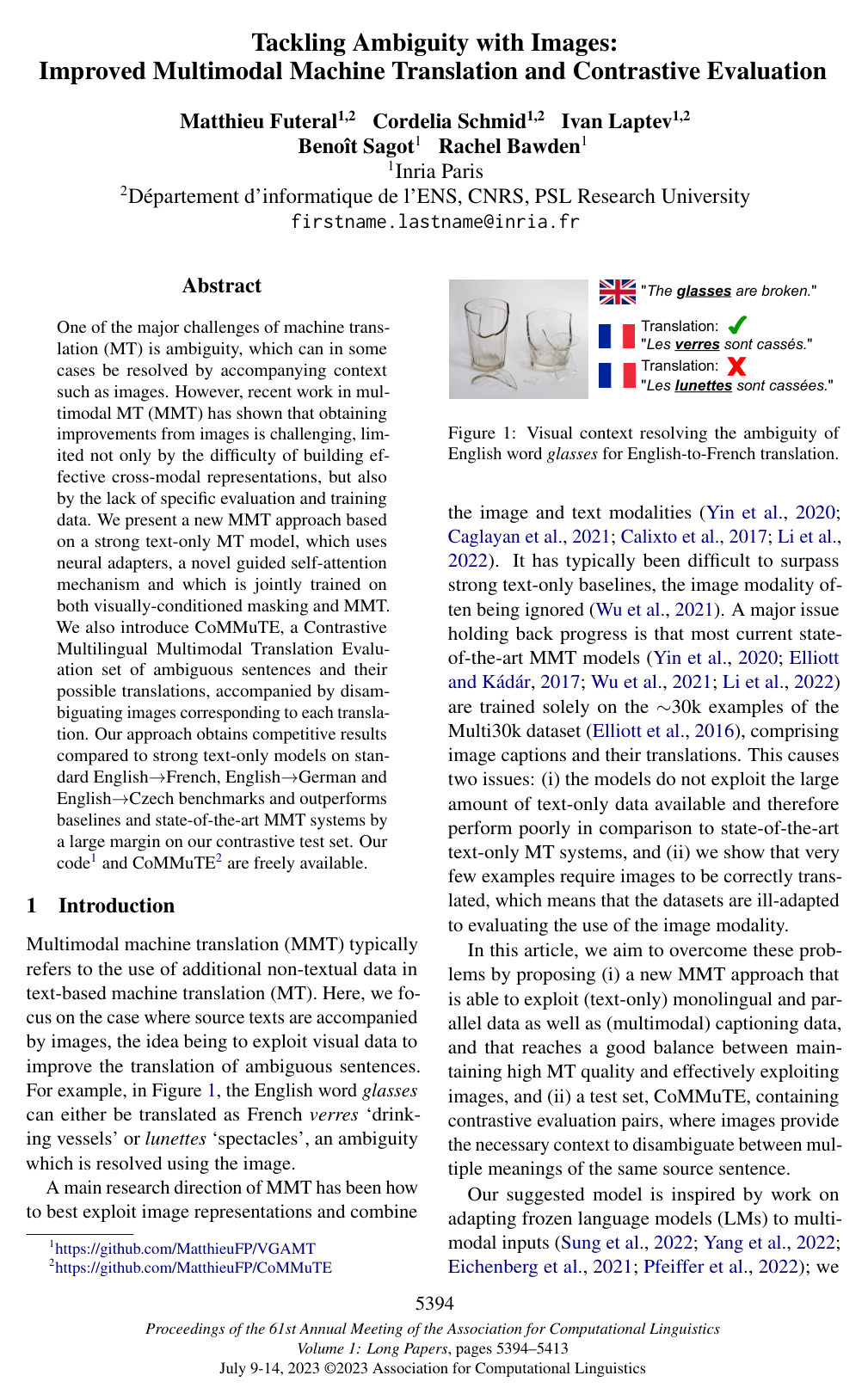
Tackling Ambiguity with Images: Improved Multimodal Machine Translation and Contrastive Evaluation
Matthieu Futeral, Cordelia Schmid, Ivan Laptev, Benoît Sagot, Rachel Bawden
Why you should read this
Proposes an adapter-based multimodal machine translation framework with guided self-attention alongside CoMMuTE, a contrastive evaluation benchmark designed to verify whether models effectively use visual context to resolve lexical ambiguity.
One of the major challenges of machine translation (MT) is ambiguity, which can in some cases be resolved by accompanying context such as images. However, recent work in multimodal MT (MMT) has shown that obtaining improvements from images is challenging, limited not only by the difficulty of building effective cross-modal representations, but also by the lack of specific evaluation and training data. We present a new MMT approach based on a strong text-only MT model, which uses neural adapters, a novel guided self-attention mechanism and which is jointly trained on both visually-conditioned masking and MMT. We also introduce CoMMuTE, a Contrastive Multilingual Multimodal Translation Evaluation set of ambiguous sentences and their possible translations, accompanied by disambiguating images corresponding to each translation. Our approach obtains competitive results compared to strong text-only models on standard English→French, English→German and English→Czech benchmarks and outperforms baselines and state-of-the-art MMT systems by a large margin on our contrastive test set. Our code¹ and CoMMuTE² are freely available.
Added
2026-10-04
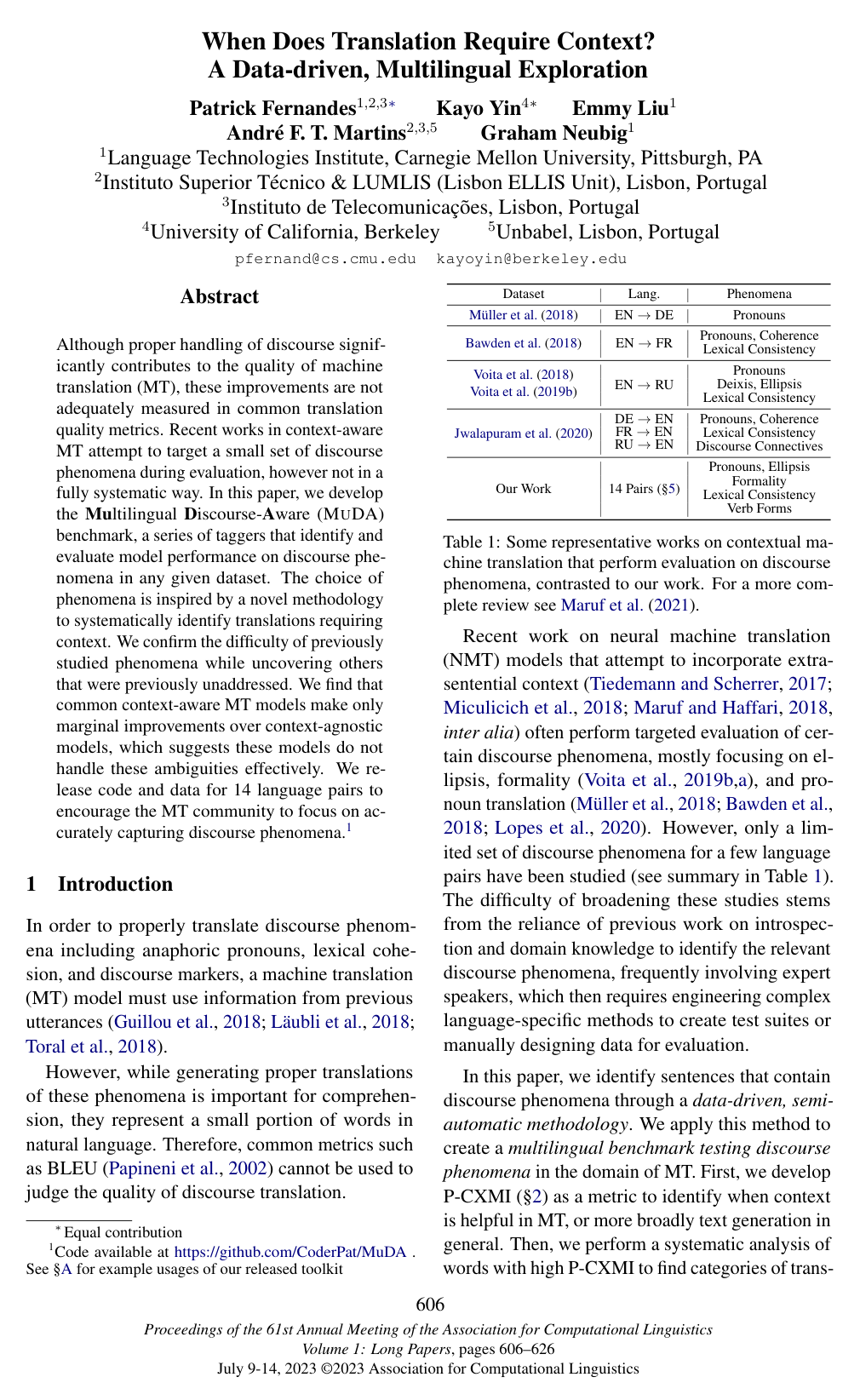
When Does Translation Require Context? A Data-driven, Multilingual Exploration
Patrick Fernandes, Kayo Yin, Emmy Liu, André F. T. Martins, Graham Neubig
Why you should read this
Introduces an information-theoretic methodology and multilingual benchmark spanning 14 language pairs to systematically identify context-dependent translation phenomena and assess how effectively context-aware models resolve discourse-level ambiguities.
Although proper handling of discourse significantly contributes to the quality of machine translation (MT), these improvements are not adequately measured in common translation quality metrics. Recent works in context-aware MT attempt to target a small set of discourse phenomena during evaluation, however not in a fully systematic way. In this paper, we develop the Multilingual Discourse-Aware (MuDA) benchmark, a series of taggers that identify and evaluate model performance on discourse phenomena in any given dataset. The choice of phenomena is inspired by a novel methodology to systematically identify translations requiring context. We confirm the difficulty of previously studied phenomena while uncovering others that were previously unaddressed. We find that common context-aware MT models make only marginal improvements over context-agnostic models, which suggests these models do not handle these ambiguities effectively. We release code and data for 14 language pairs to encourage the MT community to focus on accurately capturing discourse phenomena.
Added
2026-10-04
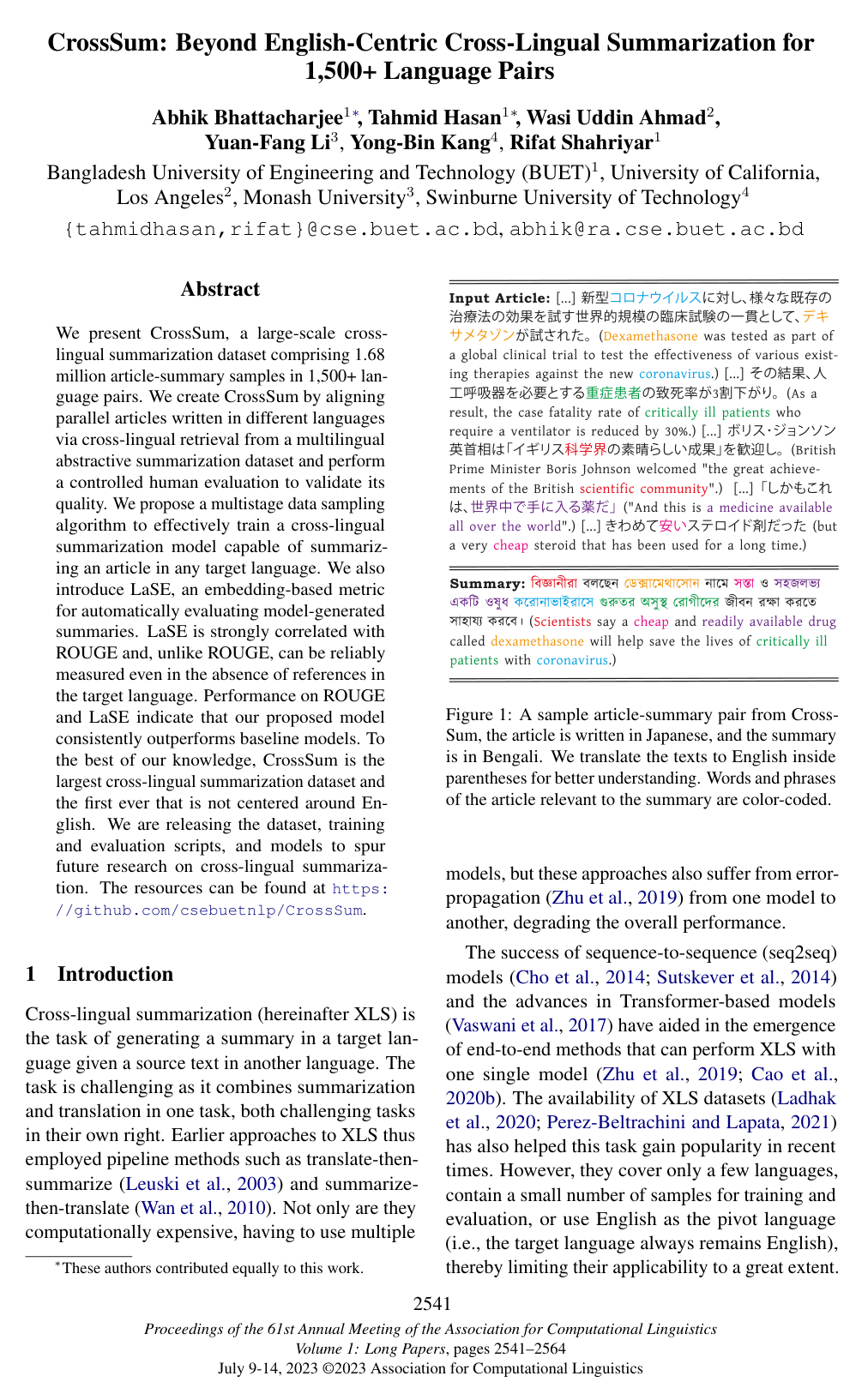
CrossSum: Beyond English-Centric Cross-Lingual Summarization for 1, 500+ Language Pairs
Abhik Bhattacharjee, Tahmid Hasan, Wasi Uddin Ahmad, Yuan-Fang Li, Yong-Bin Kang, Rifat Shahriyar
Why you should read this
Presents a large-scale dataset of 1.68 million article-summary pairs across more than 1,500 language pairs alongside a multistage sampling algorithm and an embedding-based evaluation metric to advance non-English-centric cross-lingual summarization.
We present CrossSum, a large-scale cross-lingual summarization dataset comprising 1.68 million article-summary samples in 1,500+ language pairs. We create CrossSum by aligning parallel articles written in different languages via cross-lingual retrieval from a multilingual abstractive summarization dataset and perform a controlled human evaluation to validate its quality. We propose a multistage data sampling algorithm to effectively train a cross-lingual summarization model capable of summarizing an article in any target language. We also introduce LaSE, an embedding-based metric for automatically evaluating model-generated summaries. LaSE is strongly correlated with ROUGE and, unlike ROUGE, can be reliably measured even in the absence of references in the target language. Performance on ROUGE and LaSE indicate that our proposed model consistently outperforms baseline models. To the best of our knowledge, CrossSum is the largest cross-lingual summarization dataset and the first ever that is not centered around English. We are releasing the dataset, training and evaluation scripts, and models to spur future research on cross-lingual summarization. The resources can be found at https://github.com/csebuetnlp/CrossSum.
Added
2026-09-26
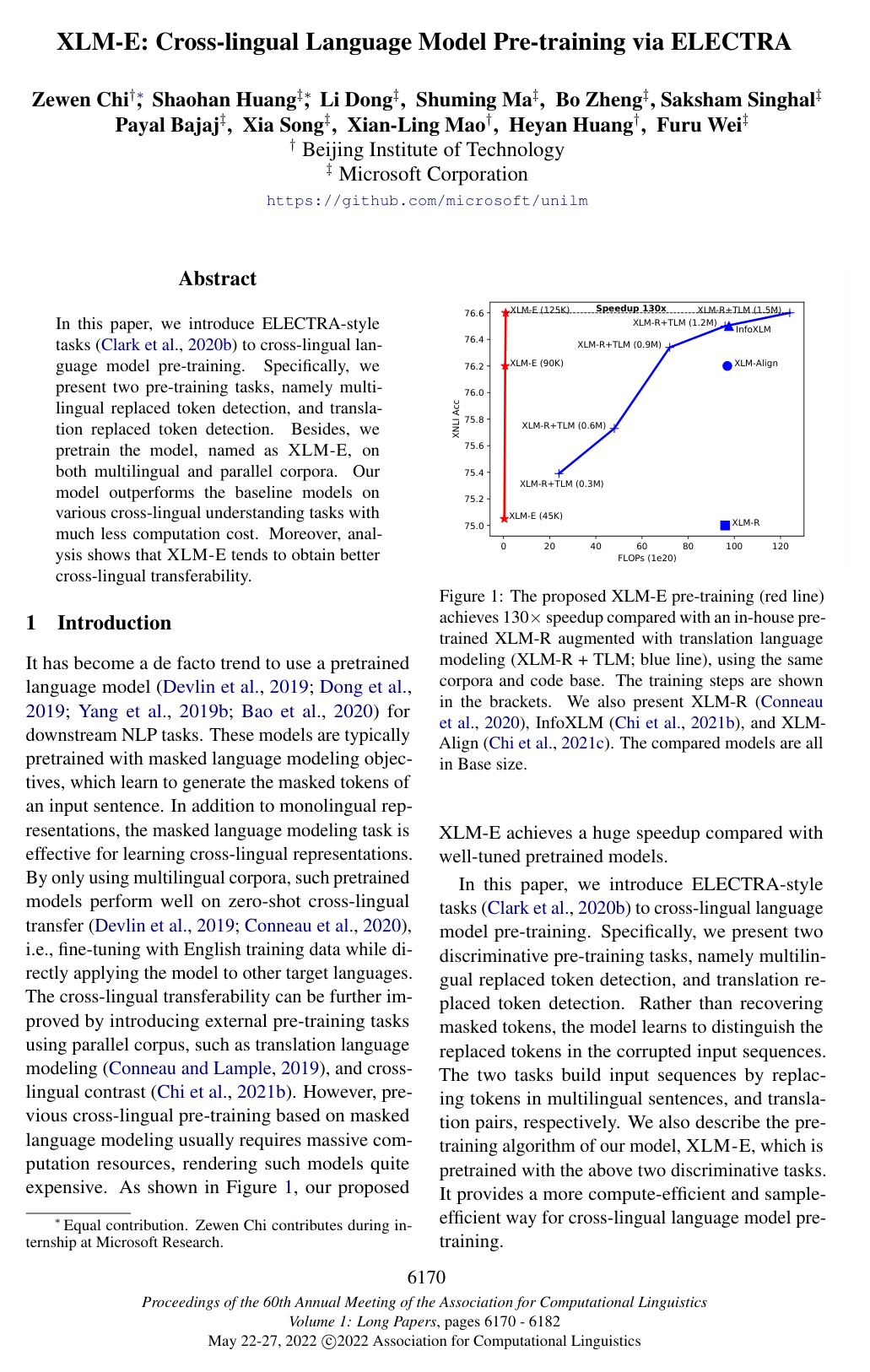
XLM-E: Cross-lingual Language Model Pre-training via ELECTRA
Zewen Chi, Shaohan Huang, Li Dong, Shuming Ma, Bo Zheng, Saksham Singhal, Payal Bajaj, Xia Song, Xian-Ling Mao, Heyan Huang, Furu Wei
Why you should read this
Proposes a compute-efficient cross-lingual pre-training framework that adapts ELECTRA-style discriminative tasks to multilingual and parallel corpora, achieving superior cross-lingual transferability over strong baselines with only a fraction of the computation cost.
In this paper, we introduce ELECTRA-style tasks (Clark et al., 2020b) to cross-lingual language model pre-training. Specifically, we present two pre-training tasks, namely multilingual replaced token detection, and translation replaced token detection. Besides, we pretrain the model, named as XLM-E, on both multilingual and parallel corpora. Our model outperforms the baseline models on various cross-lingual understanding tasks with much less computation cost. Moreover, analysis shows that XLM-E tends to obtain better cross-lingual transferability.
Added
2026-09-26
Google’s Multilingual Neural Machine Translation System: Enabling Zero-Shot Translation
Melvin Johnson, Mike Schuster, Quoc V. Le, Maxim Krikun, Yonghui Wu, Zhifeng Chen, Nikhil Thorat, Fernanda Viégas, Martin Wattenberg, Greg Corrado, Macduff Hughes, Jeffrey Dean
Why you should read this
Demonstrates that prepending a target language token enables a single neural machine translation model to translate across multiple languages and achieve zero-shot translation between language pairs never seen together during training.
We propose a simple solution to use a single Neural Machine Translation (NMT) model to translate between multiple languages. Our solution requires no change in the model architecture from our base system but instead introduces an artificial token at the beginning of the input sentence to specify the required target language. The rest of the model, which includes encoder, decoder and attention, remains unchanged and is shared across all languages. Using a shared wordpiece vocabulary, our approach enables Multilingual NMT using a single model without any increase in parameters, which is significantly simpler than previous proposals for Multilingual NMT. Our method often improves the translation quality of all involved language pairs, even while keeping the total number of model parameters constant. On the WMT'14 benchmarks, a single multilingual model achieves comparable performance for EnglishFrench and surpasses state-of-the-art results for EnglishGerman. Similarly, a single multilingual model surpasses state-of-the-art results for FrenchEnglish and GermanEnglish on WMT'14 and WMT'15 benchmarks respectively. On production corpora, multilingual models of up to twelve language pairs allow for better translation of many individual pairs. In addition to improving the translation quality of language pairs that the model was trained with, our models can also learn to perform implicit bridging between language pairs never seen explicitly during training, showing that transfer learning and zero-shot translation is possible for neural translation. Finally, we show analyses that hints at a universal interlingua representation in our models and show some interesting examples when mixing languages.
Added
2026-09-16
Improving Neural Machine Translation Models with Monolingual Data
Rico Sennrich, Barry Haddow, Alexandra Birch
Why you should read this
Introduces back-translation to train neural machine translation models on target-side monolingual data without architecture changes, substantially increasing translation accuracy across standard and low-resource benchmarks.
Neural Machine Translation (NMT) has obtained state-of-the art performance for several language pairs, while only using parallel data for training. Target-side monolingual data plays an important role in boosting fluency for phrase-based statistical machine translation, and we investigate the use of monolingual data for NMT. In contrast to previous work, which combines NMT models with separately trained language models, we note that encoder-decoder NMT architectures already have the capacity to learn the same information as a language model, and we explore strategies to train with monolingual data without changing the neural network architecture. By pairing monolingual training data with an automatic back-translation, we can treat it as additional parallel training data, and we obtain substantial improvements on the WMT 15 task English<->German (+2.8-3.7 BLEU), and for the low-resourced IWSLT 14 task Turkish->English (+2.1-3.4 BLEU), obtaining new state-of-the-art results. We also show that fine-tuning on in-domain monolingual and parallel data gives substantial improvements for the IWSLT 15 task English->German.
Added
2026-09-13