Transcending Scaling Laws with 0.1% Extra Compute Yi Tay, Jason Wei, Hyung Won Chung, Vinh Q. Tran, David R. So, Siamak Shakeri, Xavier Garcia, Huaixiu Steven Zheng, Jinfeng Rao, Aakanksha Chowdhery, Denny Zhou, Donald Metzler, Slav Petrov, Neil Houlsby, Quoc V. Le, Mostafa Dehghani
Why you should read this Demonstrates that continuing to train pretrained large language models on UL2's mixture-of-denoisers objective with roughly 0.1% additional compute dramatically improves scaling curves, achieving up to a 2x compute savings and triggering emergent reasoning capabilities at smaller model scales.
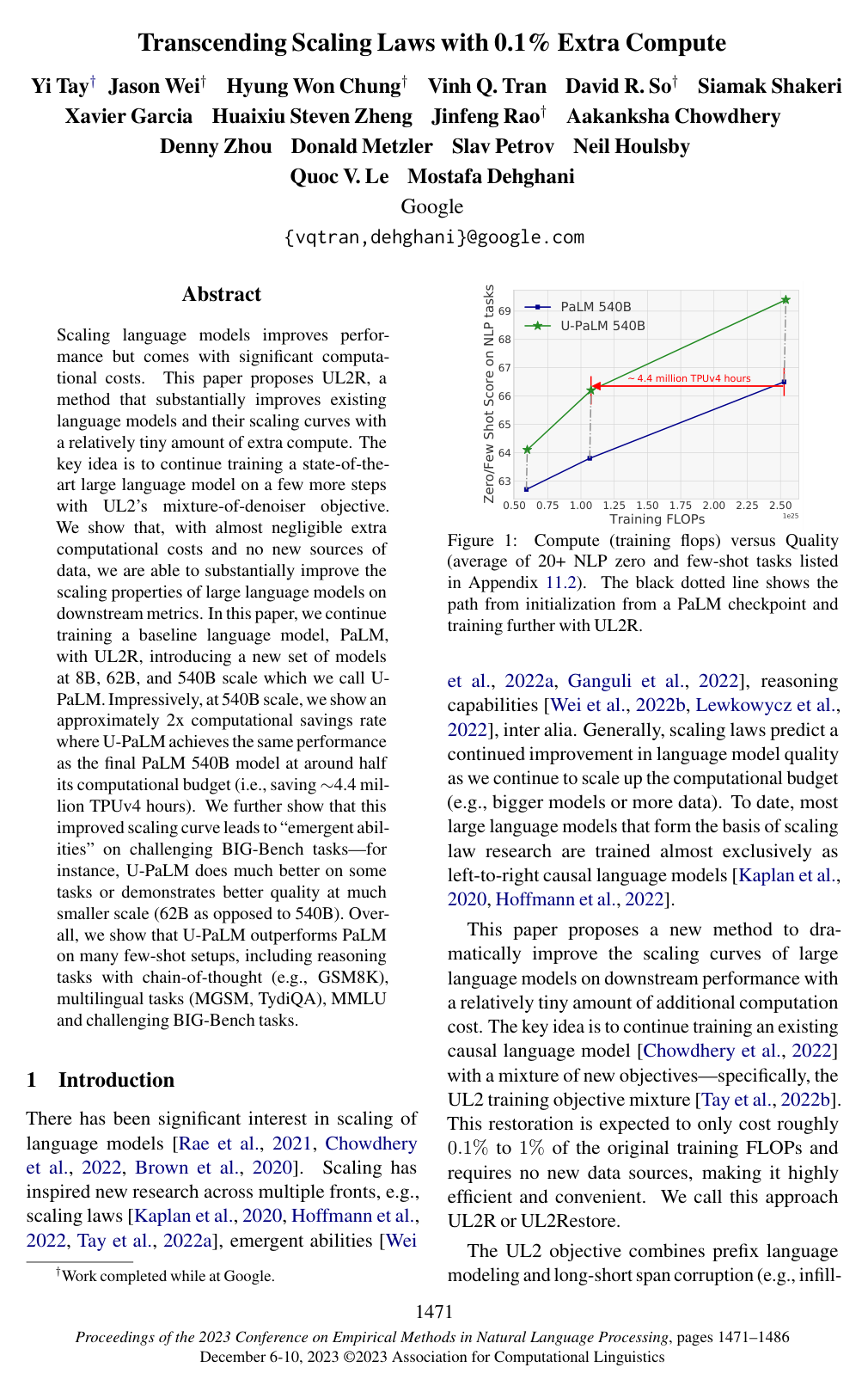
Scaling language models improves performance but comes with significant computational costs. This paper proposes UL2R, a method that substantially improves existing language models and their scaling curves with a relatively tiny amount of extra compute. The key idea is to continue training a state-of-the-art large language model on a few more steps with UL2’s mixture-of-denoiser objective. We show that, with almost negligible extra computational costs and no new sources of data, we are able to substantially improve the scaling properties of large language models on downstream metrics. In this paper, we continue training a baseline language model, PaLM, with UL2R, introducing a new set of models at 8B, 62B, and 540B scale which we call U-PaLM. Impressively, at 540B scale, we show an approximately 2x computational savings rate where U-PaLM achieves the same performance as the final PaLM 540B model at around half its computational budget (i.e., saving ∼4.4 million TPUv4 hours). We further show that this improved scaling curve leads to “emergent abilities” on challenging BIG-Bench tasks—for instance, U-PaLM does much better on some tasks or demonstrates better quality at much smaller scale (62B as opposed to 540B). Overall, we show that U-PaLM outperforms PaLM on many few-shot setups, including reasoning tasks with chain-of-thought (e.g., GSM8K), multilingual tasks (MGSM, TydiQA), MMLU and challenging BIG-Bench tasks.