Built independently by an author, for readers. Read the story and support ChapterPal

keyword

output consistency

Output consistency refers to the degree to which an artificial intelligence model produces uniform, semantically equivalent, or logically aligned responses when evaluated on identical queries or semantically equivalent variations of an input. It serves as a measure of the robustness and stability of a model's internal knowledge and reasoning processes, evaluating whether surface-level changes in phrasing, formatting, or prompt structure alter its factual determinations or predictions. Maintaining high output consistency is crucial for ensuring that a system behaves predictably and reliably, demonstrating that its answers depend on the underlying meaning of a task rather than superficial variations in the input data.

1 item

Factual Confidence of LLMs: on Reliability and Robustness of Current Estimators

Factual Confidence of LLMs: on Reliability and Robustness of Current Estimators

Matéo Mahaut, Laura Aina, Paula Czarnowska, Momchil Hardalov, Thomas Müller, Lluís Màrquez

OrganizationsAmazon Web ServicesUniversitat Pompeu Fabra

Why you should read this

Evaluates five major families of factual confidence estimators across multiple large language models and tasks, revealing that internal hidden-state probes achieve superior reliability while exposing how easily model confidence fluctuates across semantically equivalent prompts.

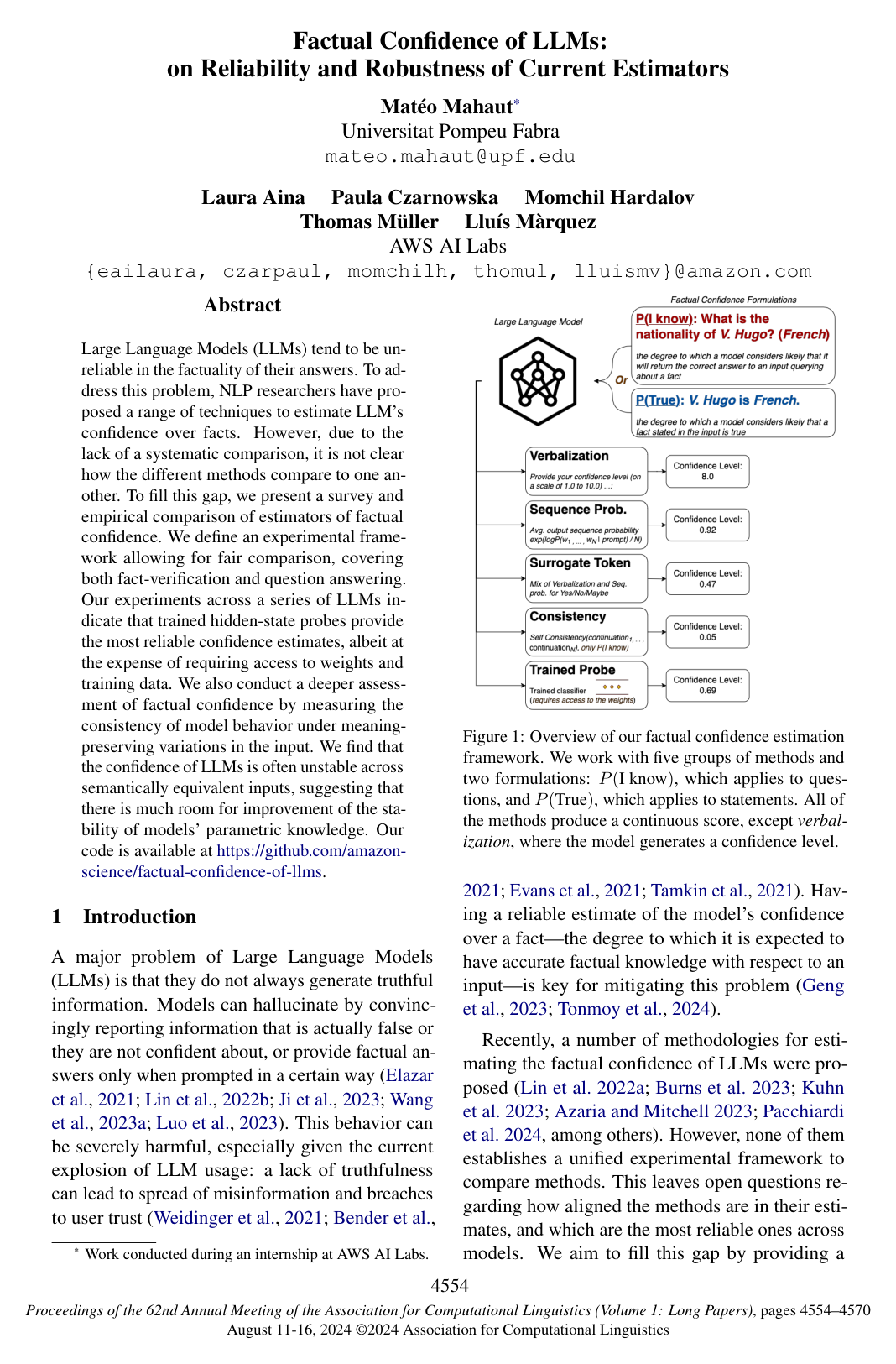
Large Language Models (LLMs) tend to be unreliable in the factuality of their answers. To address this problem, NLP researchers have proposed a range of techniques to estimate LLM’s confidence over facts. However, due to the lack of a systematic comparison, it is not clear how the different methods compare to one another. To fill this gap, we present a survey and empirical comparison of estimators of factual confidence. We define an experimental framework allowing for fair comparison, covering both fact-verification and question answering. Our experiments across a series of LLMs indicate that trained hidden-state probes provide the most reliable confidence estimates, albeit at the expense of requiring access to weights and training data. We also conduct a deeper assessment of factual confidence by measuring the consistency of model behavior under meaning-preserving variations in the input. We find that the confidence of LLMs is often unstable across semantically equivalent inputs, suggesting that there is much room for improvement of the stability of models’ parametric knowledge. Our code is available at https://github.com/amazon-science/factual-confidence-of-llms.

Added

2026-10-03