
keyword
open-vocabulary object detection
Open-vocabulary object detection is a computer vision task that aims to locate and identify objects in images using arbitrary text inputs, enabling the recognition of categories beyond the fixed set of labels seen during training. Unlike conventional closed-set detectors that are restricted to predefined classes, open-vocabulary systems bridge visual regions and natural language by leveraging shared visual-semantic representations, often derived from large-scale pre-trained vision-language models. By aligning region-level visual features with text embeddings of category names or free-form phrases, these models can localize and classify novel, user-specified concepts at inference time without requiring additional bounding box annotations or retraining.
11 items
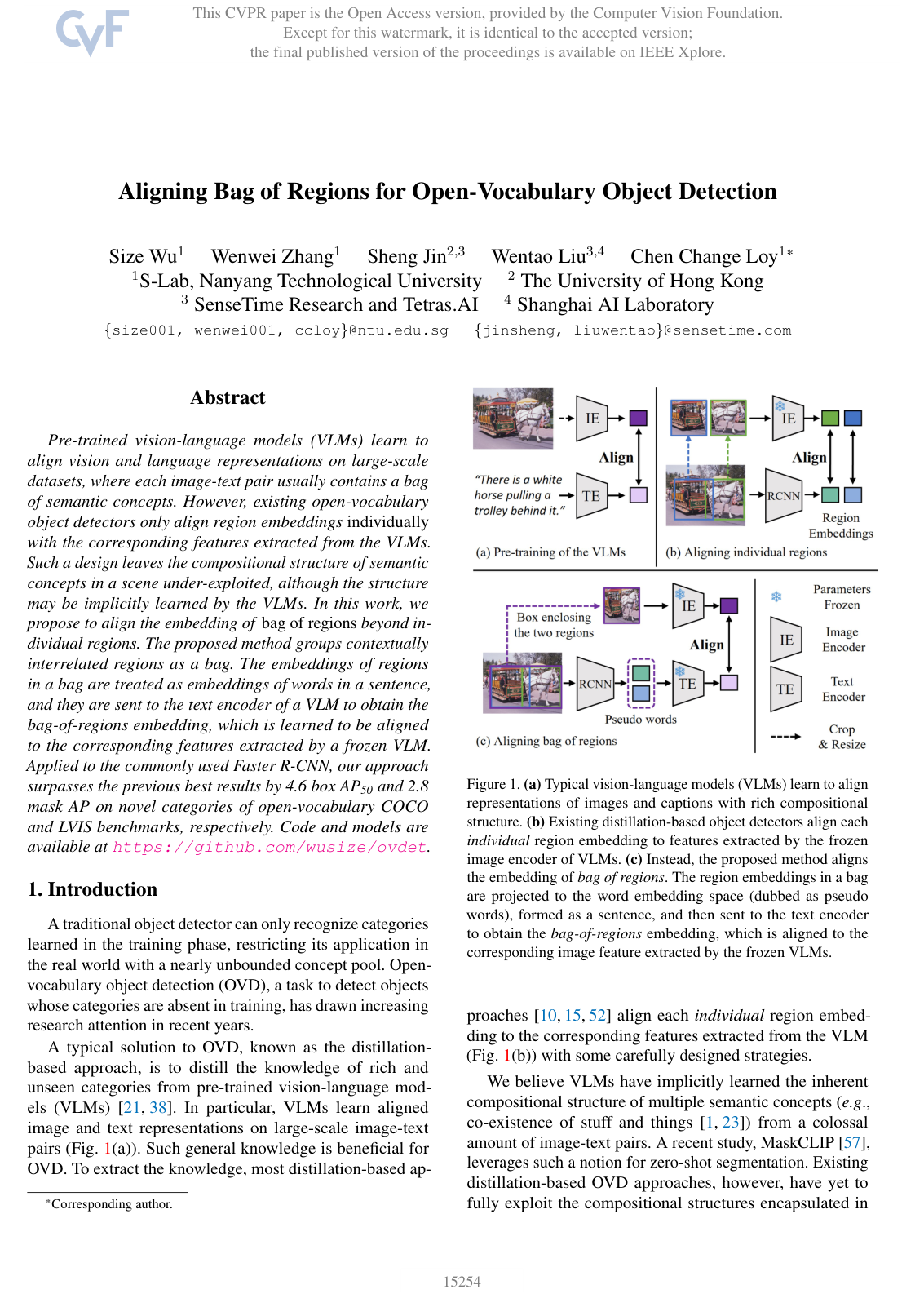
Aligning Bag of Regions for Open-Vocabulary Object Detection
Size Wu, Wenwei Zhang, Sheng Jin, Wentao Liu, Chen Change Loy
Why you should read this
Proposes BARON, an open-vocabulary object detection framework that models contextual relations among multiple regions by encoding them as pseudo-word sentences for alignment with vision-language models, significantly boosting novel-category detection performance on COCO and LVIS benchmarks.
Pre-trained vision-language models (VLMs) learn to align vision and language representations on large-scale datasets, where each image-text pair usually contains a bag of semantic concepts. However, existing open-vocabulary object detectors only align region embeddings individually with the corresponding features extracted from the VLMs. Such a design leaves the compositional structure of semantic concepts in a scene under-exploited, although the structure may be implicitly learned by the VLMs. In this work, we propose to align the embedding of bag of regions beyond individual regions. The proposed method groups contextually interrelated regions as a bag. The embeddings of regions in a bag are treated as embeddings of words in a sentence, and they are sent to the text encoder of a VLM to obtain the bag-of-regions embedding, which is learned to be aligned to the corresponding features extracted by a frozen VLM. Applied to the commonly used Faster R-CNN, our approach surpasses the previous best results by 4.6 box AP50 and 2.8 mask AP on novel categories of open-vocabulary COCO and LVIS benchmarks, respectively. Code and models are available at https://github.com/wusize/ovdet.
Added
2026-10-05
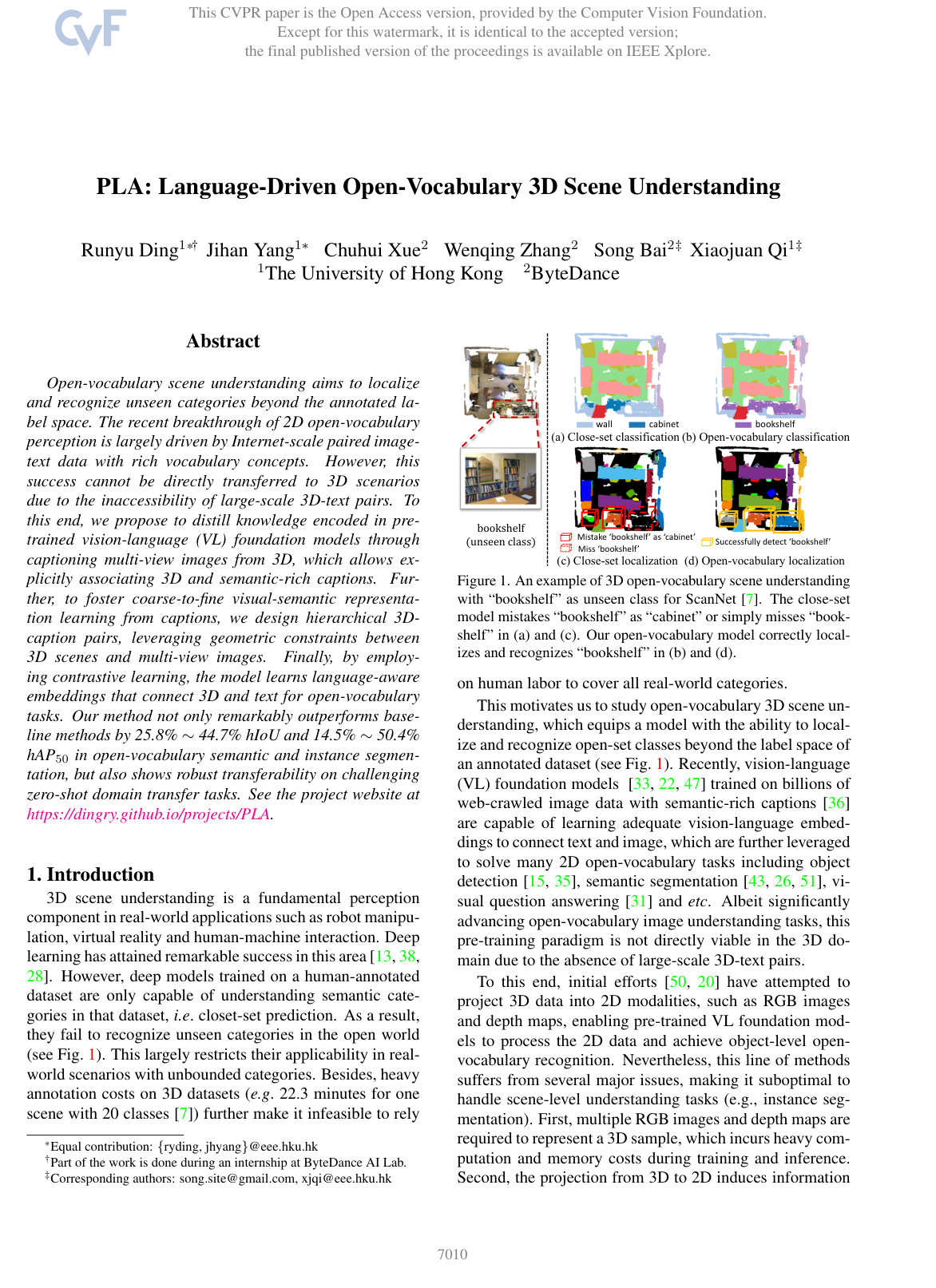
PLA: Language-Driven Open-Vocabulary 3D Scene Understanding
Runyu Ding, Jihan Yang, Chuhui Xue, Wenqing Zhang, Song Bai, Xiaojuan Qi
Why you should read this
Proposes a framework that bridges the 3D-text data scarcity gap by distilling 2D vision-language foundation models into multi-level 3D point-caption pairs, enabling effective open-vocabulary 3D semantic and instance segmentation.
Open-vocabulary scene understanding aims to localize and recognize unseen categories beyond the annotated label space. The recent breakthrough of 2D open-vocabulary perception is largely driven by Internet-scale paired image-text data with rich vocabulary concepts. However, this success cannot be directly transferred to 3D scenarios due to the inaccessibility of large-scale 3D-text pairs. To this end, we propose to distill knowledge encoded in pre-trained vision-language (VL) foundation models through captioning multi-view images from 3D, which allows explicitly associating 3D and semantic-rich captions. Further, to foster coarse-to-fine visual-semantic representation learning from captions, we design hierarchical 3D-caption pairs, leveraging geometric constraints between 3D scenes and multi-view images. Finally, by employing contrastive learning, the model learns language-aware embeddings that connect 3D and text for open-vocabulary tasks. Our method not only remarkably outperforms baseline methods by 25.8% ∼ 44.7% hIoU and 14.5% ∼ 50.4% hAP50 in open-vocabulary semantic and instance segmentation, but also shows robust transferability on challenging zero-shot domain transfer tasks. See the project website at https://dingry.github.io/projects/PLA.
Added
2026-10-05
Open-Vocabulary Semantic Segmentation with Mask-adapted CLIP
Feng Liang, Bichen Wu, Xiaoliang Dai, Kunpeng Li, Yinan Zhao, Hang Zhang, Peizhao Zhang, Peter Vajda, Diana Marculescu
Why you should read this
Proposes a mask prompt tuning technique and weakly supervised caption mining to adapt CLIP for masked region classification, achieving state-of-the-art open-vocabulary semantic segmentation that rivals fully supervised models without dataset-specific tuning.
Open-vocabulary semantic segmentation aims to segment an image into semantic regions according to text descriptions, which may not have been seen during training. Recent two-stage methods first generate class-agnostic mask proposals and then leverage pre-trained vision-language models, e.g., CLIP, to classify masked regions. We identify the performance bottleneck of this paradigm to be the pre-trained CLIP model, since it does not perform well on masked images. To address this, we propose to finetune CLIP on a collection of masked image regions and their corresponding text descriptions. We collect training data by mining an existing image-caption dataset (e.g., COCO Captions), using CLIP to match masked image regions to nouns in the image captions. Compared with the more precise and manually annotated segmentation labels with fixed classes (e.g., COCO-Stuff), we find our noisy but diverse dataset can better retain CLIP’s generalization ability. Along with finetuning the entire model, we utilize the “blank” areas in masked images using a method we dub mask prompt tuning. Experiments demonstrate mask prompt tuning brings significant improvement without modifying any weights of CLIP, and it can further improve a fully finetuned model. In particular, when trained on COCO and evaluated on ADE20K-150, our best model achieves 29.6% mIoU, which is +8.5% higher than the previous state-of-the-art. For the first time, open-vocabulary generalist models match the performance of supervised specialist models in 2017 without dataset specific adaptations.
Added
2026-10-05
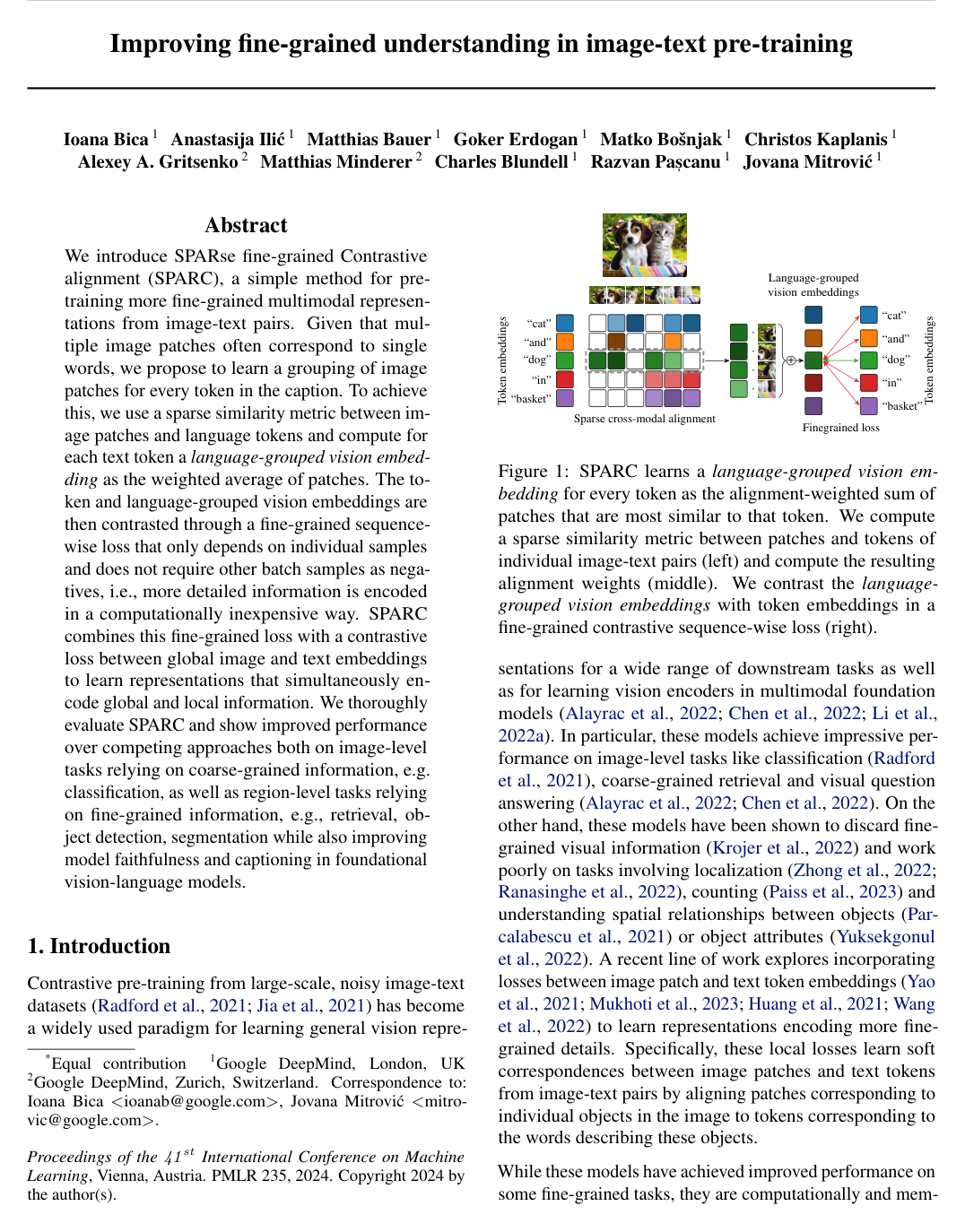
Improving fine-grained understanding in image-text pre-training
Ioana Bica, Anastasija Ilic, Matthias Bauer, Goker Erdogan, Matko Bosnjak, Christos Kaplanis, Alexey A. Gritsenko, Matthias Minderer, Charles Blundell, Razvan Pascanu, Jovana Mitrovic
Why you should read this
Proposes a computationally efficient vision-language pre-training method that groups image patches per text token via sparse alignment, boosting performance across both fine-grained region-level tasks and global image classification.
We introduce SPARCe fine-grained Contrastive alignment (SPARC), a simple method for pre-training more fine-grained multimodal representations from image-text pairs. Given that multiple image patches often correspond to single words, we propose to learn a grouping of image patches for every token in the caption. To achieve this, we use a sparse similarity metric between image patches and language tokens and compute for each text token a language-grouped vision embedding as the weighted average of patches. The token and language-grouped vision embeddings are then contrasted through a fine-grained sequence-wise loss that only depends on individual samples and does not require other batch samples as negatives, i.e., more detailed information is encoded in a computationally inexpensive way. SPARC combines this fine-grained loss with a contrastive loss between global image and text embeddings to learn representations that simultaneously encode global and local information. We thoroughly evaluate SPARC and show improved performance over competing approaches both on image-level tasks relying on coarse-grained information, e.g. classification, as well as region-level tasks relying on fine-grained information, e.g., retrieval, object detection, segmentation while also improving model faithfulness and captioning in foundational vision-language models.
Added
2026-10-03
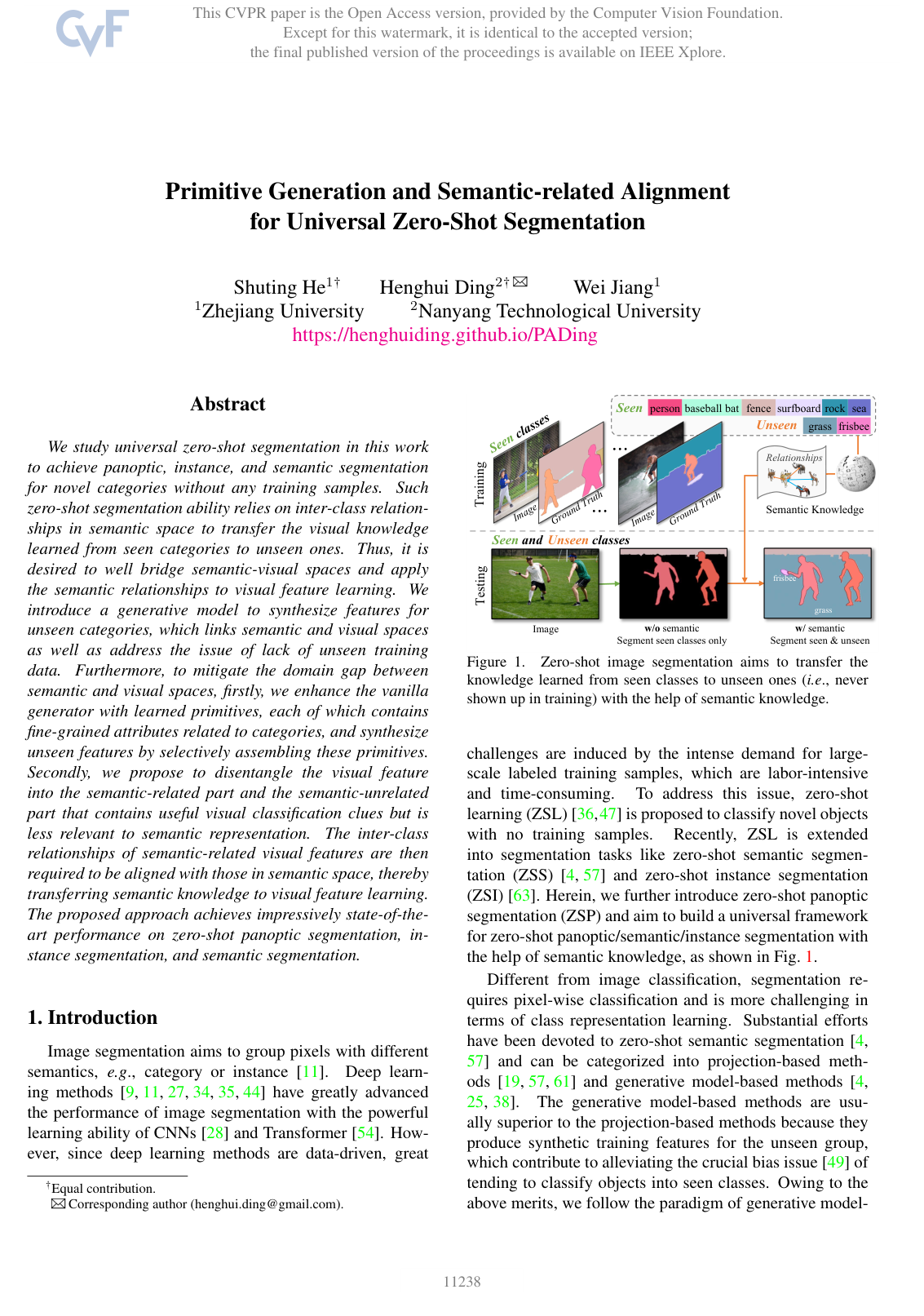
Primitive Generation and Semantic-Related Alignment for Universal Zero-Shot Segmentation
Shuting He, Henghui Ding, Wei Jiang
Why you should read this
Proposes PADing, a unified universal zero-shot segmentation framework that bridges the cross-modal domain gap by assembling learned fine-grained primitives to synthesize unseen visual features and aligning their semantic-related components with linguistic class relationships.
We study universal zero-shot segmentation in this work to achieve panoptic, instance, and semantic segmentation for novel categories without any training samples. Such zero-shot segmentation ability relies on inter-class relationships in semantic space to transfer the visual knowledge learned from seen categories to unseen ones. Thus, it is desired to well bridge semantic and visual spaces and apply the semantic relationships to visual feature learning. We introduce a generative model to synthesize features for unseen categories, which links semantic and visual spaces as well as addresses the issue of lack of unseen training data. Furthermore, to mitigate the domain gap between semantic and visual spaces, firstly, we enhance the vanilla generator with learned primitives, each of which contains fine-grained attributes related to categories, and synthesize unseen features by selectively assembling these primitives. Secondly, we propose to disentangle the visual feature into the semantic-related part and the semantic-unrelated part that contains useful visual classification clues but is less relevant to semantic representation. The inter-class relationships of semantic-related visual features are then required to be aligned with those in semantic space, thereby transferring semantic knowledge to visual feature learning. The proposed approach achieves impressively state-of-the-art performance on zero-shot panoptic segmentation, instance segmentation, and semantic segmentation.
Added
2026-09-26
CoDet: Co-occurrence Guided Region-Word Alignment for Open-Vocabulary Object Detection
Chuofan Ma, Yi Jiang, Xin Wen, Zehuan Yuan, Xiaojuan Qi
Why you should read this
Proposes an open-vocabulary object detection framework that bypasses pre-aligned vision-language models by discovering co-occurring visual objects across captioned image groups to achieve state-of-the-art novel category detection on OV-LVIS.
Deriving reliable region-word alignment from image-text pairs is critical to learn object-level vision-language representations for open-vocabulary object detection. Existing methods typically rely on pre-trained or self-trained vision-language models for alignment, which are prone to limitations in localization accuracy or generalization capabilities. In this paper, we propose CoDet, a novel approach that overcomes the reliance on pre-aligned vision-language space by reformulating region-word alignment as a co-occurring object discovery problem. Intuitively, by grouping images that mention a shared concept in their captions, objects corresponding to the shared concept shall exhibit high co-occurrence among the group. CoDet then leverages visual similarities to discover the co-occurring objects and align them with the shared concept. Extensive experiments demonstrate that CoDet has superior performances and compelling scalability in open-vocabulary detection, e.g., by scaling up the visual backbone, CoDet achieves 37.0 AP_novel^m and 44.7 AP_all^m on OV-LVIS, surpassing the previous SoTA by 4.2 AP_novel^m and 9.8 AP_all^m. Code is available at https://github.com/CVMI-Lab/CoDet.
Added
2026-09-26
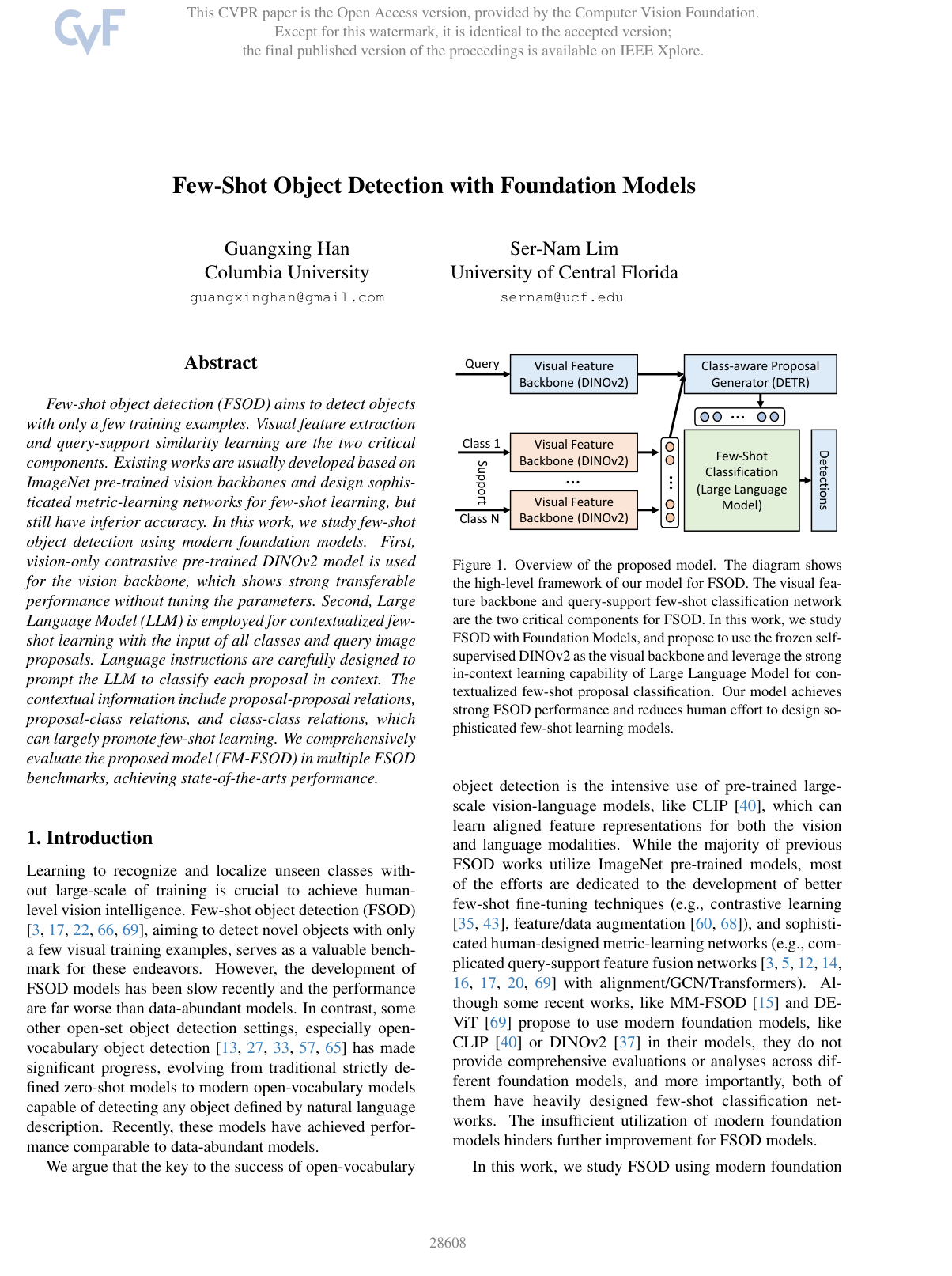
Few-Shot Object Detection with Foundation Models
Guangxing Han, Ser-Nam Lim
Why you should read this
Demonstrates how combining a frozen DINOv2 vision backbone with an in-context prompting large language model for proposal classification achieves state-of-the-art few-shot object detection performance without complex metric-learning architectures.
Few-shot object detection (FSOD) aims to detect objects with only a few training examples. Visual feature extraction and query-support similarity learning are the two critical components. Existing works are usually developed based on ImageNet pre-trained vision backbones and design sophisticated metric-learning networks for few-shot learning, but still have inferior accuracy. In this work, we study few-shot object detection using modern foundation models. First, vision-only contrastive pre-trained DINOv2 model is used for the vision backbone, which shows strong transferable performance without tuning the parameters. Second, Large Language Model (LLM) is employed for contextualized few-shot learning with the input of all classes and query image proposals. Language instructions are carefully designed to prompt the LLM to classify each proposal in context. The contextual information include proposal-proposal relations, proposal-class relations, and class-class relations, which can largely promote few-shot learning. We comprehensively evaluate the proposed model (FM-FSOD) in multiple FSOD benchmarks, achieving state-of-the-arts performance.
Added
2026-09-26
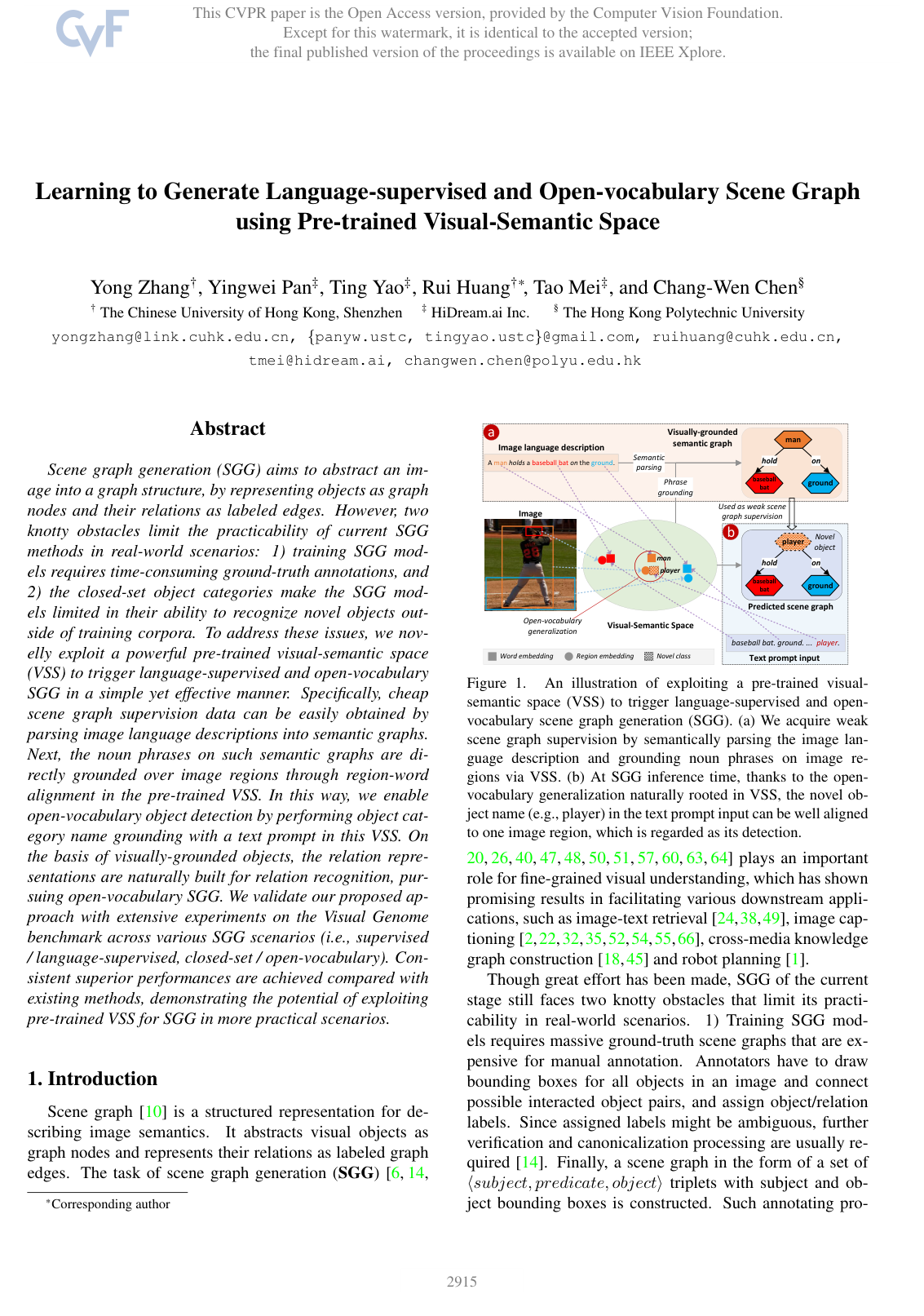
Learning to Generate Language-Supervised and Open-Vocabulary Scene Graph Using Pre-Trained Visual-Semantic Space
Yong Zhang, Yingwei Pan, Ting Yao, Rui Huang, Tao Mei, Chang Wen Chen
Why you should read this
Proposes a scene graph generation framework that uses pre-trained visual-semantic spaces to detect novel objects and relations from image captions without requiring expensive manual annotations.
Scene graph generation (SGG) aims to abstract an image into a graph structure, by representing objects as graph nodes and their relations as labeled edges. However, two knotty obstacles limit the practicability of current SGG methods in real-world scenarios: 1) training SGG models requires time-consuming ground-truth annotations, and 2) the closed-set object categories make the SGG models limited in their ability to recognize novel objects outside of training corpora. To address these issues, we novelly exploit a powerful pre-trained visual-semantic space (VSS) to trigger language-supervised and open-vocabulary SGG in a simple yet effective manner. Specifically, cheap scene graph supervision data can be easily obtained by parsing image language descriptions into semantic graphs. Next, the noun phrases on such semantic graphs are directly grounded over image regions through region-word alignment in the pre-trained VSS. In this way, we enable open-vocabulary object detection by performing object category name grounding with a text prompt in this VSS. On the basis of visually-grounded objects, the relation representations are naturally built for relation recognition, pursuing open-vocabulary SGG. We validate our proposed approach with extensive experiments on the Visual Genome benchmark across various SGG scenarios (i.e., supervised / language-supervised, closed-set / open-vocabulary). Consistent superior performances are achieved compared with existing methods, demonstrating the potential of exploiting pre-trained VSS for SGG in more practical scenarios.
Added
2026-09-26
RegionCLIP: Region-based Language-Image Pretraining
Yiwu Zhong, Jianwei Yang, Pengchuan Zhang, Chunyuan Li, Noel Codella, Liunian Harold Li, Luowei Zhou, Xiyang Dai, Lu Yuan, Yin Li, Jianfeng Gao
Why you should read this
Introduces RegionCLIP, a pretraining framework that bootstraps from CLIP to align local image regions with synthesized textual concepts, significantly advancing open-vocabulary and zero-shot object detection on COCO and LVIS.
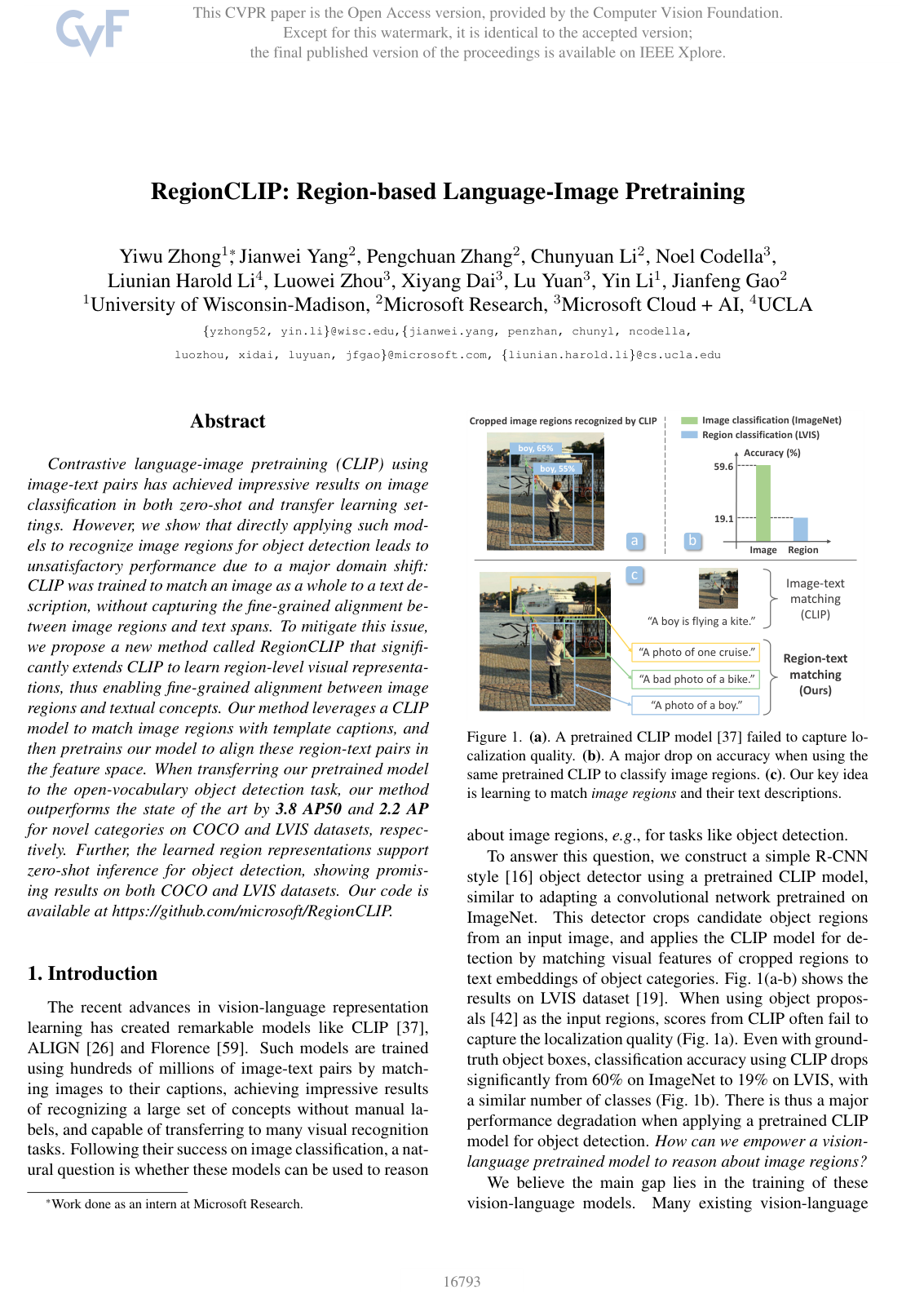
Contrastive language-image pretraining (CLIP) using image-text pairs has achieved impressive results on image classification in both zero-shot and transfer learning settings. However, we show that directly applying such models to recognize image regions for object detection leads to unsatisfactory performance due to a major domain shift: CLIP was trained to match an image as a whole to a text description, without capturing the fine-grained alignment between image regions and text spans. To mitigate this issue, we propose a new method called RegionCLIP that significantly extends CLIP to learn region-level visual representations, thus enabling fine-grained alignment between image regions and textual concepts. Our method leverages a CLIP model to match image regions with template captions, and then pretrains our model to align these region-text pairs in the feature space. When transferring our pretrained model to the open-vocabulary object detection task, our method outperforms the state of the art by 3.8 AP50 and 2.2 AP for novel categories on COCO and LVIS datasets, respectively. Further, the learned region representations support zero-shot inference for object detection, showing promising results on both COCO and LVIS datasets. Our code is available at https://github.com/microsoft/RegionCLIP.
Added
2026-09-26
Open-vocabulary Object Detection via Vision and Language Knowledge Distillation
Xiuye Gu, Tsung-Yi Lin, Weicheng Kuo, Yin Cui
Why you should read this
Introduces ViLD, a distillation framework that transfers multimodal knowledge from pretrained vision-language models into two-stage object detectors, enabling the detection of novel categories specified by arbitrary text without requiring additional bounding-box annotations.
We aim at advancing open-vocabulary object detection, which detects objects described by arbitrary text inputs. The fundamental challenge is the availability of training data. It is costly to further scale up the number of classes contained in existing object detection datasets. To overcome this challenge, we propose ViLD, a training method via Vision and Language knowledge Distillation. Our method distills the knowledge from a pretrained open-vocabulary image classification model (teacher) into a two-stage detector (student). Specifically, we use the teacher model to encode category texts and image regions of object proposals. Then we train a student detector, whose region embeddings of detected boxes are aligned with the text and image embeddings inferred by the teacher. We benchmark on LVIS by holding out all rare categories as novel categories that are not seen during training. ViLD obtains 16.1 mask AP with a ResNet-50 backbone, even outperforming the supervised counterpart by 3.8. When trained with a stronger teacher model ALIGN, ViLD achieves 26.3 AP. The model can directly transfer to other datasets without finetuning, achieving 72.2 AP on PASCAL VOC, 36.6 AP on COCO and 11.8 AP on Objects365. On COCO, ViLD outperforms the previous state-of-the-art by 4.8 on novel AP and 11.4 on overall AP. Code and demo are open-sourced at this https URL.
Added
2026-09-25
Grounded Language-Image Pre-training
Liunian Harold Li, Pengchuan Zhang, Haotian Zhang, Jianwei Yang, Chunyuan Li, Yiwu Zhong, Lijuan Wang, Lu Yuan, Lei Zhang, Jenq–Neng Hwang, Kai-Wei Chang, Jianfeng Gao
Why you should read this
Unifies object detection and phrase grounding, allowing models to identify and localize objects based on free-form language.
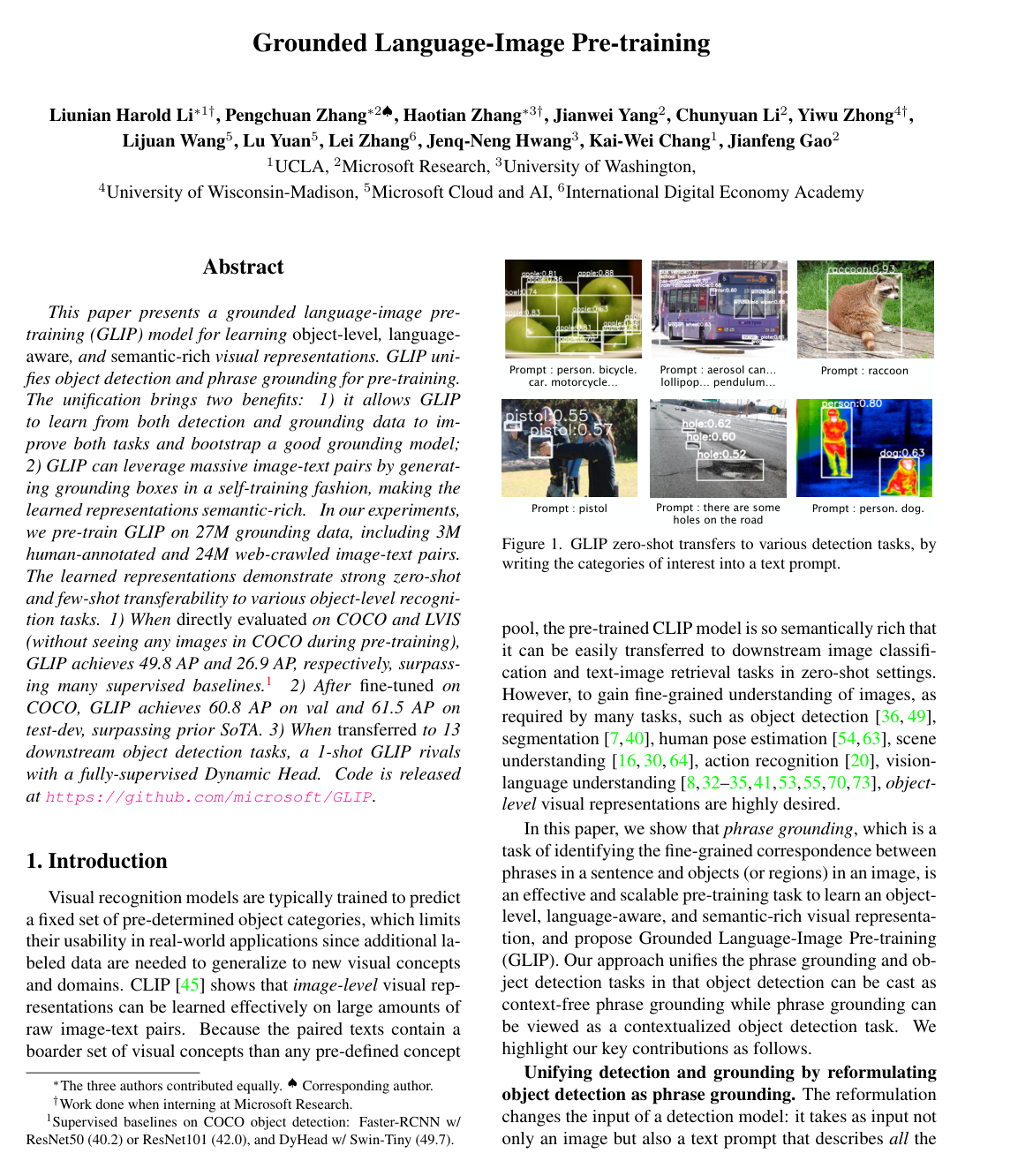
This paper presents a grounded language-image pre-training (GLIP) model for learning object-level, language-aware, and semantic-rich visual representations. GLIP unifies object detection and phrase grounding for pre-training. The unification brings two benefits: 1) it allows GLIP to learn from both detection and grounding data to improve both tasks and bootstrap a good grounding model; 2) GLIP can leverage massive image-text pairs by generating grounding boxes in a self-training fashion, making the learned representation semantic-rich. In our experiments, we pre-train GLIP on 27M grounding data, including 3M human-annotated and 24M web-crawled image-text pairs. The learned representations demonstrate strong zero-shot and few-shot transferability to various object-level recognition tasks. 1) When directly evaluated on COCO and LVIS (without seeing any images in COCO during pre-training), GLIP achieves 49.8 AP and 26.9 AP, respectively, surpassing many supervised baselines. 2) After fine-tuned on COCO, GLIP achieves 60.8 AP on val and 61.5 AP on test-dev, surpassing prior SoTA. 3) When transferred to 13 downstream object detection tasks, a 1-shot GLIP rivals with a fully-supervised Dynamic Head. Code is released at https://github.com/microsoft/GLIP.
Added
2026-01-28