
keyword
open-source multimodal models
Open-source multimodal models are artificial intelligence systems capable of processing, understanding, and generating content across multiple modalities, such as text, images, video, and audio, whose model architectures, pre-trained weights, and codebases are made publicly accessible for inspection, modification, and deployment. These systems typically combine large language models with specialized perceptual encoders or undergo joint native multimodal pre-training to execute complex cross-modal tasks, including document comprehension, visual reasoning, optical character recognition, and video analysis. By offering transparent access to model parameters, training recipes, and inference frameworks, open-source multimodal models provide developers and researchers with customizable alternatives to proprietary commercial services, facilitating independent research, community-driven evaluation, and tailored domain adaptation.
3 items
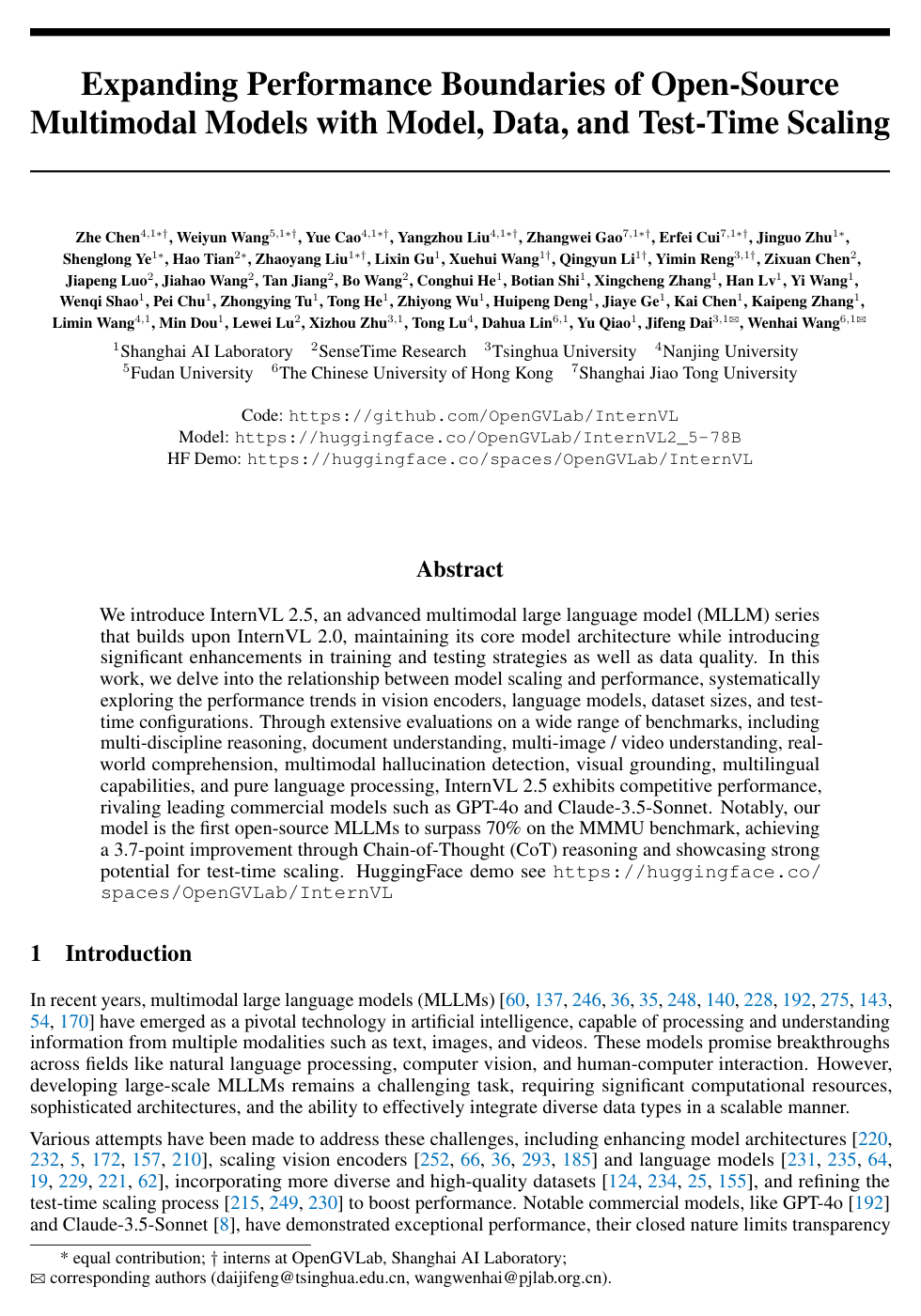
Expanding Performance Boundaries of Open-Source Multimodal Models with Model, Data, and Test-Time Scaling
Zhe Chen, Weiyun Wang, Yue Cao, Yang-Zhou Liu, Zhangwei Gao, Erfei Cui, Jinguo Zhu, Shenglong Ye, Hao Tian, Zhaoyang Liu, Lixin Gu, Xue-Hui Wang, Qing-Yun Li, Yi-Ming Ren, Zixuan Chen, Jia-Peng Luo, Jiahao Wang, Tan Jiang, Bo Wang, Conghui He, Botian Shi, Xingcheng Zhang, Han Lv, Yi Wang, Wenqi Shao, Pei Chu, Zhongying Tu, Tong He, Zhiyong Wu, Hui Deng, Jiaye Ge, Kaiming Chen, Min Dou, Lewei Lu, Xizhou Zhu, Tong Lu, Da-Hu Lin, Yunfeng Qiao, Jifeng Dai, Wenhai Wang
Why you should read this
Introduces InternVL 2.5, an open-source multimodal model series that rivals proprietary systems like GPT-4o and becomes the first open-source model to exceed 70% on the MMMU benchmark through model, data, and test-time scaling strategies.
We introduce InternVL 2.5, an advanced multimodal large language model (MLLM) series that builds upon InternVL 2.0, maintaining its core model architecture while introducing significant enhancements in training and testing strategies as well as data quality. In this work, we delve into the relationship between model scaling and performance, systematically exploring the performance trends in vision encoders, language models, dataset sizes, and test-time configurations. Through extensive evaluations on a wide range of benchmarks, including multi-discipline reasoning, document understanding, multi-image / video understanding, real-world comprehension, multimodal hallucination detection, visual grounding, multilingual capabilities, and pure language processing, InternVL 2.5 exhibits competitive performance, rivaling leading commercial models such as GPT-4o and Claude-3.5-Sonnet. Notably, our model is the first open-source MLLMs to surpass 70% on the MMMU benchmark, achieving a 3.7-point improvement through Chain-of-Thought (CoT) reasoning and showcasing strong potential for test-time scaling. We hope this model contributes to the open-source community by setting new standards for developing and applying multimodal AI systems. HuggingFace demo see this https URL
Added
2026-09-24
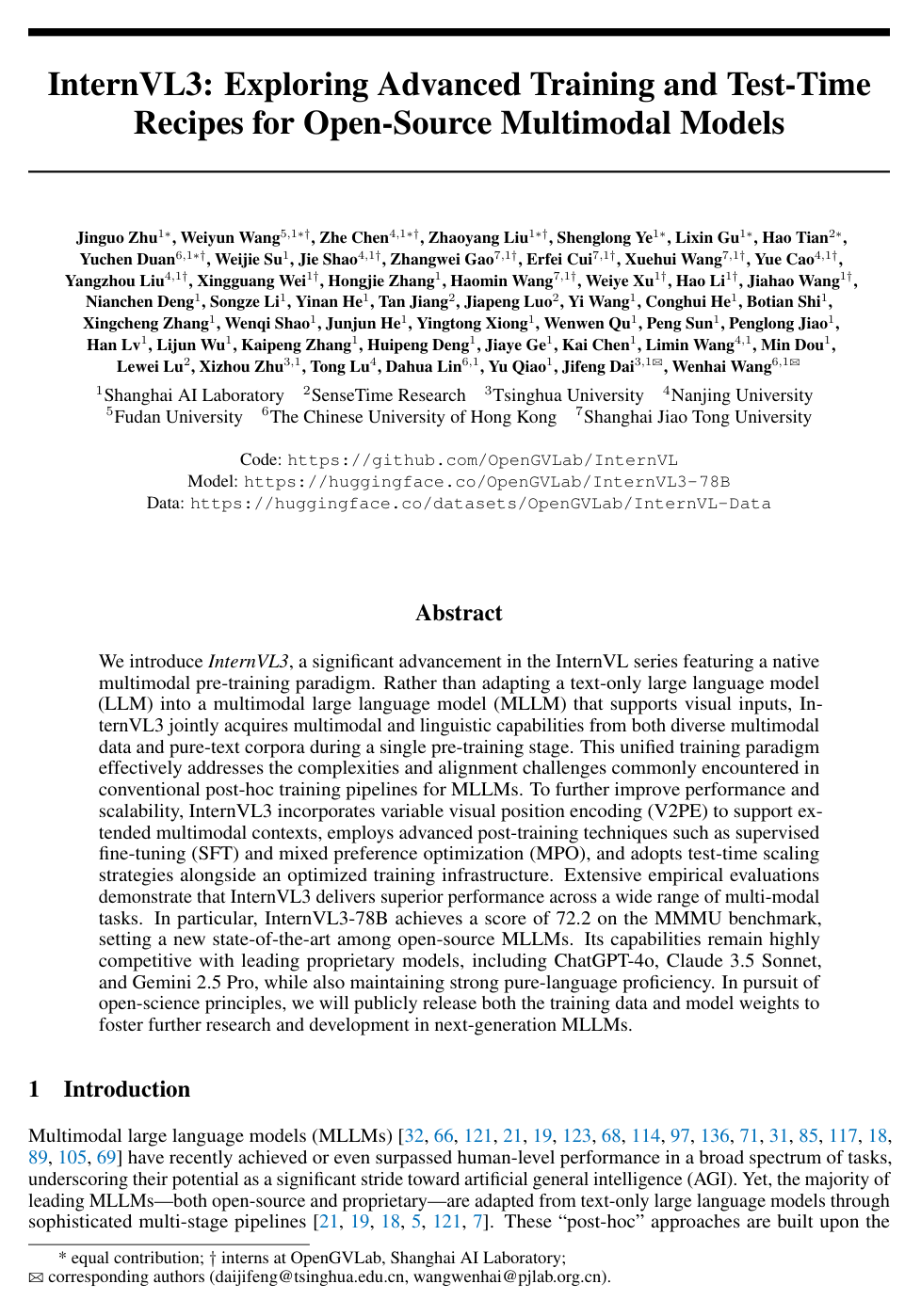
InternVL3: Exploring Advanced Training and Test-Time Recipes for Open-Source Multimodal Models
Jinguo Zhu, Weiyun Wang, Zhe Chen, Zhaoyang Liu, Shenglong Ye, Lixin Gu, Yuchen Duan, Hao Tian, Weijie Su, Jie Shao, Zhangwei Gao, Erfei Cui, Yue Cao, Yang-Zhou Liu, Haomin Wang, Weiye Xu, Hao Li, Jiahao Wang, Han Lv, De-Hua Chen, Songze Li, Yinan He, Tan Jiang, Jia-Peng Luo, Jiapeng Luo, Conghui He, Botian Shi, Xingcheng Zhang, Wenqi Shao, Junjun He, Ying Xiong, Wenwen Qu, Peng Sun, Penglong Jiao, Li-Jun Wu, Kaipeng Zhang, Hui Deng, Jiaye Ge, Kaiming Chen, Limin Wang, Min Dou, Lewei Lu, Xizhou Zhu, Tong Lu, Da-Hua Lin, Yu Qiao, Jifeng Dai, Wenhai Wang
Why you should read this
Presents InternVL3, a native multimodal model trained jointly on visual and textual corpora that matches leading proprietary systems on the MMMU benchmark by combining variable visual position encoding with advanced test-time scaling.
We introduce InternVL3, a significant advancement in the InternVL series featuring a native multimodal pre-training paradigm. Rather than adapting a text-only large language model (LLM) into a multimodal large language model (MLLM) that supports visual inputs, InternVL3 jointly acquires multimodal and linguistic capabilities from both diverse multimodal data and pure-text corpora during a single pre-training stage. This unified training paradigm effectively addresses the complexities and alignment challenges commonly encountered in conventional post-hoc training pipelines for MLLMs. To further improve performance and scalability, InternVL3 incorporates variable visual position encoding (V2PE) to support extended multimodal contexts, employs advanced post-training techniques such as supervised fine-tuning (SFT) and mixed preference optimization (MPO), and adopts test-time scaling strategies alongside an optimized training infrastructure. Extensive empirical evaluations demonstrate that InternVL3 delivers superior performance across a wide range of multi-modal tasks. In particular, InternVL3-78B achieves a score of 72.2 on the MMMU benchmark, setting a new state-of-the-art among open-source MLLMs. Its capabilities remain highly competitive with leading proprietary models, including ChatGPT-4o, Claude 3.5 Sonnet, and Gemini 2.5 Pro, while also maintaining strong pure-language proficiency. In pursuit of open-science principles, we will publicly release both the training data and model weights to foster further research and development in next-generation MLLMs.
Added
2026-09-24
Unlimited OCR Works
Youyang Yin, Huanhuan Liu, YY, Qunyi Xie, Chaorun Liu, Shiqi Yang, Shaohua Wang, Zhanlong Liu, Hao Zou, Jinyue Chen, Shu Wei, Jingjing Wu, Mingxin Huang, Zhen Wu, Guibin Wang, Tengyu Du, Lei Jia
Why you should read this
Introduces Unlimited OCR, a novel model leveraging Reference Sliding Window Attention (R-SWA), which efficiently enables single-pass transcription of dozens of document pages by maintaining a constant KV cache, thereby overcoming a critical limitation of current end-to-end OCR models and offering a generalizable parsing attention mechanism for other long-horizon tasks.
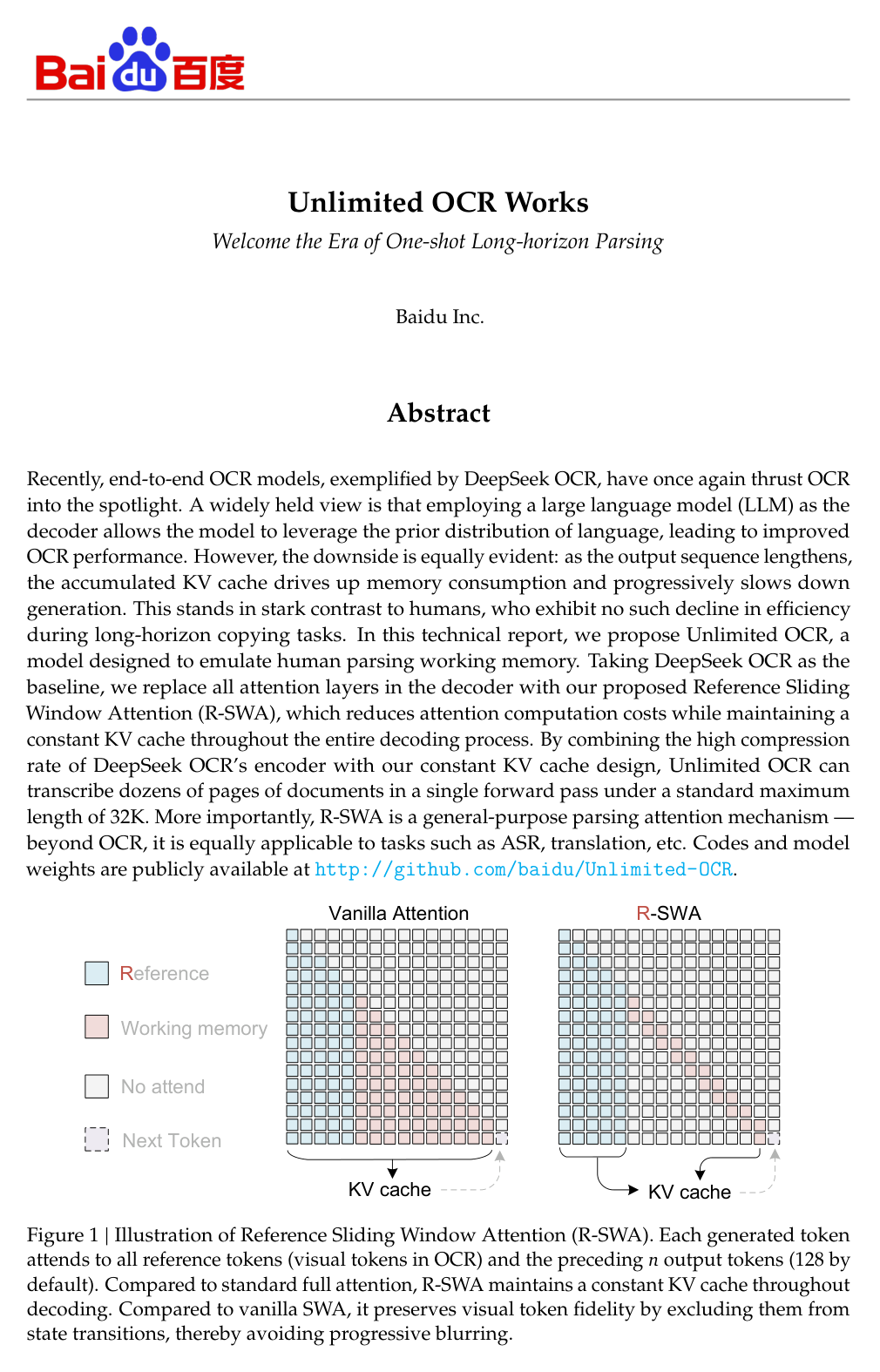
Recently, end-to-end OCR models, exemplified by DeepSeek OCR, have once again thrust OCR into the spotlight. A widely held view is that employing a large language model (LLM) as the decoder allows the model to leverage the prior distribution of language, leading to improved OCR performance. However, the downside is equally evident: as the output sequence lengthens, the accumulated KV cache drives up memory consumption and progressively slows down generation. This stands in stark contrast to humans, who exhibit no such decline in efficiency during long-horizon copying tasks. In this technical report, we propose Unlimited OCR, a model designed to emulate human parsing working memory. Taking DeepSeek OCR as the baseline, we replace all attention layers in the decoder with our proposed Reference Sliding Window Attention (R-SWA), which reduces attention computation costs while maintaining a constant KV cache throughout the entire decoding process. By combining the high compression rate of DeepSeek OCR's encoder with our constant KV cache design, Unlimited OCR can transcribe dozens of pages of documents in a single forward pass under a standard maximum length of 32K. More importantly, R-SWA is a general-purpose parsing attention mechanism - beyond OCR, it is equally applicable to tasks such as ASR, translation, etc. Codes and model weights are publicly available at this http URL.
Added
2026-07-09
