
keyword
open-source language models
Open-source language models are artificial intelligence systems designed to process and generate text whose core technical components, such as model weights, architecture code, and training configurations, are made publicly accessible. Unlike proprietary language models that are restricted to closed commercial interfaces, open-source alternatives allow developers and researchers to freely inspect, download, modify, and deploy the models on private infrastructure. This public availability promotes transparency, adaptability, and cost efficiency, enabling independent auditing of model behavior, domain-specific fine-tuning, and customizable evaluation across diverse applications.
2 items
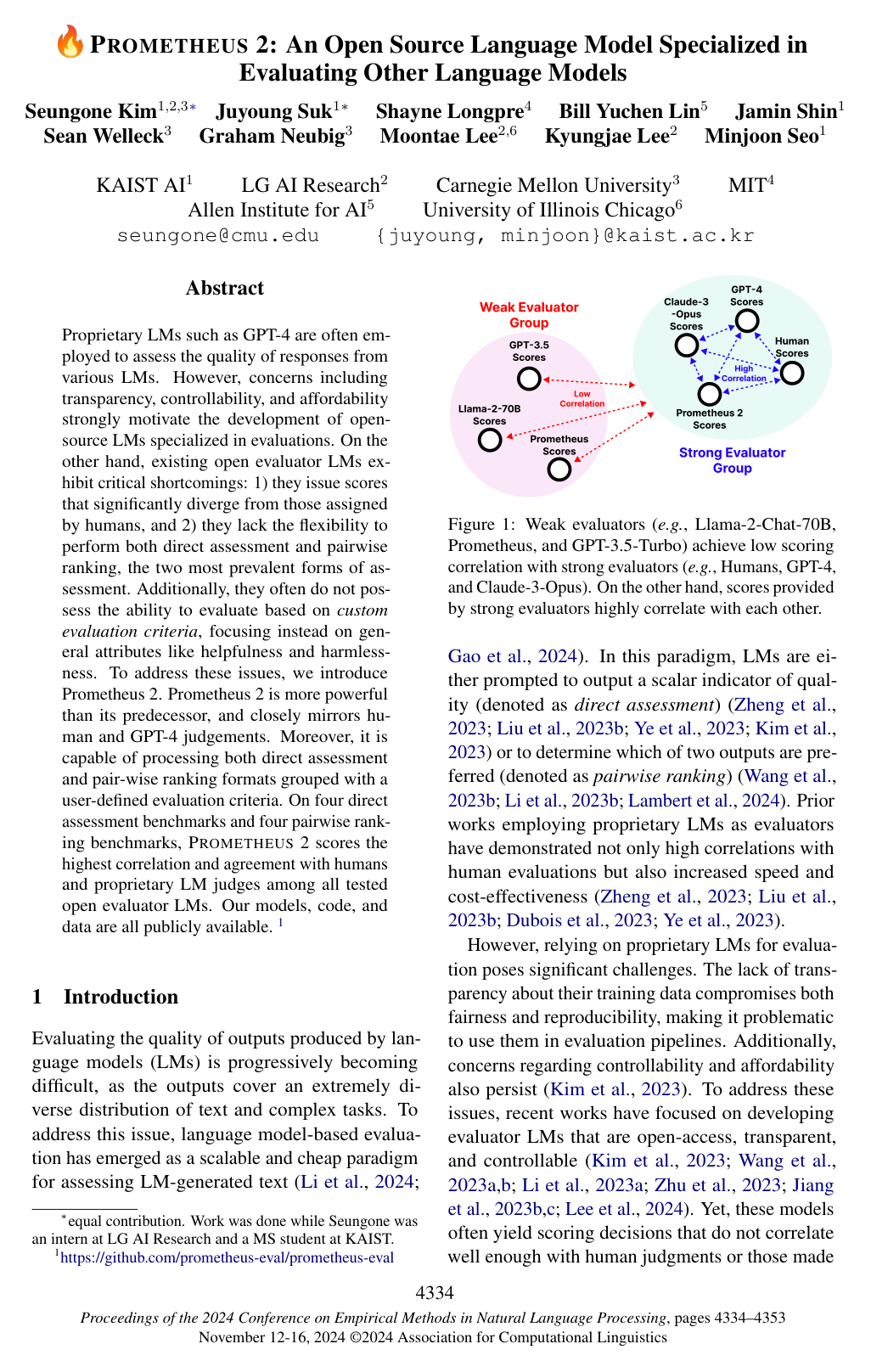
Prometheus 2: An Open Source Language Model Specialized in Evaluating Other Language Models
Seungone Kim, Juyoung Suk, Shayne Longpre, Bill Yuchen Lin, Jamin Shin, Sean Welleck, Graham Neubig, Moontae Lee, Kyungjae Lee, Minjoon Seo
Why you should read this
Presents Prometheus 2, an open-source evaluator language model that handles both direct assessment and pairwise ranking with custom criteria by merging models trained on separate evaluation formats, closely mirroring human and GPT-4 judgments.
Proprietary LMs such as GPT-4 are often employed to assess the quality of responses from various LMs. However, concerns including transparency, controllability, and affordability strongly motivate the development of open-source LMs specialized in evaluations. On the other hand, existing open evaluator LMs exhibit critical shortcomings: 1) they issue scores that significantly diverge from those assigned by humans, and 2) they lack the flexibility to perform both direct assessment and pairwise ranking, the two most prevalent forms of assessment. Additionally, they often do not possess the ability to evaluate based on *custom evaluation criteria*, focusing instead on general attributes like helpfulness and harmlessness. To address these issues, we introduce Prometheus 2. Prometheus 2 is more powerful than its predecessor, and closely mirrors human and GPT-4 judgements. Moreover, it is capable of processing both direct assessment and pair-wise ranking formats grouped with a user-defined evaluation criteria. On four direct assessment benchmarks and four pairwise ranking benchmarks, PROMETHEUS 2 scores the highest correlation and agreement with humans and proprietary LM judges among all tested open evaluator LMs. Our models, code, and data are all publicly available. 1
Added
2026-09-28
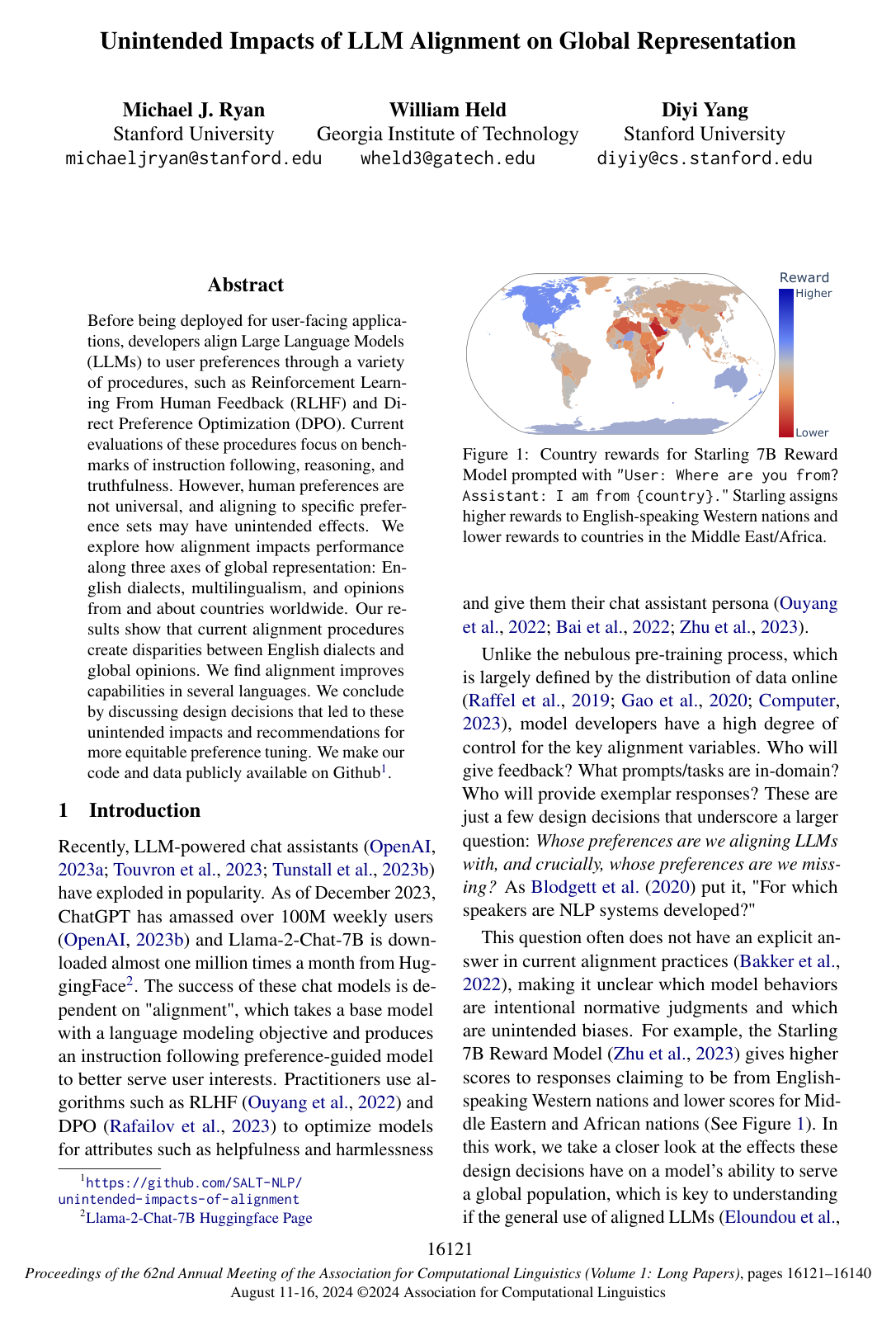
Unintended Impacts of LLM Alignment on Global Representation
Michael J. Ryan, William Barr Held, Diyi Yang
Why you should read this
Reveals how standard alignment techniques like RLHF and DPO introduce substantial global representation biases by widening performance disparities across English dialects and skewing model viewpoints toward US perspectives, while simultaneously improving non-English multilingual capabilities.
Before being deployed for user-facing applications, developers align Large Language Models (LLMs) to user preferences through a variety of procedures, such as Reinforcement Learning From Human Feedback (RLHF) and Direct Preference Optimization (DPO). Current evaluations of these procedures focus on benchmarks of instruction following, reasoning, and truthfulness. However, human preferences are not universal, and aligning to specific preference sets may have unintended effects. We explore how alignment impacts performance along three axes of global representation: English dialects, multilingualism, and opinions from and about countries worldwide. Our results show that current alignment procedures create disparities between English dialects and global opinions. We find alignment improves capabilities in several languages. We conclude by discussing design decisions that led to these unintended impacts and recommendations for more equitable preference tuning. We make our code and data publicly available on Github^1.
Added
2026-09-26