
keyword
open-domain QA tasks
Open-domain question answering tasks are natural language processing challenges in which an artificial intelligence system must answer general, fact-based questions spanning a wide variety of topics without being provided with a specific reference text containing the solution. Unlike reading comprehension or closed-domain tasks that operate on a designated passage or a narrow subject area, open-domain benchmarks require models to independently discover, evaluate, and synthesize information from extensive knowledge bases, such as large document corpora, digital encyclopedias, or the open web. To address these knowledge-intensive tasks, systems typically integrate the internal memory of large pre-trained language models with external search and retrieval mechanisms that dynamically gather supporting evidence to generate accurate and factual answers across diverse domains.
2 items
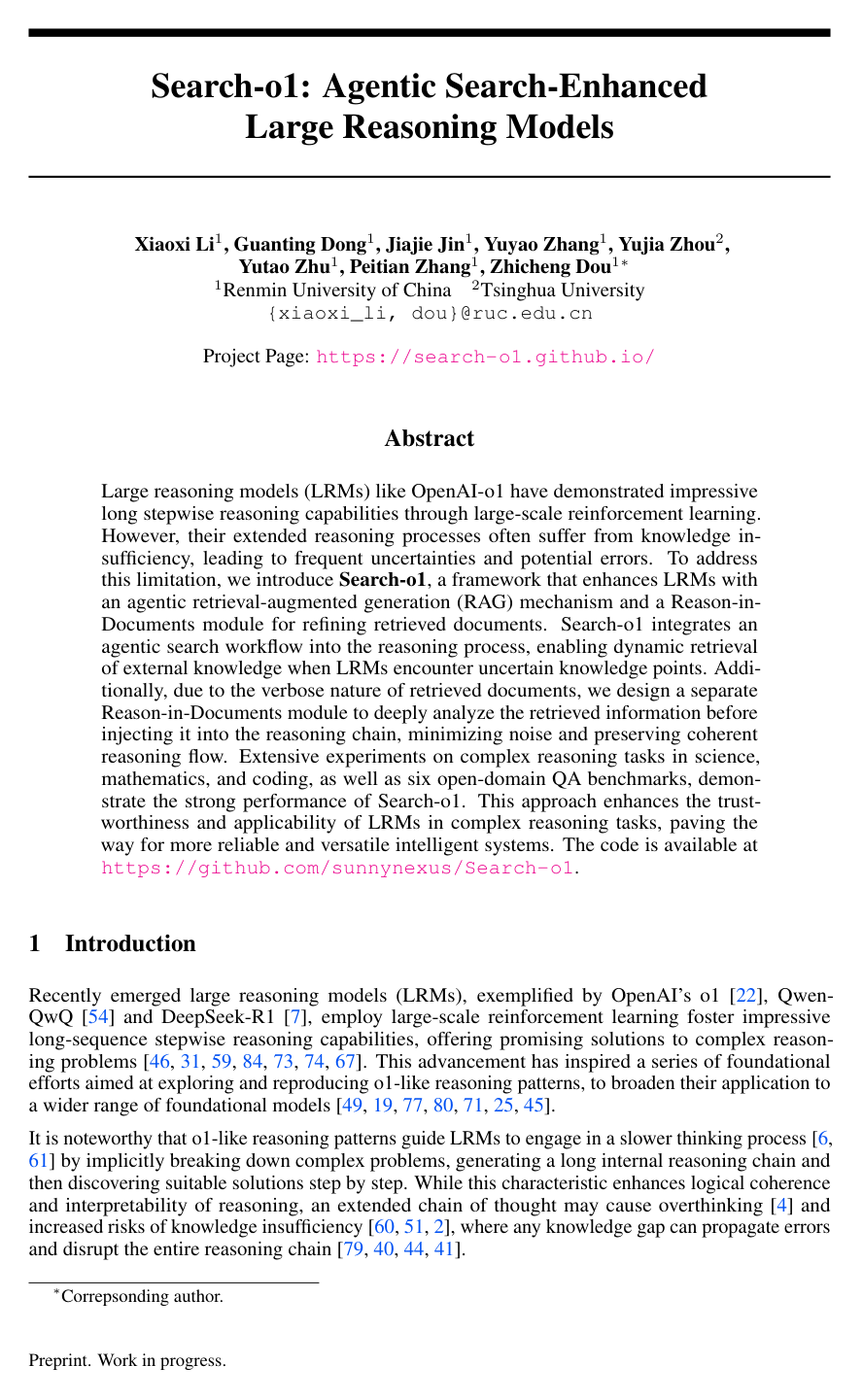
Search-o1: Agentic Search-Enhanced Large Reasoning Models
Xiaoxi Li, Guanting Dong, Jiajie Jin, Yuyao Zhang, Yujia Zhou, Yutao Zhu, Peitian Zhang, Zhicheng Dou
Why you should read this
Introduces Search-o1, a framework that integrates an agentic search workflow and a specialized document refinement module into large reasoning models to autonomously resolve knowledge gaps while preserving the logical coherence of extended chain-of-thought reasoning.
Large reasoning models (LRMs) like OpenAI-o1 have demonstrated impressive long stepwise reasoning capabilities through large-scale reinforcement learning. However, their extended reasoning processes often suffer from knowledge insufficiency, leading to frequent uncertainties and potential errors. To address this limitation, we introduce \textbf{Search-o1}, a framework that enhances LRMs with an agentic retrieval-augmented generation (RAG) mechanism and a Reason-in-Documents module for refining retrieved documents. Search-o1 integrates an agentic search workflow into the reasoning process, enabling dynamic retrieval of external knowledge when LRMs encounter uncertain knowledge points. Additionally, due to the verbose nature of retrieved documents, we design a separate Reason-in-Documents module to deeply analyze the retrieved information before injecting it into the reasoning chain, minimizing noise and preserving coherent reasoning flow. Extensive experiments on complex reasoning tasks in science, mathematics, and coding, as well as six open-domain QA benchmarks, demonstrate the strong performance of Search-o1. This approach enhances the trustworthiness and applicability of LRMs in complex reasoning tasks, paving the way for more reliable and versatile intelligent systems. The code is available at \url{https://github.com/sunnynexus/Search-o1}.
Added
2026-05-18
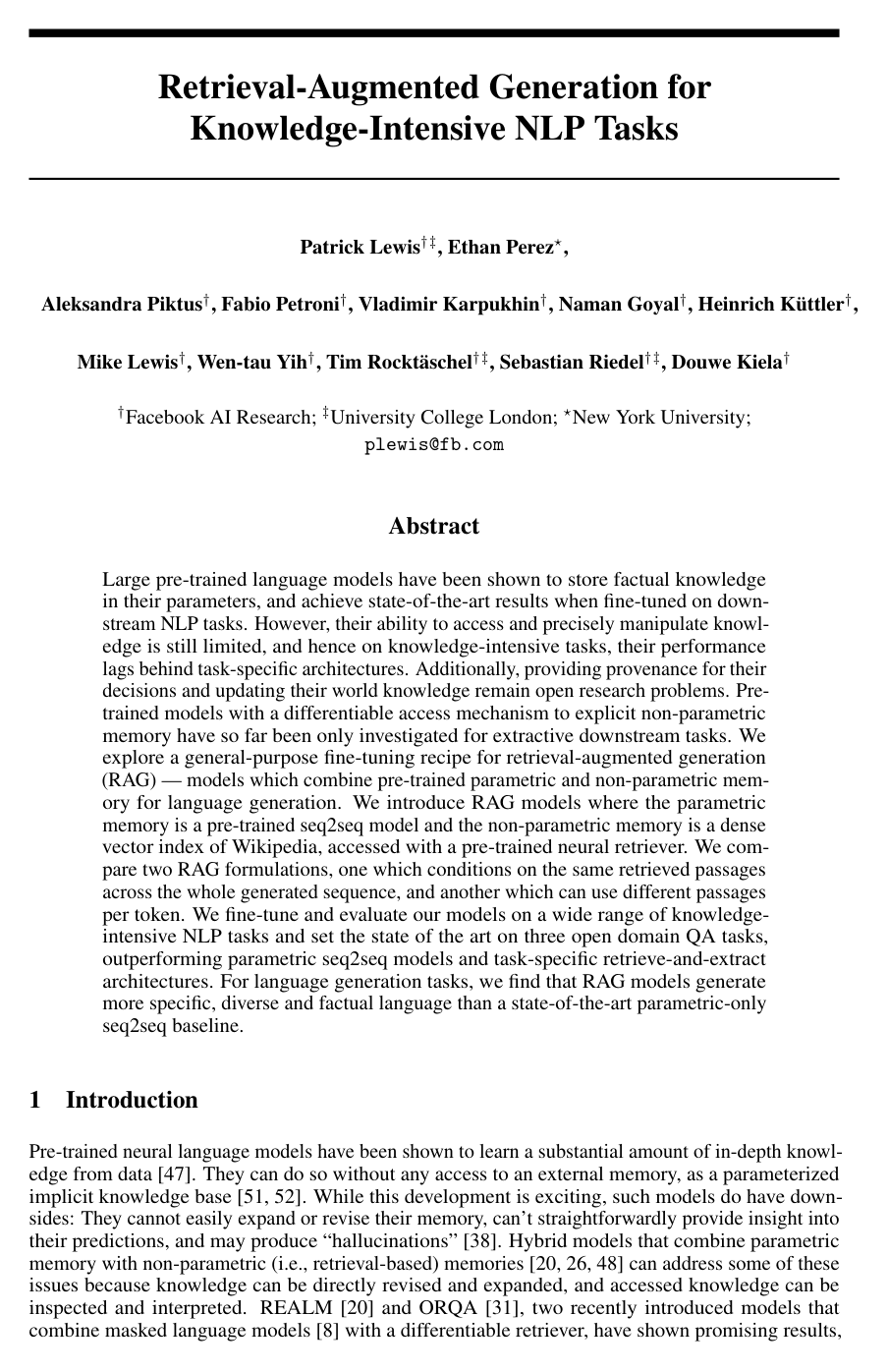
Retrieval-Augmented Generation for Knowledge-Intensive NLP Tasks
Patrick Lewis, Ethan Perez, Aleksandra Piktus, Fabio Petroni, Vladimir Karpukhin, Naman Goyal, Heinrich Küttler, Mike Lewis, Wen-tau Yih, Tim Rocktäschel, Sebastian Riedel, Douwe Kiela
Why you should read this
Proposes the definitive retrieval-augmented architecture linking a pre-trained retriever with a sequence-to-sequence generator trained end-to-end to mitigate hallucinations.
Large pre-trained language models have been shown to store factual knowledge in their parameters, and achieve state-of-the-art results when fine-tuned on downstream NLP tasks. However, their ability to access and precisely manipulate knowledge is still limited, and hence on knowledge-intensive tasks, their performance lags behind task-specific architectures. Additionally, providing provenance for their decisions and updating their world knowledge remain open research problems. Pre-trained models with a differentiable access mechanism to explicit non-parametric memory can overcome this issue, but have so far been only investigated for extractive downstream tasks. We explore a general-purpose fine-tuning recipe for retrieval-augmented generation (RAG) -- models which combine pre-trained parametric and non-parametric memory for language generation. We introduce RAG models where the parametric memory is a pre-trained seq2seq model and the non-parametric memory is a dense vector index of Wikipedia, accessed with a pre-trained neural retriever. We compare two RAG formulations, one which conditions on the same retrieved passages across the whole generated sequence, the other can use different passages per token. We fine-tune and evaluate our models on a wide range of knowledge-intensive NLP tasks and set the state-of-the-art on three open domain QA tasks, outperforming parametric seq2seq models and task-specific retrieve-and-extract architectures. For language generation tasks, we find that RAG models generate more specific, diverse and factual language than a state-of-the-art parametric-only seq2seq baseline.
Added
2026-02-14