
keyword
open-domain dialogue
Open-domain dialogue is conversation in which participants can discuss a wide range of topics without being limited to a predefined subject or set of responses. It can include social chit-chat as well as knowledge-based exchanges, and typically involves generating contextually appropriate replies across varied interactions.
3 items
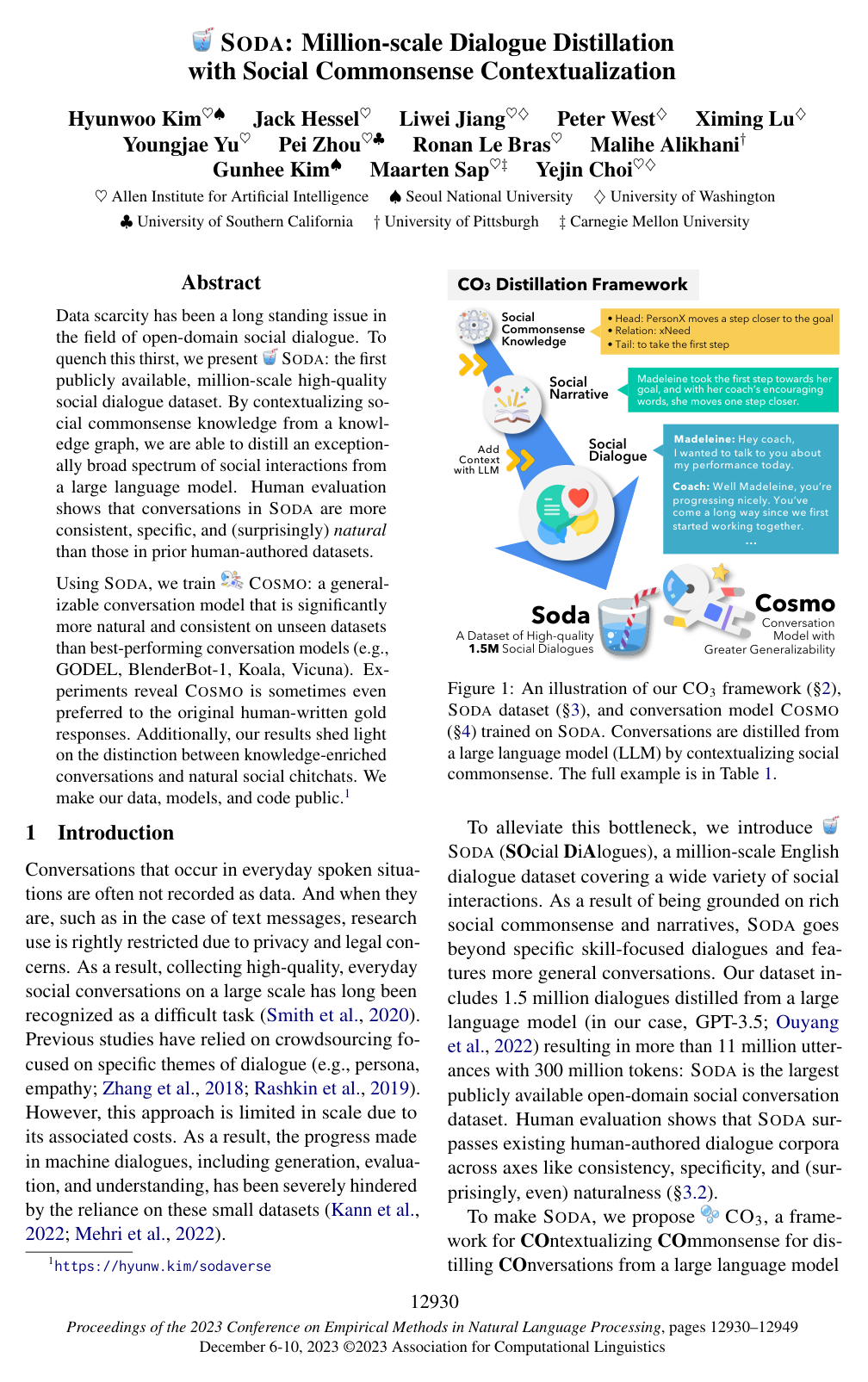
SODA: Million-scale Dialogue Distillation with Social Commonsense Contextualization
Hyunwoo Kim, Jack Hessel, Liwei Jiang, Peter West, Ximing Lu, Youngjae Yu, Pei Zhou, Ronan Le Bras, Malihe Alikhani, Gunhee Kim, Maarten Sap, Yejin Choi
Why you should read this
Presents a framework for contextualizing symbolic commonsense knowledge graphs to distill a million-scale dataset of natural social conversations from language models, enabling dialogue agents that outperform existing open-domain models on unseen interactions.
Data scarcity has been a long standing issue in the field of open-domain social dialogue. To quench this thirst, we present 🥤 SODA: the first publicly available, million-scale high-quality social dialogue dataset. By contextualizing social commonsense knowledge from a knowledge graph, we are able to distill an exceptionally broad spectrum of social interactions from a large language model. Human evaluation shows that conversations in SODA are more consistent, specific, and (surprisingly) natural than those in prior human-authored datasets. Using SODA, we train 🥤 COSMO: a generalizable conversation model that is significantly more natural and consistent on unseen datasets than best-performing conversation models (e.g., GODEL, BlenderBot-1, Koala, Vicuna). Experiments reveal COSMO is sometimes even preferred to the original human-written gold responses. Additionally, our results shed light on the distinction between knowledge-enriched conversations and natural social chitchats. We make our data, models, and code public.¹
Added
2026-10-05
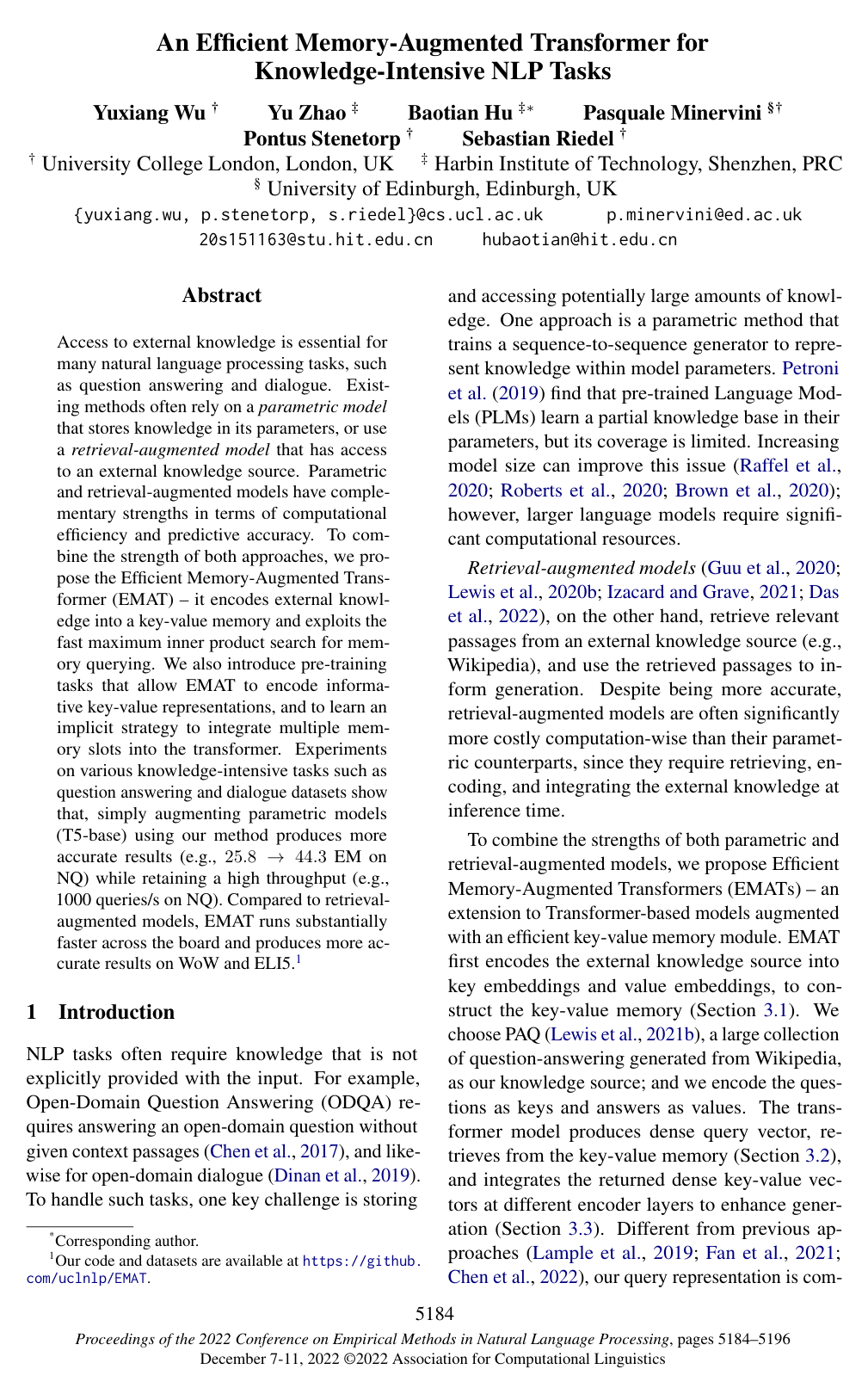
An Efficient Memory-Augmented Transformer for Knowledge-Intensive NLP Tasks
Yuxiang Wu, Yu Zhao, Baotian Hu, Pasquale Minervini, Pontus Stenetorp, Sebastian Riedel
Why you should read this
Proposes an efficient memory-augmented transformer that stores external question-answer knowledge in a fast key-value memory queried during a single forward pass, matching or exceeding the accuracy of retrieval-augmented models on open-domain NLP benchmarks while processing up to a thousand queries per second.
Access to external knowledge is essential for many natural language processing tasks, such as question answering and dialogue. Existing methods often rely on a parametric model that stores knowledge in its parameters, or use a retrieval-augmented model that has access to an external knowledge source. Parametric and retrieval-augmented models have complementary strengths in terms of computational efficiency and predictive accuracy. To combine the strength of both approaches, we propose the Efficient Memory-Augmented Transformer (EMAT) – it encodes external knowledge into a key-value memory and exploits the fast maximum inner product search for memory querying. We also introduce pre-training tasks that allow EMAT to encode informative key-value representations, and to learn an implicit strategy to integrate multiple memory slots into the transformer. Experiments on various knowledge-intensive tasks such as question answering and dialogue datasets show that, simply augmenting parametric models (T5-base) using our method produces more accurate results (e.g., 25.8 → 44.3 EM on NQ) while retaining a high throughput (e.g., 1000 queries/s on NQ). Compared to retrieval-augmented models, EMAT runs substantially faster across the board and produces more accurate results on WoW and ELI5.
Added
2026-10-03
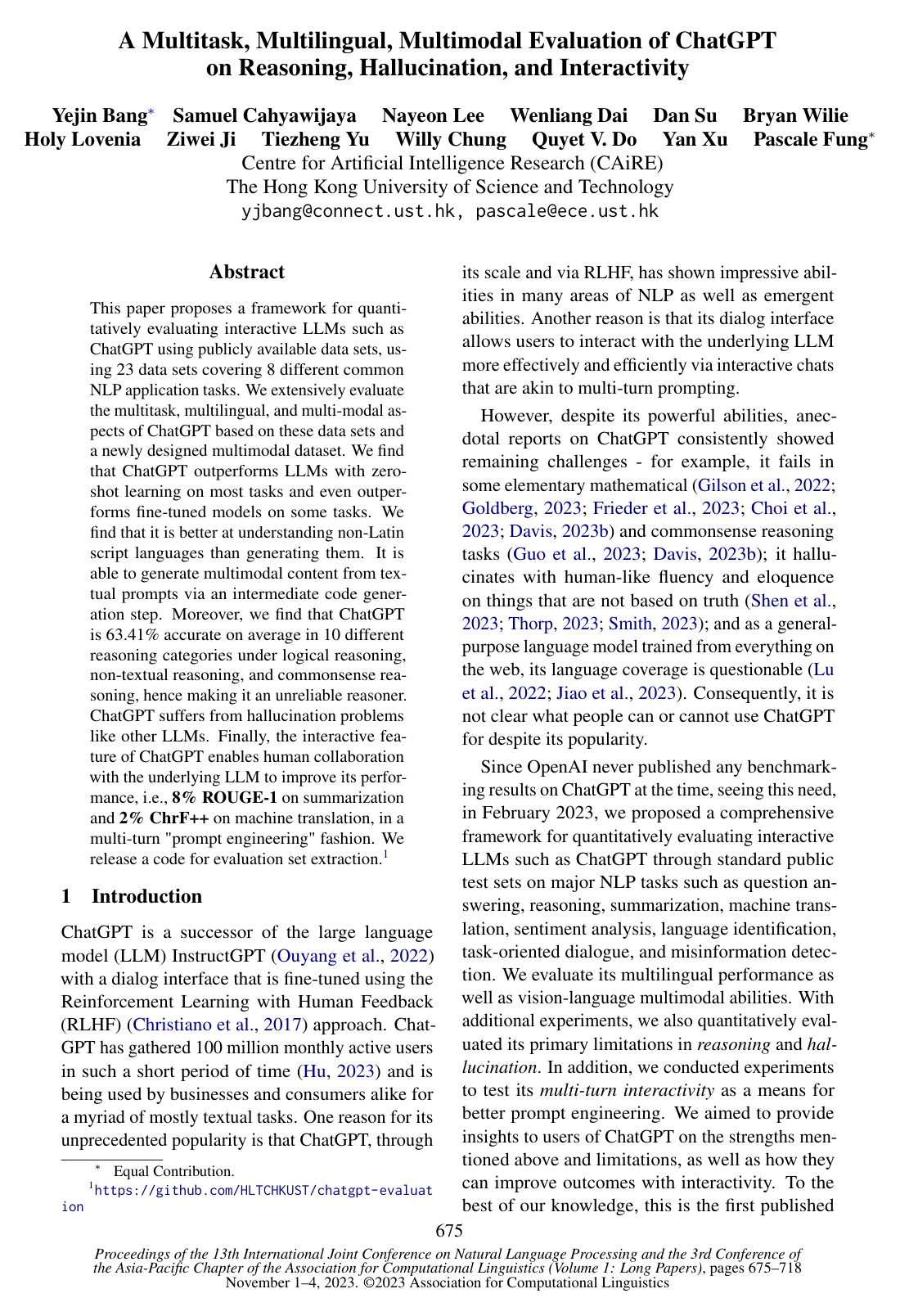
A Multitask, Multilingual, Multimodal Evaluation of ChatGPT on Reasoning, Hallucination, and Interactivity
Yejin Bang, Samuel Cahyawijaya, Nayeon Lee, Wenliang Dai, Dan Su, Bryan Wilie, Holy Lovenia, Ziwei Ji, Tiezheng Yu, Willy Chung, Quyet V. Do, Yan Xu, Pascale Fung
Why you should read this
Reveals critical limits in ChatGPT's reasoning, multilingual generation, and factual hallucination across twenty-three datasets while demonstrating how multi-turn interactive prompting significantly improves task performance.
This paper proposes a framework for quantitatively evaluating interactive LLMs such as ChatGPT using publicly available data sets. We carry out an extensive technical evaluation of ChatGPT using 23 data sets covering 8 different common NLP application tasks. We evaluate the multitask, multilingual and multi-modal aspects of ChatGPT based on these data sets and a newly designed multimodal dataset. We find that ChatGPT outperforms LLMs with zero-shot learning on most tasks and even outperforms fine-tuned models on some tasks. We find that it is better at understanding non-Latin script languages than generating them. It is able to generate multimodal content from textual prompts, via an intermediate code generation step. Moreover, we find that ChatGPT is 63.41% accurate on average in 10 different reasoning categories under logical reasoning, non-textual reasoning, and commonsense reasoning, hence making it an unreliable reasoner. It is, for example, better at deductive than inductive reasoning. ChatGPT suffers from hallucination problems like other LLMs and it generates more extrinsic hallucinations from its parametric memory as it does not have access to an external knowledge base. Finally, the interactive feature of ChatGPT enables human collaboration with the underlying LLM to improve its performance, i.e, 8% ROUGE-1 on summarization and 2% ChrF++ on machine translation, in a multi-turn "prompt engineering" fashion. We also release codebase for evaluation set extraction.
Added
2026-09-18