
keyword
obstacle avoidance
Obstacle avoidance is the capability of an autonomous agent, such as a robot or self-driving vehicle, to detect objects in its environment and dynamically adjust its trajectory or control actions to prevent collisions while navigating toward a target destination. Relying on onboard sensory systems like cameras, radar, or LiDAR, obstacle avoidance processes environmental data to identify both static and moving hazards in real time. It serves as a foundational component of automated motion planning and control, ensuring that the system can safely steer around barriers, brake for pedestrians or vehicles, and maintain a safe operating corridor without human intervention.
6 items
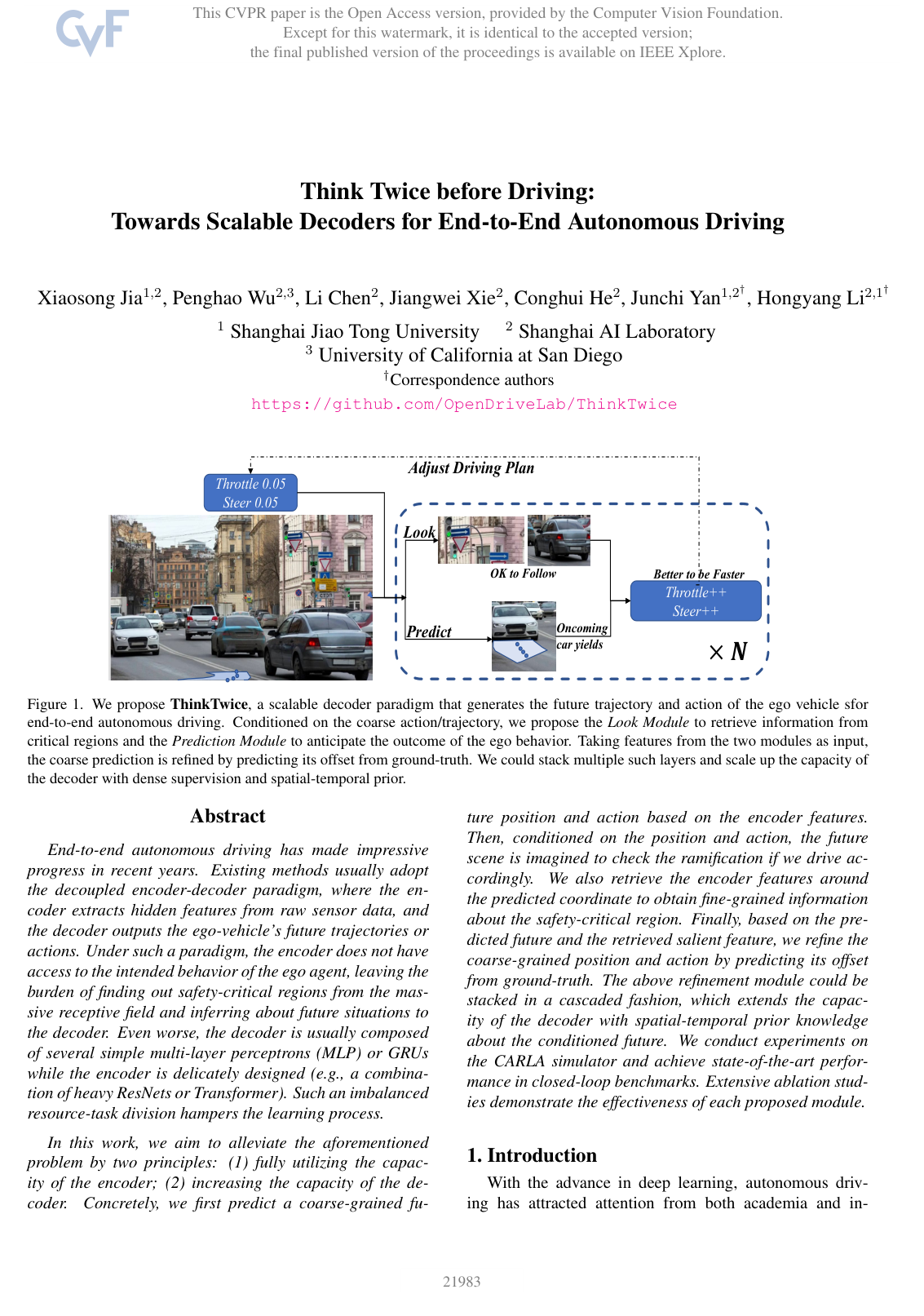
Think Twice before Driving: Towards Scalable Decoders for End-to-End Autonomous Driving
Xiaosong Jia, Penghao Wu, Li Chen, Jiangwei Xie, Conghui He, Junchi Yan, Hongyang Li
Why you should read this
Proposes a scalable cascaded decoder architecture for end-to-end autonomous driving that refines coarse driving plans by anticipating future scene representations and extracting targeted spatial features from critical regions, achieving state-of-the-art closed-loop CARLA benchmark performance.
End-to-end autonomous driving has made impressive progress in recent years. Existing methods usually adopt the decoupled encoder-decoder paradigm, where the encoder extracts hidden features from raw sensor data, and the decoder outputs the ego-vehicle's future trajectories or actions. Under such a paradigm, the encoder does not have access to the intended behavior of the ego agent, leaving the burden of finding out safety-critical regions from the massive receptive field and inferring about future situations to the decoder. Even worse, the decoder is usually composed of several simple multi-layer perceptrons (MLP) or GRUs while the encoder is delicately designed (e.g., a combination of heavy ResNets or Transformer). Such an imbalanced resource-task division hampers the learning process. In this work, we aim to alleviate the aforementioned problem by two principles: (1) fully utilizing the capacity of the encoder; (2) increasing the capacity of the decoder. Concretely, we first predict a coarse-grained future position and action based on the encoder features. Then, conditioned on the position and action, the future scene is imagined to check the ramification if we drive accordingly. We also retrieve the encoder features around the predicted coordinate to obtain fine-grained information about the safety-critical region. Finally, based on the predicted future and the retrieved salient feature, we refine the coarse-grained position and action by predicting its offset from ground-truth. The above refinement module could be stacked in a cascaded fashion, which extends the capacity of the decoder with spatial-temporal prior knowledge about the conditioned future. We conduct experiments on the CARLA simulator and achieve state-of-the-art performance in closed-loop benchmarks. Extensive ablation studies demonstrate the effectiveness of each proposed module.
Added
2026-10-05
Trajectory-guided Control Prediction for End-to-end Autonomous Driving: A Simple yet Strong Baseline
Penghao Wu, Xiaosong Jia, Li Chen, Junchi Yan, Hongyang Li, Yu Qiao
Why you should read this
Proposes a unified autonomous driving framework that integrates trajectory planning with direct control prediction, achieving top-ranked closed-loop performance on the CARLA benchmark using only a single monocular camera.
Current end-to-end autonomous driving methods either run a controller based on a planned trajectory or perform control prediction directly, which have spanned two separately studied lines of research. Seeing their potential mutual benefits to each other, this paper takes the initiative to explore the combination of these two well-developed worlds. Specifically, our integrated approach has two branches for trajectory planning and direct control, respectively. The trajectory branch predicts the future trajectory, while the control branch involves a novel multi-step prediction scheme such that the relationship between current actions and future states can be reasoned. The two branches are connected so that the control branch receives corresponding guidance from the trajectory branch at each time step. The outputs from two branches are then fused to achieve complementary advantages. Our results are evaluated in the closed-loop urban driving setting with challenging scenarios using the CARLA simulator. Even with a monocular camera input, the proposed approach ranks first on the official CARLA Leaderboard, outperforming other complex candidates with multiple sensors or fusion mechanisms by a large margin. The source code is publicly available at this https URL
Added
2026-09-26
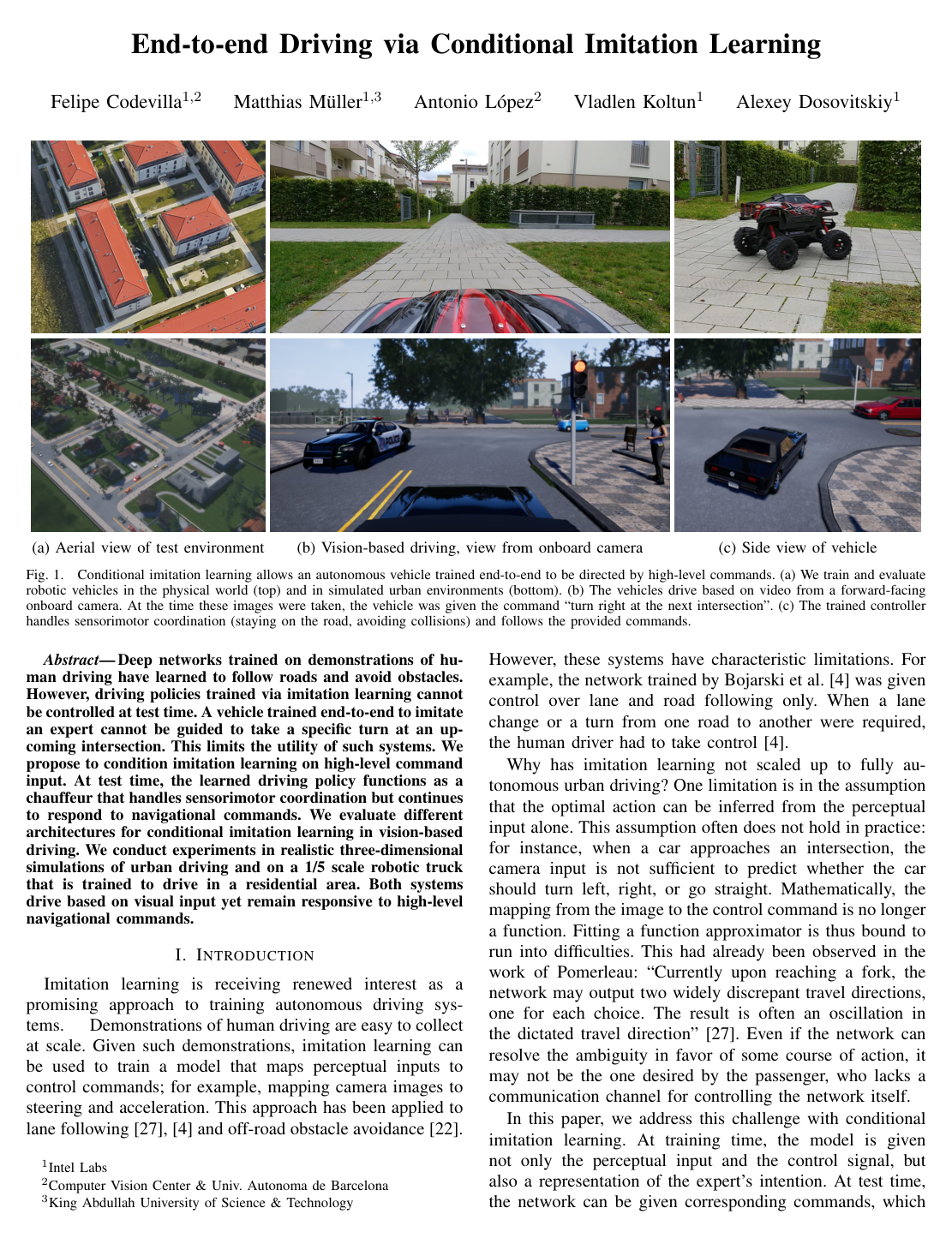
End-to-End Driving Via Conditional Imitation Learning
Felipe Codevilla, Matthias Müller, Antonio López, Vladlen Koltun, Alexey Dosovitskiy
Why you should read this
Proposes conditional imitation learning to make end-to-end autonomous driving controllable at test time, enabling vision-based policies to execute high-level directional commands across simulated urban environments and physical robotic platforms.
Deep networks trained on demonstrations of human driving have learned to follow roads and avoid obstacles. However, driving policies trained via imitation learning cannot be controlled at test time. A vehicle trained end-to-end to imitate an expert cannot be guided to take a specific turn at an upcoming intersection. This limits the utility of such systems. We propose to condition imitation learning on high-level command input. At test time, the learned driving policy functions as a chauffeur that handles sensorimotor coordination but continues to respond to navigational commands. We evaluate different architectures for conditional imitation learning in vision-based driving. We conduct experiments in realistic three-dimensional simulations of urban driving and on a 1/5 scale robotic truck that is trained to drive in a residential area. Both systems drive based on visual input yet remain responsive to high-level navigational commands. The supplementary video can be viewed at this https URL
Added
2026-09-25
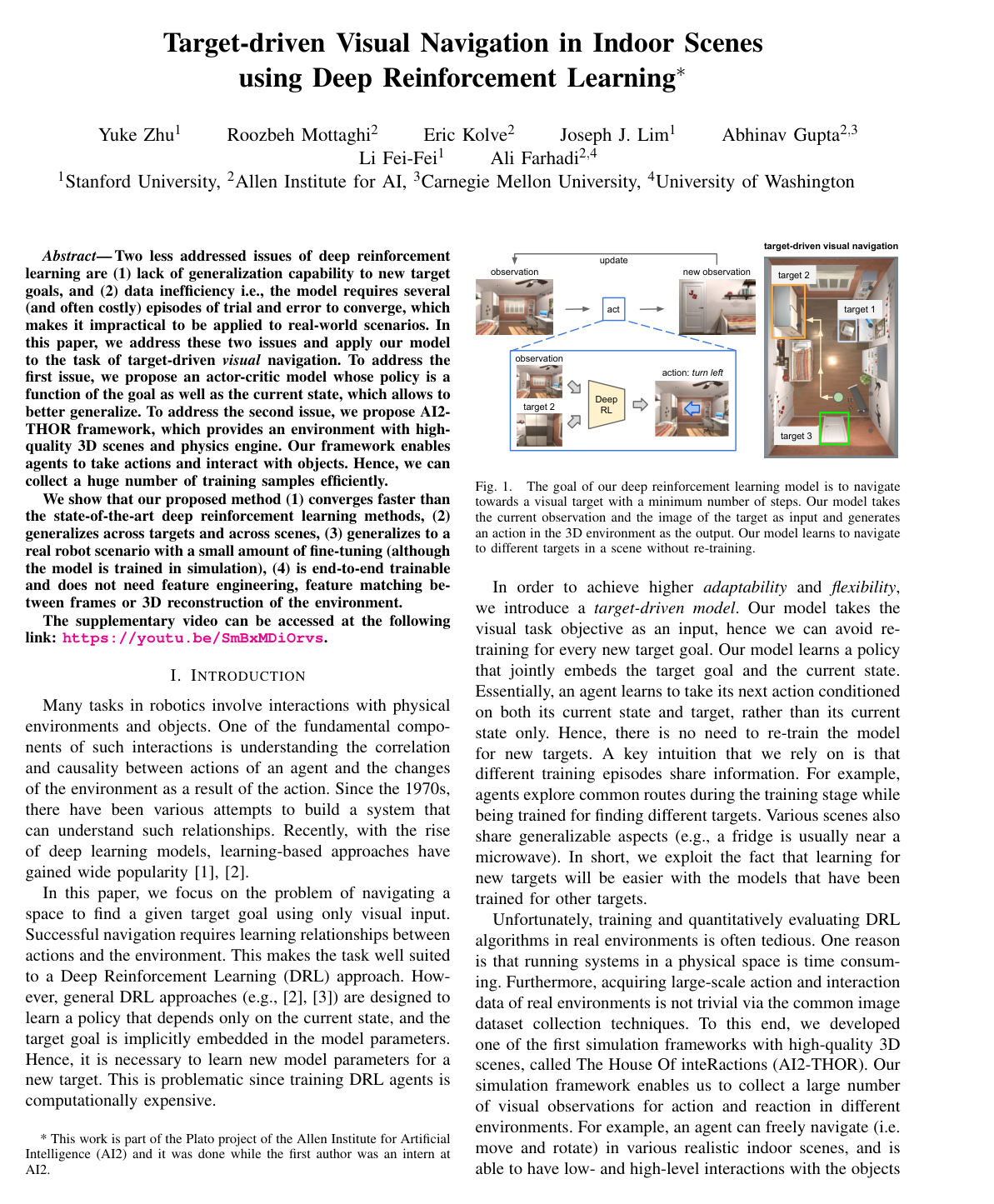
Target-driven visual navigation in indoor scenes using deep reinforcement learning
Yuke Zhu, Roozbeh Mottaghi, Eric Kolve, Joseph J. Lim, Abhinav Gupta, Li Fei-Fei, Ali Farhadi
Why you should read this
Introduces a goal-conditioned deep reinforcement learning framework and the AI2-THOR simulation platform, allowing agents to find visual targets across unseen indoor scenes and transfer learned policies to physical robots without explicit 3D mapping.
Two less addressed issues of deep reinforcement learning are (1) lack of generalization capability to new target goals, and (2) data inefficiency i.e., the model requires several (and often costly) episodes of trial and error to converge, which makes it impractical to be applied to real-world scenarios. In this paper, we address these two issues and apply our model to the task of target-driven visual navigation. To address the first issue, we propose an actor-critic model whose policy is a function of the goal as well as the current state, which allows to better generalize. To address the second issue, we propose AI2-THOR framework, which provides an environment with high-quality 3D scenes and physics engine. Our framework enables agents to take actions and interact with objects. Hence, we can collect a huge number of training samples efficiently. We show that our proposed method (1) converges faster than the state-of-the-art deep reinforcement learning methods, (2) generalizes across targets and across scenes, (3) generalizes to a real robot scenario with a small amount of fine-tuning (although the model is trained in simulation), (4) is end-to-end trainable and does not need feature engineering, feature matching between frames or 3D reconstruction of the environment. The supplementary video can be accessed at the following link: this https URL.
Added
2026-09-24
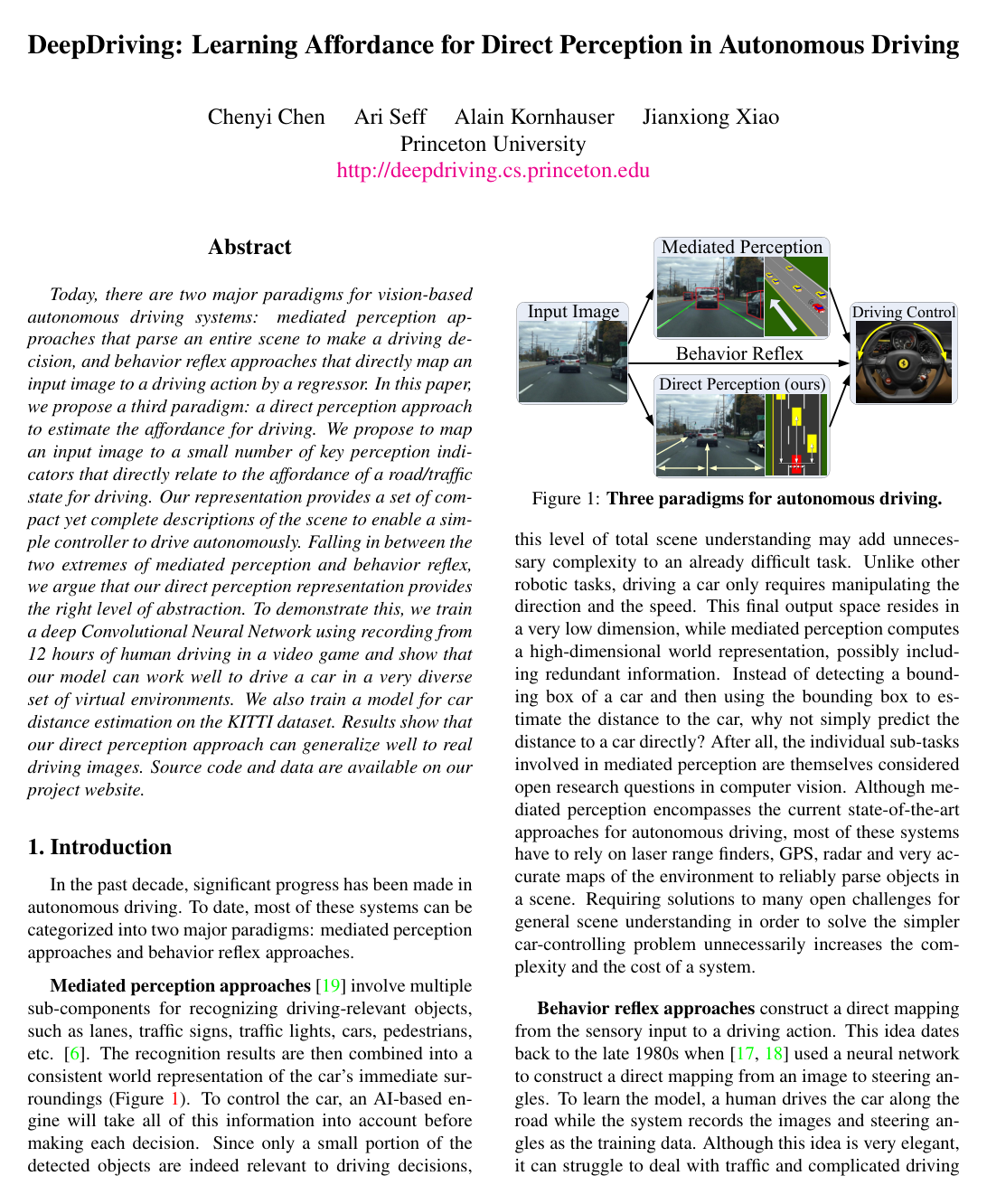
DeepDriving: Learning Affordance for Direct Perception in Autonomous Driving
Chenyi Chen, Ari Seff, Alain Kornhauser, Jianxiong Xiao
Why you should read this
Proposes a direct perception framework for autonomous driving that bridges the gap between full scene parsing and end-to-end control by learning compact driving affordances that enable simple controllers to drive across diverse simulated and real-world environments.
Today, there are two major paradigms for vision-based autonomous driving systems: mediated perception approaches that parse an entire scene to make a driving decision, and behavior reflex approaches that directly map an input image to a driving action by a regressor. In this paper, we propose a third paradigm: a direct perception approach to estimate the affordance for driving. We propose to map an input image to a small number of key perception indicators that directly relate to the affordance of a road/traffic state for driving. Our representation provides a set of compact yet complete descriptions of the scene to enable a simple controller to drive autonomously. Falling in between the two extremes of mediated perception and behavior reflex, we argue that our direct perception representation provides the right level of abstraction. To demonstrate this, we train a deep Convolutional Neural Network using recording from 12 hours of human driving in a video game and show that our model can work well to drive a car in a very diverse set of virtual environments. We also train a model for car distance estimation on the KITTI dataset. Results show that our direct perception approach can generalize well to real driving images. Source code and data are available on our project website.
Added
2026-09-18
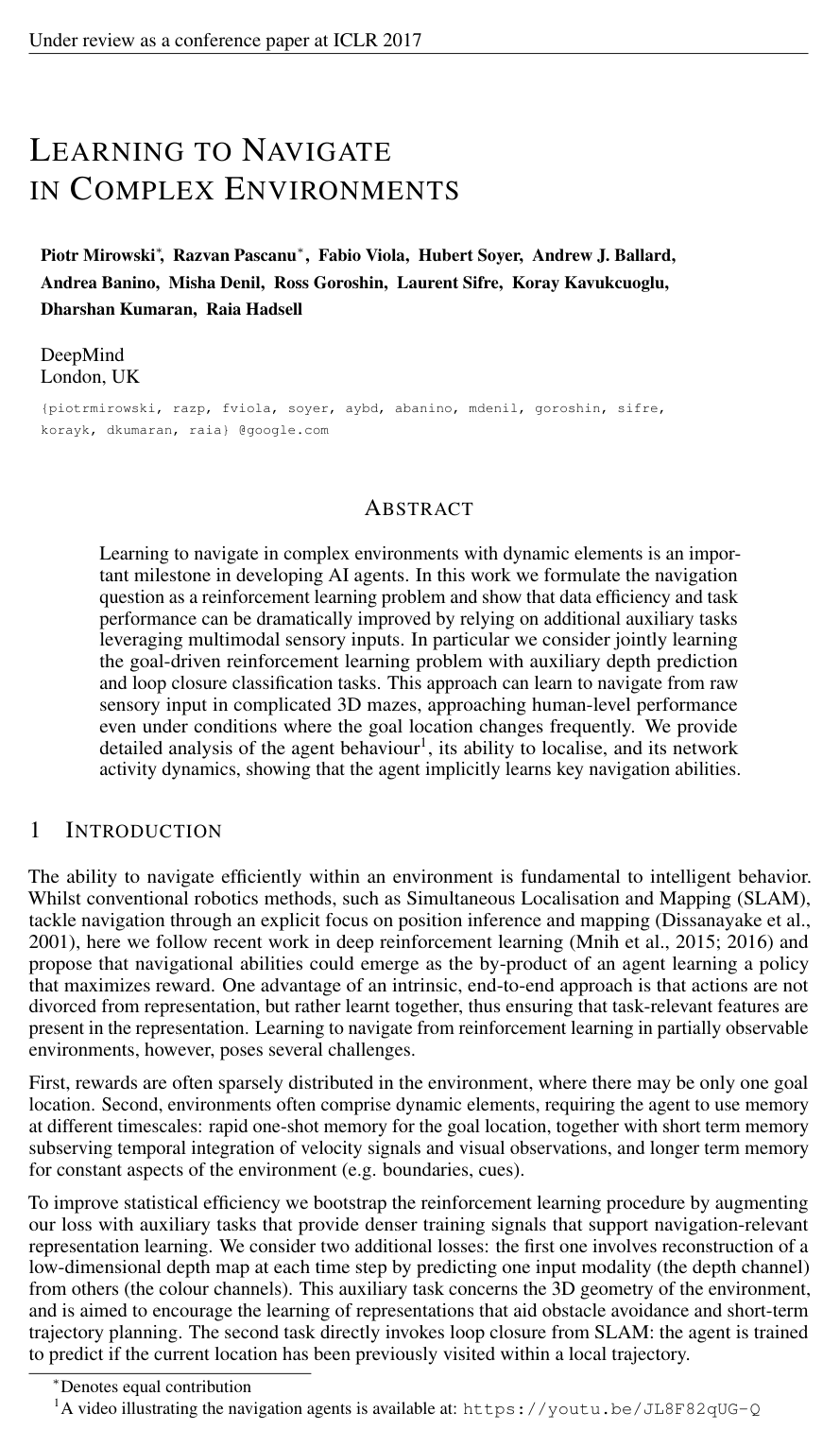
Learning to Navigate in Complex Environments
Piotr Mirowski, Razvan Pascanu, Fabio Viola, Hubert Soyer, Andrew J. Ballard, Andrea Banino, Misha Denil, Ross Goroshin, Laurent Sifre, Koray Kavukcuoglu, Dharshan Kumaran, Raia Hadsell
Why you should read this
Demonstrated that teaching an AI agent to navigate complex 3D mazes becomes dramatically faster and more effective when the agent simultaneously learns auxiliary self-supervised tasks like predicting depth and recognizing previously visited locations, revealing how multiple learning objectives can work together to bootstrap the emergence of sophisticated spatial reasoning abilities that aren't explicitly programmed.
Learning to navigate in complex environments with dynamic elements is an important milestone in developing AI agents. In this work we formulate the navigation question as a reinforcement learning problem and show that data efficiency and task performance can be dramatically improved by relying on additional auxiliary tasks leveraging multimodal sensory inputs. In particular we consider jointly learning the goal-driven reinforcement learning problem with auxiliary depth prediction and loop closure classification tasks. This approach can learn to navigate from raw sensory input in complicated 3D mazes, approaching human-level performance even under conditions where the goal location changes frequently. We provide detailed analysis of the agent behaviour, its ability to localise, and its network activity dynamics, showing that the agent implicitly learns key navigation abilities.
Added
2026-02-21