
keyword
object retrieval
Object retrieval is a computer vision and information retrieval task that involves finding images or video frames in a database that contain a specific object or instance matching a visual query. Unlike holistic image retrieval, which compares the global composition and appearance of entire scenes, object retrieval focuses on localized target regions to identify instances of an object despite substantial variations in viewpoint, scale, illumination, partial occlusion, and background clutter. To accomplish this, systems extract distinctive local descriptors or deep neural network feature embeddings from image regions, index these representations using efficient nearest-neighbor or quantization methods, and apply geometric consistency checks and re-ranking algorithms to verify that the retrieved visual elements genuinely correspond to the queried object.
5 items
Hamming Embedding and Weak Geometric Consistency for Large Scale Image Search
Hervé Jégou, Matthijs Douze, Cordelia Schmid
Why you should read this
Presents Hamming embedding and weak geometric consistency to refine visual-word descriptor matching and filter geometrically inconsistent features directly within an inverted file, substantially increasing retrieval accuracy on million-scale image databases.
This paper improves recent methods for large scale image search. State-of-the-art methods build on the bag-of-features image representation. We, first, analyze bag-of-features in the framework of approximate nearest neighbor search. This shows the sub-optimality of such a representation for matching descriptors and leads us to derive a more precise representation based on 1) Hamming embedding (HE) and 2) weak geometric consistency constraints (WGC). HE provides binary signatures that refine the matching based on visual words. WGC filters matching descriptors that are not consistent in terms of angle and scale. HE and WGC are integrated within the inverted file and are efficiently exploited for all images, even in the case of very large datasets. Experiments performed on a dataset of one million of images show a significant improvement due to the binary signature and the weak geometric consistency constraints, as well as their efficiency. Estimation of the full geometric transformation, i.e., a re-ranking step on a short list of images, is complementary to our weak geometric consistency constraints and allows to further improve the accuracy.
Added
2026-09-16
Content-Based Image Retrieval at the End of the Early Years
A. Smeulders, M. Worring, S. Santini, Amarnath Gupta, Ramesh C. Jain
Why you should read this
Explains how early content-based image retrieval systems represented, compared, and evaluated images while exposing the enduring semantic gap between visual features and user intent.
The paper presents a review of 200 references in content-based image retrieval. The paper starts with discussing the working conditions of content-based retrieval: patterns of use, types of pictures, the role of semantics, and the sensory gap. Subsequent sections discuss computational steps for image retrieval systems. Step one of the review is image processing for retrieval sorted by color, texture, and local geometry. Features for retrieval are discussed next, sorted by: accumulative and global features, salient points, object and shape features, signs, and structural combinations thereof. Similarity of pictures and objects in pictures is reviewed for each of the feature types, in close connection to the types and means of feedback the user of the systems is capable of giving by interaction. We briefly discuss aspects of system engineering: databases, system architecture, and evaluation. In the concluding section, we present our view on: the driving force of the field, the heritage from computer vision, the influence on computer vision, the role of similarity and of interaction, the need for databases, the problem of evaluation, and the role of the semantic gap.
Added
2026-09-14
Caffe: Convolutional Architecture for Fast Feature Embedding
Yangqing Jia, Evan Shelhamer, Jeff Donahue, Sergey Karayev, Jonathan Long, Ross Girshick, Sergio Guadarrama, Trevor Darrell
Why you should read this
Introduces Caffe, an open-source deep learning framework that separates model definition from hardware execution to enable fast, modular training and deployment of convolutional neural networks at scale.
Caffe provides multimedia scientists and practitioners with a clean and modifiable framework for state-of-the-art deep learning algorithms and a collection of reference models. The framework is a BSD-licensed C++ library with Python and MATLAB bindings for training and deploying general-purpose convolutional neural networks and other deep models efficiently on commodity architectures. Caffe fits industry and internet-scale media needs by CUDA GPU computation, processing over 40 million images a day on a single K40 or Titan GPU ( 2.5 ms per image). By separating model representation from actual implementation, Caffe allows experimentation and seamless switching among platforms for ease of development and deployment from prototyping machines to cloud environments. Caffe is maintained and developed by the Berkeley Vision and Learning Center (BVLC) with the help of an active community of contributors on GitHub. It powers ongoing research projects, large-scale industrial applications, and startup prototypes in vision, speech, and multimedia.
Added
2026-09-06

Product Quantization for Nearest Neighbor Search
Hervé Jégou, Matthijs Douze, Cordelia Schmid
Why you should read this
Formulates the mathematics of decomposing high-dimensional spaces into lower-dimensional Cartesian products to compress vectors and radically accelerate distance estimations.
This paper introduces a product quantization-based approach for approximate nearest neighbor search. The idea is to decompose the space into a Cartesian product of low-dimensional subspaces and to quantize each subspace separately. A vector is represented by a short code composed of its subspace quantization indices. The euclidean distance between two vectors can be efficiently estimated from their codes. An asymmetric version increases precision, as it computes the approximate distance between a vector and a code. Experimental results show that our approach searches for nearest neighbors efficiently, in particular in combination with an inverted file system. Results for SIFT and GIST image descriptors show excellent search accuracy, outperforming three state-of-the-art approaches. The scalability of our approach is validated on a data set of two billion vectors.
Added
2026-05-03
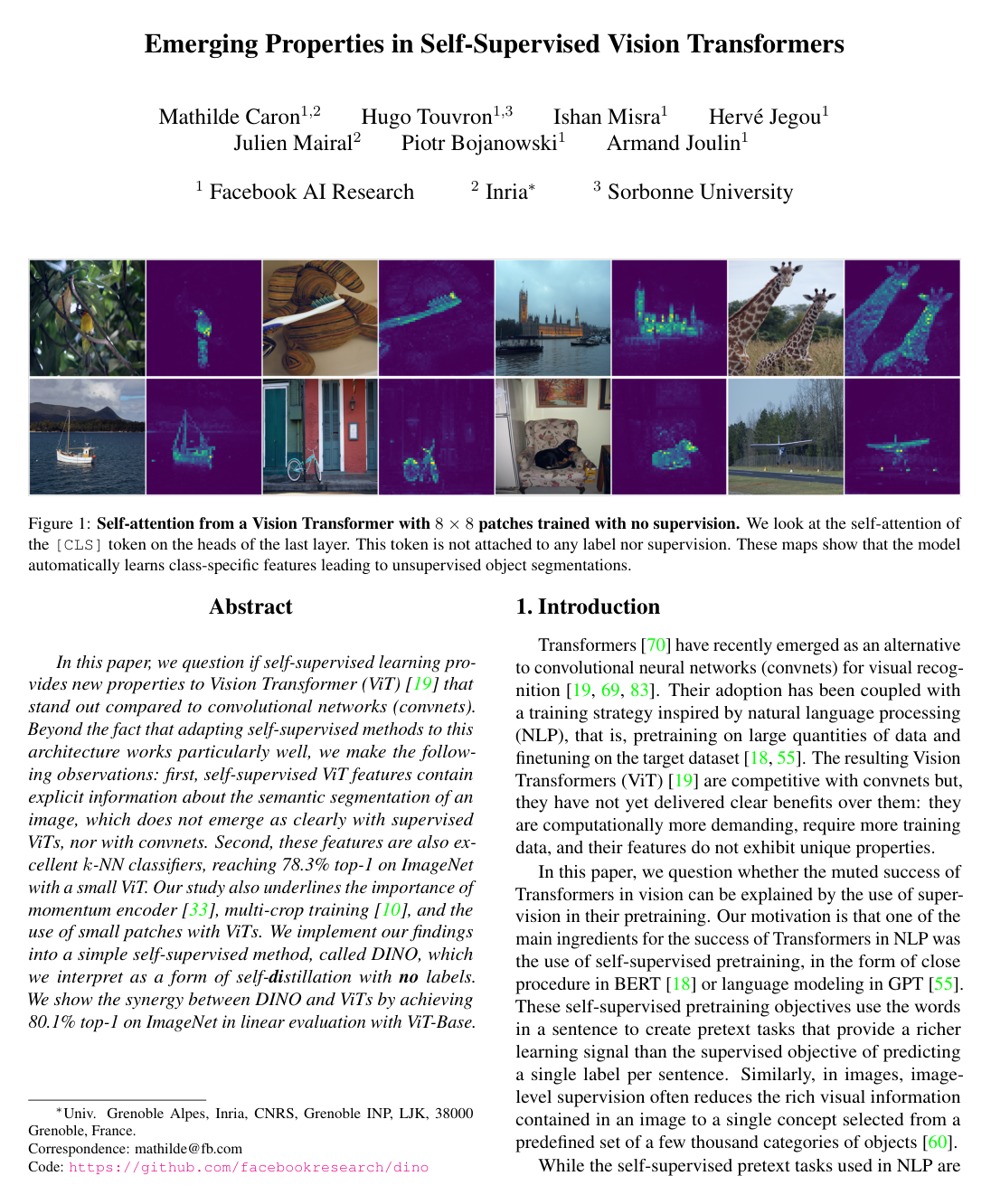
Emerging Properties in Self-Supervised Vision Transformers
Mathilde Caron, Hugo Touvron, Ishan Misra, Hervé Jégou, Julien Mairal, Piotr Bojanowski, Armand Joulin
Why you should read this
Demonstrates how self-supervised learning with Vision Transformers automatically discovers object boundaries and segmentation without any labels, a capability that doesn't emerge in supervised Vision Transformers or standard convolutional networks, and introduces DINO, a simpler self-supervised method that achieves state-of-the-art results by treating the learning process as self-distillation.
In this paper, we question if self-supervised learning provides new properties to Vision Transformer (ViT) that stand out compared to convolutional networks (convnets). Beyond the fact that adapting self-supervised methods to this architecture works particularly well, we make the following observations: first, self-supervised ViT features contain explicit information about the semantic segmentation of an image, which does not emerge as clearly with supervised ViTs, nor with convnets. Second, these features are also excellent k-NN classifiers, reaching 78.3% top-1 on ImageNet with a small ViT. Our study also underlines the importance of momentum encoder, multi-crop training, and the use of small patches with ViTs. We implement our findings into a simple self-supervised method, called DINO, which we interpret as a form of self-distillation with no labels. We show the synergy between DINO and ViTs by achieving 80.1% top-1 on ImageNet in linear evaluation with ViT-Base.
Added
2026-02-21