
keyword
NP-complete problems
An NP-complete problem is a computational decision problem that belongs to the complexity class NP, meaning a candidate solution can be verified in polynomial time, and is also NP-hard, meaning that every problem in NP can be transformed into it in polynomial time. Because of this equivalence, NP-complete problems represent the hardest problems within NP, and discovering an efficient, polynomial-time algorithm for any single NP-complete problem would guarantee that all problems in NP can be solved in polynomial time, thereby proving that P equals NP. Classic examples of NP-complete problems include the Boolean satisfiability problem, the traveling salesperson decision problem, the knapsack problem, and graph coloring.
4 items
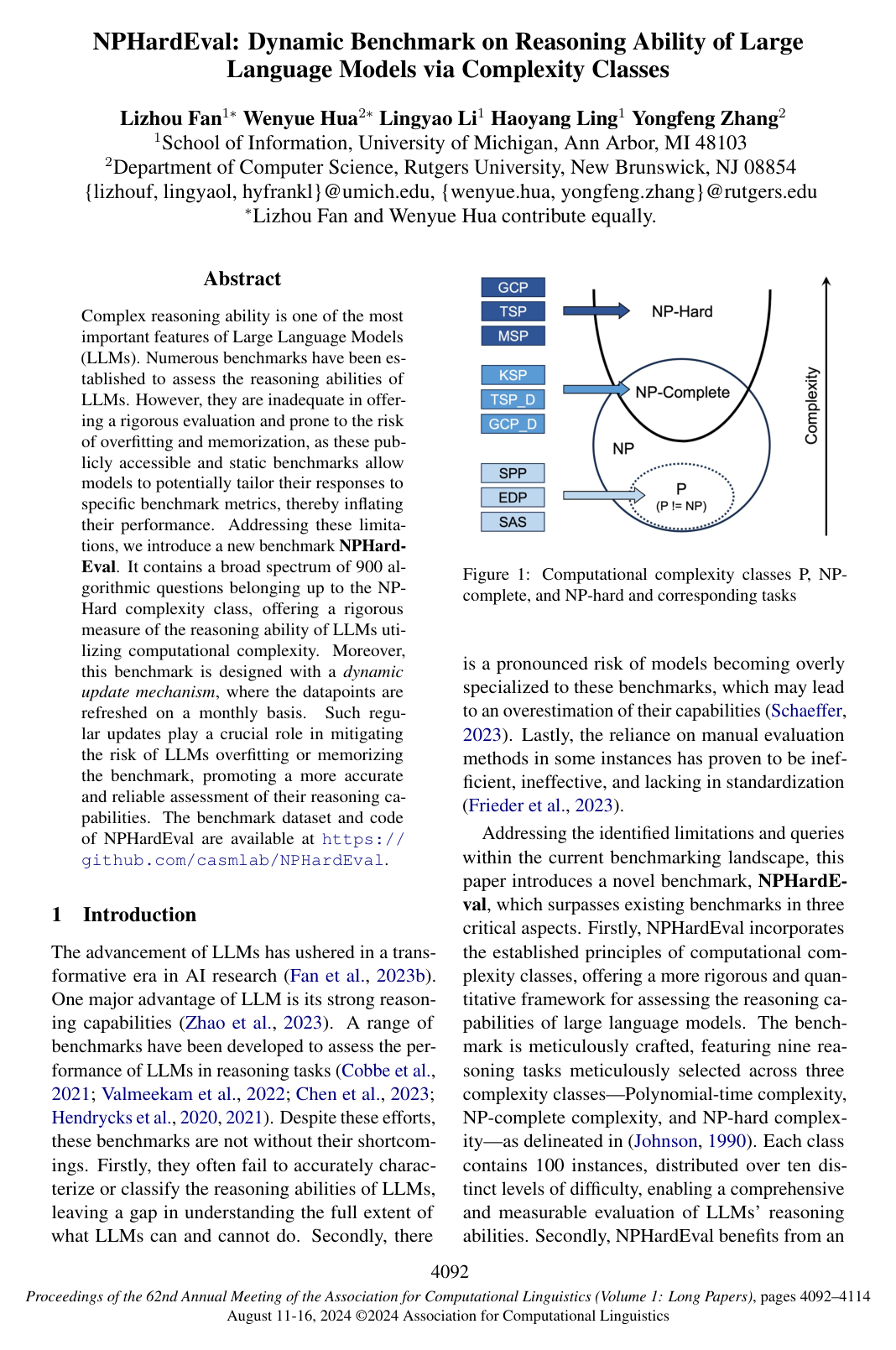
NPHardEval: Dynamic Benchmark on Reasoning Ability of Large Language Models via Complexity Classes
Lizhou Fan, Wenyue Hua, Lingyao Li, Haoyang Ling, Yongfeng Zhang
Why you should read this
Introduces NPHardEval, a dynamic monthly refreshed benchmark spanning P, NP-complete, and NP-hard complexity classes to rigorously evaluate large language model reasoning while preventing data memorization and overfitting.
Complex reasoning ability is one of the most important features of Large Language Models (LLMs). Numerous benchmarks have been established to assess the reasoning abilities of LLMs. However, they are inadequate in offering a rigorous evaluation and prone to the risk of overfitting and memorization, as these publicly accessible and static benchmarks allow models to potentially tailor their responses to specific benchmark metrics, thereby inflating their performance. Addressing these limitations, we introduce a new benchmark NPHard-Eval. It contains a broad spectrum of 900 algorithmic questions belonging up to the NP-Hard complexity class, offering a rigorous measure of the reasoning ability of LLMs utilizing computational complexity. Moreover, this benchmark is designed with a dynamic update mechanism, where the datapoints are refreshed on a monthly basis. Such regular updates play a crucial role in mitigating the risk of LLMs overfitting or memorizing the benchmark, promoting a more accurate and reliable assessment of their reasoning capabilities. The benchmark dataset and code of NPHardEval are available at https://github.com/casmlab/NPHardEval.
Added
2026-10-02
Combinatorial Optimization and Reasoning with Graph Neural Networks
Quentin Cappart, Didier Chételat, Elias B. Khalil, Andrea Lodi, Christopher Morris, Petar Velickovic
Why you should read this
Synthesizes recent advancements at the intersection of machine learning and operations research, providing a unified framework for how graph neural networks can act as standalone solvers or integrate into classical exact algorithms to solve hard combinatorial problems efficiently.
Combinatorial optimization is a well-established area in operations research and computer science. Until recently, its methods have focused on solving problem instances in isolation, ignoring that they often stem from related data distributions in practice. However, recent years have seen a surge of interest in using machine learning, especially graph neural networks (GNNs), as a key building block for combinatorial tasks, either directly as solvers or by enhancing exact solvers. The inductive bias of GNNs effectively encodes combinatorial and relational input due to their invariance to permutations and awareness of input sparsity. This paper presents a conceptual review of recent key advancements in this emerging field, aiming at optimization and machine learning researchers.
Added
2026-09-26
Where the Really Hard Problems Are
P. Cheeseman, B. Kanefsky, W. Taylor
Why you should read this
Reveals that computationally hard instances of NP-complete problems concentrate along a phase transition boundary between underconstrained and overconstrained regions, providing an order-parameter framework to predict search difficulty and distinguish hard instances from typically easy ones.
It is well known that for many NP-complete problems, such as K-Sat, etc., typical cases are easy to solve; so that computationally hard cases must be rare (assuming P = NP). This paper shows that NP-complete problems can be summarized by at least one "order parameter", and that the hard problems occur at a critical value of such a parameter. This critical value separates two regions of characteristically different properties. For example, for K-colorability, the critical value separates overconstrained from underconstrained random graphs, and it marks the value at which the probability of a solution changes abruptly from near 0 to near 1. It is the high density of well-separated almost solutions (local minima) at this boundary that cause search algorithms to "thrash". This boundary is a type of phase transition and we show that it is preserved under mappings between problems. We show that for some P problems either there is no phase transition or it occurs for bounded N (and so bounds the cost). These results suggest a way of deciding if a problem is in P or NP and why they are different. In this paper we show that for many NP problems one or more "order parameters" can be defined, and hard instances occur around particular critical values of these order parameters. In addition, such critical values form a boundary that separates the space of problems into two regions. One region is underconstrained, so the density of solutions is high, thus making it relatively easy to find a solution. The other region is overconstrained and very unlikely to contain a solution. If there are solutions in this overconstrained region, then they have such deep local minimum (strong basin of attraction) that any reasonable algorithm is likely to find it. If there is no solution, then a backtrack search can usually establish this with ease, since potential solution paths are usually cut off early in the search. Really hard problems occur on the boundary between these two regions, where the probability of a solution is low but non-negligible. At this point there are typically many local minima corresponding to almost solutions separated by high "energy barriers". These almost solutions form deep local minima that may often trap search methods that rely on local information. Because it is possible to locate a region where hard problems occur, it is possible to predict whether a particular problem is likely to be easy to solve. We expect that in future computer scientists will produce "phase diagrams" for particular problem domains to aid in hard problem identification and for prediction of solution existence probability, such as shown in [6]. We present these ideas by first showing how phase transitions arise in problem solving, and then illustrating particular transitions through several examples with different properties.
Added
2026-09-25

Mathematics for Computer Science
Eric Lehman, F Thomson Leighton, Albert R Meyer
Why you should read this
Provides foundational mathematical tools and logical reasoning skills necessary for solving complex problems in computer science.
This book provides a comprehensive introduction to mathematics for computer science, covering fundamental topics such as proofs, the well-ordering principle, logical formulas, and mathematical data types including sets, sequences, functions, and binary relations.
Added
2026-08-18
