
keyword
normalizing flows
Normalizing flows are a class of generative probabilistic models that transform a simple base probability distribution, such as a standard Gaussian, into a more complex and expressive distribution using a sequence of invertible and differentiable transformations. Based on the change-of-variables theorem from calculus, this approach allows for both exact probability density evaluation and efficient sampling of new data. Because the mapping functions are bijective and designed with tractable Jacobian determinants, data can be seamlessly transformed back and forth between a complex observed data space and a simplified latent space. Normalizing flows can be implemented as finite compositions of discrete mappings or continuously through differential equations, and they are widely applied in machine learning for tasks such as density estimation, generative modeling, and variational inference.
4 items
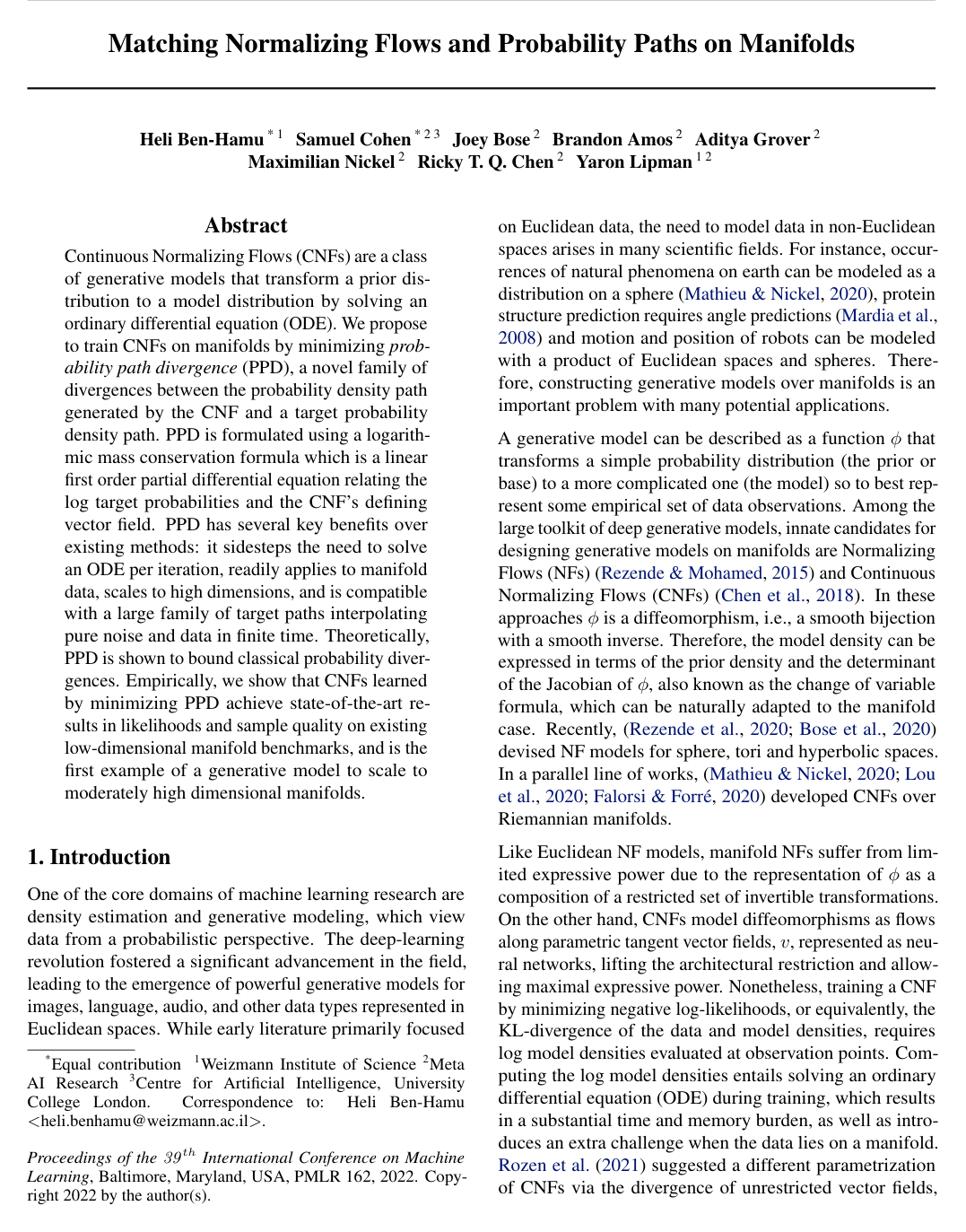
Matching Normalizing Flows and Probability Paths on Manifolds
Heli Ben-Hamu, Samuel Cohen, Joey Bose, Brandon Amos, Maximilian Nickel, Aditya Grover, Ricky T. Q. Chen, Yaron Lipman
Why you should read this
Develops a scalable Continuous Normalizing Flow training framework using Probability Path Divergence, which eliminates costly ODE integration during training and enables fast, high-quality generative modeling on curved geometric spaces and higher dimensions.
Continuous Normalizing Flows (CNFs) are a class of generative models that transform a prior distribution to a model distribution by solving an ordinary differential equation (ODE). We propose to train CNFs on manifolds by minimizing probability path divergence (PPD), a novel family of divergences between the probability density path generated by the CNF and a target probability density path. PPD is formulated using a logarithmic mass conservation formula which is a linear first order partial differential equation relating the log target probabilities and the CNF’s defining vector field. PPD has several key benefits over existing methods: it sidesteps the need to solve an ODE per iteration, readily applies to manifold data, scales to high dimensions, and is compatible with a large family of target paths interpolating pure noise and data in finite time. Theoretically, PPD is shown to bound classical probability divergences. Empirically, we show that CNFs learned by minimizing PPD achieve state-of-the-art results in likelihoods and sample quality on existing low-dimensional manifold benchmarks, and is the first example of a generative model to scale to moderately high dimensional manifolds.
Added
2026-09-26
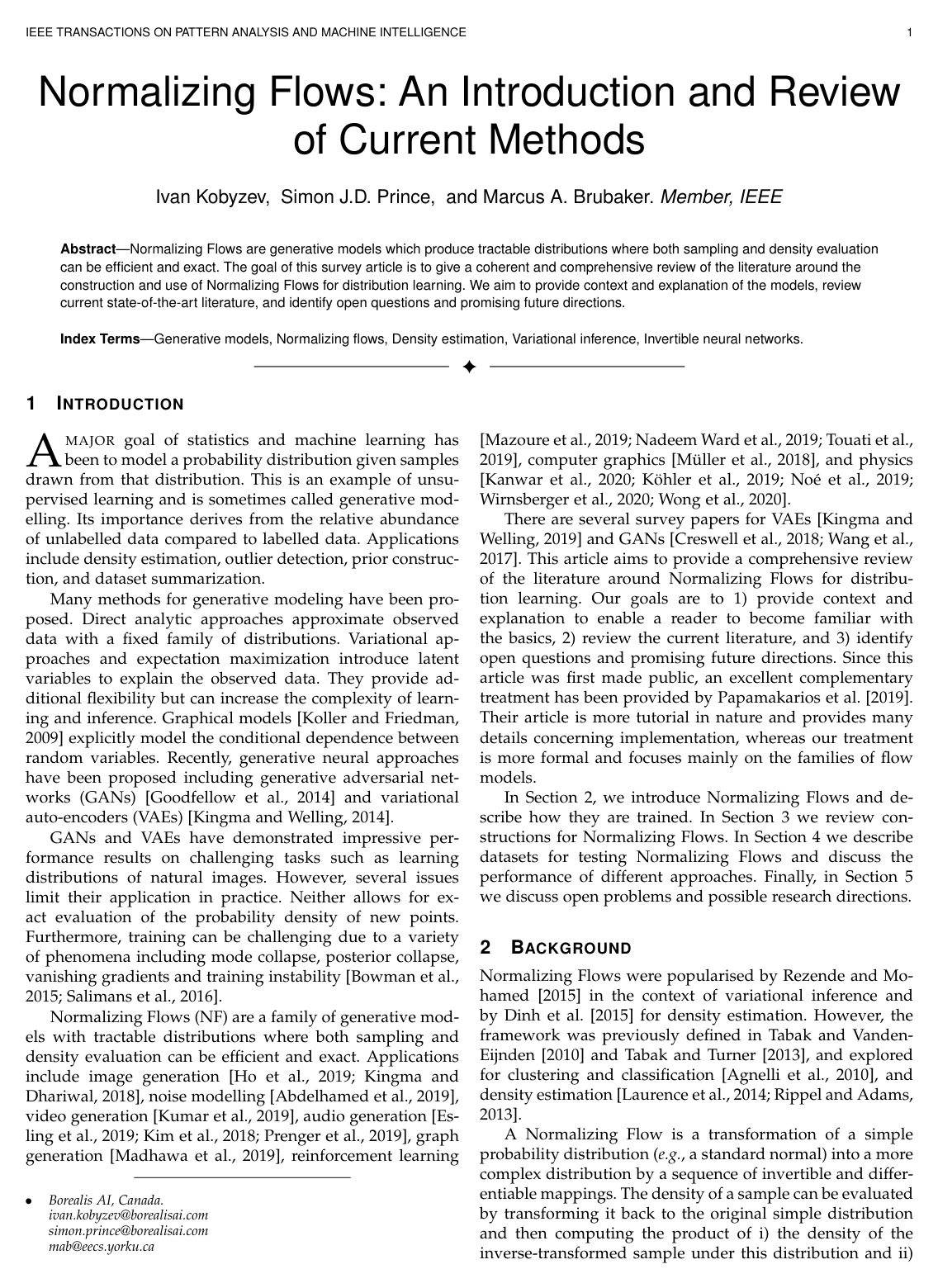
Normalizing Flows: An Introduction and Review of Current Methods
Ivan Kobyzev, Simon J.D. Prince, Marcus A. Brubaker
Why you should read this
Explains the mathematical foundations and architectural design principles of normalizing flows, offering a clear guide to how these models achieve exact probability density estimation and efficient sampling.
Normalizing Flows are generative models which produce tractable distributions where both sampling and density evaluation can be efficient and exact. The goal of this survey article is to give a coherent and comprehensive review of the literature around the construction and use of Normalizing Flows for distribution learning. We aim to provide context and explanation of the models, review current state-of-the-art literature, and identify open questions and promising future directions.
Added
2026-09-24
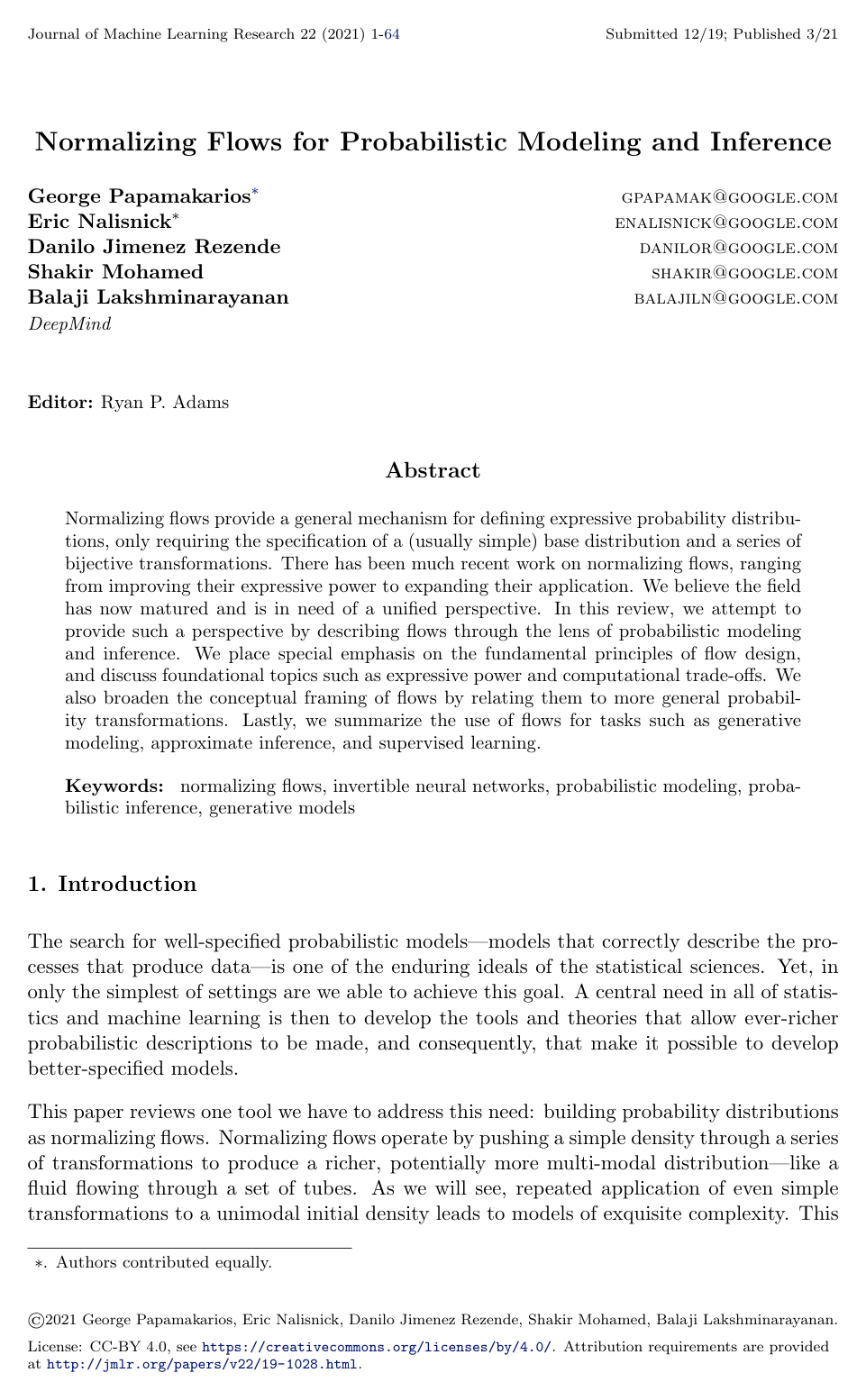
Normalizing Flows for Probabilistic Modeling and Inference
George Papamakarios, Eric Nalisnick, Danilo Jimenez Rezende, Shakir Mohamed, Balaji Lakshminarayanan
Why you should read this
Unifies the foundational principles, expressive capacity, and computational trade-offs of normalizing flows to guide their application in generative modeling and approximate inference.
Normalizing flows provide a general mechanism for defining expressive probability distributions, only requiring the specification of a (usually simple) base distribution and a series of bijective transformations. There has been much recent work on normalizing flows, ranging from improving their expressive power to expanding their application. We believe the field has now matured and is in need of a unified perspective. In this review, we attempt to provide such a perspective by describing flows through the lens of probabilistic modeling and inference. We place special emphasis on the fundamental principles of flow design, and discuss foundational topics such as expressive power and computational trade-offs. We also broaden the conceptual framing of flows by relating them to more general probability transformations. Lastly, we summarize the use of flows for tasks such as generative modeling, approximate inference, and supervised learning.
Added
2026-09-14
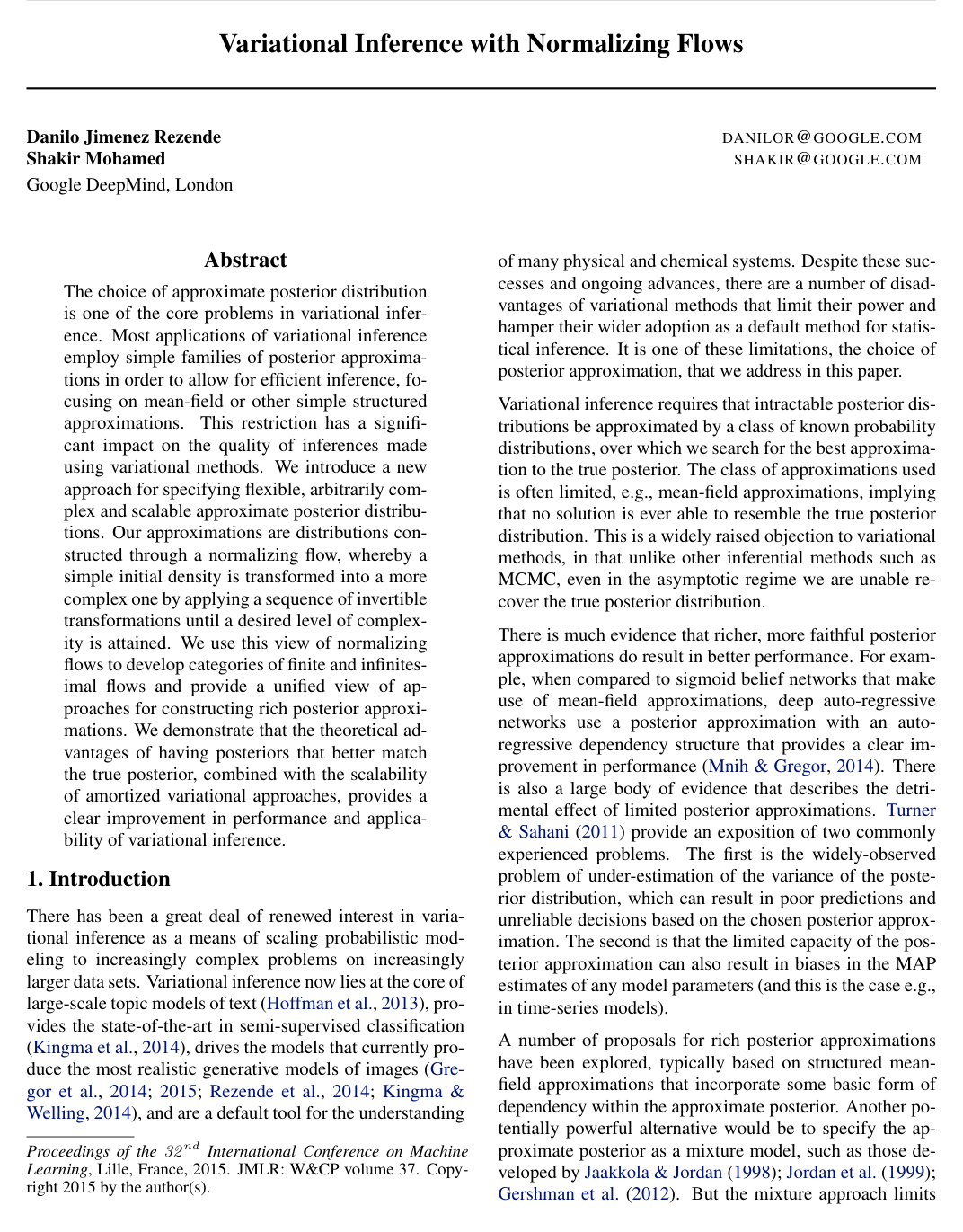
Variational Inference with Normalizing Flows
Danilo Jimenez Rezende, Shakir Mohamed
Why you should read this
Presents a novel approach using normalizing flows, this paper demonstrates how to construct arbitrarily complex and scalable approximate posterior distributions, significantly enhancing the accuracy and applicability of variational inference.
The choice of approximate posterior distribution is one of the core problems in variational inference. Most applications of variational inference employ simple families of posterior approximations in order to allow for efficient inference, focusing on mean-field or other simple structured approximations. This restriction has a significant impact on the quality of inferences made using variational methods. We introduce a new approach for specifying flexible, arbitrarily complex and scalable approximate posterior distributions. Our approximations are distributions constructed through a normalizing flow, whereby a simple initial density is transformed into a more complex one by applying a sequence of invertible transformations until a desired level of complexity is attained. We use this view of normalizing flows to develop categories of finite and infinitesimal flows and provide a unified view of approaches for constructing rich posterior approximations. We demonstrate that the theoretical advantages of having posteriors that better match the true posterior, combined with the scalability of amortized variational approaches, provides a clear improvement in performance and applicability of variational inference.
Added
2026-03-09
