
keyword
non-negative matrix factorization
Non-negative matrix factorization is a mathematical technique in multivariate data analysis and linear algebra that decomposes a non-negative data matrix into the product of two lower-rank, non-negative matrices. By enforcing strict non-negativity constraints on the factor matrices, the method ensures that the original data is represented as purely additive, parts-based combinations of latent basis components without negative cancellations. This additive property provides intuitive interpretability, making non-negative matrix factorization widely used for dimensionality reduction, feature extraction, and clustering across domains such as text mining, document analysis, computer vision, and audio signal processing. The factorization is typically computed through iterative optimization algorithms, including multiplicative update rules and alternating least squares, which minimize the reconstruction error measured by metrics such as Euclidean distance or generalized Kullback-Leibler divergence.
6 items
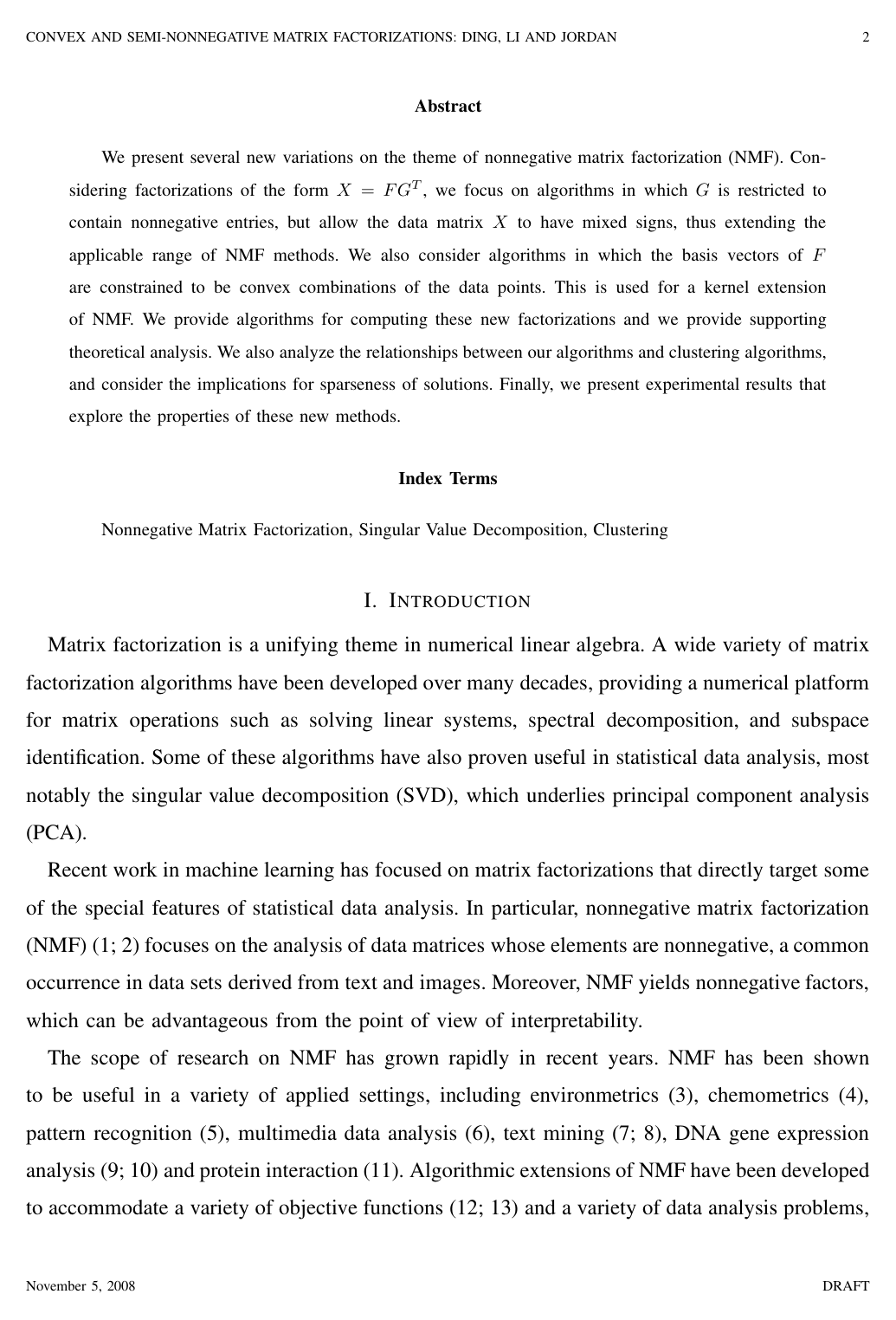
Convex and Semi-Nonnegative Matrix Factorizations
C. Ding, Tao Li, Michael I. Jordan
Why you should read this
Introduces Semi-NMF and Convex-NMF to enable nonnegative matrix factorization on mixed-sign data and kernel spaces while establishing theoretical and practical connections to K-means clustering.
We present several new variations on the theme of nonnegative matrix factorization (NMF). Considering factorizations of the form X = FG^T, we focus on algorithms in which G is restricted to contain nonnegative entries, but allow the data matrix X to have mixed signs, thus extending the applicable range of NMF methods. We also consider algorithms in which the basis vectors of F are constrained to be convex combinations of the data points. This is used for a kernel extension of NMF. We provide algorithms for computing these new factorizations and we provide supporting theoretical analysis. We also analyze the relationships between our algorithms and clustering algorithms, and consider the implications for sparseness of solutions. Finally, we present experimental results that explore the properties of these new methods.
Added
2026-09-25
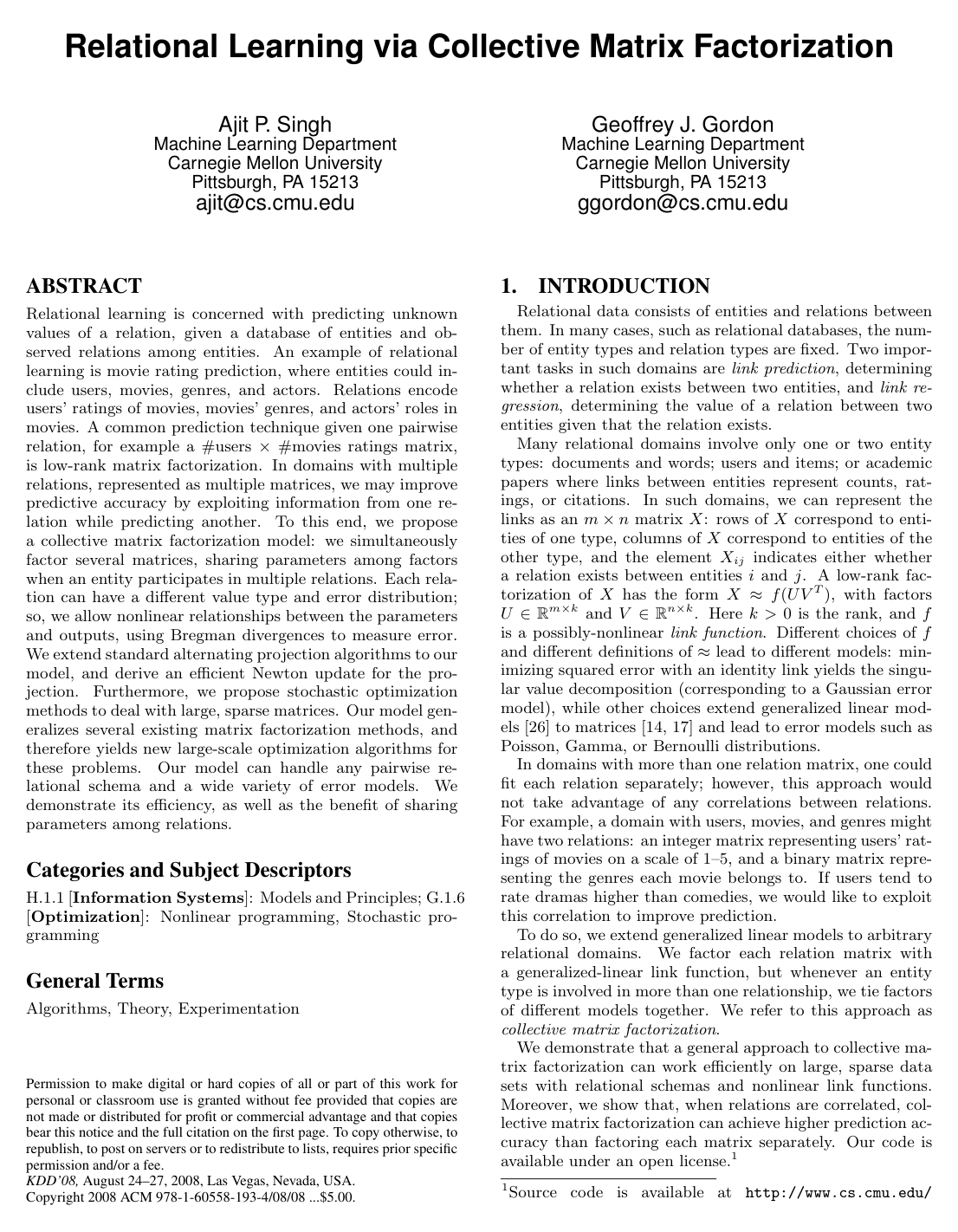
Relational learning via collective matrix factorization
Ajit P. Singh, Geoffrey J. Gordon
Why you should read this
Proposes a collective matrix factorization framework that shares latent representations across multiple interrelated matrices using Bregman divergences and scalable optimization algorithms to improve link prediction accuracy in complex relational schemas.
Relational learning is concerned with predicting unknown values of a relation, given a database of entities and observed relations among entities. An example of relational learning is movie rating prediction, where entities could include users, movies, genres, and actors. Relations encode users' ratings of movies, movies' genres, and actors' roles in movies. A common prediction technique given one pairwise relation, for example a #users × #movies ratings matrix, is low-rank matrix factorization. In domains with multiple relations, represented as multiple matrices, we may improve predictive accuracy by exploiting information from one relation while predicting another. To this end, we propose a collective matrix factorization model: we simultaneously factor several matrices, sharing parameters among factors when an entity participates in multiple relations. Each relation can have a different value type and error distribution; so, we allow nonlinear relationships between the parameters and outputs, using Bregman divergences to measure error. We extend standard alternating projection algorithms to our model, and derive an efficient Newton update for the projection. Furthermore, we propose stochastic optimization methods to deal with large, sparse matrices. Our model generalizes several existing matrix factorization methods, and therefore yields new large-scale optimization algorithms for these problems. Our model can handle any pairwise relational schema and a wide variety of error models. We demonstrate its efficiency, as well as the benefit of sharing parameters among relations.
Added
2026-09-25
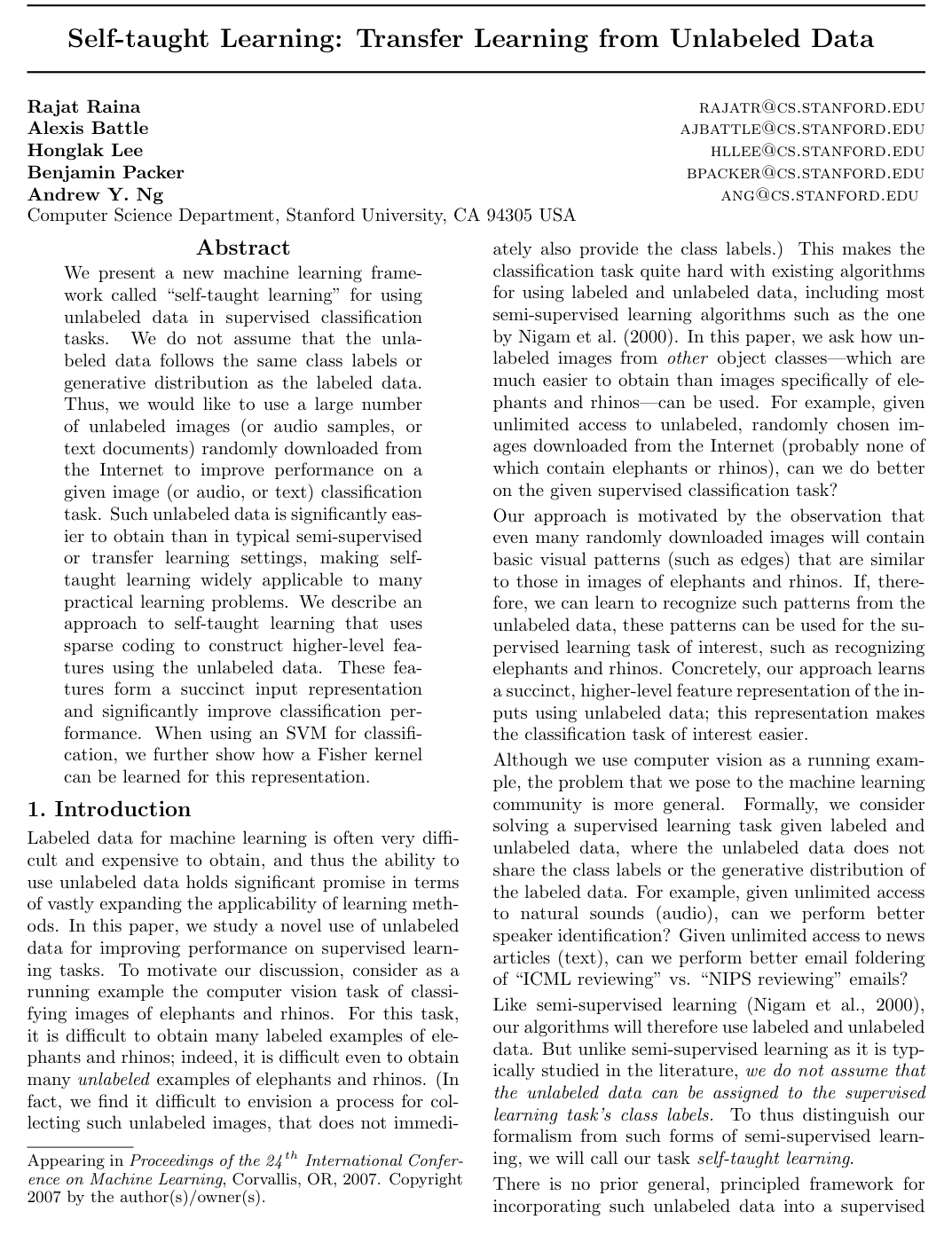
Self-taught learning: transfer learning from unlabeled data
Rajat Raina, Alexis Battle, Honglak Lee, Benjamin Packer, Andrew Y. Ng
Why you should read this
Proposes a machine learning framework that applies sparse coding to easily accessible, uncurated, and unlabeled data from entirely different classes to build higher-level feature representations that improve supervised classification performance across image, audio, and text tasks.
We present a new machine learning framework called “self-taught learning” for using unlabeled data in supervised classification tasks. We do not assume that the unlabeled data follows the same class labels or generative distribution as the labeled data. Thus, we would like to use a large number of unlabeled images (or audio samples, or text documents) randomly downloaded from the Internet to improve performance on a given image (or audio, or text) classification task. Such unlabeled data is significantly easier to obtain than in typical semi-supervised or transfer learning settings, making self-taught learning widely applicable to many practical learning problems. We describe an approach to self-taught learning that uses sparse coding to construct higher-level features using the unlabeled data. These features form a succinct input representation and significantly improve classification performance. When using an SVM for classification, we further show how a Fisher kernel can be learned for this representation.
Added
2026-09-18
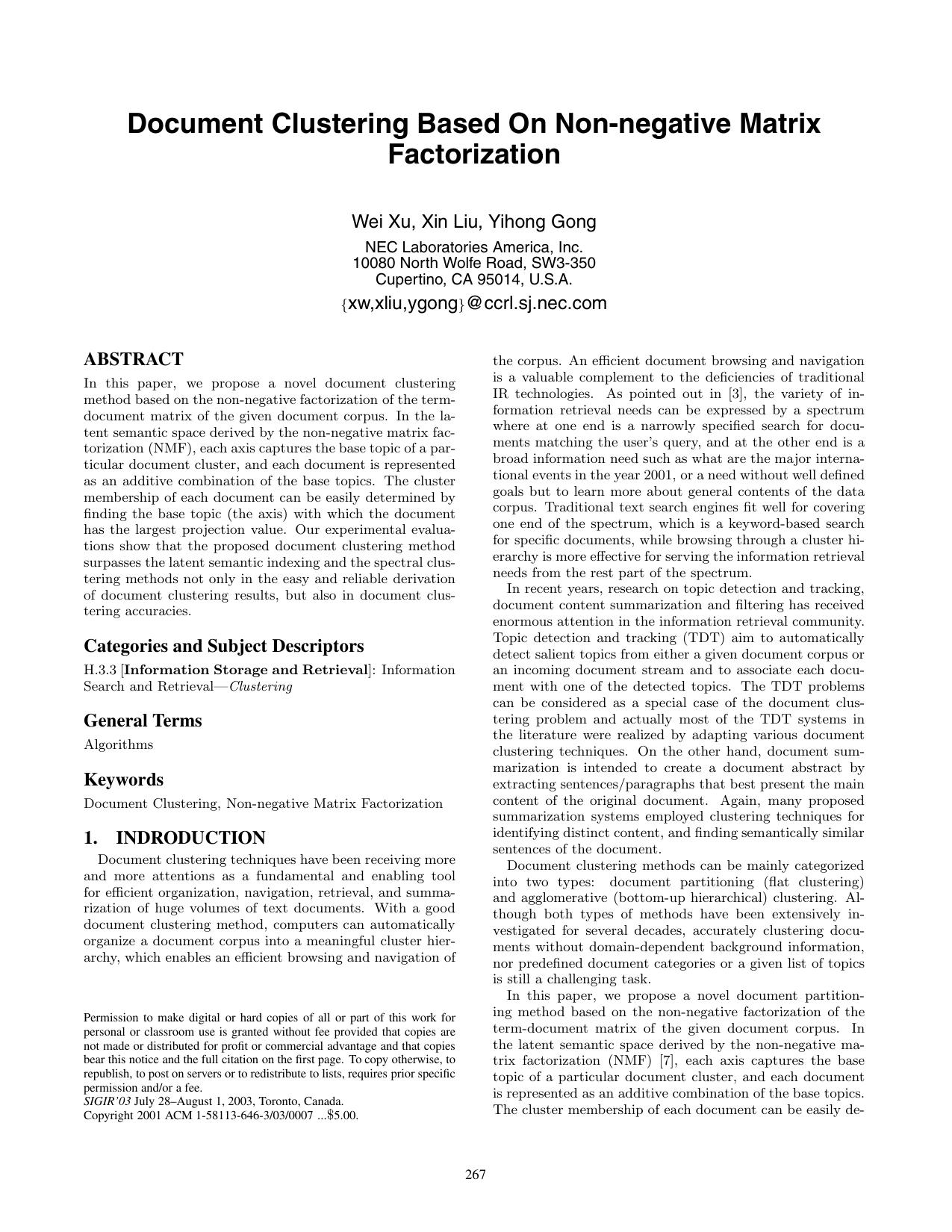
Document clustering based on non-negative matrix factorization
Wei Xu, Xin Liu, Yihong Gong
In this paper, we propose a novel document clustering method based on the non-negative factorization of the term-document matrix of the given document corpus. In the latent semantic space derived by the non-negative matrix factorization (NMF), each axis captures the base topic of a particular document cluster, and each document is represented as an additive combination of the base topics. The cluster membership of each document can be easily determined by finding the base topic (the axis) with which the document has the largest projection value. Our experimental evaluations show that the proposed document clustering method surpasses the latent semantic indexing and the spectral clustering methods not only in the easy and reliable derivation of document clustering results, but also in document clustering accuracies.
Source
https://courses.cs.umbc.edu/graduate/CMSC601/Spring11/HW/hw2/HW2_papers/document_clustering.pdfAdded
2026-09-16
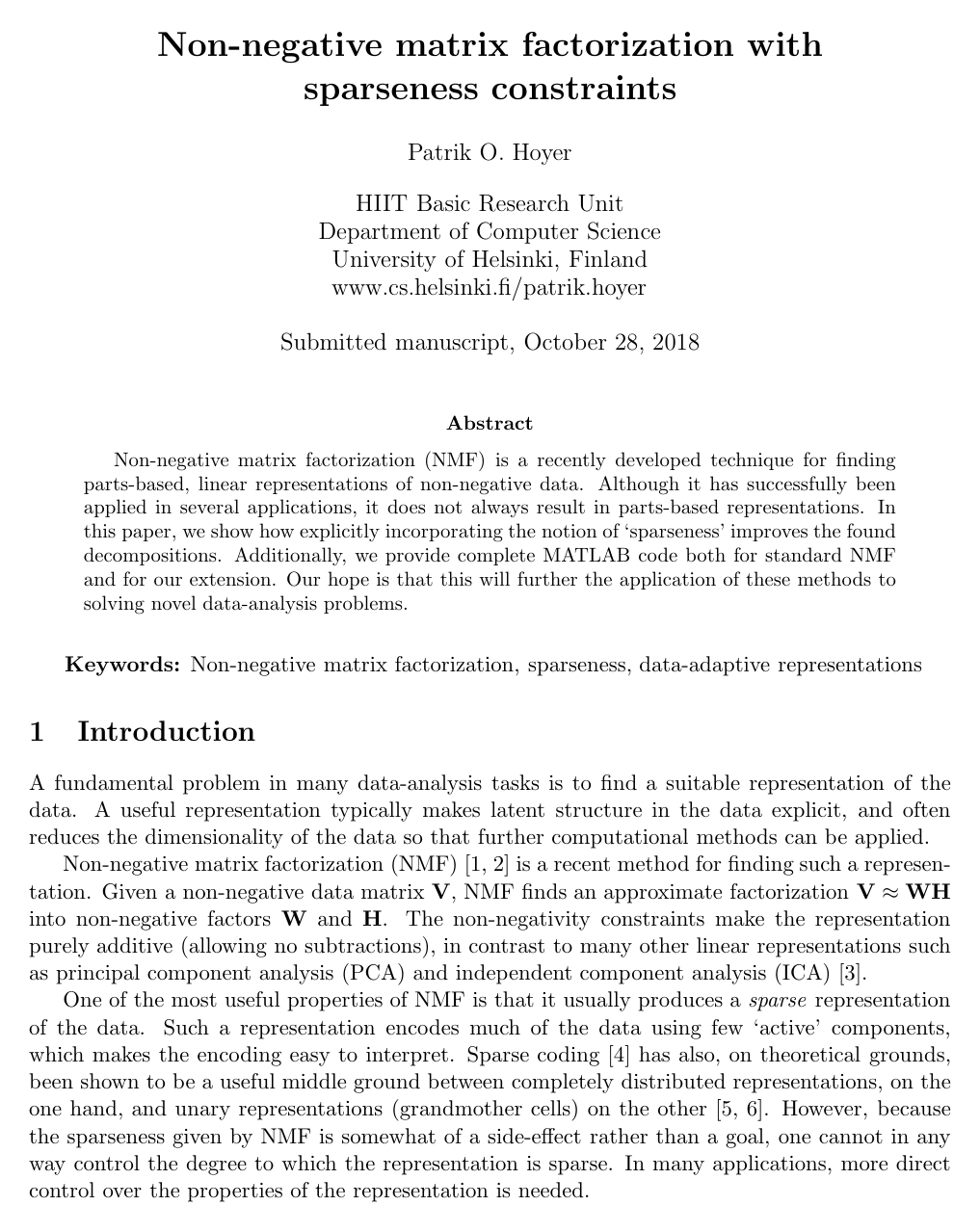
Non-negative Matrix Factorization with Sparseness Constraints
Patrik O. Hoyer
Why you should read this
Develops a non-negative matrix factorization framework with explicit sparseness constraints to reliably generate true parts-based linear representations of non-negative data.
Non-negative matrix factorization (NMF) is a recently developed technique for finding parts-based, linear representations of non-negative data. Although it has successfully been applied in several applications, it does not always result in parts-based representations. In this paper, we show how explicitly incorporating the notion of `sparseness' improves the found decompositions. Additionally, we provide complete MATLAB code both for standard NMF and for our extension. Our hope is that this will further the application of these methods to solving novel data-analysis problems.
Added
2026-09-13

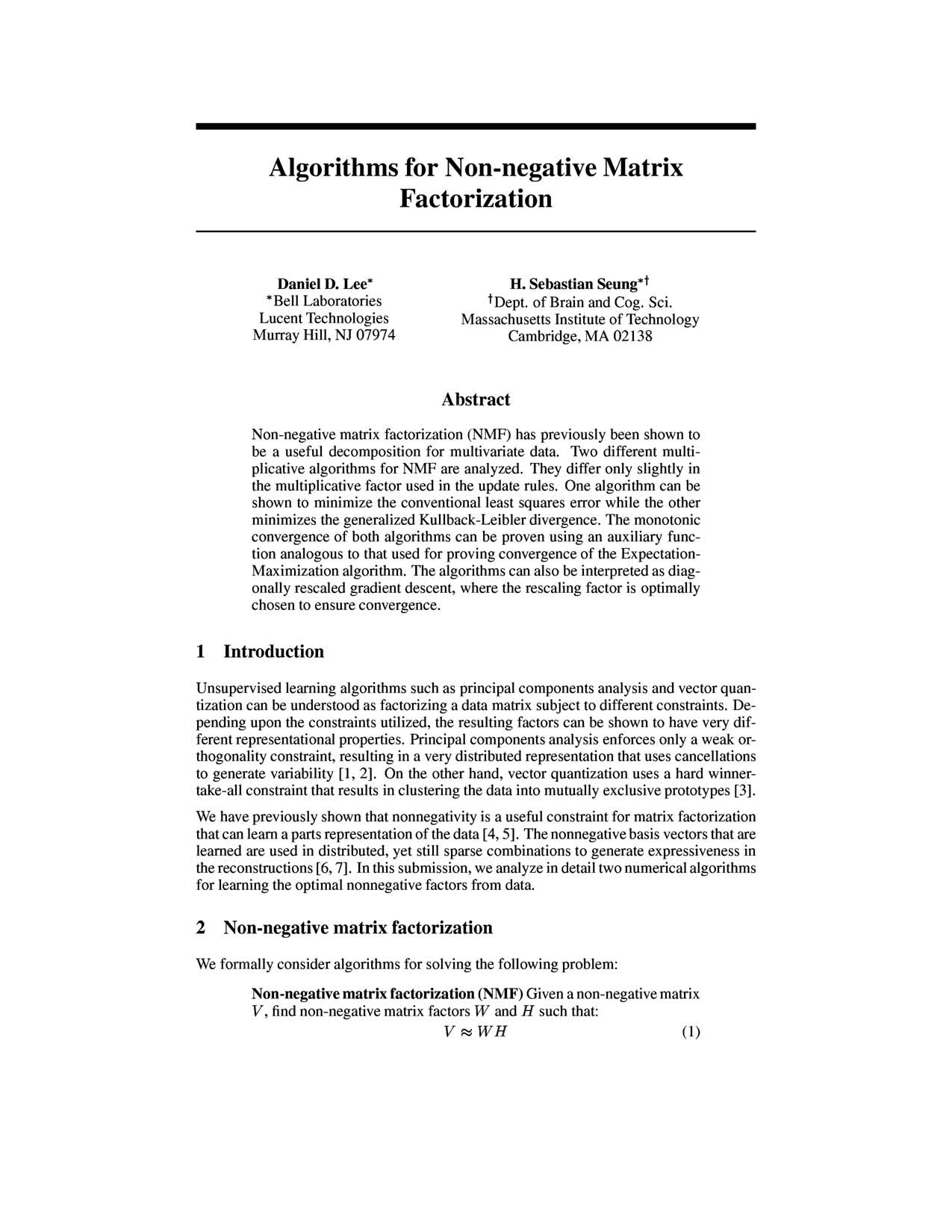
Algorithms for Non-negative Matrix Factorization
Daniel D. Lee, H. Seung
Why you should read this
Introduces the standard multiplicative update algorithms for non-negative matrix factorization and proves their monotonic convergence under both least-squares and Kullback-Leibler divergence objectives.
Non-negative matrix factorization (NMF) has previously been shown to be a useful decomposition for multivariate data. Two different multiplicative algorithms for NMF are analyzed. They differ only slightly in the multiplicative factor used in the update rules. One algorithm can be shown to minimize the conventional least squares error while the other minimizes the generalized Kullback-Leibler divergence. The monotonic convergence of both algorithms can be proven using an auxiliary function analogous to that used for proving convergence of the Expectation-Maximization algorithm. The algorithms can also be interpreted as diagonally rescaled gradient descent, where the rescaling factor is optimally chosen to ensure convergence.
Added
2026-09-07