
keyword
noisy labels
Noisy labels refer to incorrect, corrupted, or inaccurate target annotations assigned to data samples within a dataset used for supervised machine learning. These imperfect annotations typically arise from human labeling errors, automated data harvesting, sensor noise, or subjective ambiguities in the labeling process. In machine learning, particularly when training high-capacity models such as deep neural networks, noisy labels pose a significant challenge because models can memorize these false associations rather than learning true underlying patterns, which leads to severe overfitting and degraded generalization on unseen data. To counteract this degradation, researchers develop noise-robust loss functions, sample selection and filtering techniques, label correction mechanisms, and semi-supervised training pipelines capable of identifying and mitigating the adverse effects of corrupted supervision.
10 items
Mitigating Memorization of Noisy Labels by Clipping the Model Prediction
Hongxin Wei, Huiping Zhuang, Renchunzi Xie, Lei Feng, Gang Niu, Bo An, Yixuan Li
Why you should read this
Proposes LogitClip, a simple yet theoretically grounded method that bounds the norm of model logit vectors to prevent deep neural networks from overfitting to noisy labels without causing the underfitting common to symmetric loss functions.
In the presence of noisy labels, designing robust loss functions is critical for securing the generalization performance of deep neural networks. Cross Entropy (CE) loss has been shown to be not robust to noisy labels due to its unboundedness. To alleviate this issue, existing works typically design specialized robust losses with the symmetric condition, which usually lead to the underfitting issue. In this paper, our key idea is to induce a loss bound at the logit level, thus universally enhancing the noise robustness of existing losses. Specifically, we propose logit clipping (LogitClip), which clamps the norm of the logit vector to ensure that it is upper bounded by a constant. In this manner, CE loss equipped with our LogitClip method is effectively bounded, mitigating the overfitting to examples with noisy labels. Moreover, we present theoretical analyses to certify the noise-tolerant ability of LogitClip. Extensive experiments show that LogitClip not only significantly improves the noise robustness of CE loss, but also broadly enhances the generalization performance of popular robust losses.
Added
2026-10-03
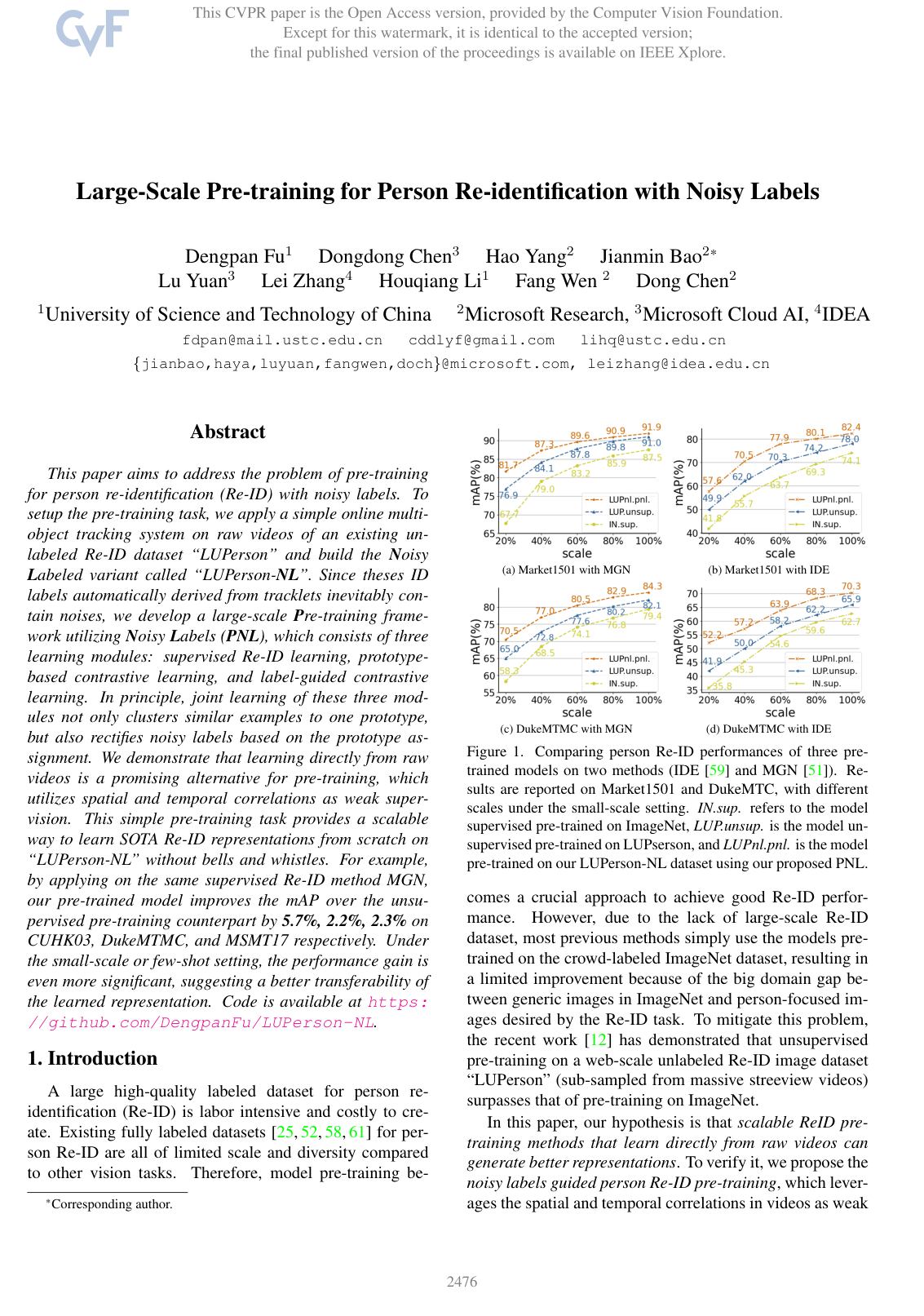
Large-Scale Pre-training for Person Re-identification with Noisy Labels
Dengpan Fu, Dongdong Chen, Hao Yang, Jianmin Bao, Lu Yuan, Lei Zhang, Houqiang Li, Fang Wen, Dong Chen
Why you should read this
Introduces a scalable pre-training framework that learns transferable person re-identification representations directly from uncurated video tracklets by combining prototype-based label rectification with label-guided contrastive learning on a ten-million-image noisy dataset.
This paper aims to address the problem of pre-training for person re-identification (Re-ID) with noisy labels. To setup the pre-training task, we apply a simple online multi-object tracking system on raw videos of an existing un-labeled Re-ID dataset “LUPerson” and build the Noisy Labeled variant called “LUPerson-NL”. Since theses ID labels automatically derived from tracklets inevitably contain noises, we develop a large-scale Pre-training frame-work utilizing Noisy Labels (PNL), which consists of three learning modules: supervised Re-ID learning, prototype-based contrastive learning, and label-guided contrastive learning. In principle, joint learning of these three mod-ules not only clusters similar examples to one prototype, but also rectifies noisy labels based on the prototype as-signment. We demonstrate that learning directly from raw videos is a promising alternative for pre-training, which utilizes spatial and temporal correlations as weak super-vision. This simple pre-training task provides a scalable way to learn SOTA Re-ID representations from scratch on “LUPerson-NL” without bells and whistles. For example, by applying on the same supervised Re-ID method MGN, our pre-trained model improves the mAP over the unsu-pervised pre-training counterpart by 5.7%, 2.2%, 2.3% on CUHK03, DukeMTMC, and MSMT17 respectively. Under the small-scale or few-shot setting, the performance gain is even more significant, suggesting a better transferability of the learned representation. Code is available at https://github.com/DengpanFu/LUPerson-NL.
Added
2026-09-26
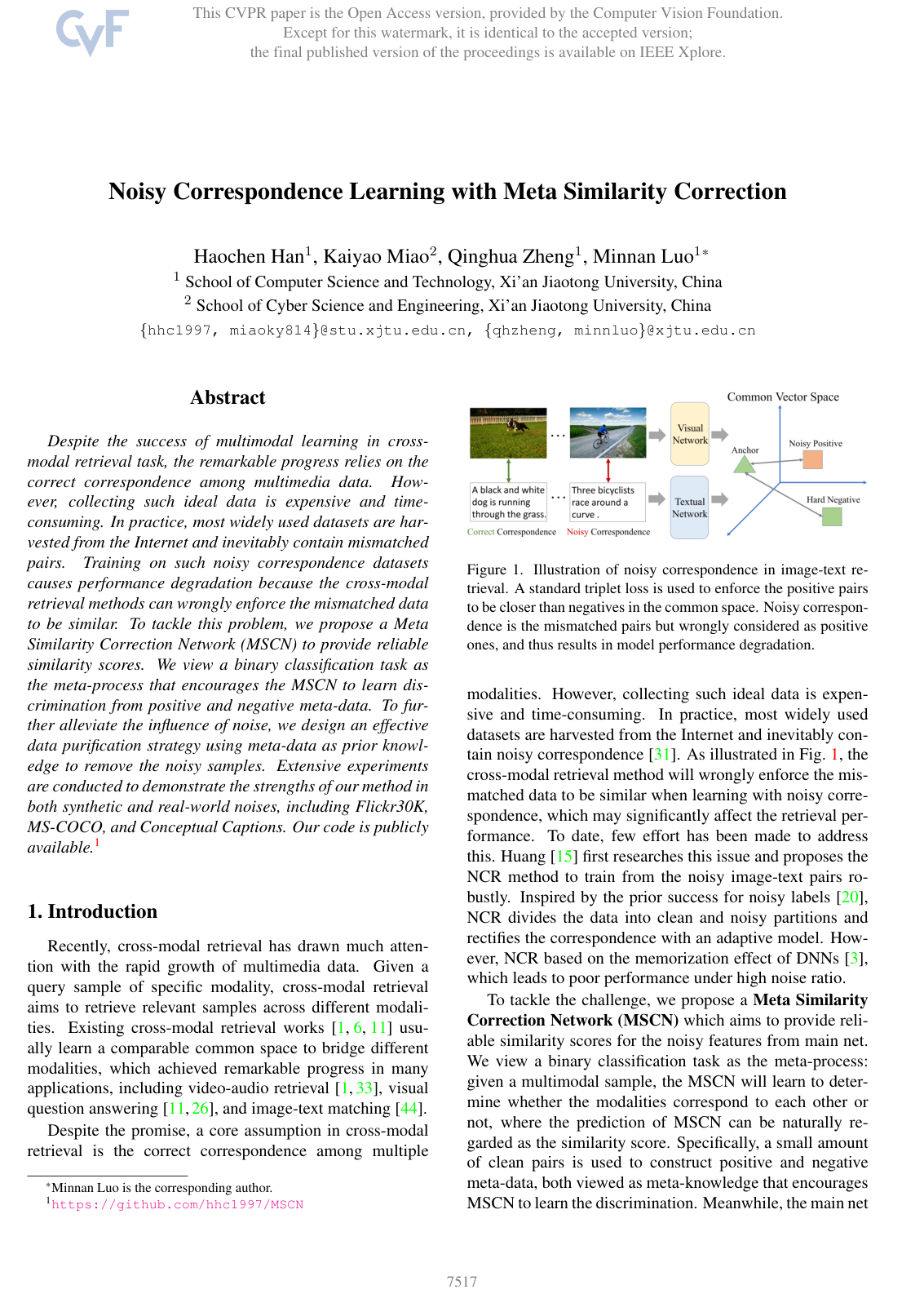
Noisy Correspondence Learning with Meta Similarity Correction
Haochen Han, Kaiyao Miao, Qinghua Zheng, Minnan Luo
Why you should read this
Proposes a meta-learning framework that trains a correction network on clean and mismatched meta-data to rectify similarity scores and filter out mismatched cross-modal pairs during retrieval training.
Despite the success of multimodal learning in cross-modal retrieval task, the remarkable progress relies on the correct correspondence among multimedia data. However, collecting such ideal data is expensive and time-consuming. In practice, most widely used datasets are harvested from the Internet and inevitably contain mismatched pairs. Training on such noisy correspondence datasets causes performance degradation because the cross-modal retrieval methods can wrongly enforce the mismatched data to be similar. To tackle this problem, we propose a Meta Similarity Correction Network (MSCN) to provide reliable similarity scores. We view a binary classification task as the meta-process that encourages the MSCN to learn discrimination from positive and negative meta-data. To further alleviate the influence of noise, we design an effective data purification strategy using meta-data as prior knowledge to remove the noisy samples. Extensive experiments are conducted to demonstrate the strengths of our method in both synthetic and real-world noises, including Flickr30K, MS-COCO, and Conceptual Captions. Our code is publicly available.
Added
2026-09-26
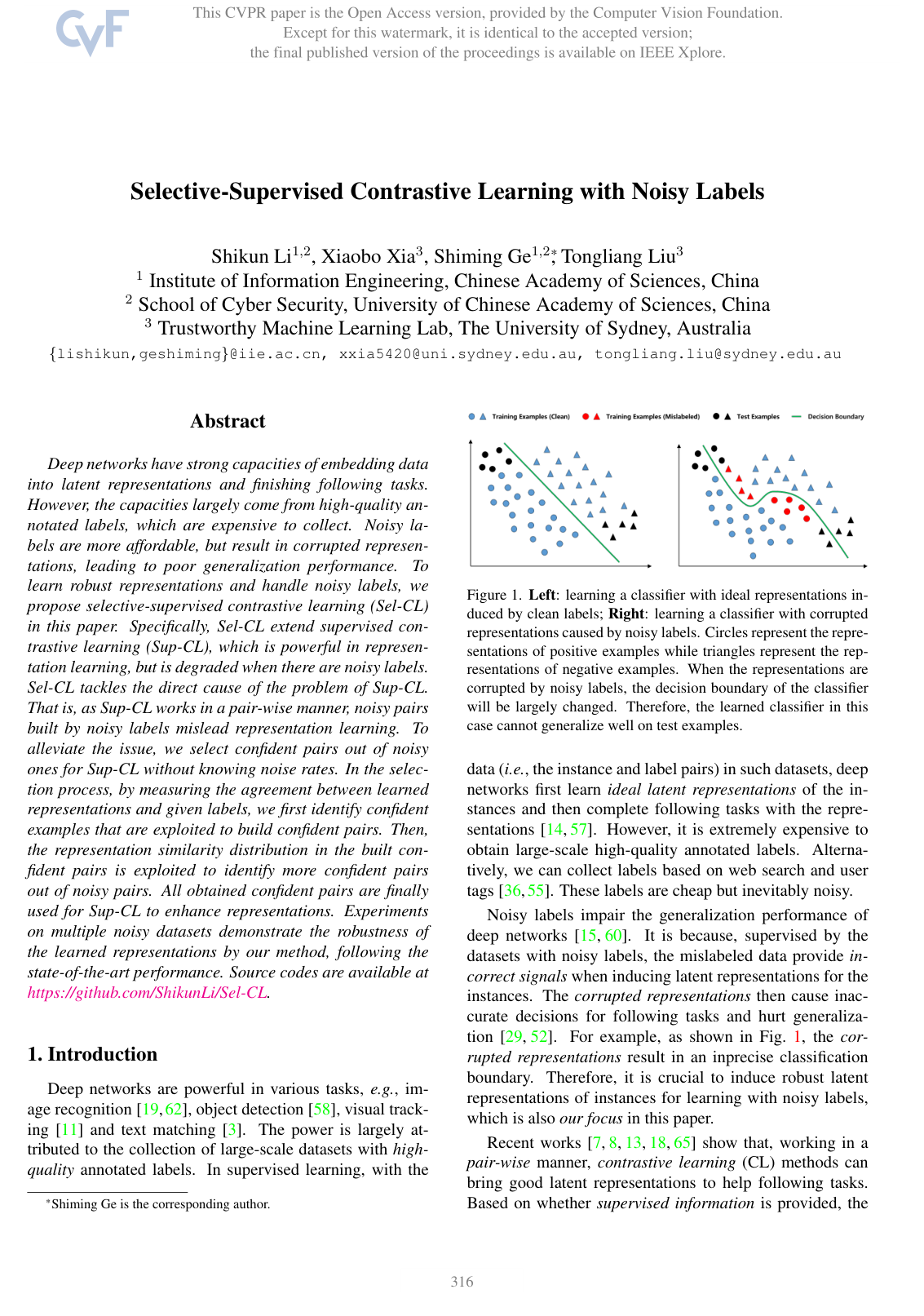
Selective-Supervised Contrastive Learning with Noisy Labels
Shikun Li, Xiaobo Xia, Shiming Ge, Tongliang Liu
Why you should read this
Proposes a selective-supervised contrastive learning framework that dynamically identifies reliable sample pairs without requiring prior knowledge of label noise rates, preventing corrupted annotations from degrading representation quality.
Deep networks have strong capacities of embedding data into latent representations and finishing following tasks. However, the capacities largely come from high-quality annotated labels, which are expensive to collect. Noisy labels are more affordable, but result in corrupted representations, leading to poor generalization performance. To learn robust representations and handle noisy labels, we propose selective-supervised contrastive learning (Sel-CL) in this paper. Specifically, Sel-CL extend supervised contrastive learning (Sup-CL), which is powerful in representation learning, but is degraded when there are noisy labels. Sel-CL tackles the direct cause of the problem of Sup-CL. That is, as Sup-CL works in a pair-wise manner, noisy pairs built by noisy labels mislead representation learning. To alleviate the issue, we select confident pairs out of noisy ones for Sup-CL without knowing noise rates. In the selection process, by measuring the agreement between learned representations and given labels, we first identify confident examples that are exploited to build confident pairs. Then, the representation similarity distribution in the built confident pairs is exploited to identify more confident pairs out of noisy pairs. All obtained confident pairs are finally used for Sup-CL to enhance representations. Experiments on multiple noisy datasets demonstrate the robustness of the learned representations by our method, following the state-of-the-art performance. Source codes are available at https://github.com/ShikunLi/Sel-CL.
Added
2026-09-26
Learning with Noisy Labels
Nagarajan Natarajan, I. Dhillon, Pradeep Ravikumar, Ambuj Tewari
Why you should read this
Establishes theoretical guarantees and practical surrogate loss modifications that enable standard classifiers like biased support vector machines and weighted logistic regression to learn effectively from class-conditional noisy labels.
In this paper, we theoretically study the problem of binary classification in the presence of random classification noise — the learner, instead of seeing the true labels, sees labels that have independently been flipped with some small probability. Moreover, random label noise is class-conditional — the flip probability depends on the class. We provide two approaches to suitably modify any given surrogate loss function. First, we provide a simple unbiased estimator of any loss, and obtain performance bounds for empirical risk minimization in the presence of iid data with noisy labels. If the loss function satisfies a simple symmetry condition, we show that the method leads to an efficient algorithm for empirical minimization. Second, by leveraging a reduction of risk minimization under noisy labels to classification with weighted 0-1 loss, we suggest the use of a simple weighted surrogate loss, for which we are able to obtain strong empirical risk bounds. This approach has a very remarkable consequence — methods used in practice such as biased SVM and weighted logistic regression are provably noise-tolerant. On a synthetic non-separable dataset, our methods achieve over 88% accuracy even when 40% of the labels are corrupted, and are competitive with respect to recently proposed methods for dealing with label noise in several benchmark datasets.
Added
2026-09-25
DivideMix: Learning with Noisy Labels as Semi-supervised Learning
Junnan Li, Richard Socher, Steven C. H. Hoi
Why you should read this
Proposes DivideMix, a framework that treats noisy label learning as a semi-supervised problem by dynamically partitioning data into clean and unlabeled sets and co-training two networks to prevent confirmation bias.
Deep neural networks are known to be annotation-hungry. Numerous efforts have been devoted to reducing the annotation cost when learning with deep networks. Two prominent directions include learning with noisy labels and semi-supervised learning by exploiting unlabeled data. In this work, we propose DivideMix, a novel framework for learning with noisy labels by leveraging semi-supervised learning techniques. In particular, DivideMix models the per-sample loss distribution with a mixture model to dynamically divide the training data into a labeled set with clean samples and an unlabeled set with noisy samples, and trains the model on both the labeled and unlabeled data in a semi-supervised manner. To avoid confirmation bias, we simultaneously train two diverged networks where each network uses the dataset division from the other network. During the semi-supervised training phase, we improve the MixMatch strategy by performing label co-refinement and label co-guessing on labeled and unlabeled samples, respectively. Experiments on multiple benchmark datasets demonstrate substantial improvements over state-of-the-art methods. Code is available at this https URL .
Added
2026-09-25
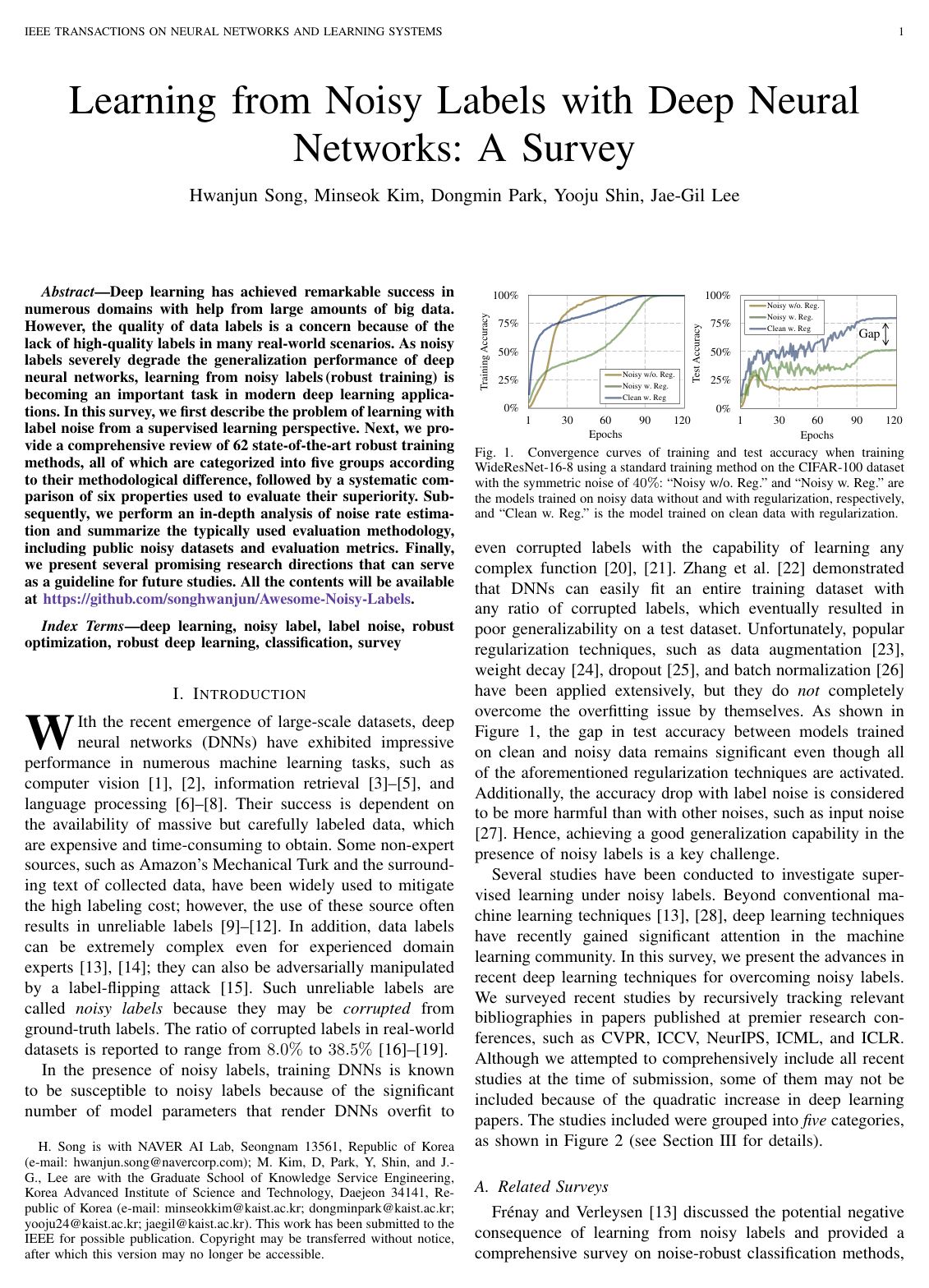
Learning From Noisy Labels With Deep Neural Networks: A Survey
Hwanjun Song, Minseok Kim, Dongmin Park, Yooju Shin, Jae-Gil Lee
Why you should read this
Categorizes 62 methods for training deep neural networks with label noise across five distinct paradigms, providing a comparative analysis of evaluation properties, noise estimation techniques, and standard benchmarks.
Deep learning has achieved remarkable success in numerous domains with help from large amounts of big data. However, the quality of data labels is a concern because of the lack of high-quality labels in many real-world scenarios. As noisy labels severely degrade the generalization performance of deep neural networks, learning from noisy labels (robust training) is becoming an important task in modern deep learning applications. In this survey, we first describe the problem of learning with label noise from a supervised learning perspective. Next, we provide a comprehensive review of 62 state-of-the-art robust training methods, all of which are categorized into five groups according to their methodological difference, followed by a systematic comparison of six properties used to evaluate their superiority. Subsequently, we perform an in-depth analysis of noise rate estimation and summarize the typically used evaluation methodology, including public noisy datasets and evaluation metrics. Finally, we present several promising research directions that can serve as a guideline for future studies. All the contents will be available at this https URL.
Added
2026-09-25
MentorNet: Learning Data-Driven Curriculum for Very Deep Neural Networks on Corrupted Labels
Lu Jiang, Zhengyuan Zhou, Thomas Leung, Li-Jia Li, Li Fei-Fei
Why you should read this
Introduces MentorNet, a neural network that learns a data-driven curriculum to dynamically reweight training samples, preventing deep models from overfitting to corrupted labels and achieving state-of-the-art performance on large-scale noisy benchmarks like WebVision.
Recent deep networks are capable of memorizing the entire data even when the labels are completely random. To overcome the overfitting on corrupted labels, we propose a novel technique of learning another neural network, called MentorNet, to supervise the training of the base deep networks, namely, StudentNet. During training, MentorNet provides a curriculum (sample weighting scheme) for StudentNet to focus on the sample the label of which is probably correct. Unlike the existing curriculum that is usually predefined by human experts, MentorNet learns a data-driven curriculum dynamically with StudentNet. Experimental results demonstrate that our approach can significantly improve the generalization performance of deep networks trained on corrupted training data. Notably, to the best of our knowledge, we achieve the best-published result on WebVision, a large benchmark containing 2.2 million images of real-world noisy labels. The code are at this https URL
Added
2026-09-24
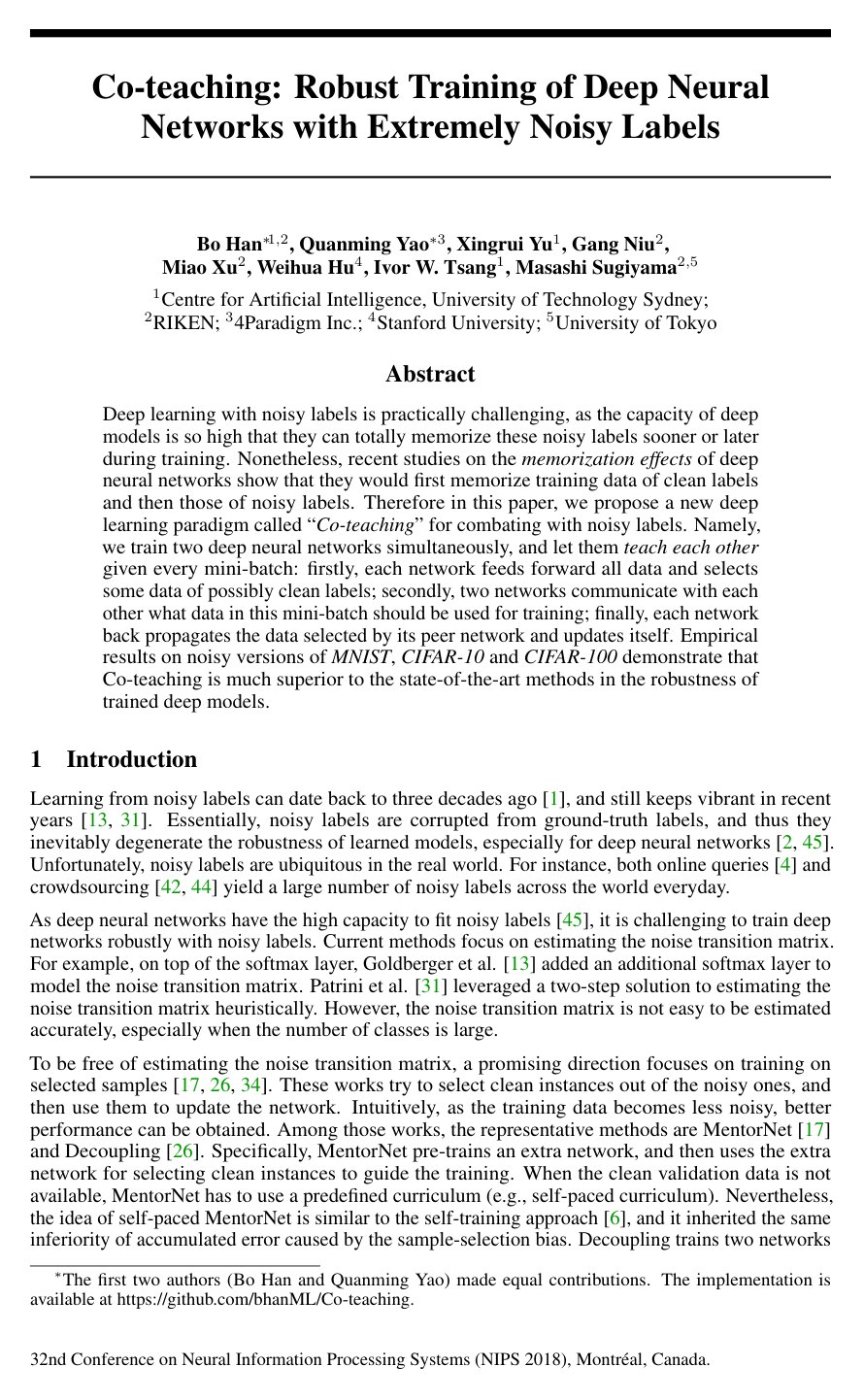
Co-teaching: Robust training of deep neural networks with extremely noisy labels
Bo Han, Quanming Yao, Xingrui Yu, Gang Niu, Miao Xu, Weihua Hu, Ivor Tsang, Masashi Sugiyama
Why you should read this
Proposes Co-teaching, a training framework where two peer neural networks iteratively select and exchange likely clean samples to prevent deep models from memorizing heavy label noise.
Deep learning with noisy labels is practically challenging, as the capacity of deep models is so high that they can totally memorize these noisy labels sooner or later during training. Nonetheless, recent studies on the memorization effects of deep neural networks show that they would first memorize training data of clean labels and then those of noisy labels. Therefore in this paper, we propose a new deep learning paradigm called Co-teaching for combating with noisy labels. Namely, we train two deep neural networks simultaneously, and let them teach each other given every mini-batch: firstly, each network feeds forward all data and selects some data of possibly clean labels; secondly, two networks communicate with each other what data in this mini-batch should be used for training; finally, each network back propagates the data selected by its peer network and updates itself. Empirical results on noisy versions of MNIST, CIFAR-10 and CIFAR-100 demonstrate that Co-teaching is much superior to the state-of-the-art methods in the robustness of trained deep models.
Added
2026-09-14
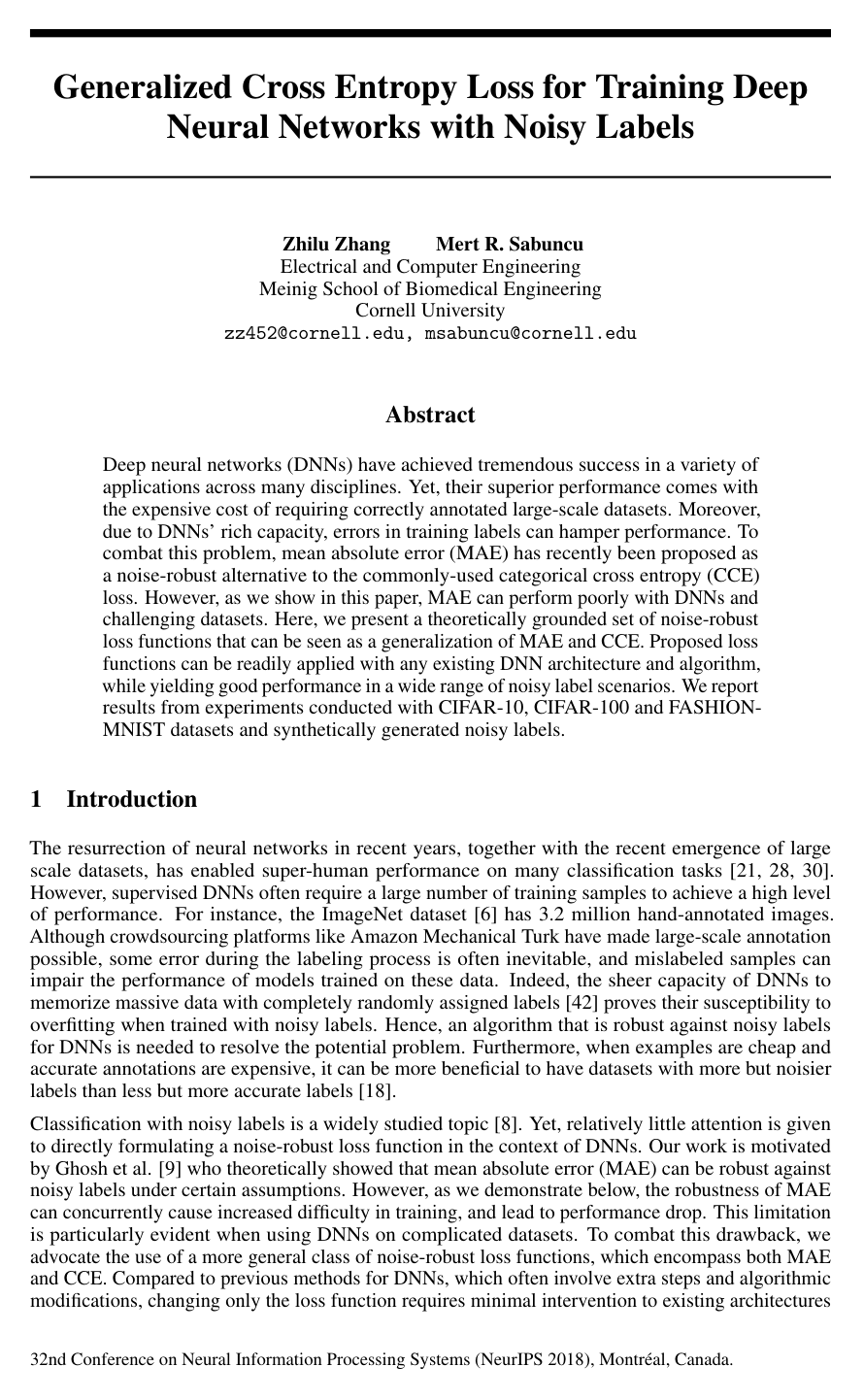
Generalized Cross Entropy Loss for Training Deep Neural Networks with Noisy Labels
Zhilu Zhang, Mert R. Sabuncu
Why you should read this
Proposes a generalized cross entropy loss function that unifies categorical cross entropy and mean absolute error, enabling deep neural networks to learn effectively from datasets with severe label noise without sacrificing convergence speed or accuracy.
Deep neural networks (DNNs) have achieved tremendous success in a variety of applications across many disciplines. Yet, their superior performance comes with the expensive cost of requiring correctly annotated large-scale datasets. Moreover, due to DNNs' rich capacity, errors in training labels can hamper performance. To combat this problem, mean absolute error (MAE) has recently been proposed as a noise-robust alternative to the commonly-used categorical cross entropy (CCE) loss. However, as we show in this paper, MAE can perform poorly with DNNs and challenging datasets. Here, we present a theoretically grounded set of noise-robust loss functions that can be seen as a generalization of MAE and CCE. Proposed loss functions can be readily applied with any existing DNN architecture and algorithm, while yielding good performance in a wide range of noisy label scenarios. We report results from experiments conducted with CIFAR-10, CIFAR-100 and FASHION-MNIST datasets and synthetically generated noisy labels.
Added
2026-09-11