
keyword
noisy annotations
Noisy annotations refer to training labels or target data in machine learning datasets that contain errors, inaccuracies, or inconsistencies. In supervised and weakly supervised learning tasks such as image classification, object detection, and semantic or instance segmentation, these imperfections can manifest as misidentified categories, coarse or displaced boundary masks, omitted objects, or imperfect pseudo-labels generated by automated models. Because deep learning models can easily memorize erroneous supervision and suffer from degraded generalization performance, datasets with noisy annotations typically require robust training strategies, such as loss reweighting, label cleaning, confidence estimation, or noise-tolerant distillation frameworks to prevent the model from learning incorrect patterns.
2 items
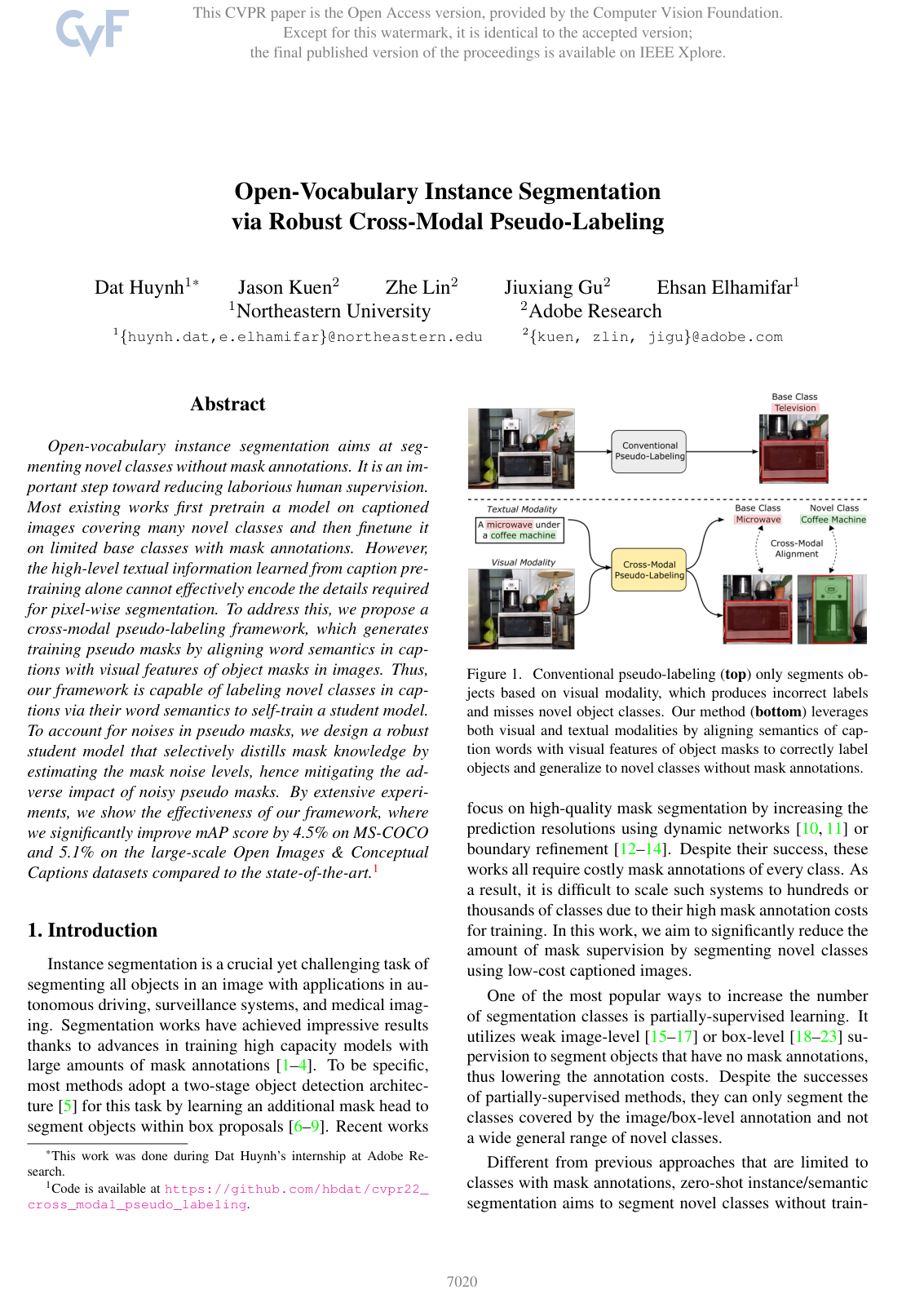
Open-Vocabulary Instance Segmentation via Robust Cross-Modal Pseudo-Labeling
Dat Huynh, Jason Kuen, Zhe Lin, Jiuxiang Gu, Ehsan Elhamifar
Why you should read this
Proposes a cross-modal pseudo-labeling framework that aligns caption words with visual mask features and filters label noise to segment novel object classes without mask annotations.
Open-vocabulary instance segmentation aims at segmenting novel classes without mask annotations. It is an important step toward reducing laborious human supervision. Most existing works first pretrain a model on captioned images covering many novel classes and then finetune it on limited base classes with mask annotations. However, the high-level textual information learned from caption pre-training alone cannot effectively encode the details required for pixel-wise segmentation. To address this, we propose a cross-modal pseudo-labeling framework, which generates training pseudo masks by aligning word semantics in captions with visual features of object masks in images. Thus, our framework is capable of labeling novel classes in captions via their word semantics to self-train a student model. To account for noises in pseudo masks, we design a robust student model that selectively distills mask knowledge by estimating the mask noise levels, hence mitigating the adverse impact of noisy pseudo masks. By extensive experiments, we show the effectiveness of our framework, where we significantly improve mAP score by 4.5% on MS-COCO and 5.1% on the large-scale Open Images & Conceptual Captions datasets compared to the state-of-the-art.
Added
2026-09-26
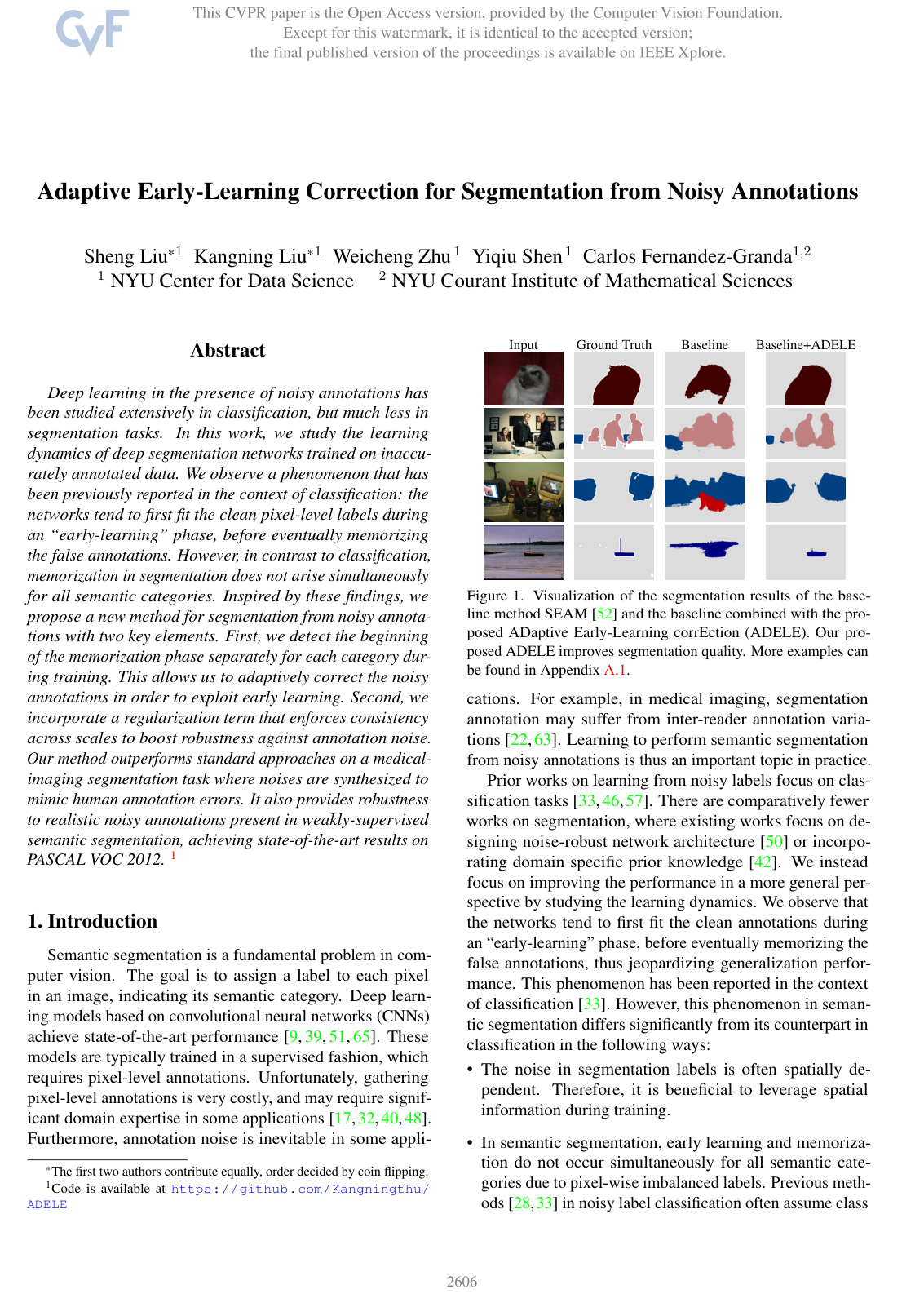
Adaptive Early-Learning Correction for Segmentation from Noisy Annotations
Sheng Liu, Kangning Liu, Weicheng Zhu, Yiqiu Shen, Carlos Fernandez-Granda
Why you should read this
Proposes an adaptive label correction method that prevents deep segmentation models from memorizing noisy annotations by independently monitoring category-specific early-learning dynamics and enforcing spatial consistency.
Added
2026-09-26