
keyword
NLG evaluation
Natural language generation evaluation is the process of assessing the quality, accuracy, and effectiveness of text produced by artificial intelligence systems and computational language models. It encompasses a variety of methodologies used to measure how well generated outputs meet task objectives and align with human expectations in applications such as summarization, dialogue systems, and open-ended text generation. These evaluations typically examine multiple qualitative and semantic dimensions, including grammatical fluency, logical coherence, relevance, factual consistency, and naturalness. The assessment can be conducted through human evaluation, which serves as a primary benchmark for reliability, or through automated methods, including traditional string-similarity metrics, learned neural evaluators, and model-based scoring or ranking frameworks. By quantifying performance and identifying generation errors, this process plays a vital role in benchmarking model capabilities and guiding the development of language generation systems.
7 items
Benchmarking Foundation Models with Language-Model-as-an-Examiner
Yushi Bai, Jiahao Ying, Yixin Cao, Xin Lv, Yuze He, Xiaozhi Wang, Jifan Yu, Kaisheng Zeng, Yijia Xiao, Haozhe Lyu, Jiayin Zhang, Juanzi Li, Lei Hou
Why you should read this
Proposes a reference-free evaluation framework that uses language models to dynamically generate open-ended questions across diverse domains and assess peer models through multi-round questioning, effectively resolving test data leakage and single-evaluator bias.
Numerous benchmarks have been established to assess the performance of foundation models on open-ended question answering, which serves as a comprehensive test of a model’s ability to understand and generate language in a manner similar to humans. Most of these works focus on proposing new datasets, however, we see two main issues within previous benchmarking pipelines, namely testing leakage and evaluation automation. In this paper, we propose a novel benchmarking framework, Language-Model-as-an-Examiner, where the LM serves as a knowledgeable examiner that formulates questions based on its knowledge and evaluates responses in a reference-free manner. Our framework allows for effortless extensibility as various LMs can be adopted as the examiner, and the questions can be constantly updated given more diverse trigger topics. For a more comprehensive and equitable evaluation, we devise three strategies: (1) We instruct the LM examiner to generate questions across a multitude of domains to probe for a broad acquisition, and raise follow-up questions to engage in a more in-depth assessment. (2) Upon evaluation, the examiner combines both scoring and ranking measurements, providing a reliable result as it aligns closely with human annotations. (3) We additionally propose a decentralized Peer-examination method to address the biases in a single examiner. Our data and benchmarking results are available at: http://lmexam.xlore.cn.
Added
2026-10-05
LLM-Rubric: A Multidimensional, Calibrated Approach to Automated Evaluation of Natural Language Texts
Helia Hashemi, Jason Eisner, Corby Rosset, Benjamin Van Durme, Chris Kedzie
Why you should read this
Proposes LLM-RUBRIC, an automated evaluation framework that queries large language models across multidimensional rubric criteria and calibrates their probability outputs with a personalized neural network to predict individual human annotator judgments with double the accuracy of standard models.
This paper introduces a framework for the automated evaluation of natural language texts. A manually constructed rubric describes how to assess multiple dimensions of interest. To evaluate a text, a large language model (LLM) is prompted with each rubric question and produces a distribution over potential responses. The LLM predictions often fail to agree well with human judges—indeed, the humans do not fully agree with one another. However, the multiple LLM distributions can be combined to predict each human judge's annotations on all questions, including a summary question that assesses overall quality or relevance. LLM-RUBRIC accomplishes this by training a small feed-forward neural network that includes both judge-specific and judge-independent parameters. When evaluating dialogue systems in a human-AI information-seeking task, we find that LLM-RUBRIC with 9 questions (assessing dimensions such as naturalness, conciseness, and citation quality) predicts human judges' assessment of overall user satisfaction, on a scale of 1–4, with RMS error < 0.5, a 2× improvement over the uncalibrated baseline.
Added
2026-10-02
Towards a Unified Multi-Dimensional Evaluator for Text Generation
Ming Zhong, Yang Liu, Da Yin, Yuning Mao, Yizhu Jiao, Pengfei Liu, Chenguang Zhu, Heng Ji, Jiawei Han
Why you should read this
Proposes UniEval, a unified text generation evaluator that reframes multi-dimensional assessment as Boolean question answering, markedly improving correlation with human judgments across summarization and dialogue while enabling zero-shot generalization to unseen criteria.
Multi-dimensional evaluation is the dominant paradigm for human evaluation in Natural Language Generation (NLG), i.e., evaluating the generated text from multiple explainable dimensions, such as coherence and fluency. However, automatic evaluation in NLG is still dominated by similarity-based metrics, and we lack a reliable framework for a more comprehensive evaluation of advanced models. In this paper, we propose a unified multi-dimensional evaluator UniEval for NLG. We re-frame NLG evaluation as a Boolean Question Answering (QA) task, and by guiding the model with different questions, we can use one evaluator to evaluate from multiple dimensions. Furthermore, thanks to the unified Boolean QA format, we are able to introduce an intermediate learning phase that enables UniEval to incorporate external knowledge from multiple related tasks and gain further improvement. Experiments on three typical NLG tasks show that UniEval correlates substantially better with human judgments than existing metrics. Specifically, compared to the top-performing unified evaluators, UniEval achieves a 23% higher correlation on text summarization, and over 43% on dialogue response generation. Also, UniEval demonstrates a strong zero-shot learning ability for unseen evaluation dimensions and tasks. Source code, data and all pre-trained evaluators are available on our GitHub repository (this https URL).
Added
2026-09-29
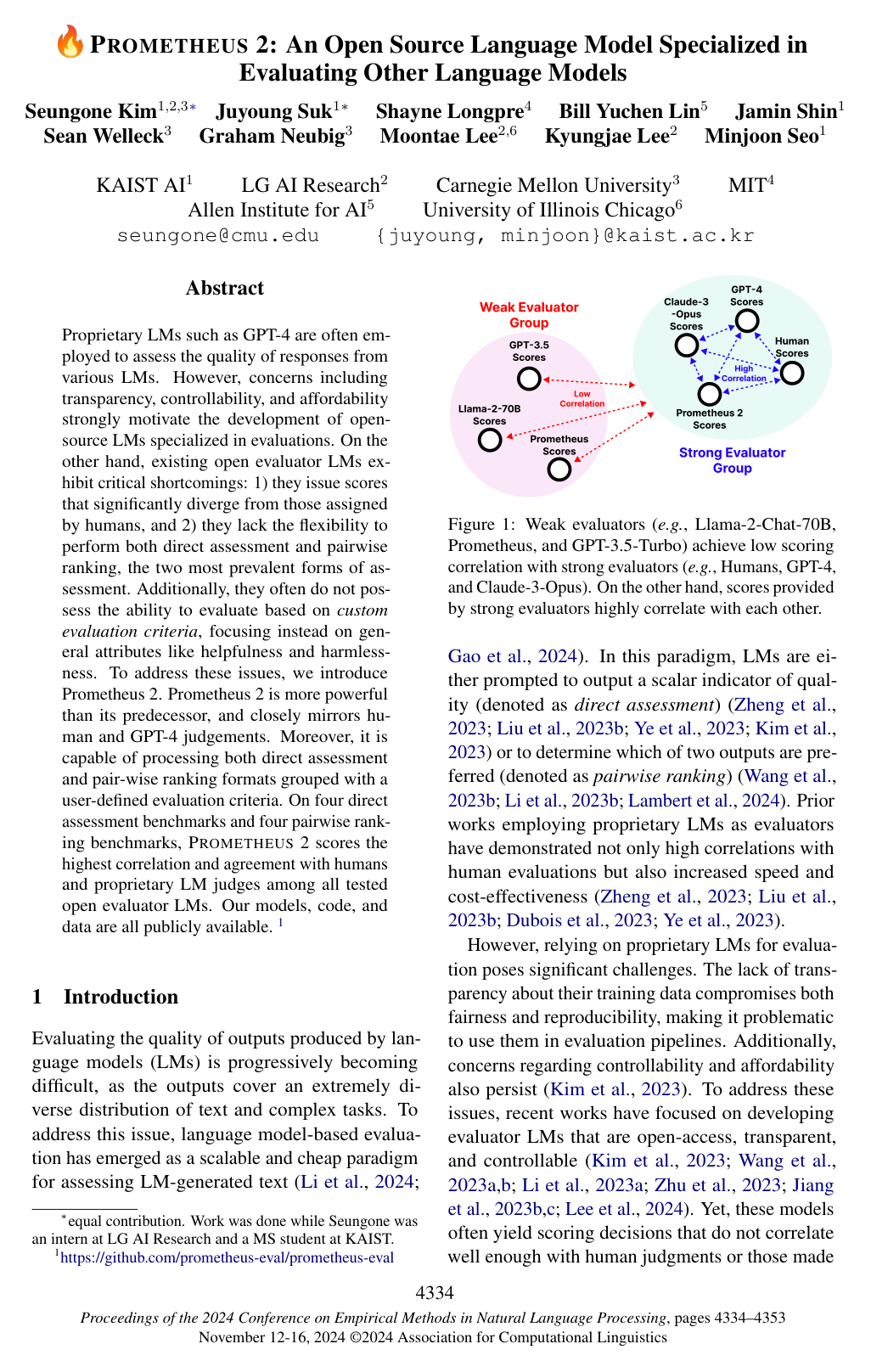
Prometheus 2: An Open Source Language Model Specialized in Evaluating Other Language Models
Seungone Kim, Juyoung Suk, Shayne Longpre, Bill Yuchen Lin, Jamin Shin, Sean Welleck, Graham Neubig, Moontae Lee, Kyungjae Lee, Minjoon Seo
Why you should read this
Presents Prometheus 2, an open-source evaluator language model that handles both direct assessment and pairwise ranking with custom criteria by merging models trained on separate evaluation formats, closely mirroring human and GPT-4 judgments.
Proprietary LMs such as GPT-4 are often employed to assess the quality of responses from various LMs. However, concerns including transparency, controllability, and affordability strongly motivate the development of open-source LMs specialized in evaluations. On the other hand, existing open evaluator LMs exhibit critical shortcomings: 1) they issue scores that significantly diverge from those assigned by humans, and 2) they lack the flexibility to perform both direct assessment and pairwise ranking, the two most prevalent forms of assessment. Additionally, they often do not possess the ability to evaluate based on *custom evaluation criteria*, focusing instead on general attributes like helpfulness and harmlessness. To address these issues, we introduce Prometheus 2. Prometheus 2 is more powerful than its predecessor, and closely mirrors human and GPT-4 judgements. Moreover, it is capable of processing both direct assessment and pair-wise ranking formats grouped with a user-defined evaluation criteria. On four direct assessment benchmarks and four pairwise ranking benchmarks, PROMETHEUS 2 scores the highest correlation and agreement with humans and proprietary LM judges among all tested open evaluator LMs. Our models, code, and data are all publicly available. 1
Added
2026-09-28
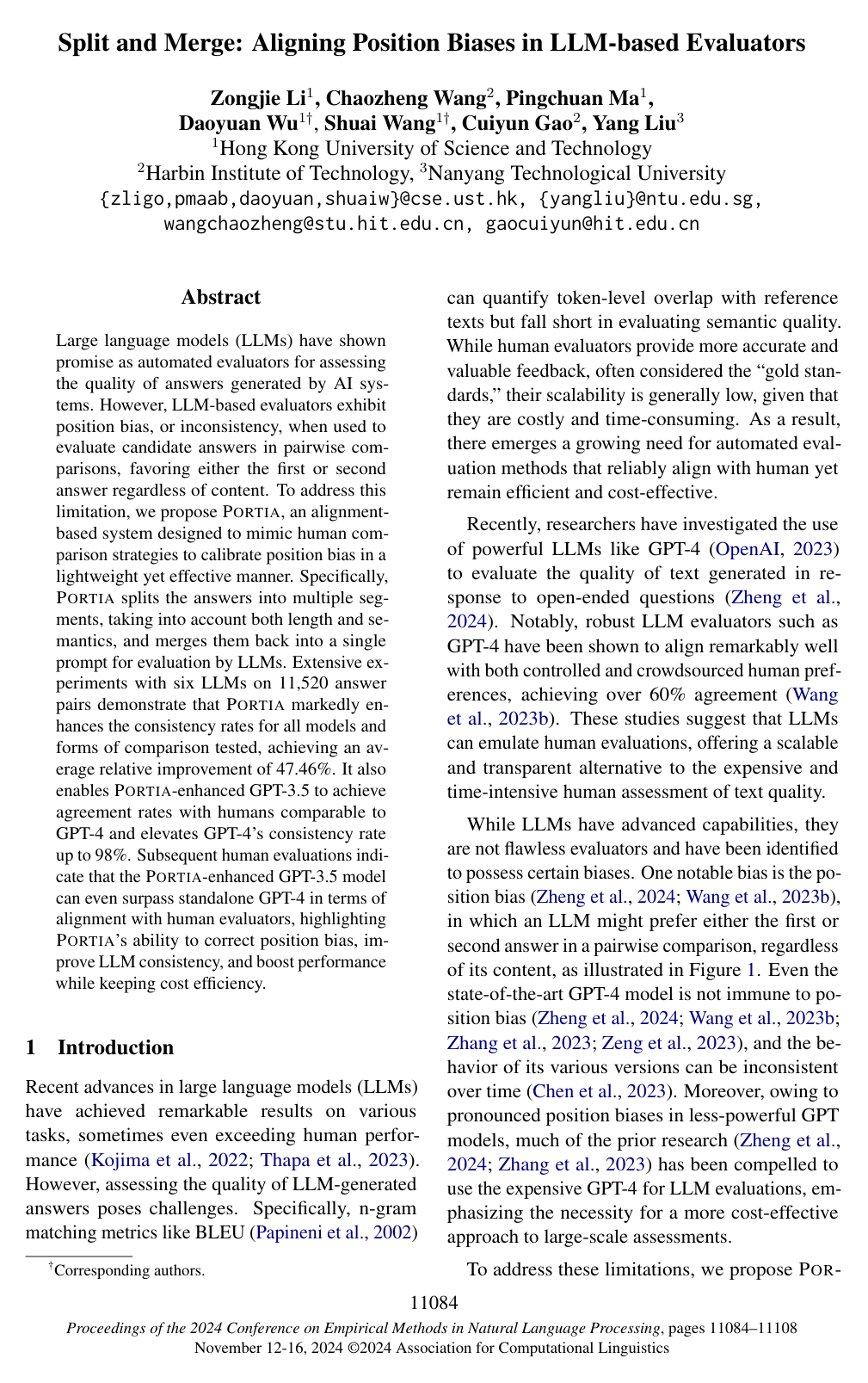
Split and Merge: Aligning Position Biases in LLM-based Evaluators
Zongjie Li, Chaozheng Wang, Pingchuan Ma, Daoyuan Wu, Shuai Wang, Cuiyun Gao, Yang Liu
Why you should read this
Proposes PORTIA, a split-and-merge prompting framework that mitigates pairwise position bias in large language model evaluators by segmenting and aligning candidate answers, enabling cost-effective models like GPT-3.5 to rival or exceed standalone GPT-4 in human agreement.
Large language models (LLMs) have shown promise as automated evaluators for assessing the quality of answers generated by AI systems. However, LLM-based evaluators exhibit position bias, or inconsistency, when used to evaluate candidate answers in pairwise comparisons, favoring either the first or second answer regardless of content. To address this limitation, we propose PORTIA, an alignment-based system designed to mimic human comparison strategies to calibrate position bias in a lightweight yet effective manner. Specifically, PORTIA splits the answers into multiple segments, taking into account both length and semantics, and merges them back into a single prompt for evaluation by LLMs. Extensive experiments with six LLMs on 11,520 answer pairs demonstrate that PORTIA markedly enhances the consistency rates for all models and forms of comparison tested, achieving an average relative improvement of 47.46%. It also enables PORTIA-enhanced GPT-3.5 to achieve agreement rates with humans comparable to GPT-4 and elevates GPT-4’s consistency rate up to 98%. Subsequent human evaluations indicate that the PORTIA-enhanced GPT-3.5 model can even surpass standalone GPT-4 in terms of alignment with human evaluators, highlighting PORTIA’s ability to correct position bias, improve LLM consistency, and boost performance while keeping cost efficiency. can quantify token-level overlap with reference texts but fall short in evaluating semantic quality. While human evaluators provide more accurate and valuable feedback, often considered the “gold standards,” their scalability is generally low, given that they are costly and time-consuming. As a result, there emerges a growing need for automated evaluation methods that reliably align with human yet remain efficient and cost-effective.
Added
2026-09-26
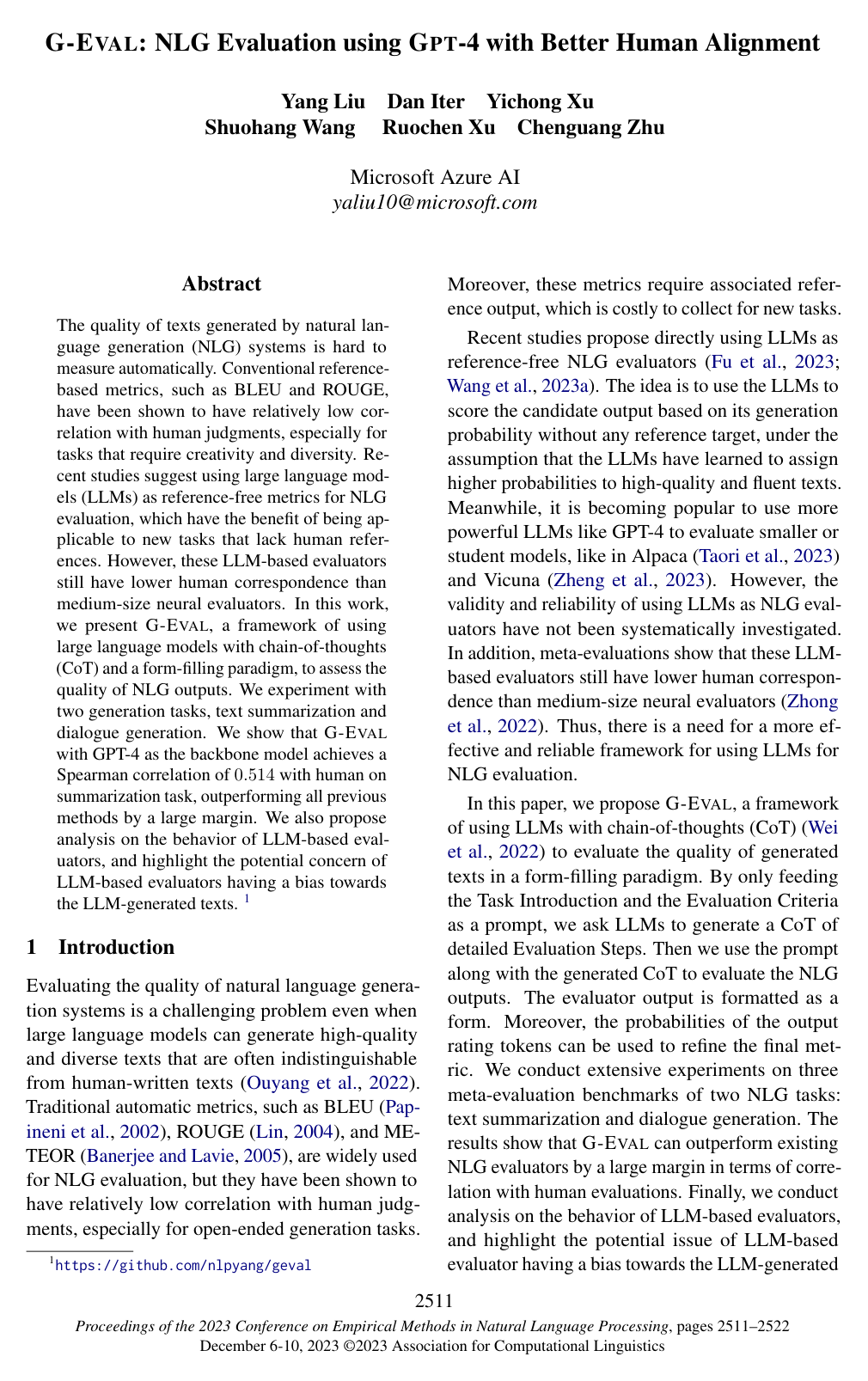
G-Eval: NLG Evaluation using GPT-4 with Better Human Alignment
Yang Liu, Dan Iter, Yichong Xu, Shuo Wang, Ruochen Xu, Chenguang Zhu
Why you should read this
Proposes G-Eval, a framework that uses chain-of-thought prompting with GPT-4 to evaluate natural language generation, significantly outperforming traditional metrics in human correlation while exposing critical evaluator biases.
The quality of texts generated by natural language generation (NLG) systems is hard to measure automatically. Conventional reference-based metrics, such as BLEU and ROUGE, have been shown to have relatively low correlation with human judgments, especially for tasks that require creativity and diversity. Recent studies suggest using large language models (LLMs) as reference-free metrics for NLG evaluation, which have the benefit of being applicable to new tasks that lack human references. However, these LLM-based evaluators still have lower human correspondence than medium-size neural evaluators. In this work, we present G-Eval, a framework of using large language models with chain-of-thoughts (CoT) and a form-filling paradigm, to assess the quality of NLG outputs. We experiment with two generation tasks, text summarization and dialogue generation. We show that G-Eval with GPT-4 as the backbone model achieves a Spearman correlation of 0.514 with human on summarization task, outperforming all previous methods by a large margin. We also propose preliminary analysis on the behavior of LLM-based evaluators, and highlight the potential issue of LLM-based evaluators having a bias towards the LLM-generated texts. The code is at this https URL
Added
2026-09-13
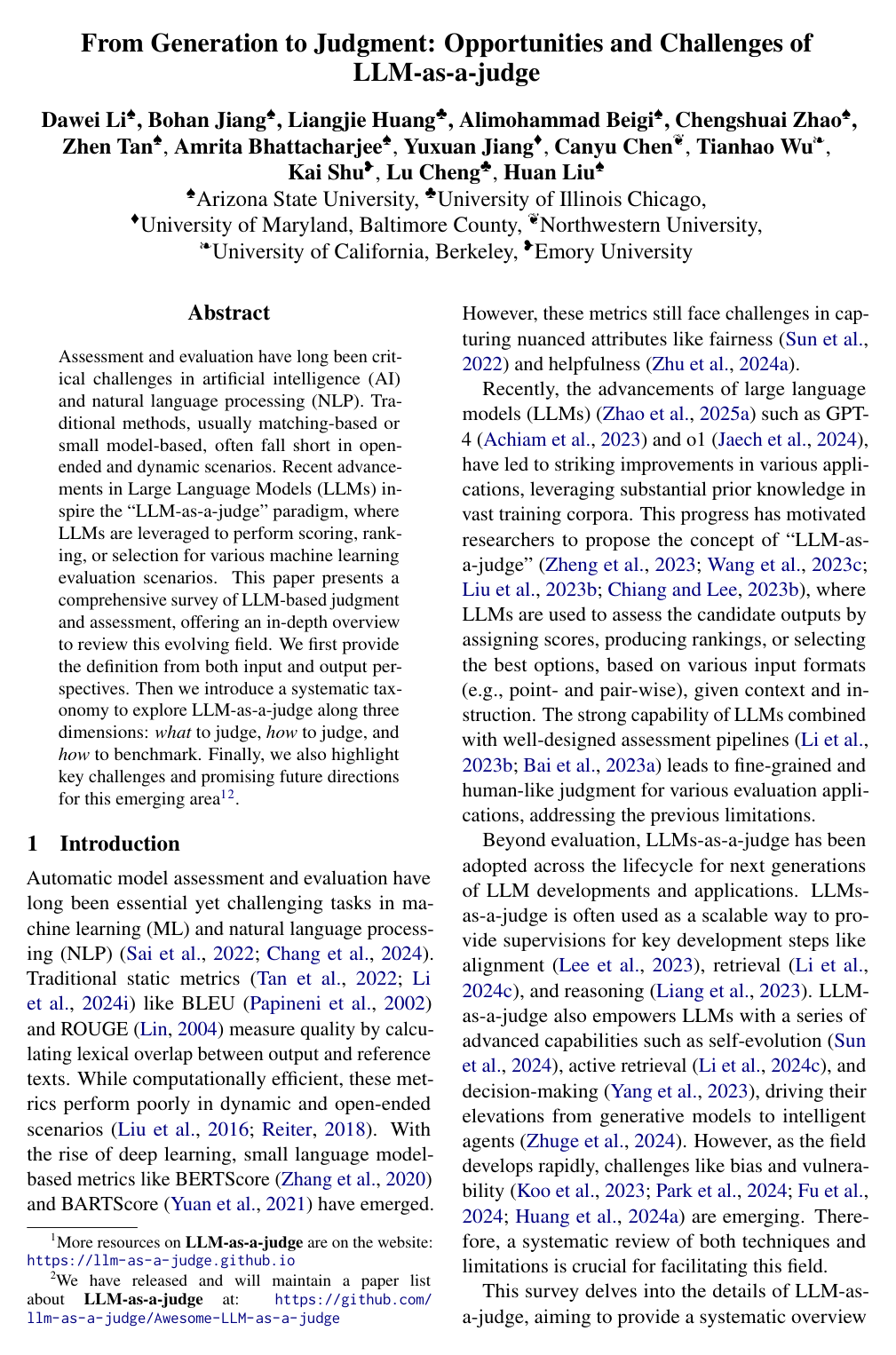
From Generation to Judgment: Opportunities and Challenges of LLM-as-a-judge
Dawei Li, Bohan Jiang, Liangjie Huang, Alimohammad Beigi, Chengshuai Zhao, Zhen Tan, Amrita Bhattacharjee, Yuxuan Jiang, Canyu Chen, Tianhao Wu, Kai Shu, Lu Cheng, Huan Liu
Why you should read this
Presents a comprehensive taxonomy and critical overview of the "LLM-as-a-judge" paradigm, detailing its definition, methods of judgment, benchmarking, challenges, and future directions.
Assessment and evaluation have long been critical challenges in artificial intelligence (AI) and natural language processing (NLP). Traditional methods, usually matching-based or small model-based, often fall short in open-ended and dynamic scenarios. Recent advancements in Large Language Models (LLMs) inspire the "LLM-as-a-judge" paradigm, where LLMs are leveraged to perform scoring, ranking, or selection for various machine learning evaluation scenarios. This paper presents a comprehensive survey of LLM-based judgment and assessment, offering an in-depth overview to review this evolving field. We first provide the definition from both input and output perspectives. Then we introduce a systematic taxonomy to explore LLM-as-a-judge along three dimensions: what to judge, how to judge, and how to benchmark. Finally, we also highlight key challenges and promising future directions for this emerging area. More resources on LLM-as-a-judge are on the website: this https URL and this https URL.
Added
2026-05-20
