Built independently by an author, for readers. Read the story and support ChapterPal

keyword

news summarization

News summarization is the natural language processing task of automatically generating a concise, coherent, and factually accurate overview of one or more news articles while preserving the essential information, key events, and primary entities. In computational linguistics and machine learning, this process is typically carried out using either extractive techniques, which identify and assemble the most salient sentences directly from the source text, or abstractive techniques, which use language models to synthesize and rephrase the underlying information into novel wording. It can be applied to individual stories or across multiple reports covering the same topic, allowing readers and content aggregation systems to quickly distill complex current events, eliminate redundant reporting, and understand major developments efficiently.

1 item

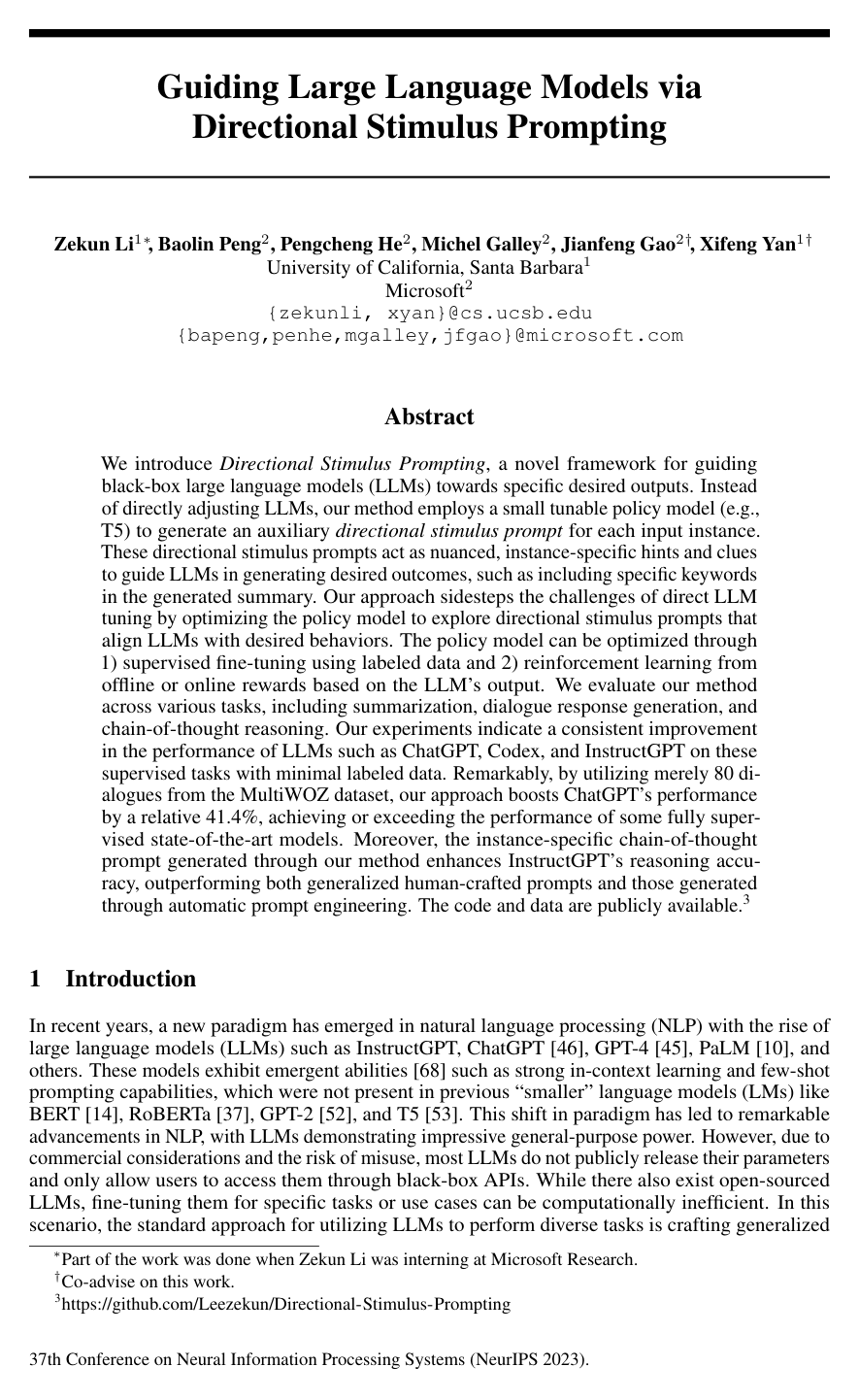
Guiding Large Language Models via Directional Stimulus Prompting

Guiding Large Language Models via Directional Stimulus Prompting

Zekun Li, Baolin Peng, Pengcheng He, Michel Galley, Jianfeng Gao, Xifeng Yan

OrganizationsMicrosoftUniversity of California, Santa Barbara

Why you should read this

Proposes Directional Stimulus Prompting, a framework that trains a small tunable model to generate instance-specific prompt hints for black-box language models, significantly boosting task performance and reasoning accuracy with minimal labeled data.

We introduce Directional Stimulus Prompting, a novel framework for guiding black-box large language models (LLMs) towards specific desired outputs. Instead of directly adjusting LLMs, our method employs a small tunable policy model (e.g., T5) to generate an auxiliary directional stimulus prompt for each input instance. These directional stimulus prompts act as nuanced, instance-specific hints and clues to guide LLMs in generating desired outcomes, such as including specific keywords in the generated summary. Our approach sidesteps the challenges of direct LLM tuning by optimizing the policy model to explore directional stimulus prompts that align LLMs with desired behaviors. The policy model can be optimized through 1) supervised fine-tuning using labeled data and 2) reinforcement learning from offline or online rewards based on the LLM’s output. We evaluate our method across various tasks, including summarization, dialogue response generation, and chain-of-thought reasoning. Our experiments indicate a consistent improvement in the performance of LLMs such as ChatGPT, Codex, and InstructGPT on these supervised tasks with minimal labeled data. Remarkably, by utilizing merely 80 dialogues from the MultiWOZ dataset, our approach boosts ChatGPT’s performance by a relative 41.4%, achieving or exceeding the performance of some fully supervised state-of-the-art models. Moreover, the instance-specific chain-of-thought prompt generated through our method enhances InstructGPT’s reasoning accuracy, outperforming both generalized human-crafted prompts and those generated through automatic prompt engineering. The code and data are publicly available.

Added

2026-09-26