Built independently by an author, for readers. Read the story and support ChapterPal

keyword

neuro-symbolic models

Neuro-symbolic models are artificial intelligence systems that combine deep neural networks with symbolic reasoning techniques to perform learning and inference. While neural networks excel at statistical pattern recognition and learning representations from raw, unstructured data, symbolic components apply explicit rules, mathematical operations, and formal logic to manipulate discrete concepts. By integrating connectionist learning with structured symbolic manipulation, these hybrid systems aim to enhance interpretability, data efficiency, and safety while providing robust capabilities in tasks that require abstract multi-step reasoning, mathematical problem-solving, and generalizable logical deduction.

1 item

NumGLUE: A Suite of Fundamental yet Challenging Mathematical Reasoning Tasks

NumGLUE: A Suite of Fundamental yet Challenging Mathematical Reasoning Tasks

Swaroop Mishra, Arindam Mitra, Neeraj Varshney, Bhavdeep Singh Sachdeva, Peter Clark, Chitta Baral, Ashwin Kalyan

OrganizationsAllen Institute for AIArizona State UniversityMicrosoft

Why you should read this

Presents NUMGLUE, an eight-task benchmark spanning roughly 100,000 problems that exposes large language models' severe arithmetic brittleness compared to human reasoning while showing that joint multi-task training significantly boosts numerical performance across diverse question formats.

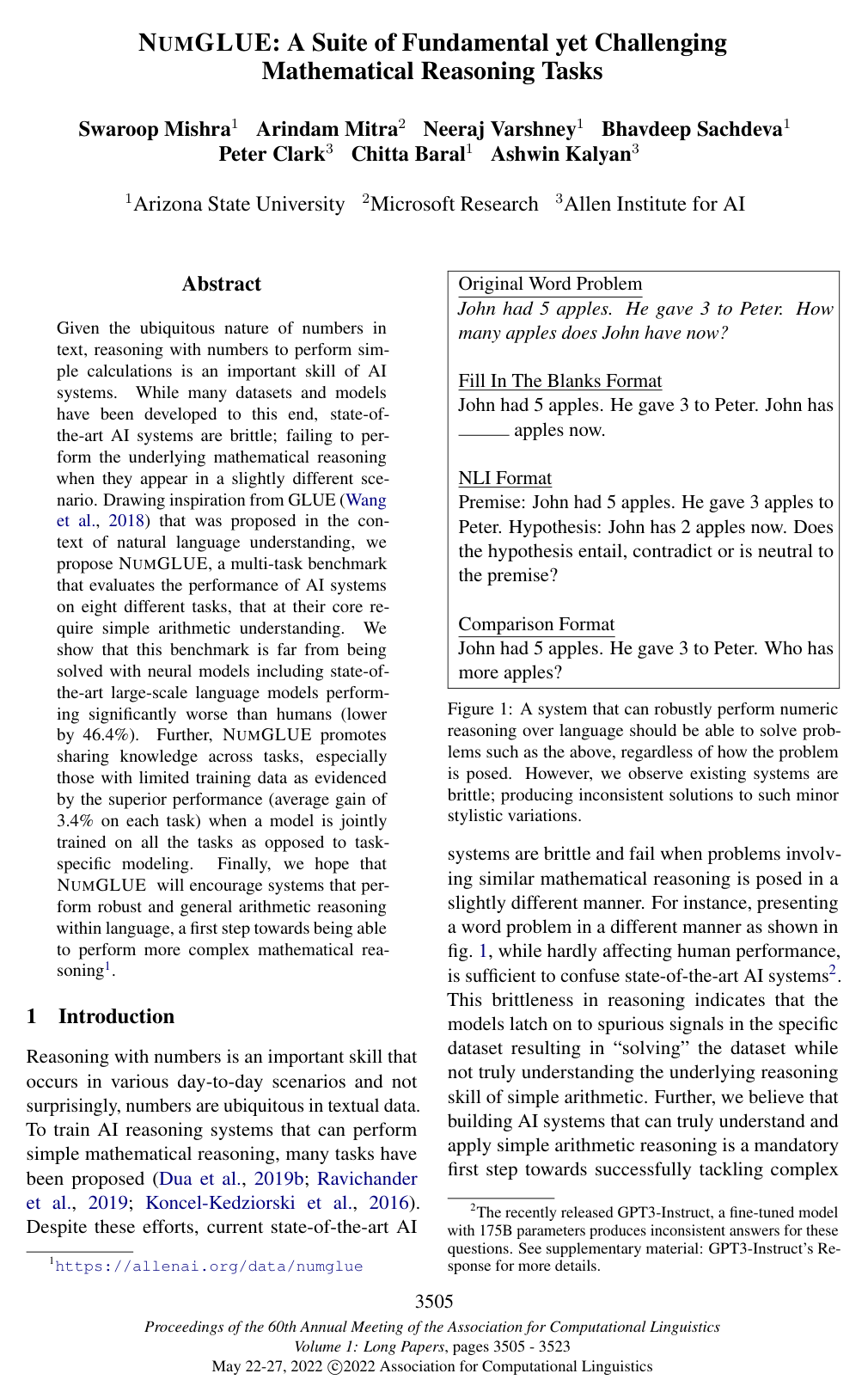
Given the ubiquitous nature of numbers in text, reasoning with numbers to perform simple calculations is an important skill of AI systems. While many datasets and models have been developed to this end, state-of-the-art AI systems are brittle; failing to perform the underlying mathematical reasoning when they appear in a slightly different scenario. Drawing inspiration from GLUE (Wang et al., 2018) that was proposed in the context of natural language understanding, we propose NUMGLUE, a multi-task benchmark that evaluates the performance of AI systems on eight different tasks, that at their core require simple arithmetic understanding. We show that this benchmark is far from being solved with neural models including state-of-the-art large-scale language models performing significantly worse than humans (lower by 46.4%). Further, NUMGLUE promotes sharing knowledge across tasks, especially those with limited training data as evidenced by the superior performance (average gain of 3.4% on each task) when a model is jointly trained on all the tasks as opposed to task-specific modeling. Finally, we hope that NUMGLUE will encourage systems that perform robust and general arithmetic reasoning within language, a first step towards being able to perform more complex mathematical reasoning.

Added

2026-09-26