
keyword
neural image compression
Neural image compression is a data compression approach that employs artificial neural networks to reduce the file size of digital images while maintaining visual quality. Instead of using hand-crafted, rule-based transforms found in conventional codecs, it typically uses deep autoencoders to map pixel data into a lower-dimensional latent representation, quantizes the resulting features into discrete values, and compresses them using learned probabilistic entropy models. The entire system is trained end-to-end to balance the transmission bitrate against the distortion and perceptual fidelity of the reconstructed image, enabling adaptable, high-efficiency encoding.
2 items
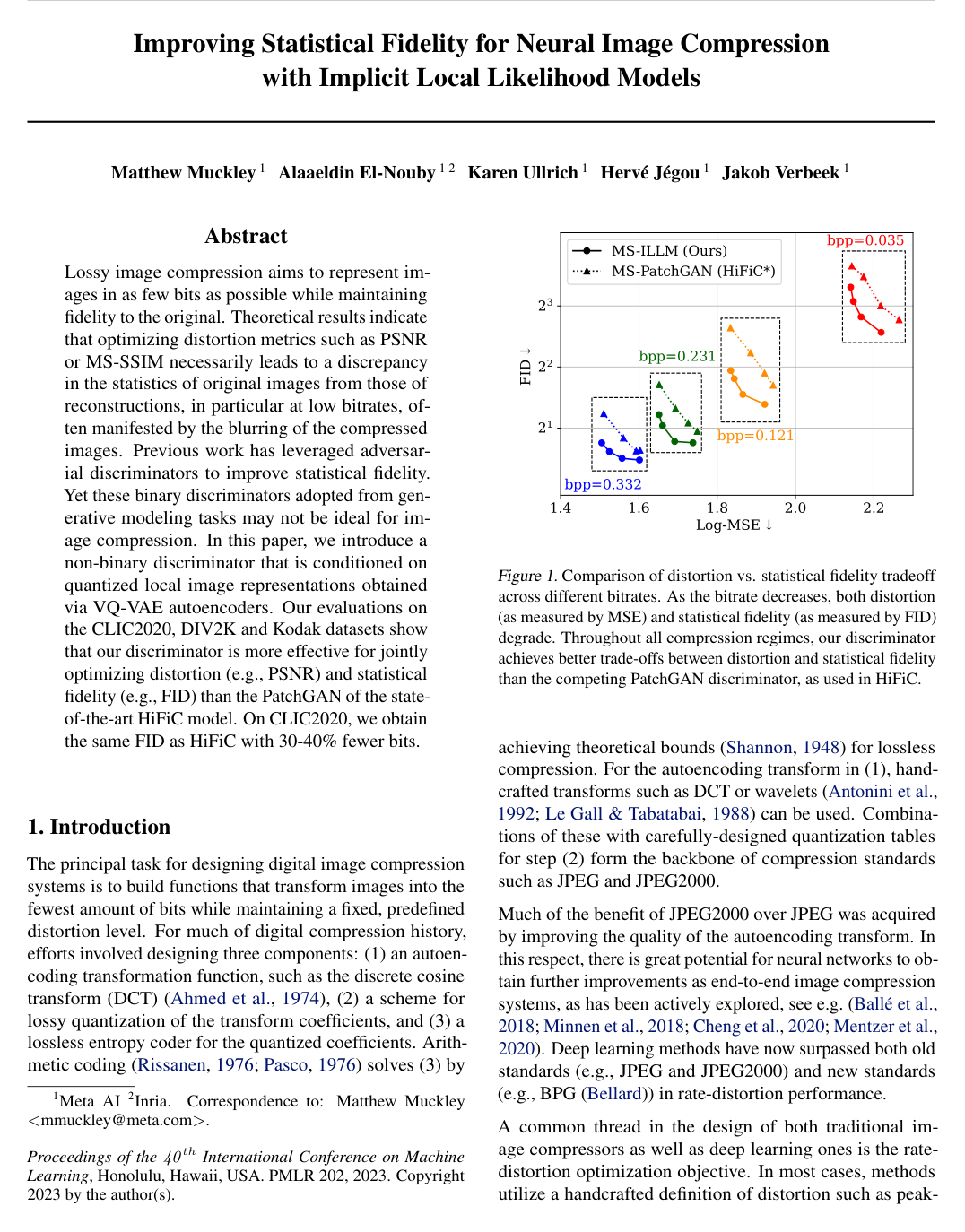
Improving Statistical Fidelity for Neural Image Compression with Implicit Local Likelihood Models
Matthew J. Muckley, Alaaeldin El-Nouby, Karen Ullrich, Hervé Jégou, Jakob Verbeek
Why you should read this
Introduces a non-binary adversarial discriminator conditioned on quantized local VQ-VAE representations that achieves state-of-the-art statistical fidelity and distortion trade-offs in neural image compression, matching HiFiC's FID using 30–40% fewer bits.
Lossy image compression aims to represent images in as few bits as possible while maintaining fidelity to the original. Theoretical results indicate that optimizing distortion metrics such as PSNR or MS-SSIM necessarily leads to a discrepancy in the statistics of original images from those of reconstructions, in particular at low bitrates, often manifested by the blurring of the compressed images. Previous work has leveraged adversarial discriminators to improve statistical fidelity. Yet these binary discriminators adopted from generative modeling tasks may not be ideal for image compression. In this paper, we introduce a non-binary discriminator that is conditioned on quantized local image representations obtained via VQ-VAE autoencoders. Our evaluations on the CLIC2020, DIV2K and Kodak datasets show that our discriminator is more effective for jointly optimizing distortion (e.g., PSNR) and statistical fidelity (e.g., FID) than the PatchGAN of the state-of-the-art HiFiC model. On CLIC2020, we obtain the same FID as HiFiC with 30-40% fewer bits.
Added
2026-10-01
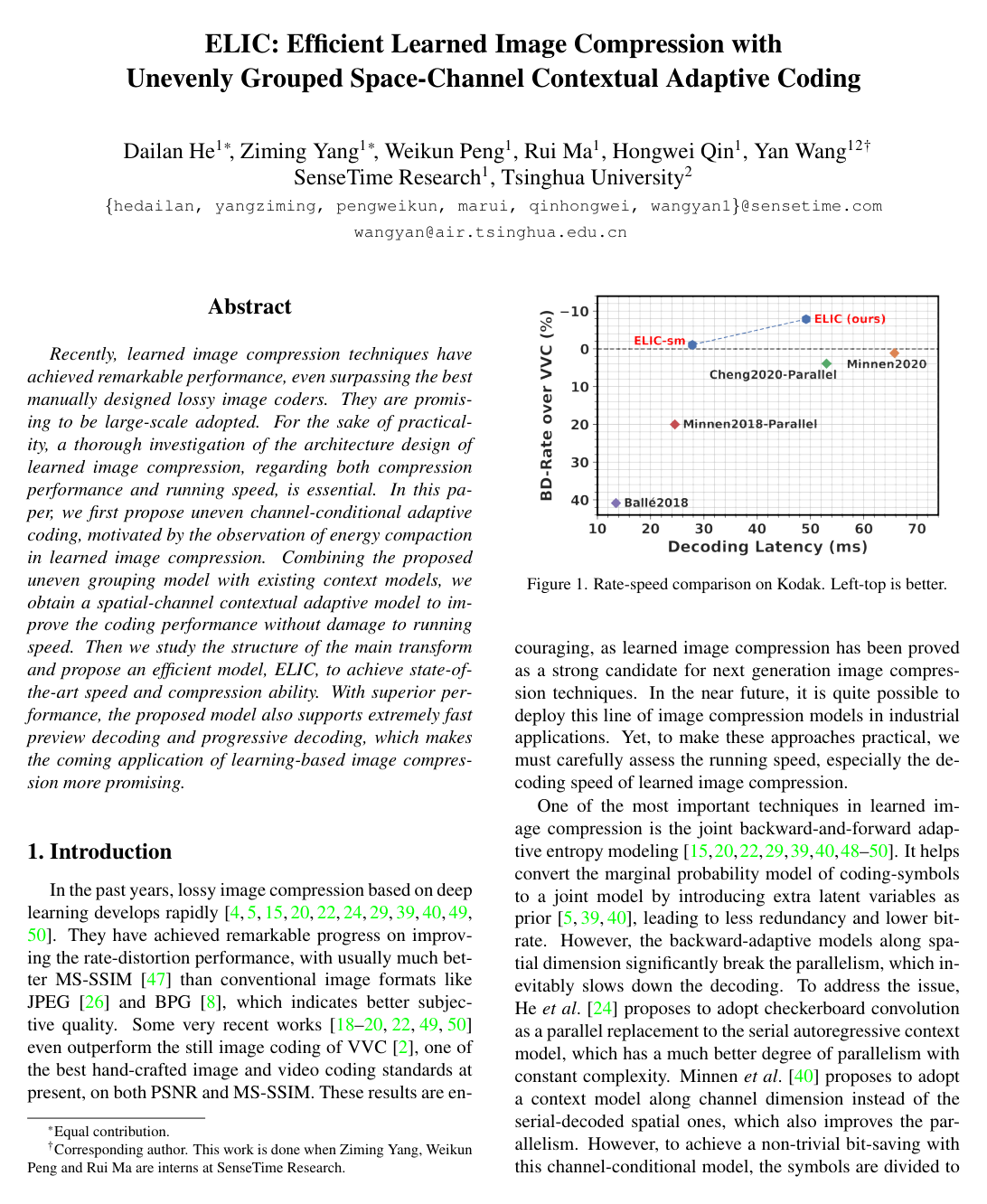
ELIC: Efficient Learned Image Compression with Unevenly Grouped Space-Channel Contextual Adaptive Coding
Dailan He, Ziming Yang, Weikun Peng, Rui Ma, Hongwei Qin, Yan Wang
Why you should read this
Presents ELIC, a learned image compression architecture that combines uneven space-channel contextual coding with efficient transform design to achieve state-of-the-art rate-distortion performance alongside fast inference, preview decoding, and progressive decoding.
Recently, learned image compression techniques have achieved remarkable performance, even surpassing the best manually designed lossy image coders. They are promising to be large-scale adopted. For the sake of practicality, a thorough investigation of the architecture design of learned image compression, regarding both compression performance and running speed, is essential. In this paper, we first propose uneven channel-conditional adaptive coding, motivated by the observation of energy compaction in learned image compression. Combining the proposed uneven grouping model with existing context models, we obtain a spatial-channel contextual adaptive model to improve the coding performance without damage to running speed. Then we study the structure of the main transform and propose an efficient model, ELIC, to achieve state-of-the-art speed and compression ability. With superior performance, the proposed model also supports extremely fast preview decoding and progressive decoding, which makes the coming application of learning-based image compression more promising.
Added
2026-09-26