
keyword
neural collaborative filtering
Neural collaborative filtering is a deep learning approach used in recommender systems to predict user preferences and interactions by modeling the relationships between users and items. Unlike traditional collaborative filtering techniques such as matrix factorization, which rely on linear inner products of user and item latent vectors, neural collaborative filtering employs neural network architectures like multi-layer perceptrons to learn complex, non-linear interaction functions directly from data. By mapping user and item representations into dense latent spaces and processing them through non-linear layers, this framework can capture intricate user behavior and implicit feedback patterns to produce personalized recommendations.
5 items
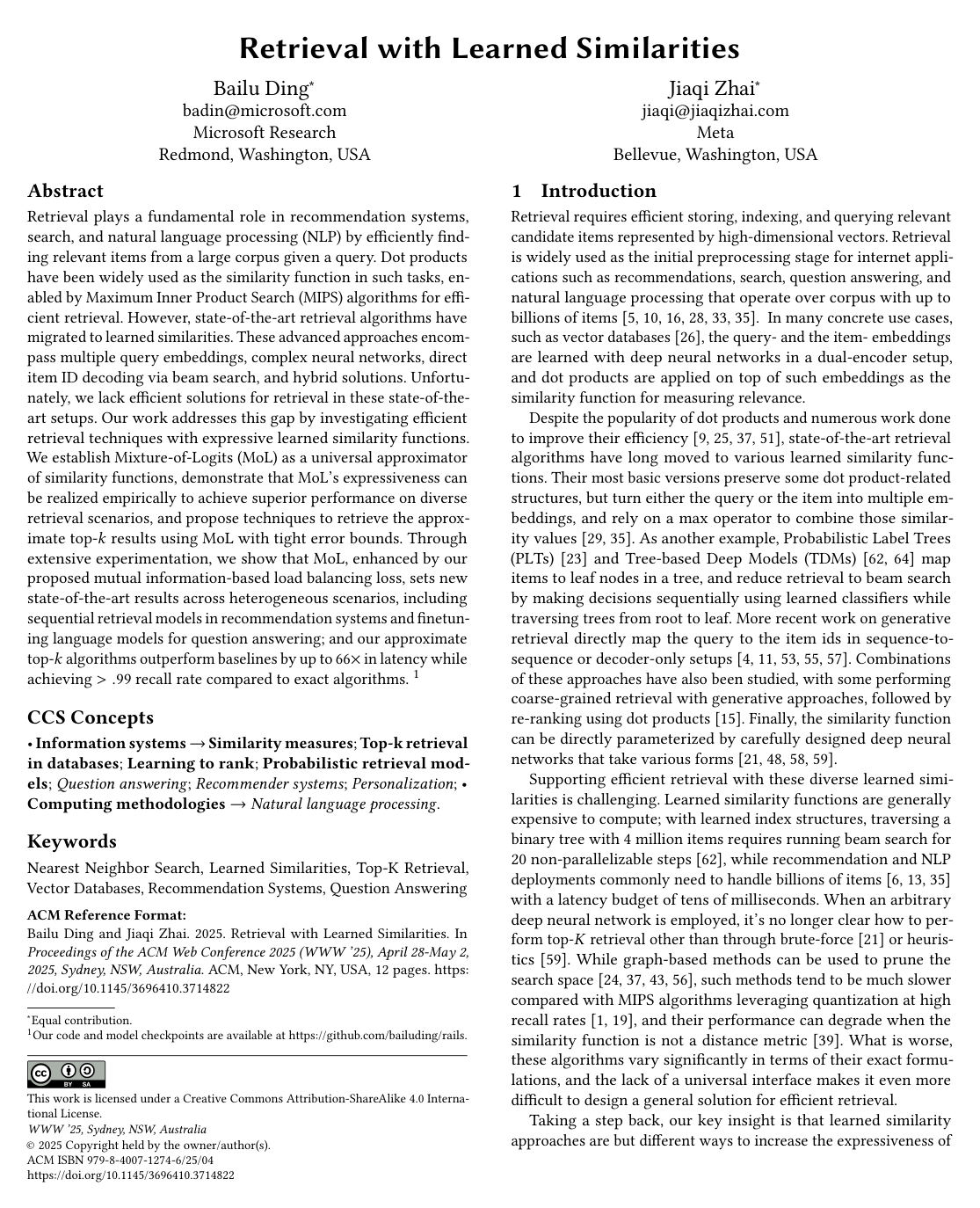
Retrieval with Learned Similarities
Bailu Ding, Jiaqi Zhai
Why you should read this
Develops Mixture-of-Logits and an approximate top-k search algorithm to enable efficient retrieval with complex learned similarities, cutting latency by up to 66x while maintaining over 99% recall across recommendation and question answering tasks.
Retrieval plays a fundamental role in recommendation systems, search, and natural language processing (NLP) by efficiently finding relevant items from a large corpus given a query. Dot products have been widely used as the similarity function in such tasks, enabled by Maximum Inner Product Search (MIPS) algorithms for efficient retrieval. However, state-of-the-art retrieval algorithms have migrated to learned similarities. These advanced approaches encompass multiple query embeddings, complex neural networks, direct item ID decoding via beam search, and hybrid solutions. Unfortunately, we lack efficient solutions for retrieval in these state-of-the-art setups. Our work addresses this gap by investigating efficient retrieval techniques with expressive learned similarity functions. We establish Mixture-of-Logits (MoL) as a universal approximator of similarity functions, demonstrate that MoL's expressiveness can be realized empirically to achieve superior performance on diverse retrieval scenarios, and propose techniques to retrieve the approximate top-k results using MoL with tight error bounds. Through extensive experimentation, we show that MoL, enhanced by our proposed mutual information-based load balancing loss, sets new state-of-the-art results across heterogeneous scenarios, including sequential retrieval models in recommendation systems and finetuning language models for question answering; and our approximate top- algorithms outperform baselines by up to 66x in latency while achieving >.99 recall rate compared to exact algorithms.
Added
2026-09-29
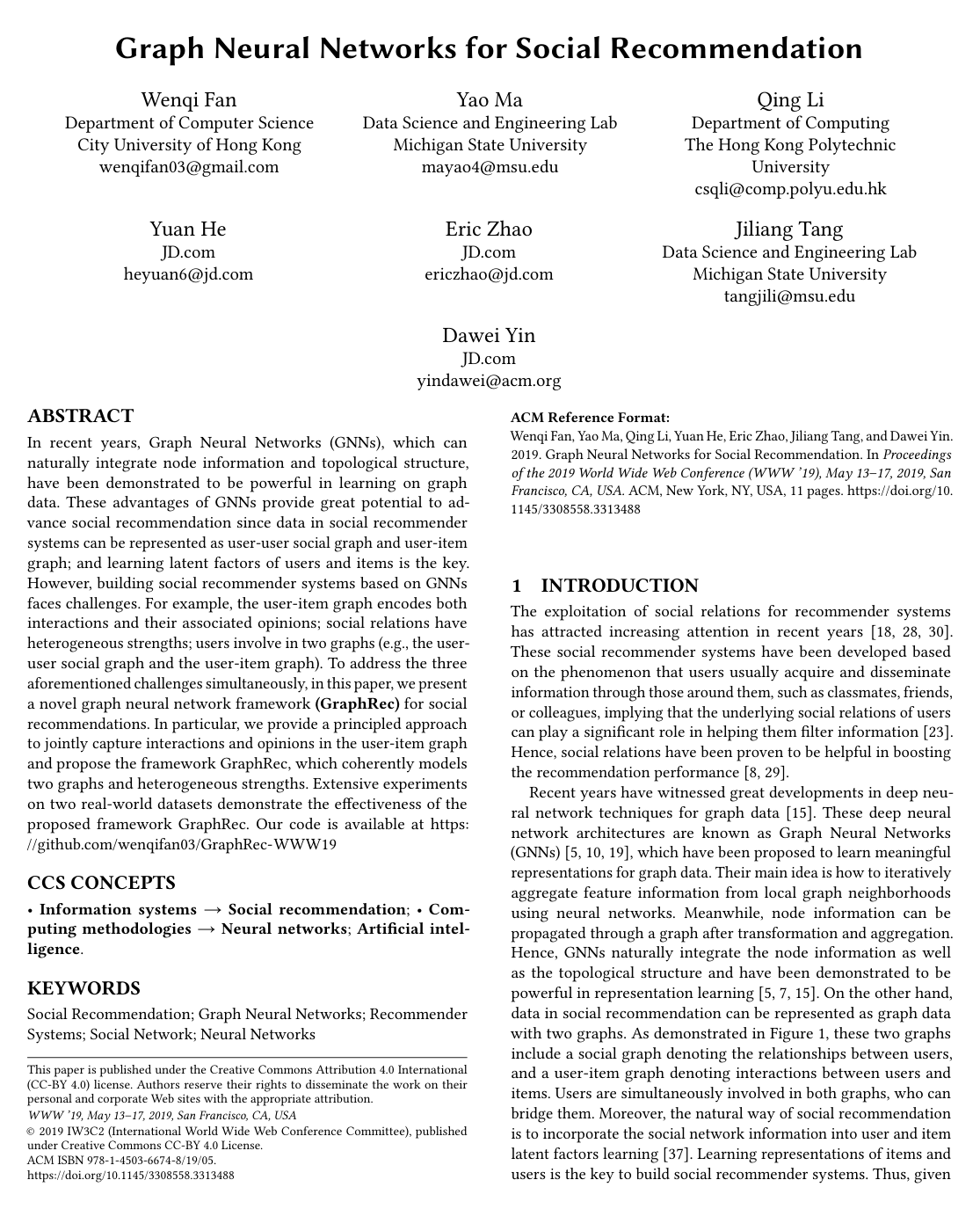
Graph Neural Networks for Social Recommendation
Wenqi Fan, Yao Ma, Qing Li, Yuan He, Eric Zhao, Jiliang Tang, Dawei Yin
Why you should read this
Develops GraphRec, a graph neural network framework that captures user-item interactions, rating opinions, and social ties with varying relationship strengths to improve social recommendation accuracy.
In recent years, Graph Neural Networks (GNNs), which can naturally integrate node information and topological structure, have been demonstrated to be powerful in learning on graph data. These advantages of GNNs provide great potential to advance social recommendation since data in social recommender systems can be represented as user-user social graph and user-item graph; and learning latent factors of users and items is the key. However, building social recommender systems based on GNNs faces challenges. For example, the user-item graph encodes both interactions and their associated opinions; social relations have heterogeneous strengths; users involve in two graphs (e.g., the user-user social graph and the user-item graph). To address the three aforementioned challenges simultaneously, in this paper, we present a novel graph neural network framework (GraphRec) for social recommendations. In particular, we provide a principled approach to jointly capture interactions and opinions in the user-item graph and propose the framework GraphRec, which coherently models two graphs and heterogeneous strengths. Extensive experiments on two real-world datasets demonstrate the effectiveness of the proposed framework GraphRec. Our code is available at \url{this https URL}
Added
2026-09-14
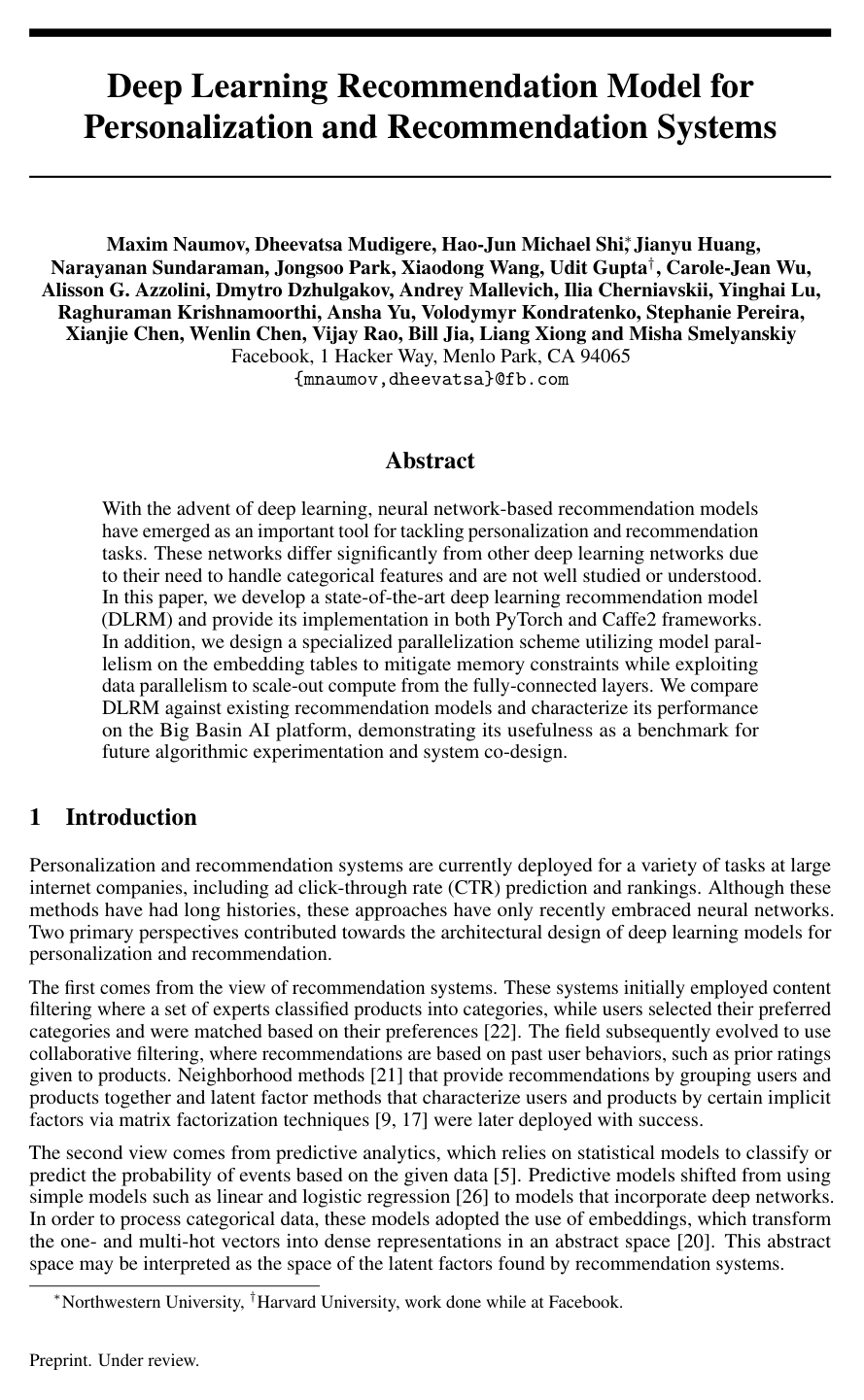
Deep Learning Recommendation Model for Personalization and Recommendation Systems
Maxim Naumov, Dheevatsa Mudigere, Hao-Jun Michael Shi, Jianyu Huang, Narayanan Sundaraman, Jongsoo Park, Xiaodong Wang, Udit Gupta, Carole-Jean Wu, Alisson G. Azzolini, Dmytro Dzhulgakov, Andrey Mallevich, Ilia Cherniavskii, Yinghai Lu, Raghuraman Krishnamoorthi, Ansha Yu, Volodymyr Y. Kondratenko, Stephanie Pereira, Xianjie Chen, Wenlin Chen, Vijay Rao, Bill Jia, Liang Xiong, Misha Smelyanskiy
Why you should read this
Presents a state-of-the-art deep learning recommendation model that synthesizes predictive analytics and collaborative filtering through a specialized parallelization scheme designed to manage large-scale categorical data and memory constraints.
With the advent of deep learning, neural network-based recommendation models have emerged as an important tool for tackling personalization and recommendation tasks. These networks differ significantly from other deep learning networks due to their need to handle categorical features and are not well studied or understood. In this paper, we develop a state-of-the-art deep learning recommendation model (DLRM) and provide its implementation in both PyTorch and Caffe2 frameworks. In addition, we design a specialized parallelization scheme utilizing model parallelism on the embedding tables to mitigate memory constraints while exploiting data parallelism to scale-out compute from the fully-connected layers. We compare DLRM against existing recommendation models and characterize its performance on the Big Basin AI platform, demonstrating its usefulness as a benchmark for future algorithmic experimentation and system co-design.
Added
2026-06-03
License
Published with permission
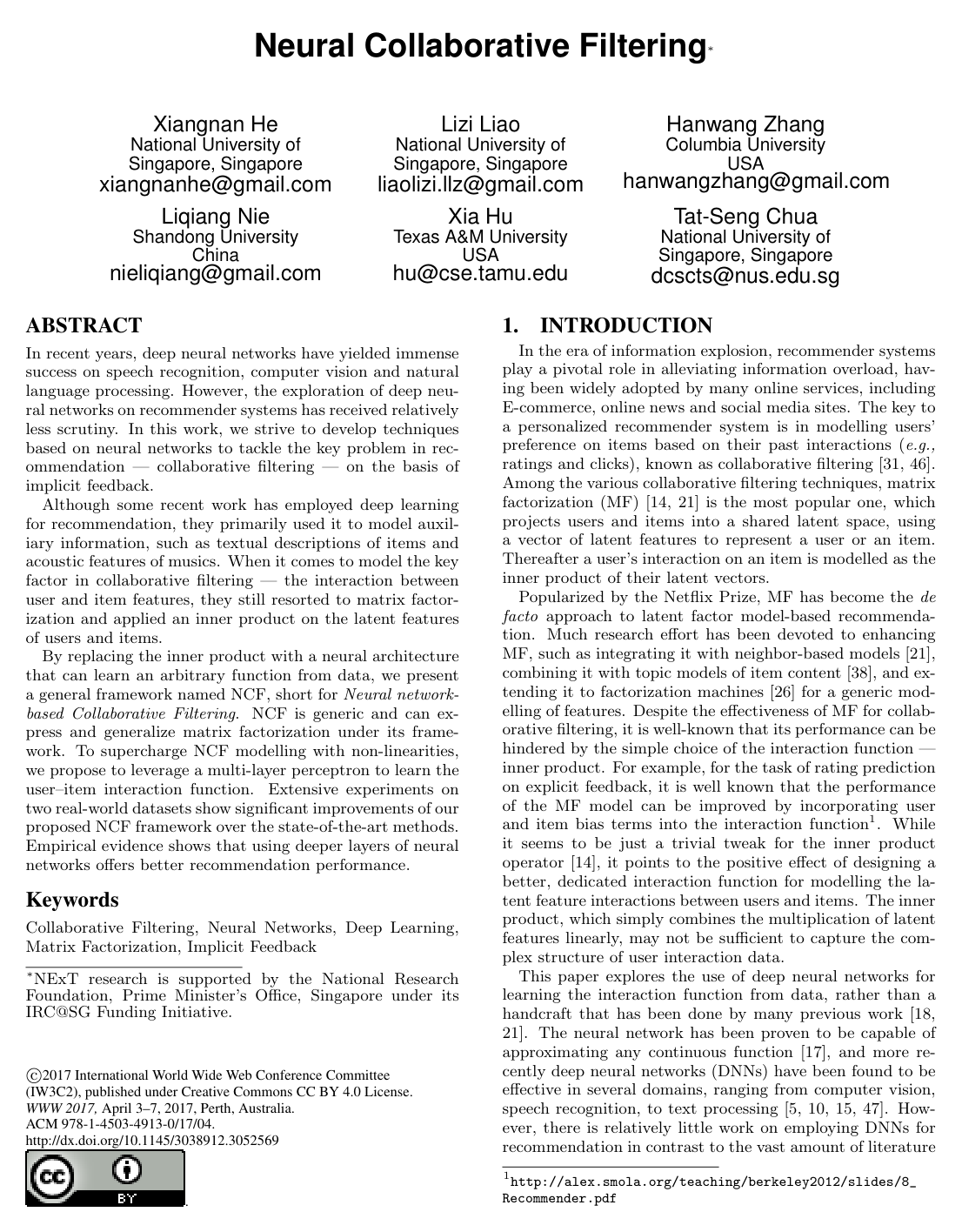
Neural Collaborative Filtering
Xiangnan He, Lizi Liao, Hanwang Zhang, Liqiang Nie, Xia Hu, Tat-Seng Chua
Why you should read this
Introduces Neural Collaborative Filtering (NCF), a general framework that significantly improves recommender systems by replacing the conventional inner product with a neural architecture capable of learning arbitrary user-item interaction functions through multi-layer perceptrons, outperforming state-of-the-art methods.
In recent years, deep neural networks have yielded immense success on speech recognition, computer vision and natural language processing. However, the exploration of deep neural networks on recommender systems has received relatively less scrutiny. In this work, we strive to develop techniques based on neural networks to tackle the key problem in recommendation -- collaborative filtering -- on the basis of implicit feedback. Although some recent work has employed deep learning for recommendation, they primarily used it to model auxiliary information, such as textual descriptions of items and acoustic features of musics. When it comes to model the key factor in collaborative filtering -- the interaction between user and item features, they still resorted to matrix factorization and applied an inner product on the latent features of users and items. By replacing the inner product with a neural architecture that can learn an arbitrary function from data, we present a general framework named NCF, short for Neural network-based Collaborative Filtering. NCF is generic and can express and generalize matrix factorization under its framework. To supercharge NCF modelling with non-linearities, we propose to leverage a multi-layer perceptron to learn the user-item interaction function. Extensive experiments on two real-world datasets show significant improvements of our proposed NCF framework over the state-of-the-art methods. Empirical evidence shows that using deeper layers of neural networks offers better recommendation performance.
Added
2026-05-06

Are we really making much progress? A worrying analysis of recent neural recommendation approaches
Maurizio Ferrari Dacrema, Paolo Cremonesi, Dietmar Jannach
Why you should read this
Exposes severe systemic methodological flaws plaguing broader AI recommendation research systematically unmasking the fact that dozens of elite neural architectures frequently fail completely to beat properly tuned simple heuristics.
Deep learning techniques have become the method of choice for researchers working on algorithmic aspects of recommender systems. With the strongly increased interest in machine learning in general, it has, as a result, become difficult to keep track of what represents the state-of-the-art at the moment, e.g., for top-n recommendation tasks. At the same time, several recent publications point out problems in today's research practice in applied machine learning, e.g., in terms of the reproducibility of the results or the choice of the baselines when proposing new models.
Added
2026-01-25