
keyword
neighborhood models
Neighborhood models are a class of collaborative filtering algorithms used in recommender systems that predict a user preference for an item based on the relationships between similar users or similar items. In an item-based neighborhood approach, the system estimates a rating or interaction by evaluating how the target user rated items that are most similar to the target item, while a user-based approach relies on preferences expressed by a cluster of users with historically similar tastes. These models compute similarities using metrics like Pearson correlation or cosine similarity, or alternatively learn similarity weights through global optimization functions. Because predictions are derived directly from the relationships among close neighbors, neighborhood models are valued for their intuitive logic, computational straightforwardness, and ability to provide clear explanations for why specific recommendations are generated.
3 items
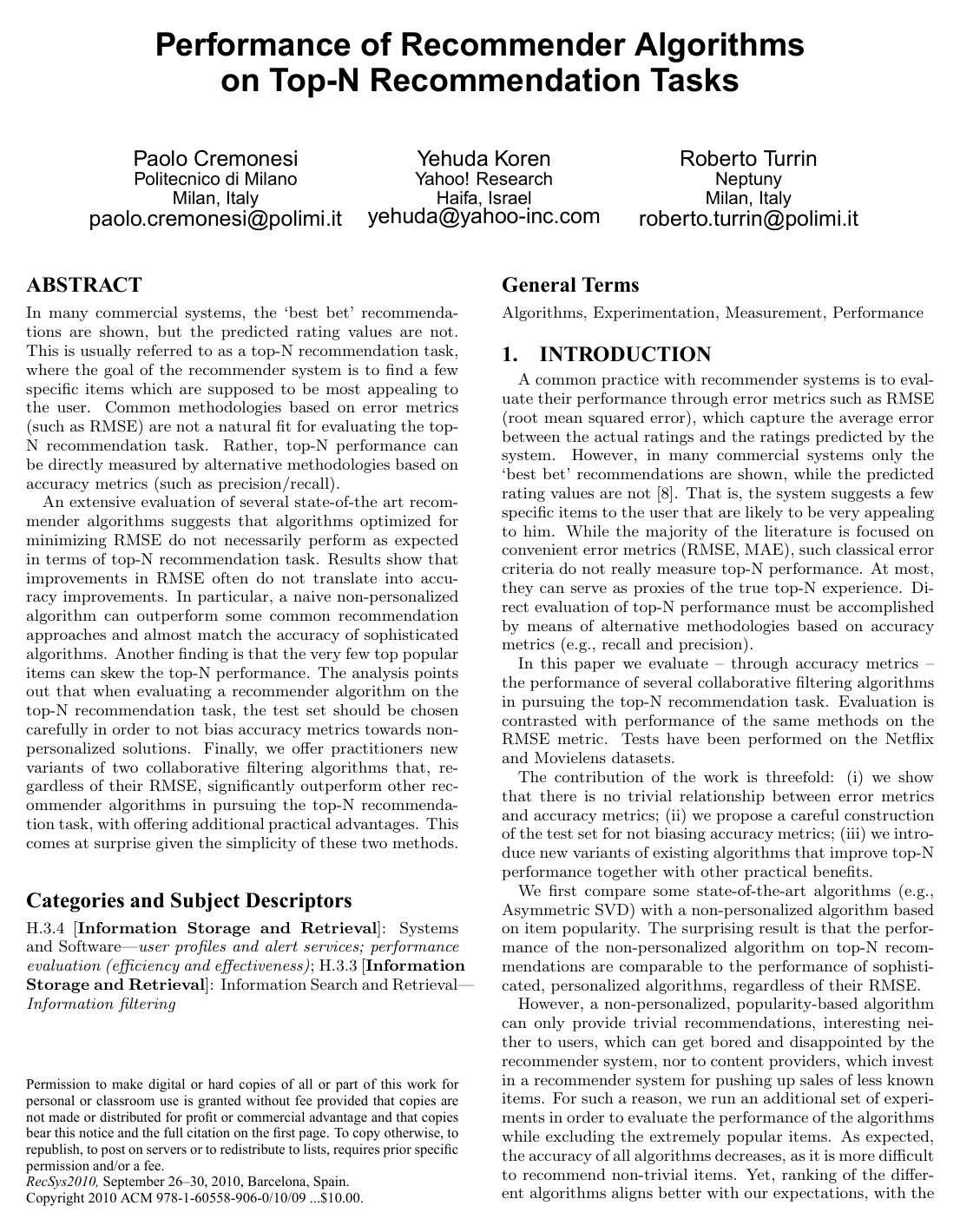
Performance of recommender algorithms on top-n recommendation tasks
P. Cremonesi, Y. Koren, Roberto Turrin
Why you should read this
Demonstrates that minimizing rating prediction error like RMSE fails to optimize top-N recommendation quality, exposing how popularity bias skews standard evaluations and offering simpler collaborative filtering variants that achieve superior ranking accuracy.
In many commercial systems, the ‘best bet’ recommendations are shown, but the predicted rating values are not. This is usually referred to as a top-N recommendation task, where the goal of the recommender system is to find a few specific items which are supposed to be most appealing to the user. Common methodologies based on error metrics (such as RMSE) are not a natural fit for evaluating the top-N recommendation task. Rather, top-N performance can be directly measured by alternative methodologies based on accuracy metrics (such as precision/recall). An extensive evaluation of several state-of-the art recommender algorithms suggests that algorithms optimized for minimizing RMSE do not necessarily perform as expected in terms of top-N recommendation task. Results show that improvements in RMSE often do not translate into accuracy improvements. In particular, a naive non-personalized algorithm can outperform some common recommendation approaches and almost match the accuracy of sophisticated algorithms. Another finding is that the very few top popular items can skew the top-N performance. The analysis points out that when evaluating a recommender algorithm on the top-N recommendation task, the test set should be chosen carefully in order to not bias accuracy metrics towards non-personalized solutions. Finally, we offer practitioners new variants of two collaborative filtering algorithms that, regardless of their RMSE, significantly outperform other recommender algorithms in pursuing the top-N recommendation task, with offering additional practical advantages. This comes at surprise given the simplicity of these two methods.
Added
2026-09-24
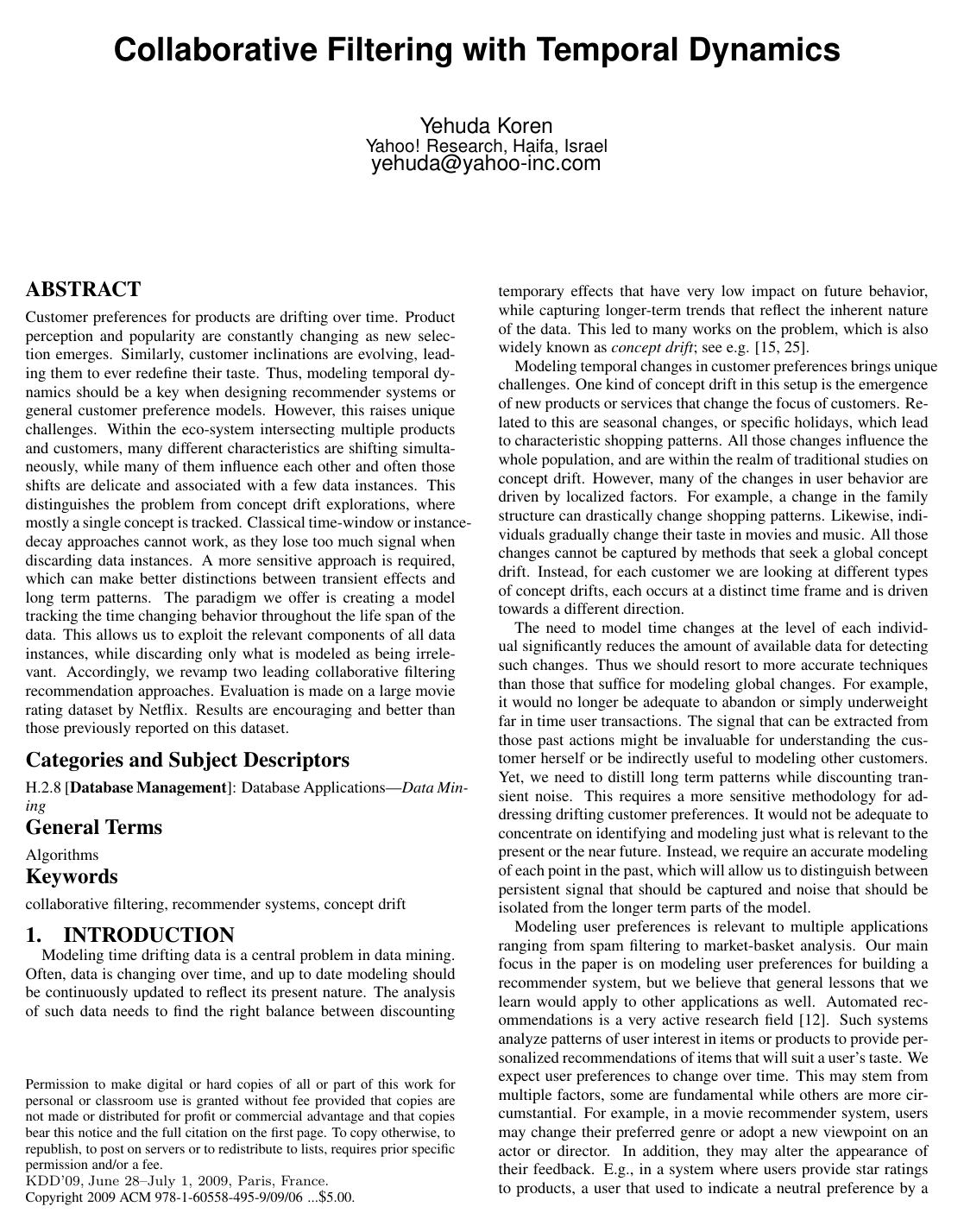
Collaborative filtering with temporal dynamics
Yehuda Koren
Why you should read this
Demonstrates how modeling the drift of user preferences and item biases over time is essential for high-accuracy predictions.
Customer preferences for products are drifting over time. Product perception and popularity are constantly changing as new selection emerges. Similarly, customer inclinations are evolving, leading them to ever redefine their taste. Thus, modeling temporal dynamics should be a key when designing recommender systems or general customer preference models. However, this raises unique challenges. Within the eco-system intersecting multiple products and customers, many different characteristics are shifting simultaneously, while many of them influence each other and often those shifts are delicate and associated with a few data instances. This distinguishes the problem from concept drift explorations, where mostly a single concept is tracked. Classical time-window or instance-decay approaches cannot work, as they lose too much signal when discarding data instances. A more sensitive approach is required, which can make better distinctions between transient effects and long term patterns. The paradigm we offer is creating a model tracking the time changing behavior throughout the life span of the data. This allows us to exploit the relevant components of all data instances, while discarding only what is modeled as being irrelevant. Accordingly, we revamp two leading collaborative filtering recommendation approaches. Evaluation is made on a large movie rating dataset by Netflix. Results are encouraging and better than those previously reported on this dataset.
Added
2026-01-25
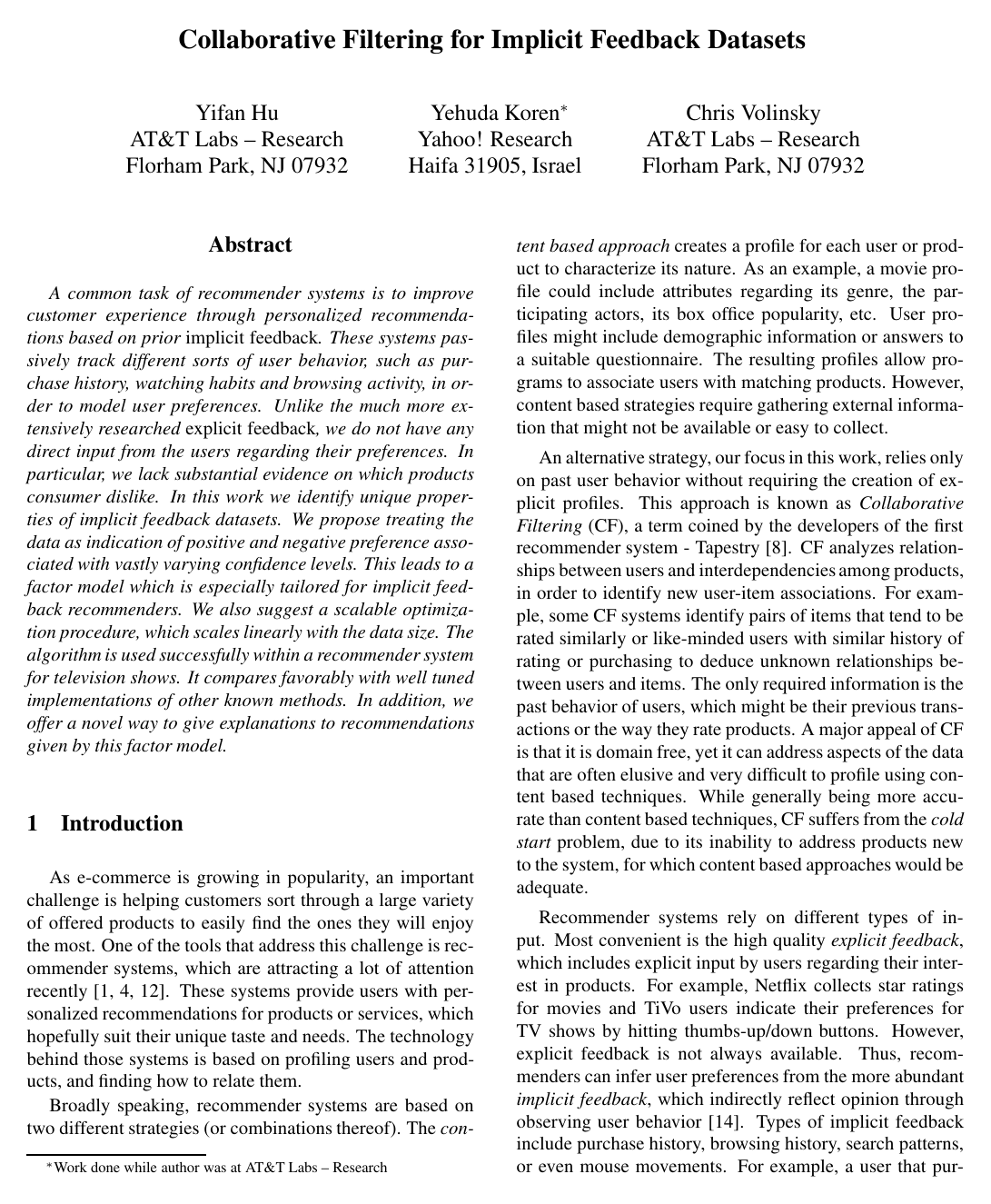
Collaborative Filtering for Implicit Feedback Datasets
Yifan Hu, Yehuda Koren, Chris Volinsky
Why you should read this
Solves the critical problem of learning user preferences from binary signals (clicks/views) using a weighted alternating least squares algorithm.
A common task of recommender systems is to improve customer experience through personalized recommendations based on prior implicit feedback. These systems passively track different sorts of user behavior, such as purchase history, watching habits and browsing activity, in order to model user preferences. Unlike the much more extensively researched explicit feedback, we do not have any direct input from the users regarding their preferences. In particular, we lack substantial evidence on which products consumer dislike. In this work we identify unique properties of implicit feedback datasets. We propose treating the data as indication of positive and negative preference associated with vastly varying confidence levels. This leads to a factor model which is especially tailored for implicit feedback recommenders. We also suggest a scalable optimization procedure, which scales linearly with the data size. The algorithm is used successfully within a recommender system for television shows. It compares favorably with well tuned implementations of other known methods. In addition, we offer a novel way to give explanations to recommendations given by this factor model.
Added
2026-01-25