
keyword
Natural language instructions
Natural language instructions are human-readable textual directives, prompts, or task specifications expressed in everyday human language that guide an artificial intelligence system to perform a desired task or achieve a specific objective. Unlike formal programming code, fixed parameter configurations, or mathematical representations, these instructions describe intended behaviors, operational constraints, and expected output formats in conventional written text. In modern machine learning, natural language instructions enable models, including large language models and embodied agents, to adapt and generalize to novel tasks in zero-shot and few-shot settings without requiring task-specific architectural redesigns. They serve as a foundational mechanism for aligning computational systems with user intent, controlling generative outputs, guiding conversational interactions, and coordinating decision-making or physical actions across diverse environments.
8 items
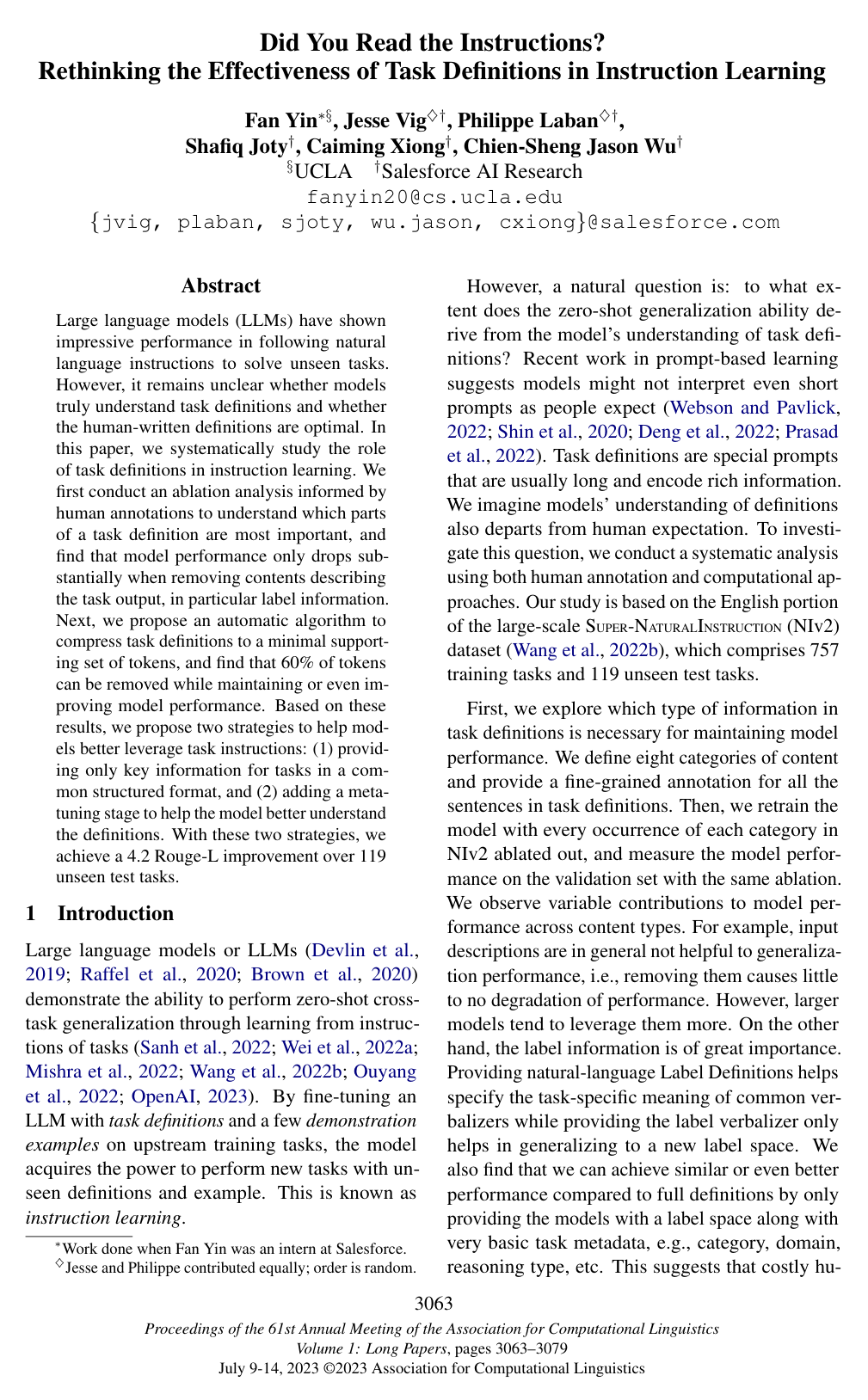
Did You Read the Instructions? Rethinking the Effectiveness of Task Definitions in Instruction Learning
Fan Yin, Jesse Vig, Philippe Laban, Shafiq Joty, Caiming Xiong, Chien-Sheng Wu
Why you should read this
Reveals that language models ignore most natural-language task definition content beyond output label specifications, and introduces structured prompting and meta-tuning strategies that significantly boost generalization on unseen tasks while cutting instruction length by over half.
Large language models (LLMs) have shown impressive performance in following natural language instructions to solve unseen tasks. However, it remains unclear whether models truly understand task definitions and whether the human-written definitions are optimal. In this paper, we systematically study the role of task definitions in instruction learning. We first conduct an ablation analysis informed by human annotations to understand which parts of a task definition are most important, and find that model performance only drops substantially when removing contents describing the task output, in particular label information. Next, we propose an automatic algorithm to compress task definitions to a minimal supporting set of tokens, and find that 60% of tokens can be removed while maintaining or even improving model performance. Based on these results, we propose two strategies to help models better leverage task instructions: (1) providing only key information for tasks in a common structured format, and (2) adding a meta-tuning stage to help the model better understand the definitions. With these two strategies, we achieve a 4.2 Rouge-L improvement over 119 unseen test tasks.
Added
2026-10-03
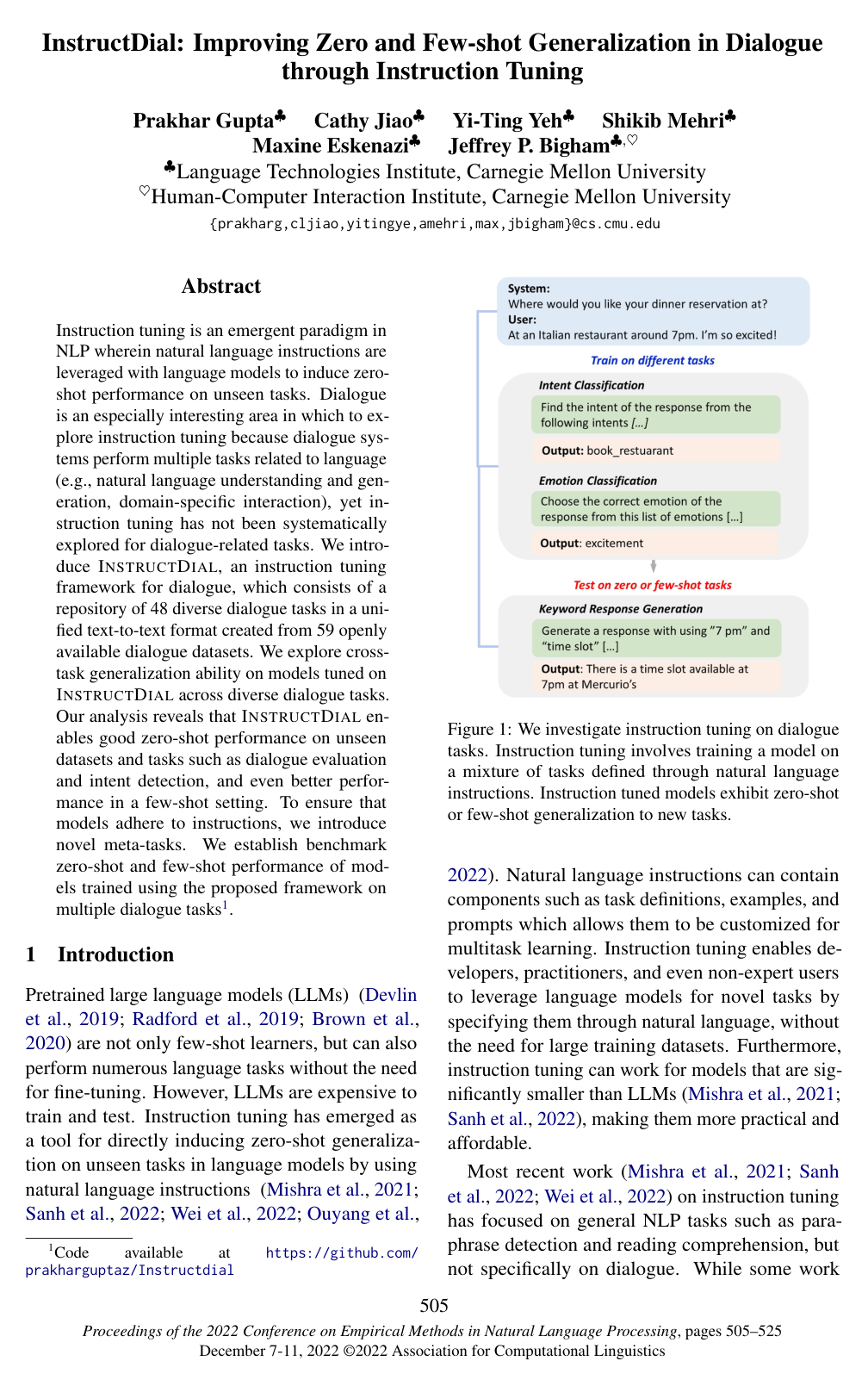
InstructDial: Improving Zero and Few-shot Generalization in Dialogue through Instruction Tuning
Prakhar Gupta, Cathy Jiao, Yi-Ting Yeh, Shikib Mehri, Maxine Eskénazi, Jeffrey P. Bigham
Why you should read this
Introduces an instruction-tuning framework unifying 48 dialogue tasks across 59 datasets, establishing benchmarks that boost zero- and few-shot cross-task generalization while incorporating novel meta-tasks to ensure instruction adherence.
Instruction tuning is an emergent paradigm in NLP wherein natural language instructions are leveraged with language models to induce zero-shot performance on unseen tasks. Dialogue is an especially interesting area in which to explore instruction tuning because dialogue systems perform multiple tasks related to language (e.g., natural language understanding and generation, domain-specific interaction), yet instruction tuning has not been systematically explored for dialogue-related tasks. We introduce InstructDial, an instruction tuning framework for dialogue, which consists of a repository of 48 diverse dialogue tasks in a unified text-to-text format created from 59 openly available dialogue datasets. We explore cross-task generalization ability on models tuned on InstructDial across diverse dialogue tasks. Our analysis reveals that InstructDial enables good zero-shot performance on unseen datasets and tasks such as dialogue evaluation and intent detection, and even better performance in a few-shot setting. To ensure that models adhere to instructions, we introduce novel meta-tasks. We establish benchmark zero-shot and few-shot performance of models trained using the proposed framework on multiple dialogue tasks¹.
Added
2026-10-03
Core Challenges in Embodied Vision-Language Planning
Jonathan Francis, Nariaki Kitamura, Felix Labelle, Xiaopeng Lu, Ingrid Navarro, Jean Oh
Why you should read this
Presents a unifying taxonomy and comparative review of embodied vision-language planning methods, benchmarks, and simulation environments to clarify critical open challenges for deploying interactive agents in the physical world.
Recent advances in the areas of multimodal machine learning and artificial intelligence (AI) have led to the development of challenging tasks at the intersection of Computer Vision, Natural Language Processing, and Embodied AI. Whereas many approaches and previous survey pursuits have characterised one or two of these dimensions, there has not been a holistic analysis at the center of all three. Moreover, even when combinations of these topics are considered, more focus is placed on describing, e.g., current architectural methods, as opposed to also illustrating high-level challenges and opportunities for the field. In this survey paper, we discuss Embodied Vision-Language Planning (EVLP) tasks, a family of prominent embodied navigation and manipulation problems that jointly use computer vision and natural language. We propose a taxonomy to unify these tasks and provide an in-depth analysis and comparison of the new and current algorithmic approaches, metrics, simulated environments, as well as the datasets used for EVLP tasks. Finally, we present the core challenges that we believe new EVLP works should seek to address, and we advocate for task construction that enables model generalizability and furthers real-world deployment.
Added
2026-10-03
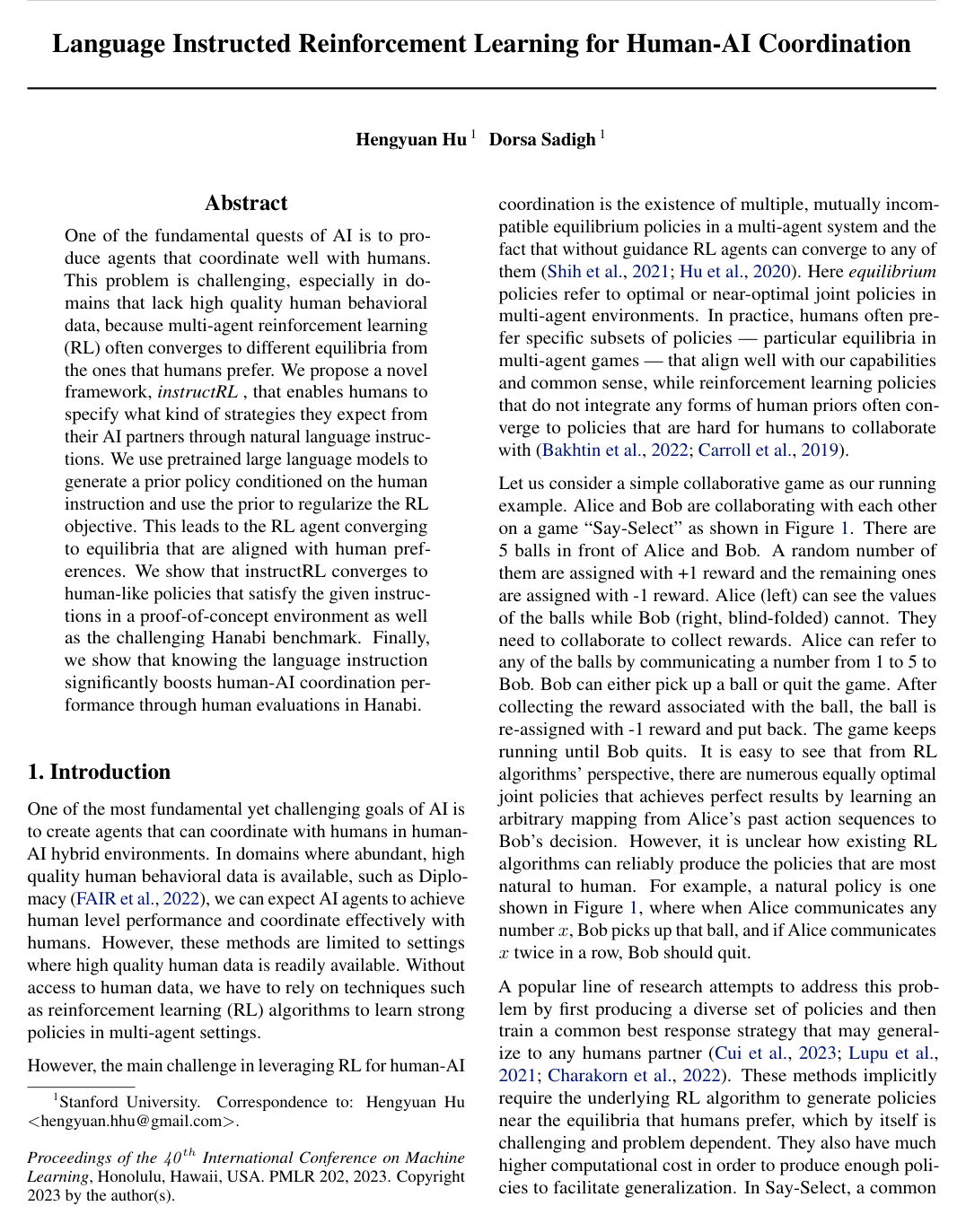
Language Instructed Reinforcement Learning for Human-AI Coordination
Hengyuan Hu, Dorsa Sadigh
Why you should read this
Proposes instructRL, a framework that uses pretrained large language models to turn natural language instructions into prior policies that guide multi-agent reinforcement learning toward human-compatible equilibria without requiring human demonstration data.
Added
2026-10-02
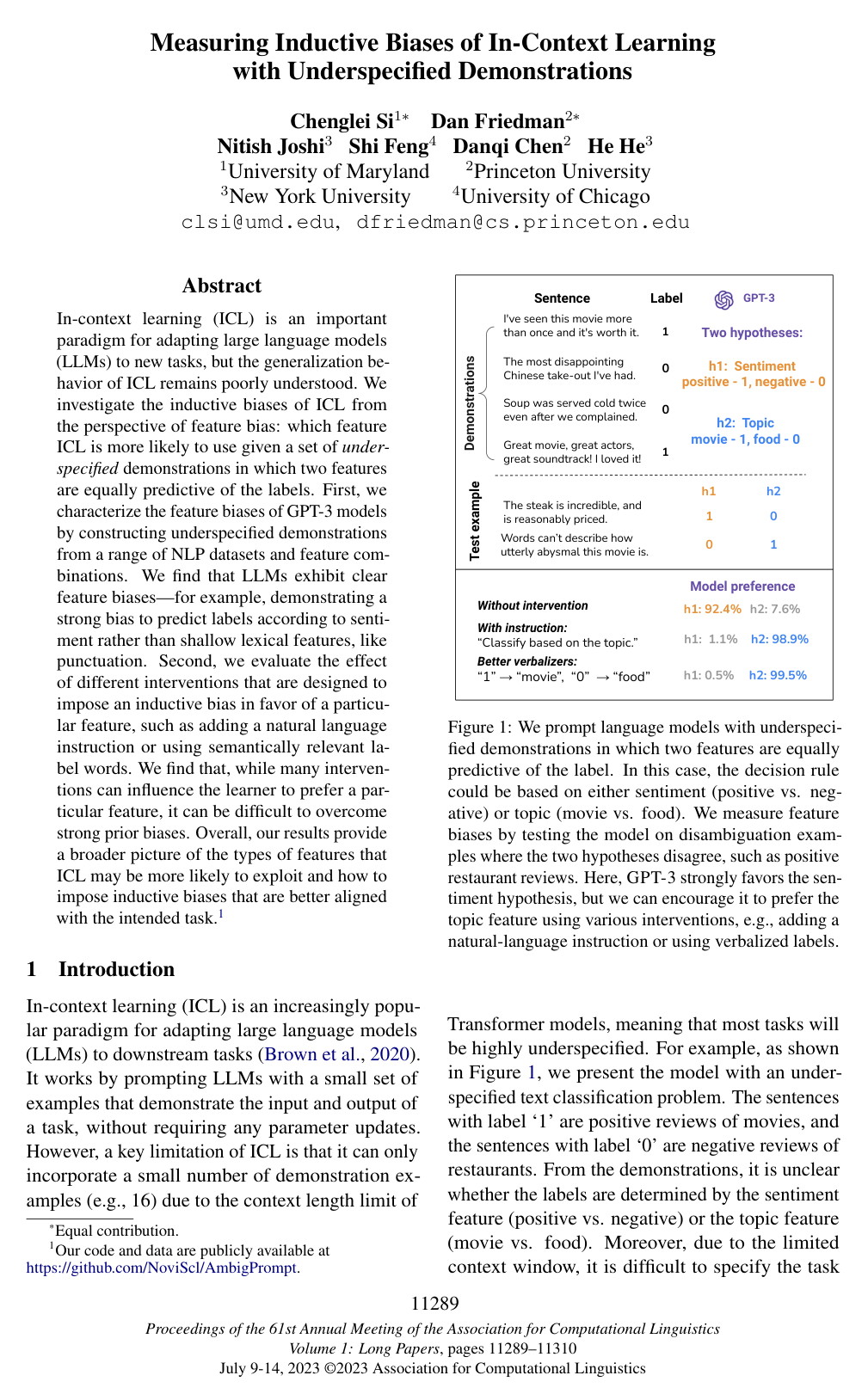
Measuring Inductive Biases of In-Context Learning with Underspecified Demonstrations
Chenglei Si, Dan Friedman, Nitish Joshi, Shi Feng, Danqi Chen, He He
Why you should read this
Reveals how large language models resolve ambiguous in-context demonstrations by favoring semantic features over shallow lexical cues and evaluates the limits of prompt interventions in steering models away from their default feature biases.
In-context learning (ICL) is an important paradigm for adapting large language models (LLMs) to new tasks, but the generalization behavior of ICL remains poorly understood. We investigate the inductive biases of ICL from the perspective of feature bias: which feature ICL is more likely to use given a set of under-specified demonstrations in which two features are equally predictive of the labels. First, we characterize the feature biases of GPT-3 models by constructing underspecified demonstrations from a range of NLP datasets and feature combinations. We find that LLMs exhibit clear feature biases—for example, demonstrating a strong bias to predict labels according to sentiment rather than shallow lexical features, like punctuation. Second, we evaluate the effect of different interventions that are designed to impose an inductive bias in favor of a particular feature, such as adding a natural language instruction or using semantically relevant label words. We find that, while many interventions can influence the learner to prefer a particular feature, it can be difficult to overcome strong prior biases. Overall, our results provide a broader picture of the types of features that ICL may be more likely to exploit and how to impose inductive biases that are better aligned with the intended task.
Added
2026-09-26
Controlled Text Generation with Natural Language Instructions
Wangchunshu Zhou, Yuchen Eleanor Jiang, Ethan Wilcox, Ryan Cotterell, Mrinmaya Sachan
Why you should read this
Introduces INSTRUCTCTG, a training-time framework that verbalizes diverse lexical, syntactic, semantic, style, and length constraints into natural language prompts to control text generation efficiently without modifying decoding algorithms.
Large language models can be prompted to produce fluent output for a wide range of tasks without being specifically trained to do so. Nevertheless, it is notoriously difficult to control their generation in such a way that it satisfies user-specified constraints. In this paper, we present INSTRUCTCTG, a simple controlled text generation framework that incorporates different constraints by verbalizing them as natural language instructions. We annotate natural texts through a combination of off-the-shelf NLP tools and simple heuristics with the linguistic and extra-linguistic constraints they satisfy. Then, we verbalize the constraints into natural language instructions to form weakly supervised training data, i.e., we prepend the natural language verbalizations of the constraints in front of their corresponding natural language sentences. Next, we fine-tune a pre-trained language model on the augmented corpus. Compared to existing methods, INSTRUCTCTG is more flexible in terms of the types of constraints it allows the practitioner to use. It also does not require any modification of the decoding procedure. Finally, INSTRUCTCTG allows the model to adapt to new constraints without re-training through the use of in-context learning. Our code is available at https://github.com/MichaelZhouwang/InstructCTG.
Added
2026-09-26
Large Language Models Are Human-Level Prompt Engineers
Yongchao Zhou, Andrei Ioan Muresanu, Ziwen Han, Keiran Paster, Silviu Pitis, Harris Chan, Jimmy Ba
Why you should read this
Proposes Automatic Prompt Engineer, a method that treats instructions as programs to automatically generate and optimize prompts that match or outperform human-crafted baselines across diverse natural language processing tasks.
By conditioning on natural language instructions, large language models (LLMs) have displayed impressive capabilities as general-purpose computers. However, task performance depends significantly on the quality of the prompt used to steer the model, and most effective prompts have been handcrafted by humans. Inspired by classical program synthesis and the human approach to prompt engineering, we propose Automatic Prompt Engineer (APE) for automatic instruction generation and selection. In our method, we treat the instruction as the "program," optimized by searching over a pool of instruction candidates proposed by an LLM in order to maximize a chosen score function. To evaluate the quality of the selected instruction, we evaluate the zero-shot performance of another LLM following the selected instruction. Experiments on 24 NLP tasks show that our automatically generated instructions outperform the prior LLM baseline by a large margin and achieve better or comparable performance to the instructions generated by human annotators on 19/24 tasks. We conduct extensive qualitative and quantitative analyses to explore the performance of APE. We show that APE-engineered prompts can be applied to steer models toward truthfulness and/or informativeness, as well as to improve few-shot learning performance by simply prepending them to standard in-context learning prompts. Please check out our webpage at this https URL.
Added
2026-09-24
Training language models to follow instructions with human feedback
Long Ouyang, Jeff Wu, Xu Jiang, Diogo Almeida, Carroll L. Wainwright, Pamela Mishkin, Chong Zhang, Sandhini Agarwal, Katarina Slama, Alex Ray, John Schulman, Jacob Hilton, Fraser Kelton, Luke Miller, Maddie Simens, Amanda Askell, Peter Welinder, Paul Christiano, Jan Leike, Ryan Lowe
Why you should read this
Demonstrates how fine-tuning language models with human feedback can produce significantly more aligned, truthful, and less toxic outputs, even with substantially fewer parameters, drastically improving their practical utility.
Making language models bigger does not inherently make them better at following a user's intent. For example, large language models can generate outputs that are untruthful, toxic, or simply not helpful to the user. In other words, these models are not aligned with their users. In this paper, we show an avenue for aligning language models with user intent on a wide range of tasks by fine-tuning with human feedback. Starting with a set of labeler-written prompts and prompts submitted through the OpenAI API, we collect a dataset of labeler demonstrations of the desired model behavior, which we use to fine-tune GPT-3 using supervised learning. We then collect a dataset of rankings of model outputs, which we use to further fine-tune this supervised model using reinforcement learning from human feedback. We call the resulting models InstructGPT. In human evaluations on our prompt distribution, outputs from the 1.3B parameter InstructGPT model are preferred to outputs from the 175B GPT-3, despite having 100x fewer parameters. Moreover, InstructGPT models show improvements in truthfulness and reductions in toxic output generation while having minimal performance regressions on public NLP datasets. Even though InstructGPT still makes simple mistakes, our results show that fine-tuning with human feedback is a promising direction for aligning language models with human intent.
Added
2026-03-23
License
Published with permission