
keyword
natural language generation
Natural language generation is a subfield of artificial intelligence and natural language processing focused on the computational production of coherent, fluent, and meaningful human language text from various input sources. These systems convert non-linguistic data, such as structured tables and images, as well as linguistic inputs into well-formed natural prose. Predominantly driven by deep learning and sequence-to-sequence language models, natural language generation powers diverse applications, including abstractive summarization, conversational agents, machine translation, and generative question answering. Core areas of development within the field center on enhancing output fluency, maintaining factual consistency with source data, adhering to task-specific constraints, and developing reliable metrics to evaluate generated text quality.
23 items
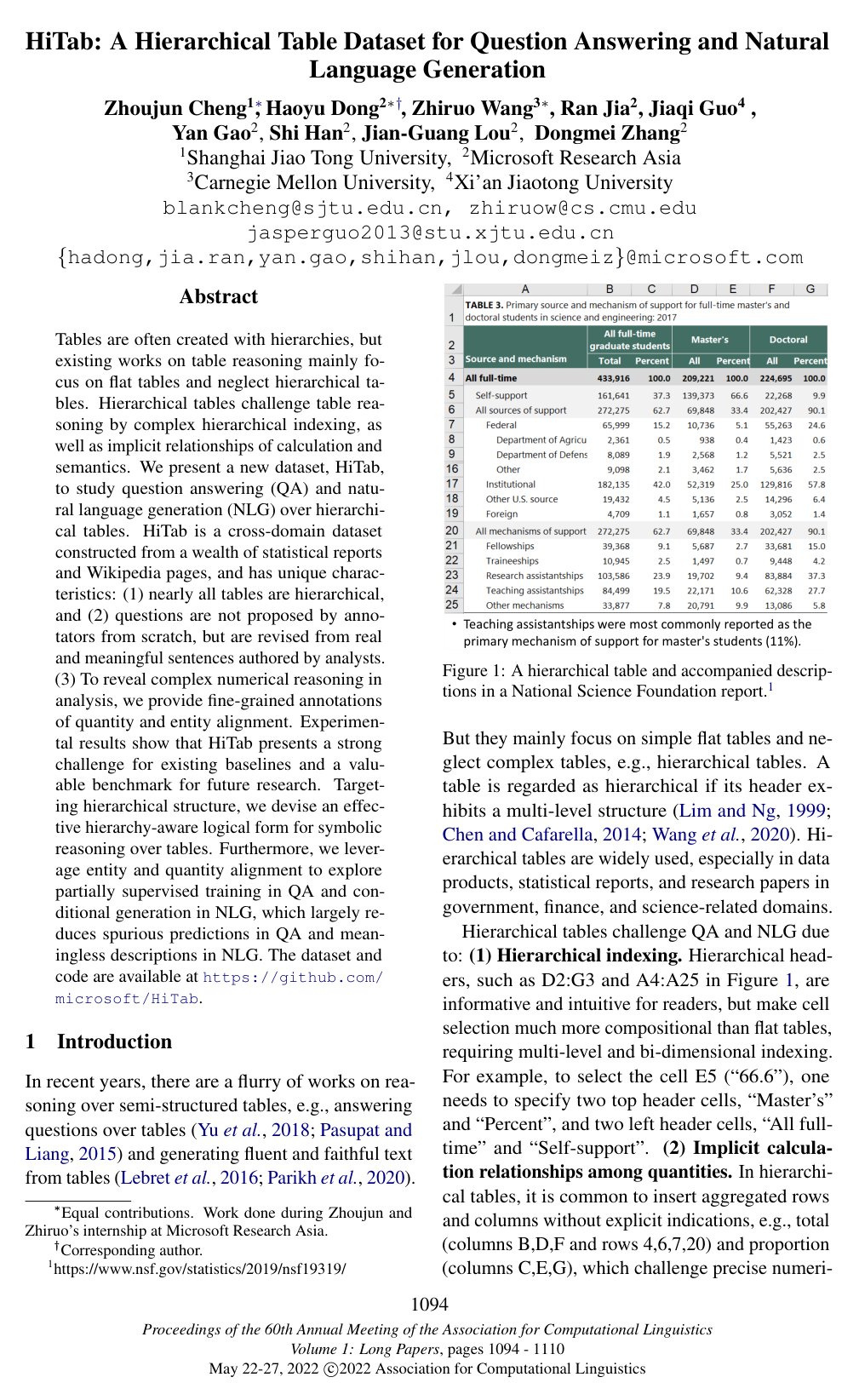
HiTab: A Hierarchical Table Dataset for Question Answering and Natural Language Generation
Zhoujun Cheng, Haoyu Dong, Zhiruo Wang, Ran Jia, Jiaqi Guo, Yan Gao, Shi Han, Jian-Guang Lou, Dongmei Zhang
Why you should read this
Introduces HiTab, a cross-domain benchmark derived from statistical reports with fine-grained entity and quantity alignments to advance numerical reasoning, question answering, and text generation over complex hierarchical tables.
Tables are often created with hierarchies, but existing works on table reasoning mainly focus on flat tables and neglect hierarchical tables. Hierarchical tables challenge table reasoning by complex hierarchical indexing, as well as implicit relationships of calculation and semantics. We present a new dataset, HiTab, to study question answering (QA) and natural language generation (NLG) over hierarchical tables. HiTab is a cross-domain dataset constructed from a wealth of statistical reports and Wikipedia pages, and has unique characteristics: (1) nearly all tables are hierarchical, and (2) questions are not proposed by annotators from scratch, but are revised from real and meaningful sentences authored by analysts. (3) To reveal complex numerical reasoning in analysis, we provide fine-grained annotations of quantity and entity alignment. Experimental results show that HiTab presents a strong challenge for existing baselines and a valuable benchmark for future research. Targeting hierarchical structure, we devise an effective hierarchy-aware logical form for symbolic reasoning over tables. Furthermore, we leverage entity and quantity alignment to explore partially supervised training in QA and conditional generation in NLG, which largely reduces spurious predictions in QA and meaningless descriptions in NLG. The dataset and code are available at https://github.com/microsoft/HiTab.
Added
2026-10-05
EditEval: An Instruction-Based Benchmark for Text Improvements
Jane Dwivedi-Yu, Timo Schick, Zhengbao Jiang, Maria Lomeli, Patrick Lewis, Gautier Izacard, Edouard Grave, Sebastian Riedel, Fabio Petroni
Why you should read this
Introduces EditEval, an instruction-based benchmark to assess how language models perform modular text-editing tasks like factual updates and tone neutralization, exposing critical performance gaps and metric inconsistencies in iterative text revision.
Evaluation of text generation to date has primarily focused on content created sequentially, rather than improvements on a piece of text. Writing, however, is naturally an iterative and incremental process that requires expertise in different modular skills such as fixing outdated information or making the style more consistent. Even so, comprehensive evaluation of a model's capacity to perform these skills and the ability to edit remains sparse. This work presents EditEval: An instruction-based, benchmark and evaluation suite that leverages high-quality existing and new datasets for automatic evaluation of editing capabilities such as making text more cohesive and paraphrasing. We evaluate several pre-trained models, which shows that InstructGPT and PEER perform the best, but that most baselines fall below the supervised SOTA, particularly when neutralizing and updating information. Our analysis also shows that commonly used metrics for editing tasks do not always correlate well, and that optimization for prompts with the highest performance does not necessarily entail the strongest robustness to different models. Through the release of this benchmark and a publicly available leaderboard challenge, we hope to unlock future research in developing models capable of iterative and more controllable editing.
Added
2026-10-05

DialogVED: A Pre-trained Latent Variable Encoder-Decoder Model for Dialog Response Generation
Wei Chen, Yeyun Gong, Song Wang, Bolun Yao, Weizhen Qi, Zhongyu Wei, Xiaowu Hu, Bartuer Zhou, Yi Mao, Weizhu Chen, Biao Cheng, Nan Duan
Why you should read this
Proposes a pre-trained dialogue model that integrates continuous latent variables into an encoder-decoder architecture to resolve the one-to-many response problem, achieving state-of-the-art response diversity and relevance across PersonaChat, DailyDialog, and DSTC7-AVSD benchmarks.
Dialog response generation in open domain is an important research topic where the main challenge is to generate relevant and diverse responses. In this paper, we propose a new dialog pre-training framework called DialogVED, which introduces continuous latent variables into the enhanced encoder-decoder pre-training framework to increase the relevance and diversity of responses. With the help of a large dialog corpus (Reddit), we pre-train the model using the following 4 tasks, used in training language models (LMs) and Variational Autoencoders (VAEs) literature: 1) masked language model; 2) response generation; 3) bag-of-words prediction; and 4) KL divergence reduction. We also add additional parameters to model the turn structure in dialogs to improve the performance of the pre-trained model. We conduct experiments on PersonaChat, DailyDialog, and DSTC7-AVSD benchmarks for response generation. Experimental results show that our model achieves the new state-of-the-art results on all these datasets.
Added
2026-10-03
On the Blind Spots of Model-Based Evaluation Metrics for Text Generation
Tianxing He, Jingyu Zhang, Tianle Wang, Sachin Kumar, Kyunghyun Cho, James R. Glass, Yulia Tsvetkov
Why you should read this
Exposes critical failure modes in popular pretrained language model-based evaluation metrics like BERTScore and MAUVE using synthetic stress tests, while providing practical workarounds to ensure more reliable text generation assessment.
In this work, we study the blind spots of model-based evaluation metrics for text generation. We first analyze the behaviors of model-based metrics under adversarial perturbations and find that they are vulnerable to adversarial attacks. We then show that the blind spots are caused by the fact that model-based metrics are trained on the same data distribution as the generation models. We further propose a simple method to mitigate the blind spots by training the metric on a different data distribution. Experiments on multiple text generation tasks demonstrate the effectiveness of our method.
Added
2026-10-03
Scoring Rules! Statistical and Strategic Alignment for Text Evaluation Metrics
Shengwei Xu, Yuxuan Lu, Yifan Wu, Jason D. Hartline, Grant Schoenebeck
Why you should read this
Demonstrates that popular LLM-as-a-judge evaluation metrics can be easily gamed despite high human correlation, introducing a mutual-information design framework that produces scoring rules resistant to strategic manipulation.
Reference-based text evaluation metrics, which are widely used to assess natural language generation systems, score a candidate response by comparing it with a reference response. The reliability of an evaluation metric is usually judged by its statistical correlation with human ratings. However, as these metrics are increasingly used as optimization objectives, correlation alone is no longer sufficient: agents may strategically game the evaluation metric. We study this issue through two complementary notions of alignment. A metric is statistically aligned if it correlates with human ratings and strategically aligned if it resists perturbations that do not add task-relevant information. We make two contributions. First, we propose test principles for reference-based metrics consisting of human-rating correlation, degradation sensitivity, and manipulation robustness. These principles evaluate whether a metric agrees with human judgments, penalizes low-effort information loss, and resists strategic score inflation. Second, we develop a unified design framework for mutual-information-based metrics that decomposes existing and new metrics into four choices: information measure, estimation method, text representation, and prediction mechanism. Across peer review, summarization, and question answering, we find that strong human-rating correlation does not imply strategic alignment: LLM-as-a-Judge achieves high correlation but is susceptible to manipulation. In contrast, mutual-information-based metrics substantially improve manipulation robustness. Our framework also uncovers a new metric that achieves the strongest overall robustness in our experiments while remaining competitive on human-rating correlation.
Added
2026-09-29
NeuroLogic A*esque Decoding: Constrained Text Generation with Lookahead Heuristics
Ximing Lu, Sean Welleck, Peter West, Liwei Jiang, Jungo Kasai, Daniel Khashabi, Ronan Le Bras, Lianhui Qin, Youngjae Yu, Rowan Zellers, Noah A. Smith, Yejin Choi
Why you should read this
Proposes an A*-inspired decoding algorithm with efficient lookahead heuristics that enables autoregressive language models to satisfy complex lexical constraints and achieve state-of-the-art performance across multiple text generation benchmarks without task-specific training data.
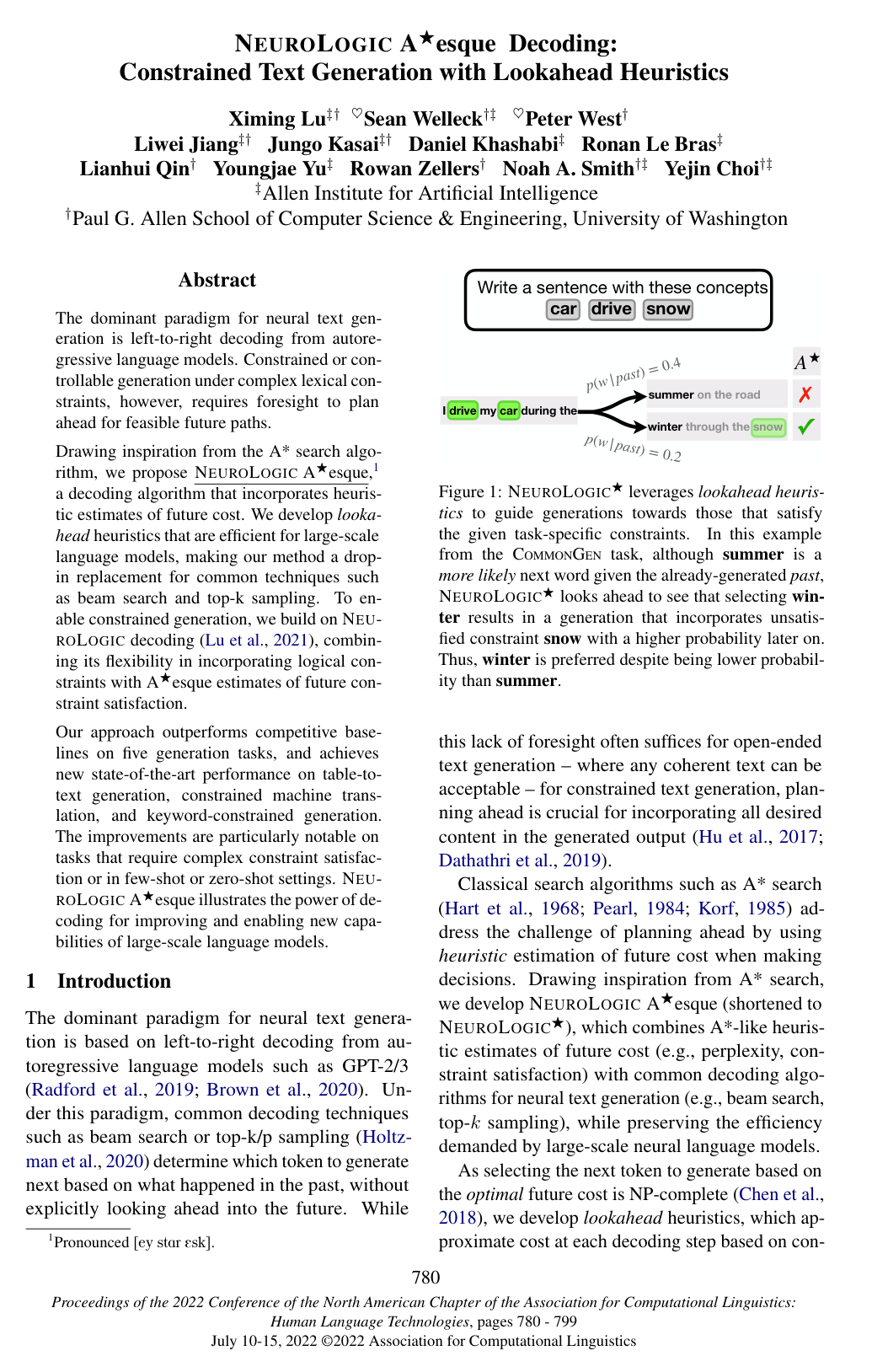
The dominant paradigm for neural text generation is left-to-right decoding from autoregressive language models. Constrained or controllable generation under complex lexical constraints, however, requires foresight to plan ahead for feasible future paths. Drawing inspiration from the A* search algorithm, we propose NEUROLOGIC A★esque,1 a decoding algorithm that incorporates heuristic estimates of future cost. We develop lookahead heuristics that are efficient for large-scale language models, making our method a drop-in replacement for common techniques such as beam search and top-k sampling. To enable constrained generation, we build on NEUROLOGIC decoding (Lu et al., 2021), combining its flexibility in incorporating logical constraints with A★esque estimates of future constraint satisfaction. Our approach outperforms competitive baselines on five generation tasks, and achieves new state-of-the-art performance on table-to-text generation, constrained machine translation, and keyword-constrained generation. The improvements are particularly notable on tasks that require complex constraint satisfaction or in few-shot or zero-shot settings. NEUROLOGIC A★esque illustrates the power of decoding for improving and enabling new capabilities of large-scale language models.
Added
2026-09-28
BRIO: Bringing Order to Abstractive Summarization
Yixin Liu, Pengfei Liu, Dragomir R. Radev, Graham Neubig
Why you should read this
Introduces a contrastive training paradigm that coordinates model probabilities with candidate summary quality to overcome exposure bias and achieve state-of-the-art abstractive summarization performance on CNN/DailyMail and XSum.
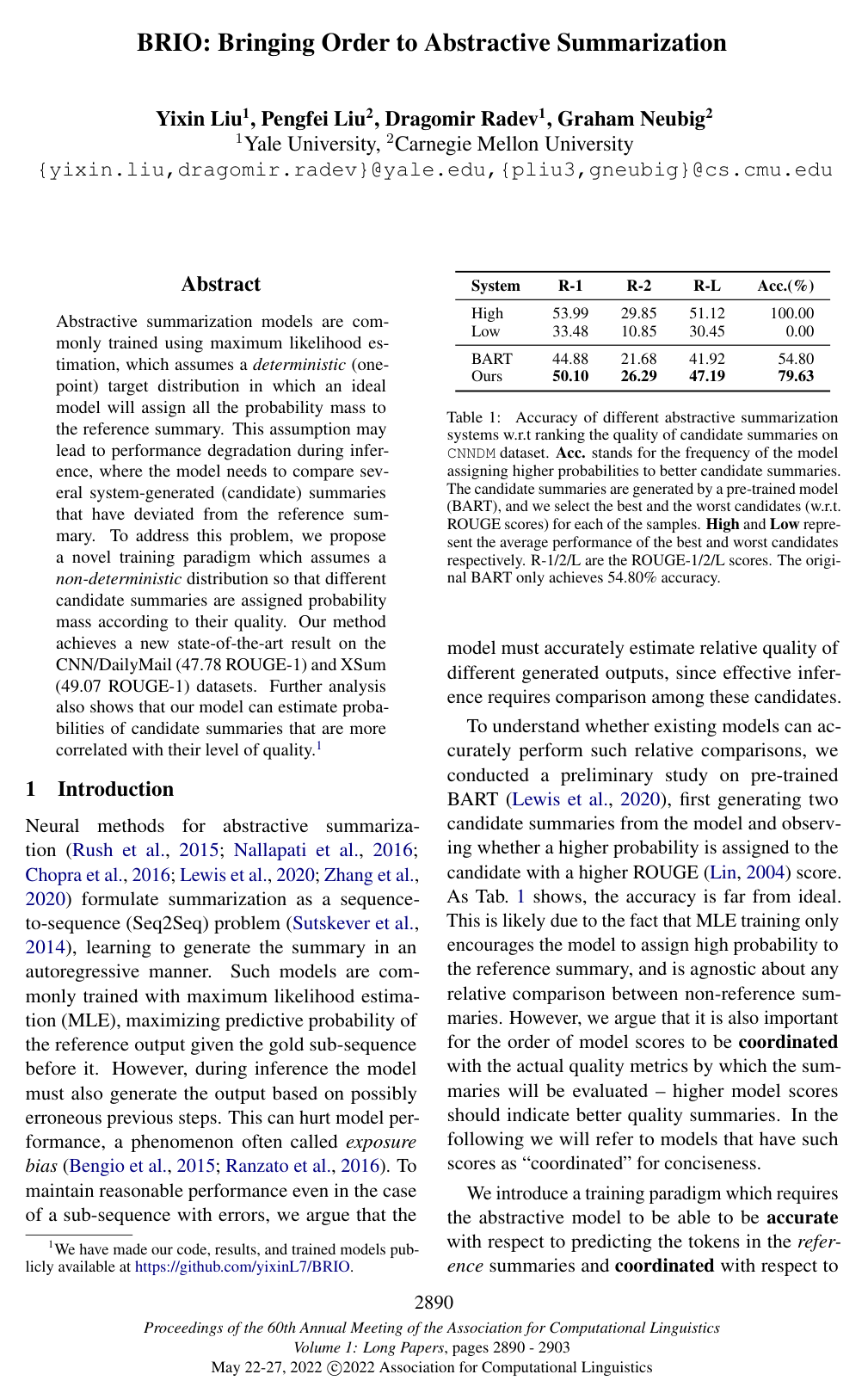
Abstractive summarization models are commonly trained using maximum likelihood estimation, which assumes a deterministic (one-point) target distribution in which an ideal model will assign all the probability mass to the reference summary. This assumption may lead to performance degradation during inference, where the model needs to compare several system-generated (candidate) summaries that have deviated from the reference summary. To address this problem, we propose a novel training paradigm which assumes a non-deterministic distribution so that different candidate summaries are assigned probability mass according to their quality. Our method achieves a new state-of-the-art result on the CNN/DailyMail (47.78 ROUGE-1) and XSum (49.07 ROUGE-1) datasets. Further analysis also shows that our model can estimate probabilities of candidate summaries that are more correlated with their level of quality.¹
Added
2026-09-28
VisualGPT: Data-efficient Adaptation of Pretrained Language Models for Image Captioning
Jun Chen, Han Guo, Kai Yi, Boyang Li, Mohamed Elhoseiny
Why you should read this
Proposes a data-efficient adaptation framework for image captioning that balances pretrained language model knowledge with visual features via a self-resurrecting activation unit, outperforming baselines under extreme low-data regimes.
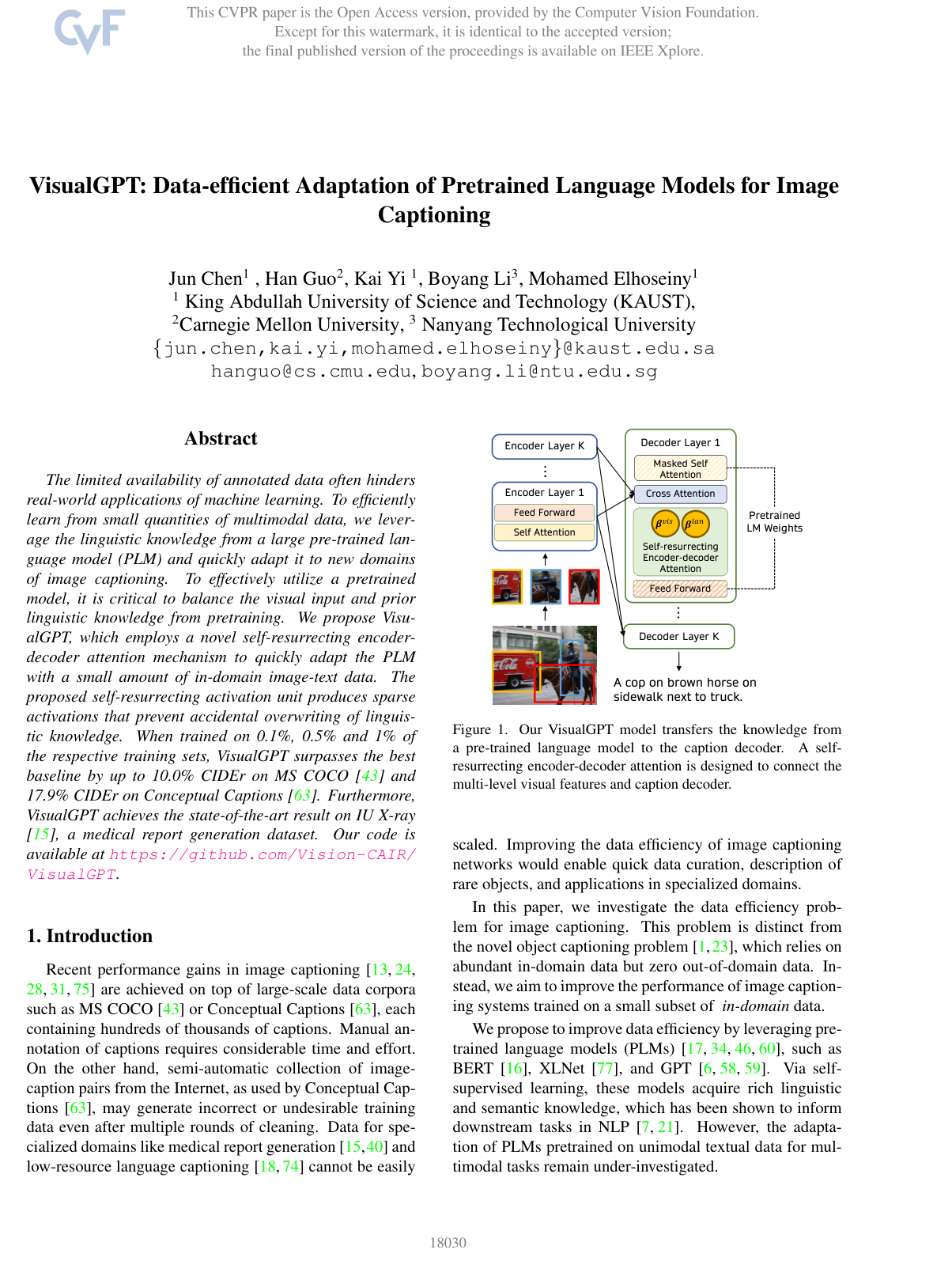
The limited availability of annotated data often hinders real-world applications of machine learning. To efficiently learn from small quantities of multimodal data, we leverage the linguistic knowledge from a large pre-trained language model (PLM) and quickly adapt it to new domains of image captioning. To effectively utilize a pretrained model, it is critical to balance the visual input and prior linguistic knowledge from pretraining. We propose VisualGPT, which employs a novel self-resurrecting encoder-decoder attention mechanism to quickly adapt the PLM with a small amount of in-domain image-text data. The proposed self-resurrecting activation unit produces sparse activations that prevent accidental overwriting of linguistic knowledge. When trained on 0.1%, 0.5% and 1% of the respective training sets, VisualGPT surpasses the best baseline by up to 10.0% CIDEr on MS COCO [43] and 17.9% CIDEr on Conceptual Captions [63]. Furthermore, VisualGPT achieves the state-of-the-art result on IU X-ray [15], a medical report generation dataset. Our code is available at https://github.com/Vision-CAIR/VisualGPT.
Added
2026-09-26
Generative Knowledge Graph Construction: A Review
Hongbin Ye, Ningyu Zhang, Hui Chen, Huajun Chen
Why you should read this
Presents a systematic taxonomy and critical analysis of sequence-to-sequence approaches for knowledge graph construction, comparing how different generation targets unify information extraction tasks across diverse benchmarks.
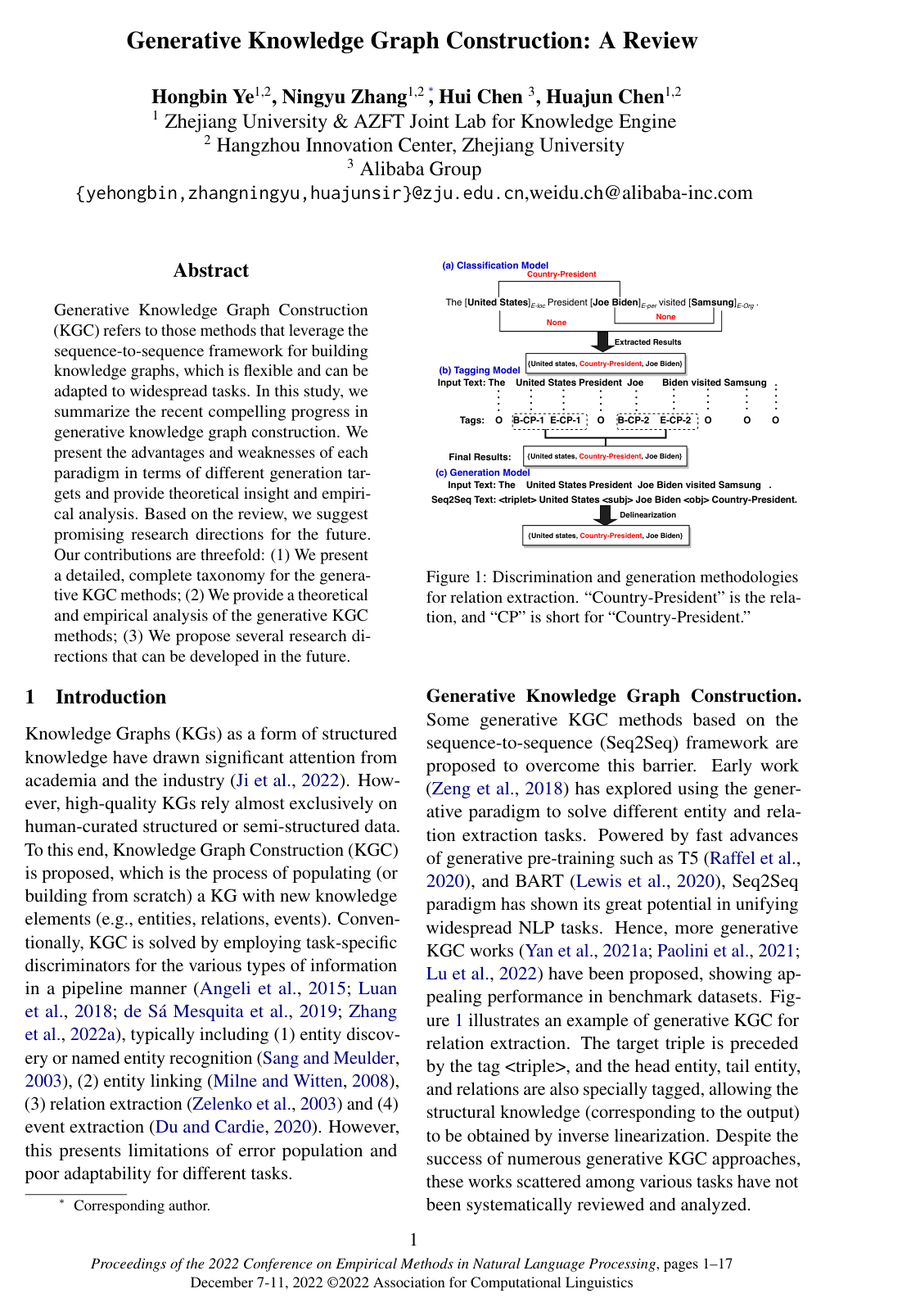
Generative Knowledge Graph Construction (KGC) refers to those methods that leverage the sequence-to-sequence framework for building knowledge graphs, which is flexible and can be adapted to widespread tasks. In this study, we summarize the recent compelling progress in generative knowledge graph construction. We present the advantages and weaknesses of each paradigm in terms of different generation targets and provide theoretical insight and empirical analysis. Based on the review, we suggest promising research directions for the future. Our contributions are threefold: (1) We present a detailed, complete taxonomy for the generative KGC methods; (2) We provide a theoretical and empirical analysis of the generative KGC methods; (3) We propose several research directions that can be developed in the future.
Added
2026-09-26
On the Limitations of Reference-Free Evaluations of Generated Text
Daniel Deutsch, Rotem Dror, Dan Roth
Why you should read this
Demonstrates that reference-free text evaluation metrics act as generation models themselves, exposing critical flaws where metrics favor models similar to their own architecture and penalize superior human-written outputs.
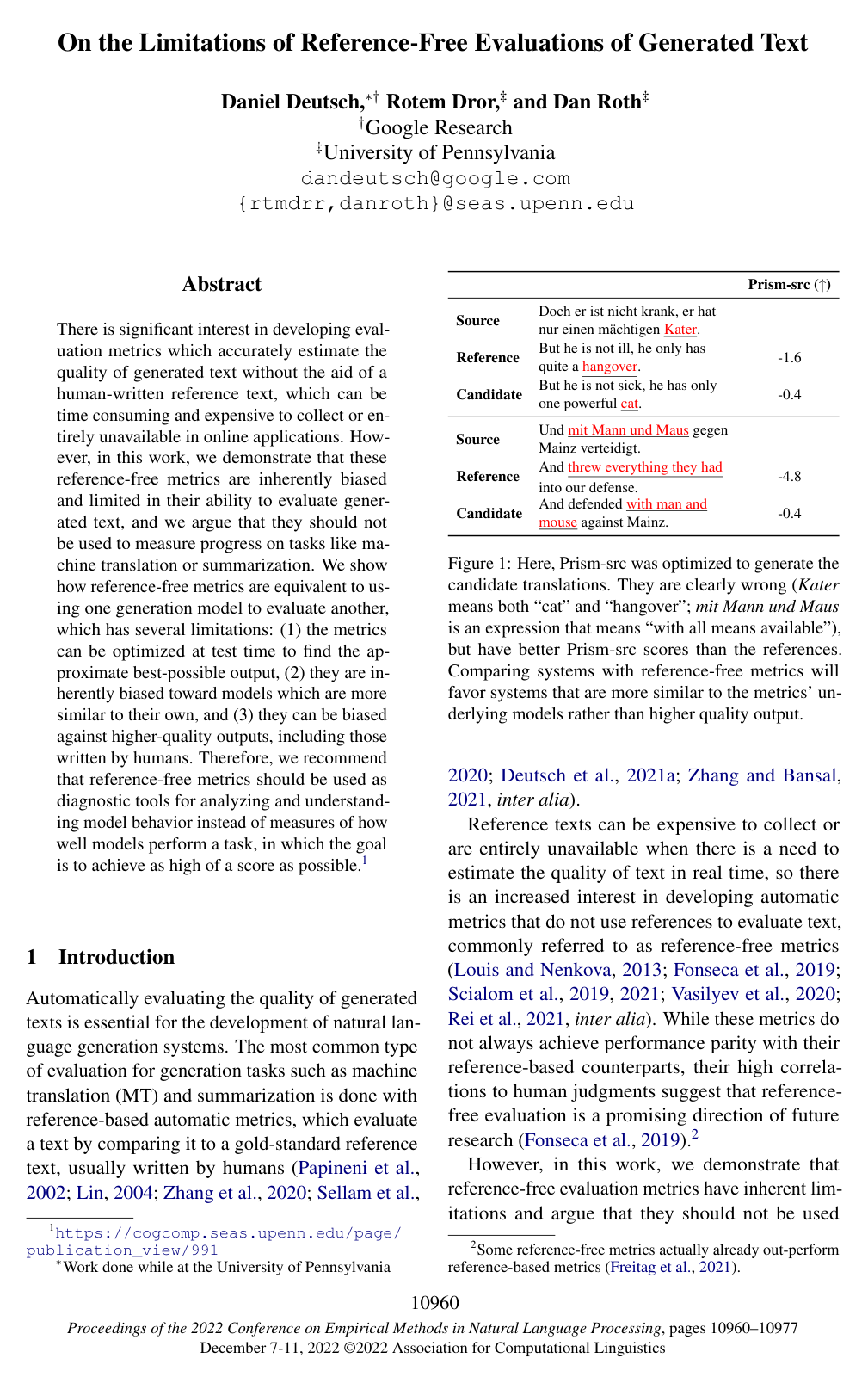
There is significant interest in developing evaluation metrics which accurately estimate the quality of generated text without the aid of a human-written reference text, which can be time consuming and expensive to collect or entirely unavailable in online applications. However, in this work, we demonstrate that these reference-free metrics are inherently biased and limited in their ability to evaluate generated text, and we argue that they should not be used to measure progress on tasks like machine translation or summarization. We show how reference-free metrics are equivalent to using one generation model to evaluate another, which has several limitations: (1) the metrics can be optimized at test time to find the approximate best-possible output, (2) they are inherently biased toward models which are more similar to their own, and (3) they can be biased against higher-quality outputs, including those written by humans. Therefore, we recommend that reference-free metrics should be used as diagnostic tools for analyzing and understanding model behavior instead of measures of how well models perform a task, in which the goal is to achieve as high of a score as possible.¹
Added
2026-09-26
SEAHORSE: A Multilingual, Multifaceted Dataset for Summarization Evaluation
Elizabeth Clark, Shruti Rijhwani, Sebastian Gehrmann, Joshua Maynez, Roee Aharoni, Vitaly Nikolaev, Thibault Sellam, Aditya Siddhant, Dipanjan Das, Ankur P. Parikh
Why you should read this
Introduces a massive dataset of 96,000 human-annotated summaries spanning six languages and six quality dimensions, providing an essential resource for training and benchmarking learned summarization metrics that generalize well to out-of-domain evaluation tasks.
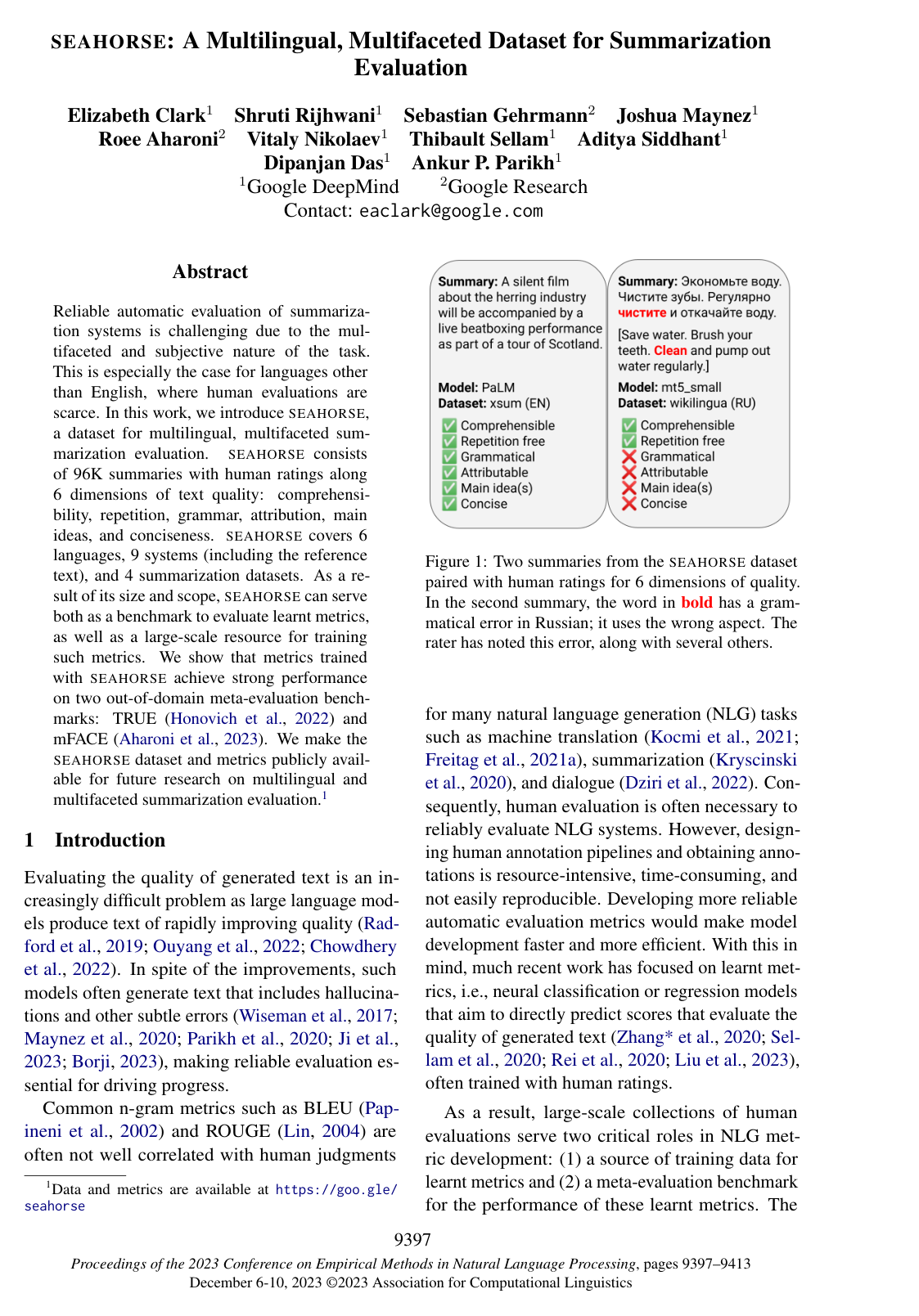
Reliable automatic evaluation of summarization systems is challenging due to the multifaceted and subjective nature of the task. This is especially the case for languages other than English, where human evaluations are scarce. In this work, we introduce SEAHORSE, a dataset for multilingual, multifaceted summarization evaluation. SEAHORSE consists of 96K summaries with human ratings along 6 dimensions of text quality: comprehensibility, repetition, grammar, attribution, main ideas, and conciseness. SEAHORSE covers 6 languages, 9 systems (including the reference text), and 4 summarization datasets. As a result of its size and scope, SEAHORSE can serve both as a benchmark to evaluate learnt metrics, as well as a large-scale resource for training such metrics. We show that metrics trained with SEAHORSE achieve strong performance on two out-of-domain meta-evaluation benchmarks: TRUE (Honovich et al., 2022) and mFACE (Aharoni et al., 2023). We make the SEAHORSE dataset and metrics publicly available for future research on multilingual and multifaceted summarization evaluation.1
Added
2026-09-26
Watermarking Conditional Text Generation for AI Detection: Unveiling Challenges and a Semantic-Aware Watermark Remedy
Yu Fu, Deyi Xiong, Yue Dong
Why you should read this
Presents a semantic-aware watermarking algorithm for conditional text generation that preserves output quality in summarization and data-to-text tasks by aligning green-list vocabulary partitions with input context embeddings.
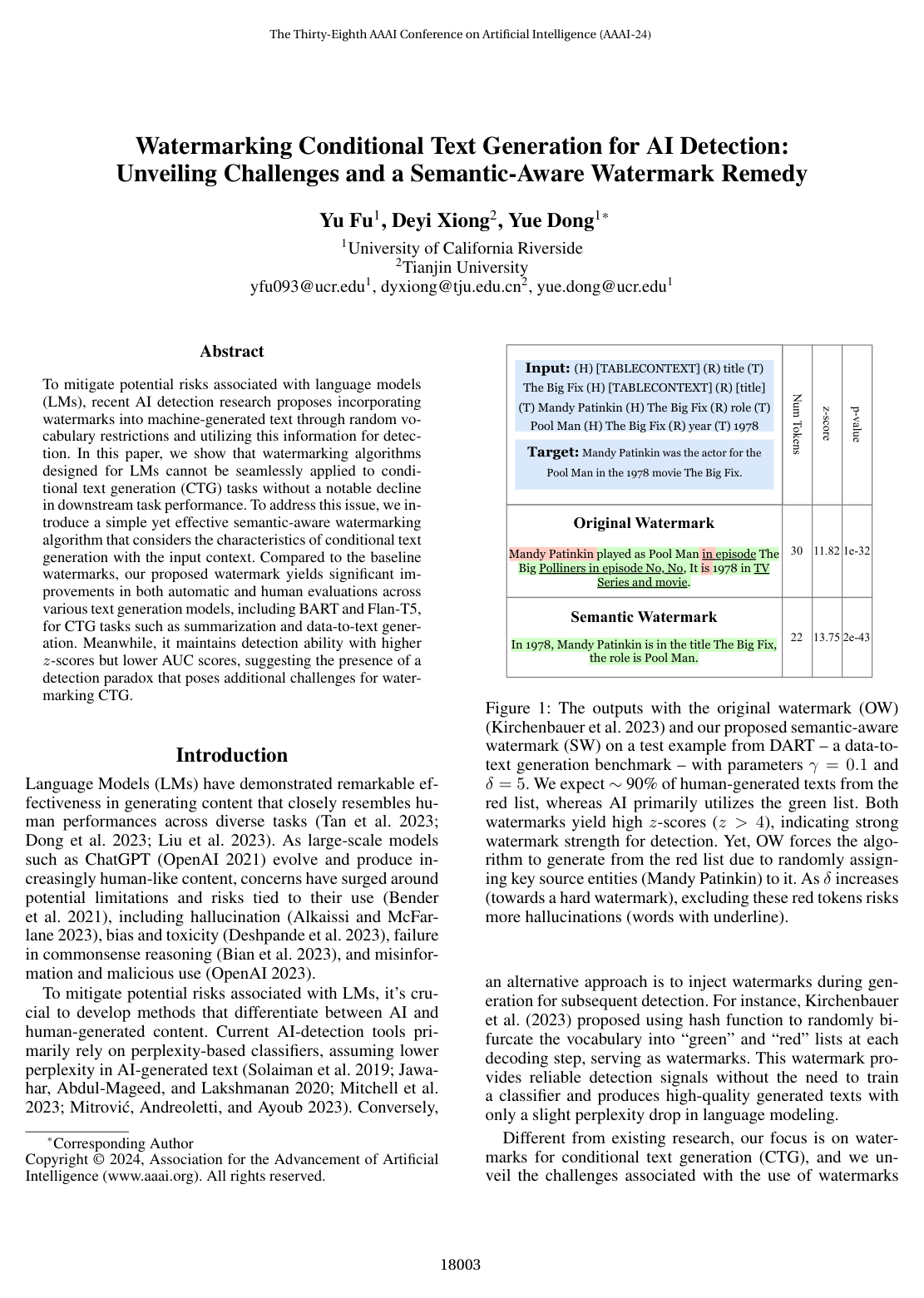
To mitigate potential risks associated with language models (LMs), recent AI detection research proposes incorporating watermarks into machine-generated text through random vocabulary restrictions and utilizing this information for detection. In this paper, we show that watermarking algorithms designed for LMs cannot be seamlessly applied to conditional text generation (CTG) tasks without a notable decline in downstream task performance. To address this issue, we introduce a simple yet effective semantic-aware watermarking algorithm that considers the characteristics of conditional text generation with the input context. Compared to the baseline watermarks, our proposed watermark yields significant improvements in both automatic and human evaluations across various text generation models, including BART and Flan-T5, for CTG tasks such as summarization and data-to-text generation. Meanwhile, it maintains detection ability with higher z-scores but lower AUC scores, suggesting the presence of a detection paradox that poses additional challenges for watermarking CTG.
Added
2026-09-26
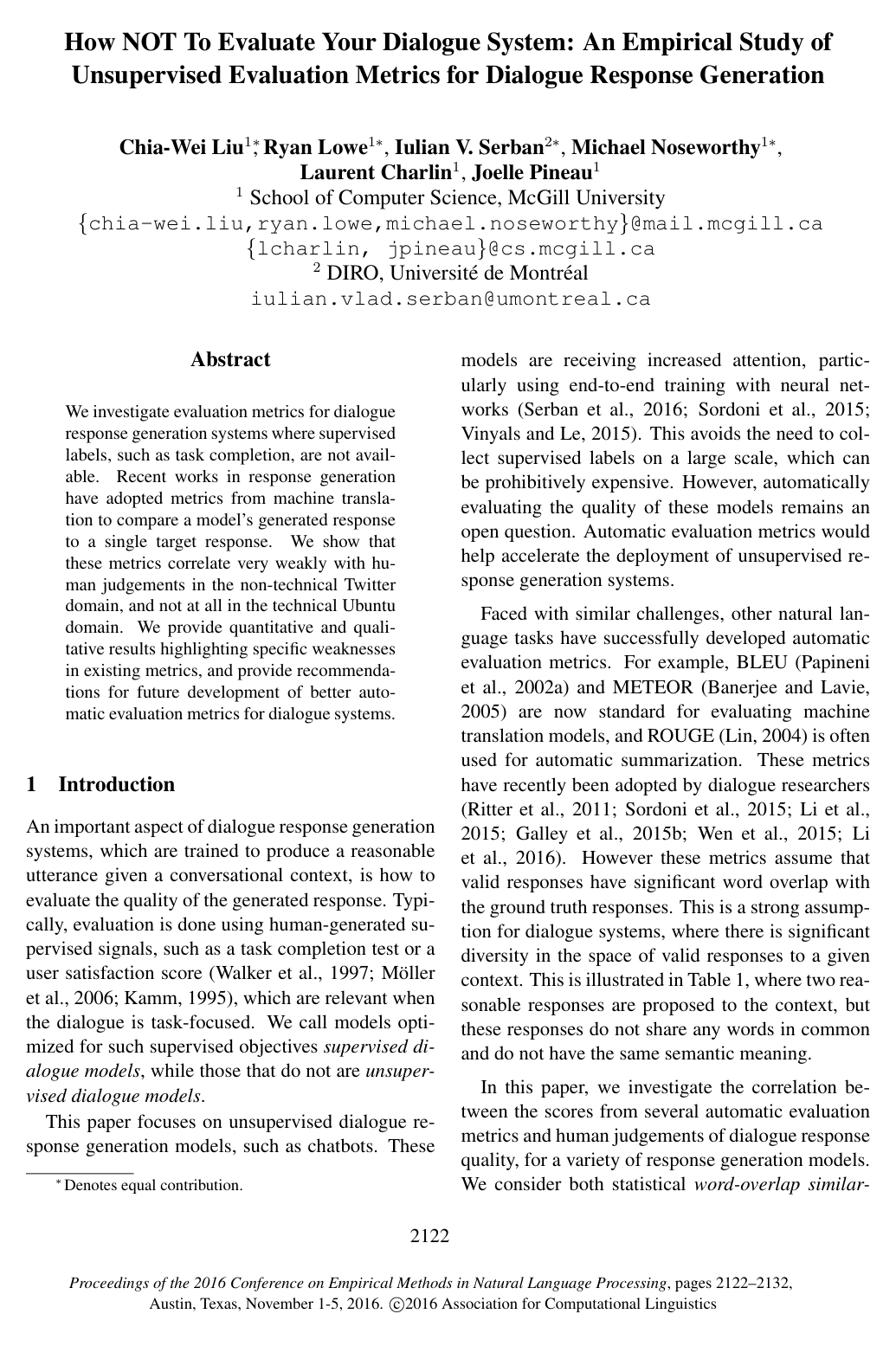
How NOT To Evaluate Your Dialogue System: An Empirical Study of Unsupervised Evaluation Metrics for Dialogue Response Generation
Chia-Wei Liu, Ryan Lowe, Iulian Serban, Michael Noseworthy, Laurent Charlin, Joelle Pineau
Why you should read this
Demonstrates that widely used machine translation metrics correlate poorly or not at all with human judgments when evaluating dialogue response generation, exposing critical flaws in standard conversational benchmarks.
We investigate evaluation metrics for dialogue response generation systems where supervised labels, such as task completion, are not available. Recent works in response generation have adopted metrics from machine translation to compare a model's generated response to a single target response. We show that these metrics correlate very weakly with human judgements in the non-technical Twitter domain, and not at all in the technical Ubuntu domain. We provide quantitative and qualitative results highlighting specific weaknesses in existing metrics, and provide recommendations for future development of better automatic evaluation metrics for dialogue systems.
Added
2026-09-25
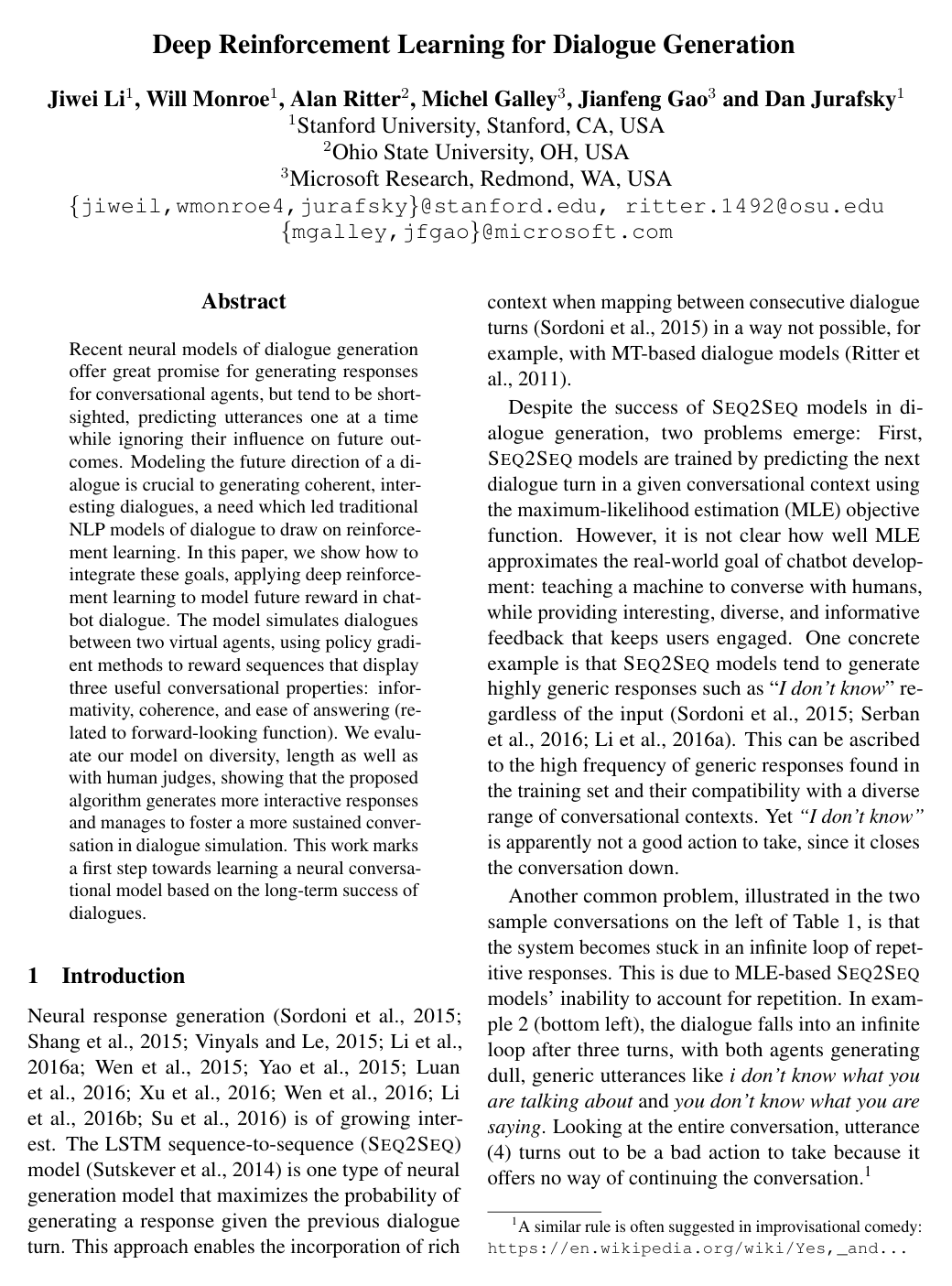
Deep Reinforcement Learning for Dialogue Generation
Jiwei Li, Will Monroe, Alan Ritter, Dan Jurafsky, Michel Galley, Jianfeng Gao
Why you should read this
Proposes a deep reinforcement learning framework that trains neural dialogue agents through simulated multi-turn interactions, optimizing for long-term coherence and informativeness to overcome the repetitive, shortsighted traps of standard sequence-to-sequence models.
Recent neural models of dialogue generation offer great promise for generating responses for conversational agents, but tend to be shortsighted, predicting utterances one at a time while ignoring their influence on future outcomes. Modeling the future direction of a dialogue is crucial to generating coherent, interesting dialogues, a need which led traditional NLP models of dialogue to draw on reinforcement learning. In this paper, we show how to integrate these goals, applying deep reinforcement learning to model future reward in chatbot dialogue. The model simulates dialogues between two virtual agents, using policy gradient methods to reward sequences that display three useful conversational properties: informativity (non-repetitive turns), coherence, and ease of answering (related to forward-looking function). We evaluate our model on diversity, length as well as with human judges, showing that the proposed algorithm generates more interactive responses and manages to foster a more sustained conversation in dialogue simulation. This work marks a first step towards learning a neural conversational model based on the long-term success of dialogues.
Added
2026-09-25
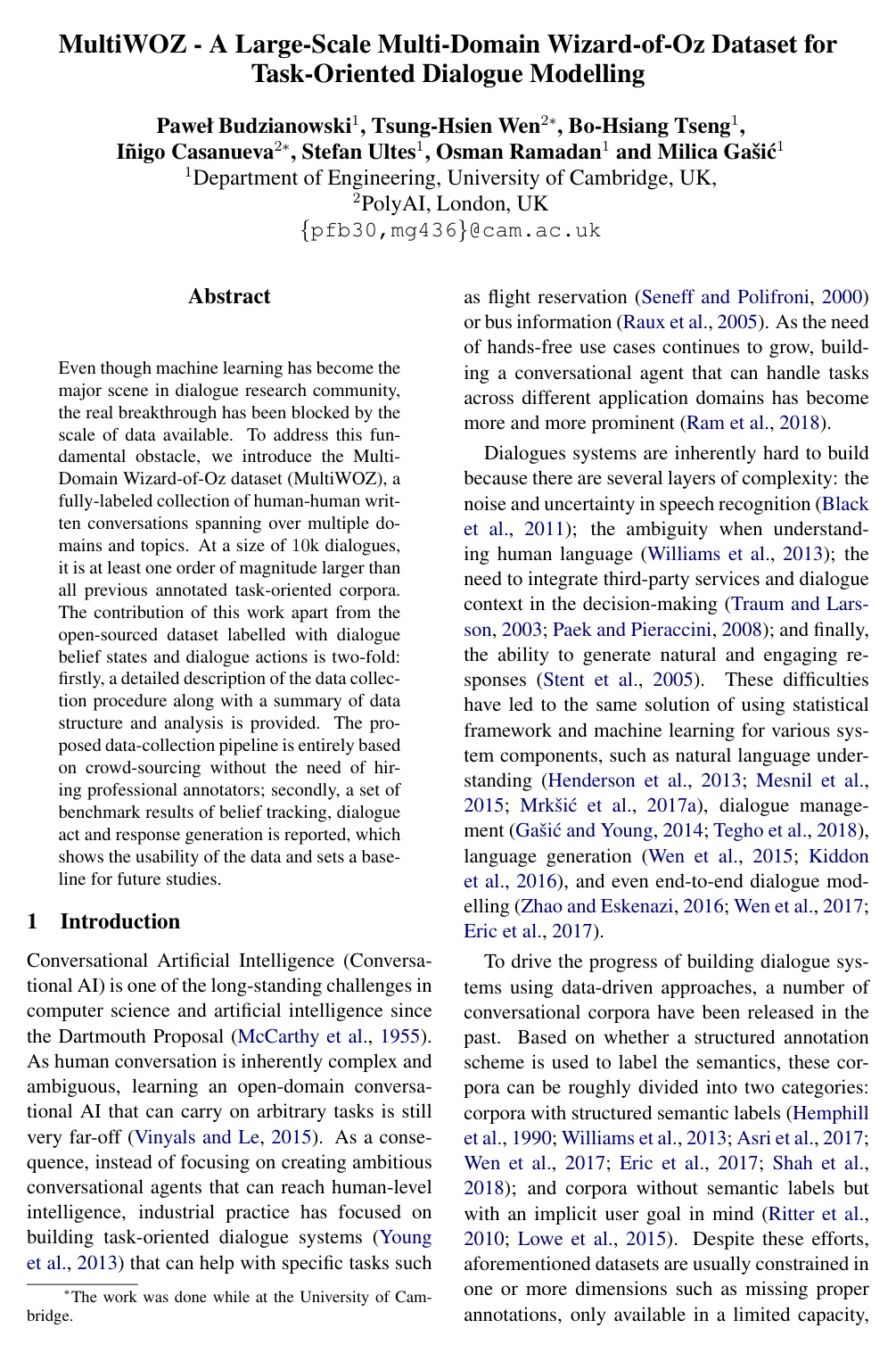
MultiWOZ - A Large-Scale Multi-Domain Wizard-of-Oz Dataset for Task-Oriented Dialogue Modelling
Paweł Budzianowski, Tsung-Hsien Wen, Bo-Hsiang Tseng, Iñigo Casanueva, Stefan Ultes, Osman Ramadan, Milica Gašić
Why you should read this
Introduces MultiWOZ, an open-source corpus of over 10,000 multi-domain conversations with dialogue state and action annotations that overcomes previous data scarcity barriers and establishes standardized baselines for task-oriented dialogue systems.
Even though machine learning has become the major scene in dialogue research community, the real breakthrough has been blocked by the scale of data available. To address this fundamental obstacle, we introduce the Multi-Domain Wizard-of-Oz dataset (MultiWOZ), a fully-labeled collection of human-human written conversations spanning over multiple domains and topics. At a size of k dialogues, it is at least one order of magnitude larger than all previous annotated task-oriented corpora. The contribution of this work apart from the open-sourced dataset labelled with dialogue belief states and dialogue actions is two-fold: firstly, a detailed description of the data collection procedure along with a summary of data structure and analysis is provided. The proposed data-collection pipeline is entirely based on crowd-sourcing without the need of hiring professional annotators; secondly, a set of benchmark results of belief tracking, dialogue act and response generation is reported, which shows the usability of the data and sets a baseline for future studies.
Added
2026-09-24
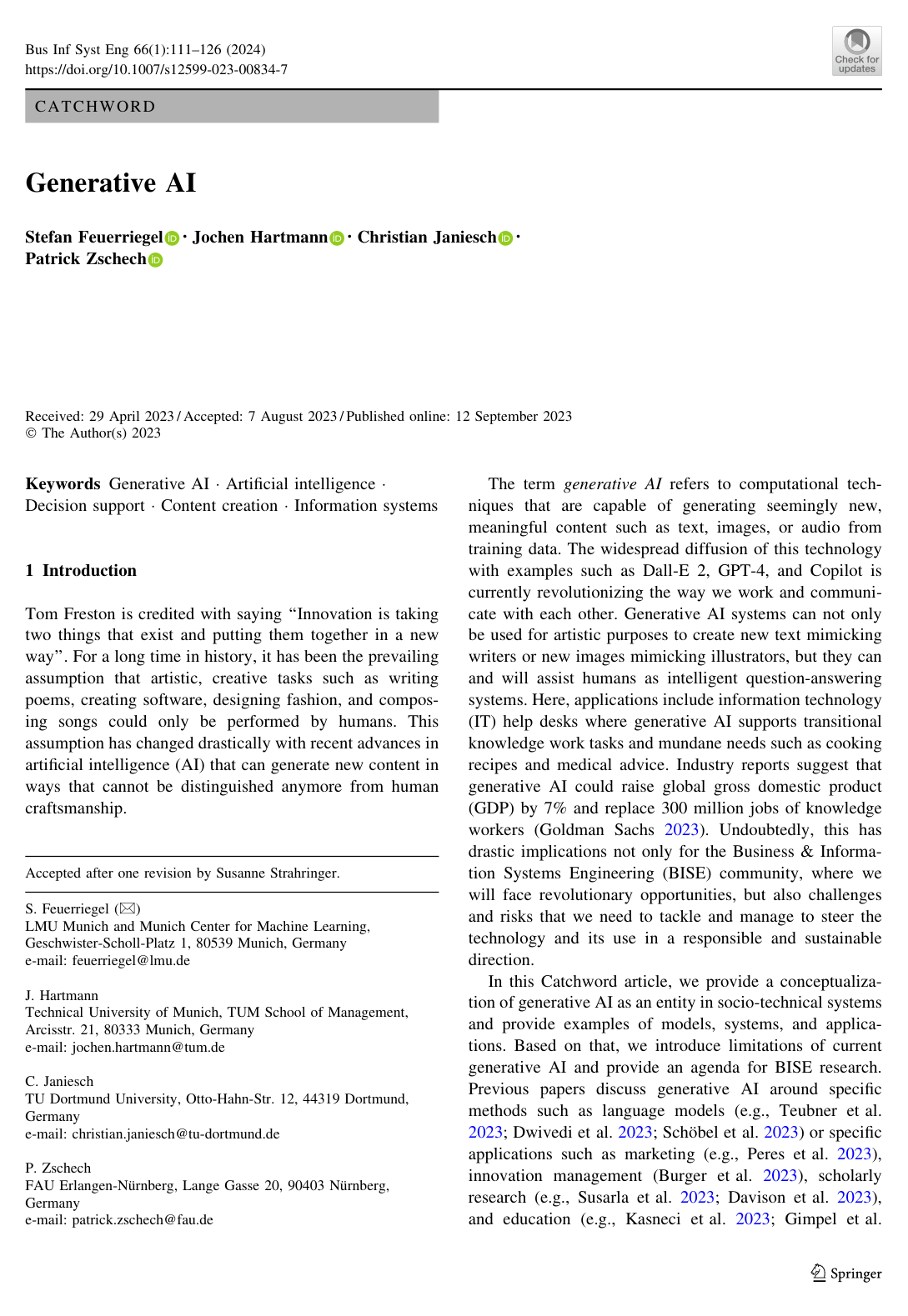
Generative AI
Stefan Feuerriegel, Jochen Hartmann, Christian Janiesch, Patrick Zschech
Why you should read this
Conceptualizes generative AI as an entity within socio-technical systems and sets a structured research agenda addressing the distinct operational challenges and opportunities it creates for business and information systems engineering.
The term "generative AI" refers to computational techniques that are capable of generating seemingly new, meaningful content such as text, images, or audio from training data. The widespread diffusion of this technology with examples such as Dall-E 2, GPT-4, and Copilot is currently revolutionizing the way we work and communicate with each other. In this article, we provide a conceptualization of generative AI as an entity in socio-technical systems and provide examples of models, systems, and applications. Based on that, we introduce limitations of current generative AI and provide an agenda for Business & Information Systems Engineering (BISE) research. Different from previous works, we focus on generative AI in the context of information systems, and, to this end, we discuss several opportunities and challenges that are unique to the BISE community and make suggestions for impactful directions for BISE research.
Added
2026-09-24
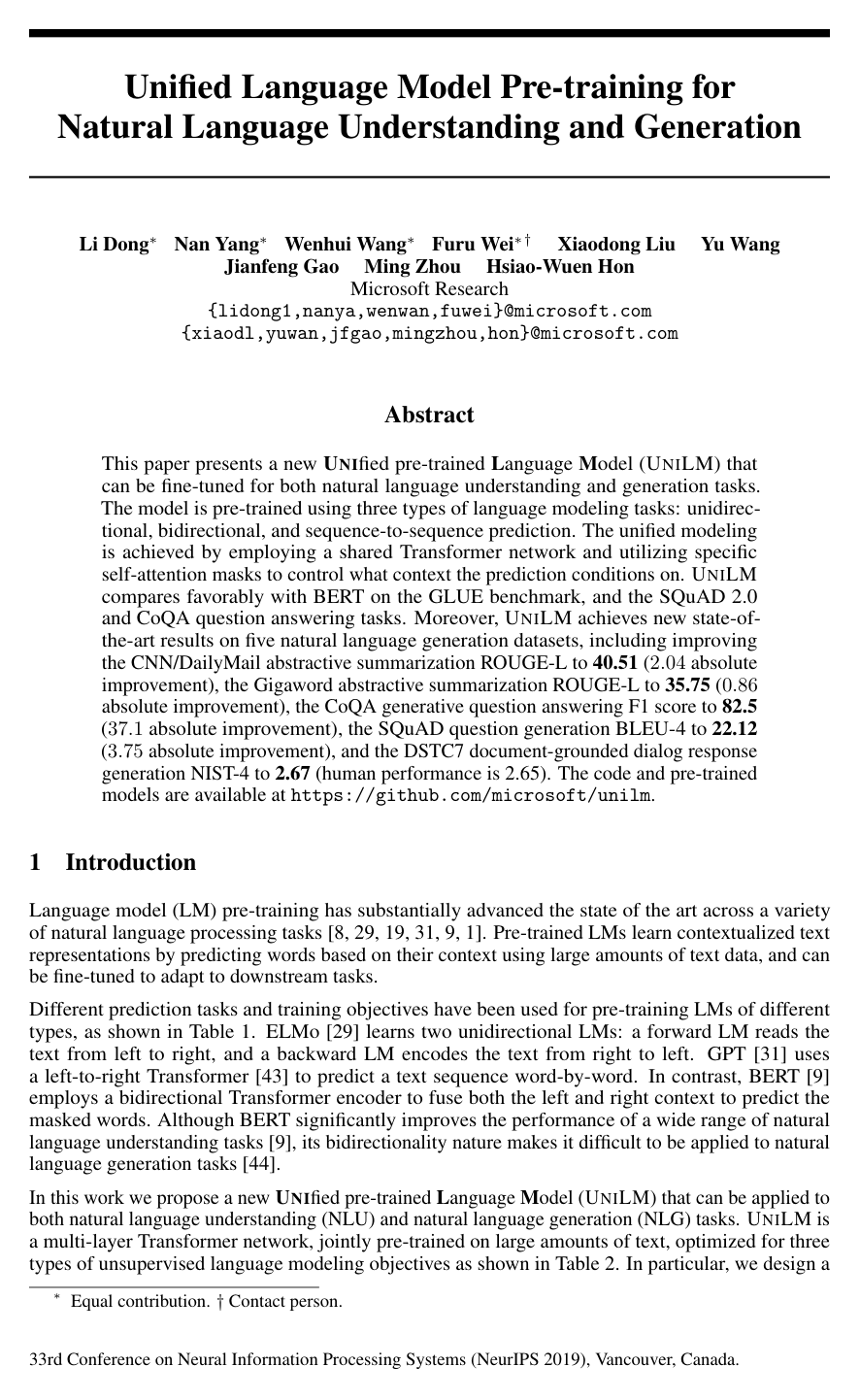
Unified Language Model Pre-training for Natural Language Understanding and Generation
Li Dong, Nan Yang, Wenhui Wang, Furu Wei, Xiaodong Liu, Yu Wang, Jianfeng Gao, Ming Zhou, Hsiao-Wuen Hon
Why you should read this
Introduces a unified pre-training architecture that uses variable self-attention masks to support both natural language understanding and generation within a single shared Transformer, outperforming standard baselines across diverse tasks like abstractive summarization, question answering, and dialogue.
This paper presents a new Unified pre-trained Language Model (UniLM) that can be fine-tuned for both natural language understanding and generation tasks. The model is pre-trained using three types of language modeling tasks: unidirectional, bidirectional, and sequence-to-sequence prediction. The unified modeling is achieved by employing a shared Transformer network and utilizing specific self-attention masks to control what context the prediction conditions on. UniLM compares favorably with BERT on the GLUE benchmark, and the SQuAD 2.0 and CoQA question answering tasks. Moreover, UniLM achieves new state-of-the-art results on five natural language generation datasets, including improving the CNN/DailyMail abstractive summarization ROUGE-L to 40.51 (2.04 absolute improvement), the Gigaword abstractive summarization ROUGE-L to 35.75 (0.86 absolute improvement), the CoQA generative question answering F1 score to 82.5 (37.1 absolute improvement), the SQuAD question generation BLEU-4 to 22.12 (3.75 absolute improvement), and the DSTC7 document-grounded dialog response generation NIST-4 to 2.67 (human performance is 2.65). The code and pre-trained models are available at this https URL.
Added
2026-09-24
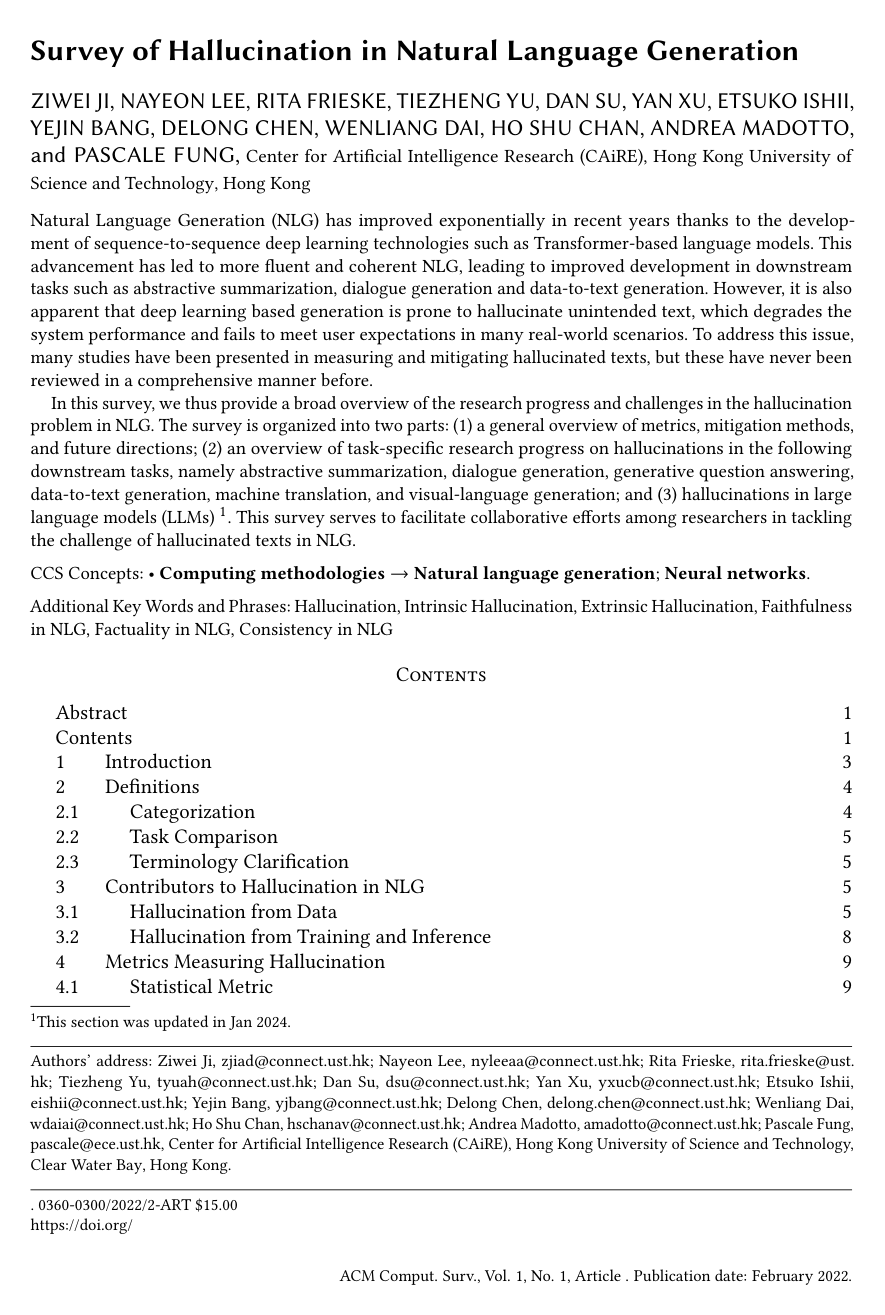
Survey of Hallucination in Natural Language Generation
Ziwei Ji, Nayeon Lee, Rita Frieske, Tiezheng Yu, Dan Su, Yan Xu, Etsuko Ishii, Ye Jin Bang, Andrea Madotto, Pascale Fung
Why you should read this
Systematizes the evaluation metrics and mitigation techniques for hallucinations across diverse natural language generation tasks and large language models to guide the development of factually reliable systems.
Natural Language Generation (NLG) has improved exponentially in recent years thanks to the development of sequence-to-sequence deep learning technologies such as Transformer-based language models. This advancement has led to more fluent and coherent NLG, leading to improved development in downstream tasks such as abstractive summarization, dialogue generation and data-to-text generation. However, it is also apparent that deep learning based generation is prone to hallucinate unintended text, which degrades the system performance and fails to meet user expectations in many real-world scenarios. To address this issue, many studies have been presented in measuring and mitigating hallucinated texts, but these have never been reviewed in a comprehensive manner before. In this survey, we thus provide a broad overview of the research progress and challenges in the hallucination problem in NLG. The survey is organized into two parts: (1) a general overview of metrics, mitigation methods, and future directions; (2) an overview of task-specific research progress on hallucinations in the following downstream tasks, namely abstractive summarization, dialogue generation, generative question answering, data-to-text generation, machine translation, and visual-language generation; and (3) hallucinations in large language models (LLMs). This survey serves to facilitate collaborative efforts among researchers in tackling the challenge of hallucinated texts in NLG.
Added
2026-09-14
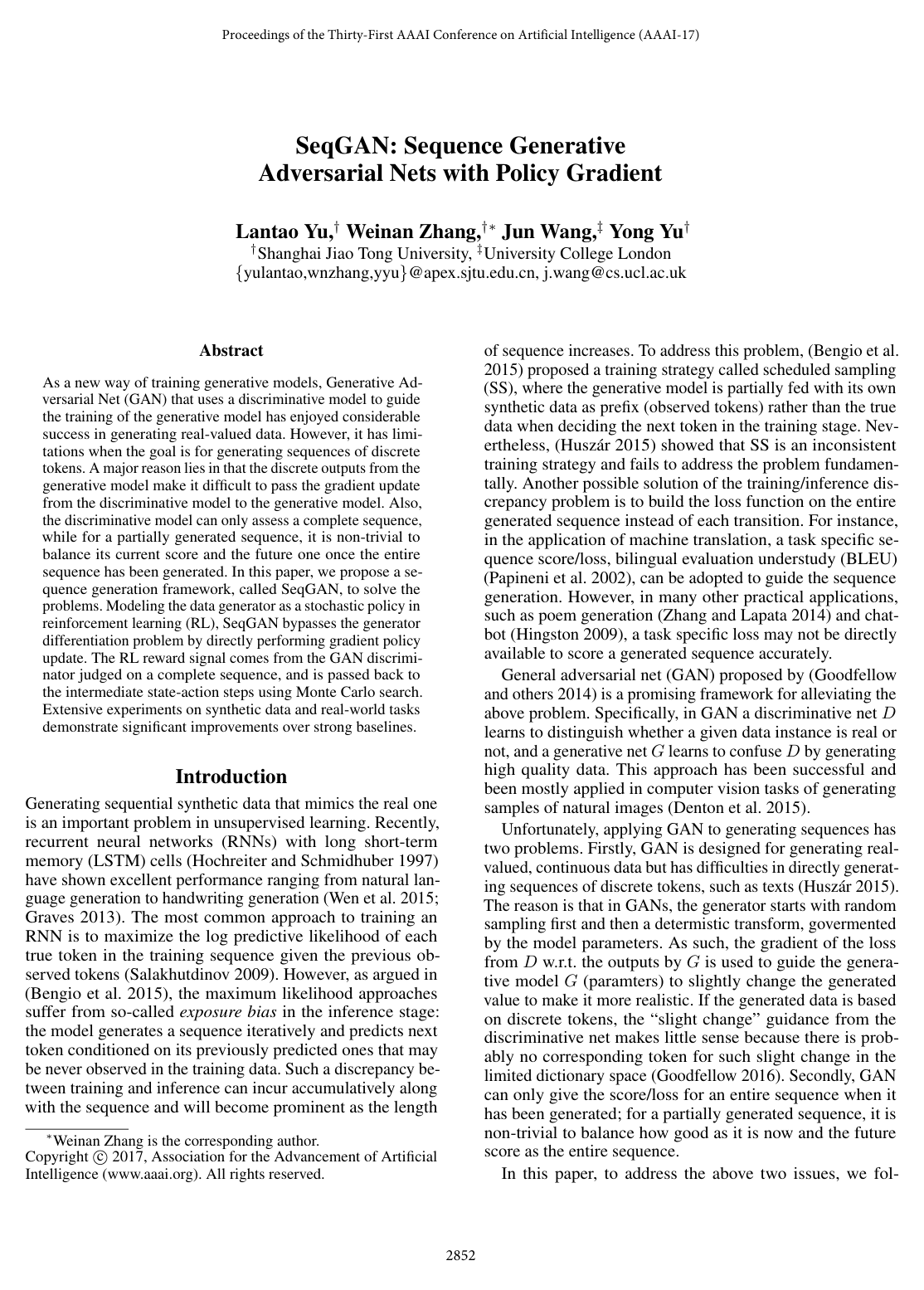
SeqGAN: Sequence Generative Adversarial Nets with Policy Gradient
Lantao Yu, Weinan Zhang, Jun Wang, Yong Yu
Why you should read this
Introduces SeqGAN to overcome the non-differentiability barrier of discrete sequence generation in generative adversarial networks by framing the generator as a reinforcement learning policy trained through policy gradients and Monte Carlo search.
As a new way of training generative models, Generative Adversarial Nets (GAN) that uses a discriminative model to guide the training of the generative model has enjoyed considerable success in generating real-valued data. However, it has limitations when the goal is for generating sequences of discrete tokens. A major reason lies in that the discrete outputs from the generative model make it difficult to pass the gradient update from the discriminative model to the generative model. Also, the discriminative model can only assess a complete sequence, while for a partially generated sequence, it is non-trivial to balance its current score and the future one once the entire sequence has been generated. In this paper, we propose a sequence generation framework, called SeqGAN, to solve the problems. Modeling the data generator as a stochastic policy in reinforcement learning (RL), SeqGAN bypasses the generator differentiation problem by directly performing gradient policy update. The RL reward signal comes from the GAN discriminator judged on a complete sequence, and is passed back to the intermediate state-action steps using Monte Carlo search. Extensive experiments on synthetic data and real-world tasks demonstrate significant improvements over strong baselines.
Added
2026-09-14
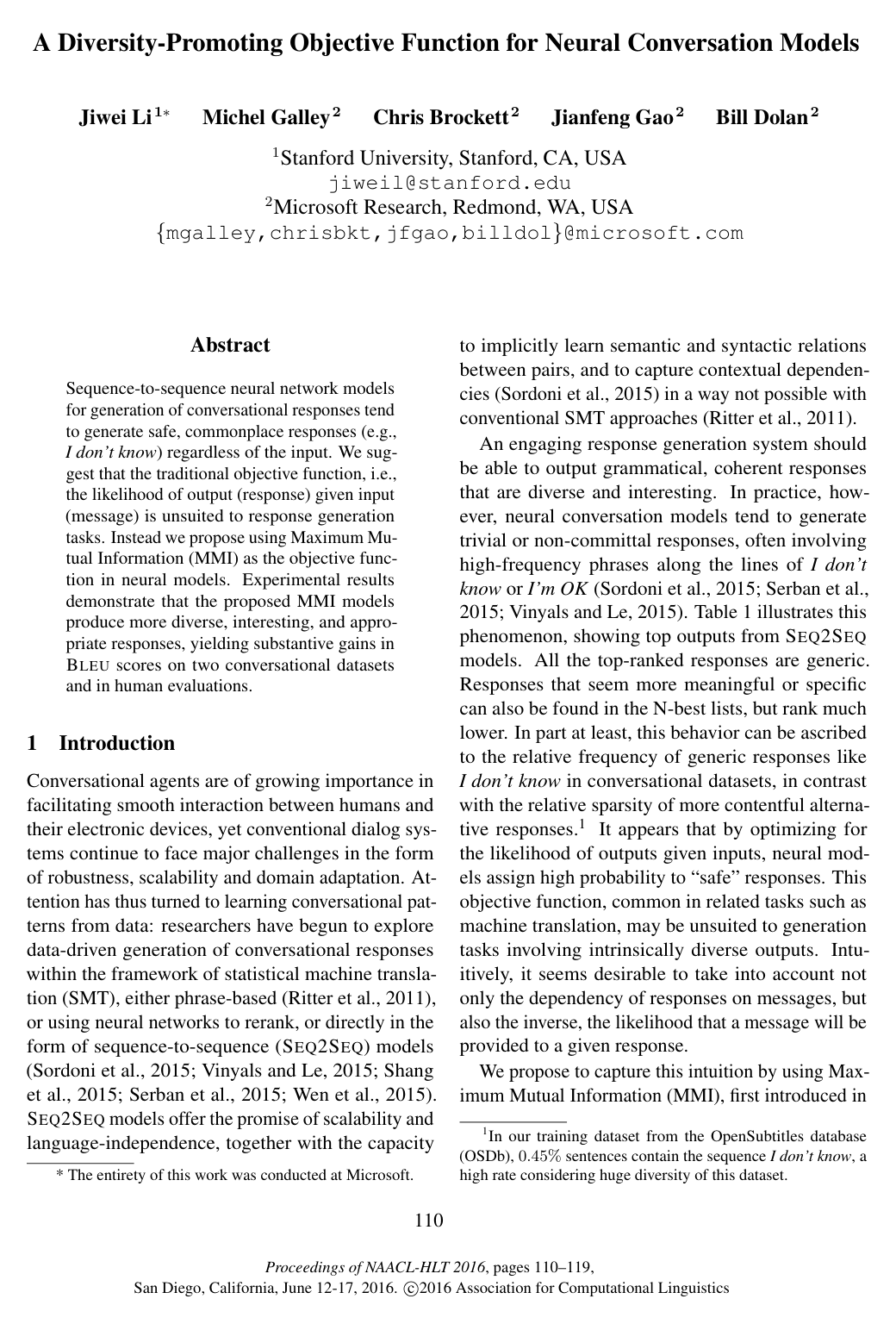
A Diversity-Promoting Objective Function for Neural Conversation Models
Jiwei Li, Michel Galley, Chris Brockett, Jianfeng Gao, Bill Dolan
Why you should read this
Proposes a Maximum Mutual Information objective function for neural conversation models to overcome the pervasive issue of dull, generic outputs and generate significantly more diverse, contextually appropriate dialogue.
Sequence-to-sequence neural network models for generation of conversational responses tend to generate safe, commonplace responses (e.g., "I don't know") regardless of the input. We suggest that the traditional objective function, i.e., the likelihood of output (response) given input (message) is unsuited to response generation tasks. Instead we propose using Maximum Mutual Information (MMI) as the objective function in neural models. Experimental results demonstrate that the proposed MMI models produce more diverse, interesting, and appropriate responses, yielding substantive gains in BLEU scores on two conversational datasets and in human evaluations.
Added
2026-09-14