
keyword
natural image denoising
Natural image denoising is an image processing and computer vision task focused on removing unwanted noise and visual distortions from photographs of real-world scenes to reconstruct a clean, high-fidelity representation of the original subject. During photographic capture, transmission, or compression, factors such as low-light conditions, thermal fluctuations, and sensor limitations often introduce random variations in pixel brightness and color, commonly modeled as Gaussian, Poisson, or salt-and-pepper noise. The central objective is to suppress these artifacts while preserving essential natural image structures, including sharp boundaries, subtle textures, and color gradients, without causing blurriness or introducing synthetic artifacts. Methodologies range from classical spatial and transform-domain filtering, such as wavelet transforms and non-local means, to modern deep learning architectures that leverage convolutional neural networks to learn statistical image priors and separate noise from true scene content.
2 items
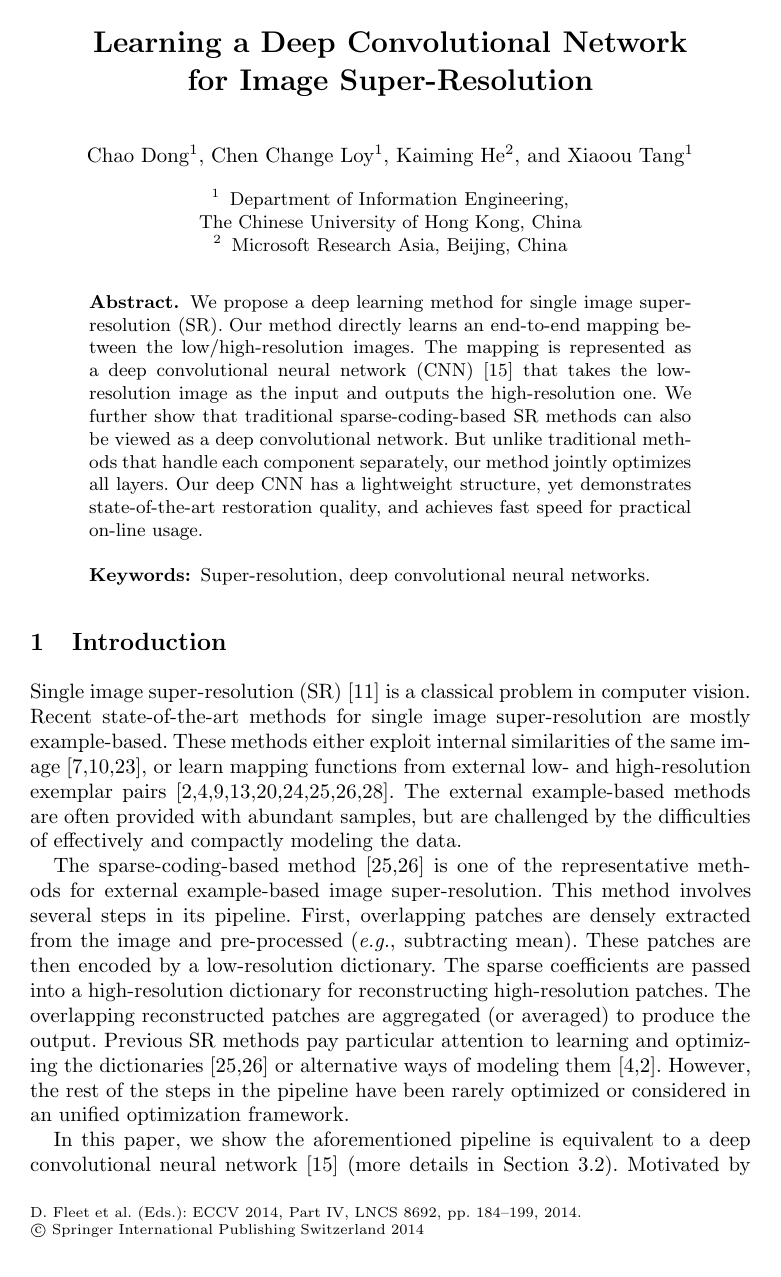
Learning a Deep Convolutional Network for Image Super-Resolution
Chao Dong, Chen Change Loy, Kaiming He, Xiaoou Tang
Why you should read this
Introduces the foundational end-to-end convolutional neural network for single-image super-resolution, proving that a lightweight deep architecture can outperform traditional sparse-coding pipelines in both restoration quality and computational speed.
We propose a deep learning method for single image super-resolution (SR). Our method directly learns an end-to-end mapping between the low/high-resolution images. The mapping is represented as a deep convolutional neural network (CNN) [15] that takes the low-resolution image as the input and outputs the high-resolution one. We further show that traditional sparse-coding-based SR methods can also be viewed as a deep convolutional network. But unlike traditional methods that handle each component separately, our method jointly optimizes all layers. Our deep CNN has a lightweight structure, yet demonstrates state-of-the-art restoration quality, and achieves fast speed for practical on-line usage.
Added
2026-09-09
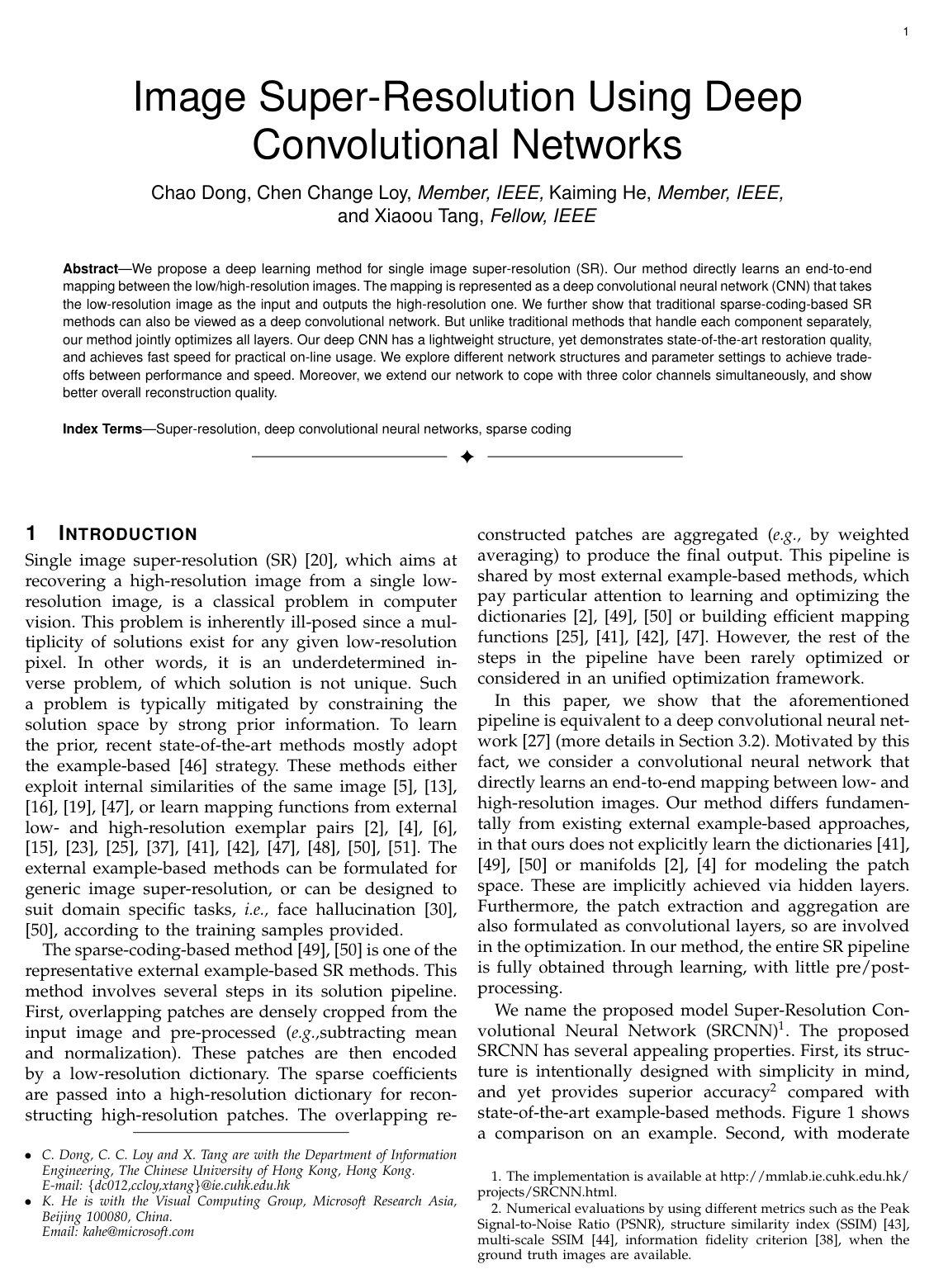
Image Super-Resolution Using Deep Convolutional Networks
Chao Dong, Chen Change Loy, Kaiming He, Xiaoou Tang
Why you should read this
Proposes an end-to-end deep convolutional neural network for single-image super-resolution that unifies classical sparse-coding methods into a joint optimization framework to achieve fast, high-quality image reconstruction.
We propose a deep learning method for single image super-resolution (SR). Our method directly learns an end-to-end mapping between the low/high-resolution images. The mapping is represented as a deep convolutional neural network (CNN) that takes the low-resolution image as the input and outputs the high-resolution one. We further show that traditional sparse-coding-based SR methods can also be viewed as a deep convolutional network. But unlike traditional methods that handle each component separately, our method jointly optimizes all layers. Our deep CNN has a lightweight structure, yet demonstrates state-of-the-art restoration quality, and achieves fast speed for practical on-line usage. We explore different network structures and parameter settings to achieve trade-offs between performance and speed. Moreover, we extend our network to cope with three color channels simultaneously, and show better overall reconstruction quality.
Added
2026-09-07