Built independently by an author, for readers. Read the story and support ChapterPal

keyword

multiscale feature pyramids

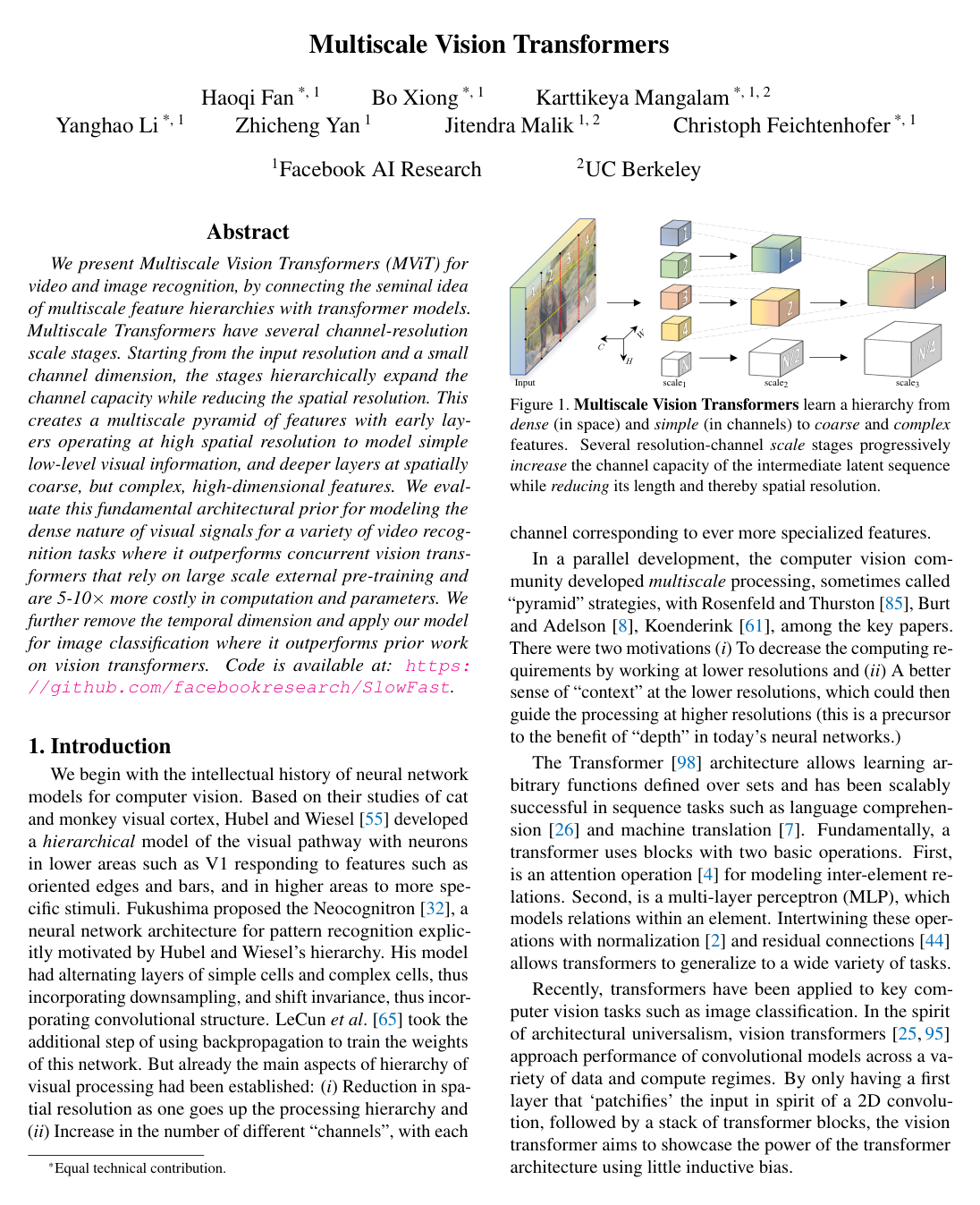
A multiscale feature pyramid is a hierarchical representation in computer vision neural networks that structures visual information across multiple spatial resolutions and channel dimensions. In this architecture, early network layers operate at high spatial resolutions with lower channel capacity to capture fine-grained, low-level details such as edges and textures, while deeper layers progressively reduce spatial resolution and expand channel capacity to represent complex, high-level semantic context. By organizing representations into a tiered multi-resolution structure, multiscale feature pyramids enable visual models to efficiently detect, segment, and recognize visual patterns or objects across varying sizes and scales in images and video.

1 item

Multiscale Vision Transformers

Multiscale Vision Transformers

Haoqi Fan, Bo Xiong, Karttikeya Mangalam, Yanghao Li, Zhicheng Yan, Jitendra Malik, Christoph Feichtenhofer

OrganizationsMetaUniversity of California Berkeley

Why you should read this

Develops Multiscale Vision Transformers, a hierarchical architecture that incorporates multiscale feature pyramids into visual attention to achieve superior video and image recognition performance with up to ten times less computation and without requiring massive external pre-training.

We present Multiscale Vision Transformers (MViT) for video and image recognition, by connecting the seminal idea of multiscale feature hierarchies with transformer models. Multiscale Transformers have several channel-resolution scale stages. Starting from the input resolution and a small channel dimension, the stages hierarchically expand the channel capacity while reducing the spatial resolution. This creates a multiscale pyramid of features with early layers operating at high spatial resolution to model simple low-level visual information, and deeper layers at spatially coarse, but complex, high-dimensional features. We evaluate this fundamental architectural prior for modeling the dense nature of visual signals for a variety of video recognition tasks where it outperforms concurrent vision transformers that rely on large scale external pre-training and are 5-10x more costly in computation and parameters. We further remove the temporal dimension and apply our model for image classification where it outperforms prior work on vision transformers. Code is available at: this https URL

Added

2026-09-24