
keyword
Multiple Kernel Learning
Multiple kernel learning is a machine learning framework that automatically learns an optimal combination of multiple kernel functions or representations instead of relying on a single predefined kernel. In kernel-based methods, such as support vector machines, kernels map data into higher-dimensional feature spaces to capture complex, non-linear relationships. Multiple kernel learning optimizes the weights or parameters assigned to various candidate kernels, often through mathematical optimization techniques involving linear, conic, or non-linear combinations, simultaneously with training the predictive model. By integrating diverse feature representations, data modalities, or similarity measures, this approach enhances generalization performance, improves model interpretability, and automates the process of kernel selection.
3 items
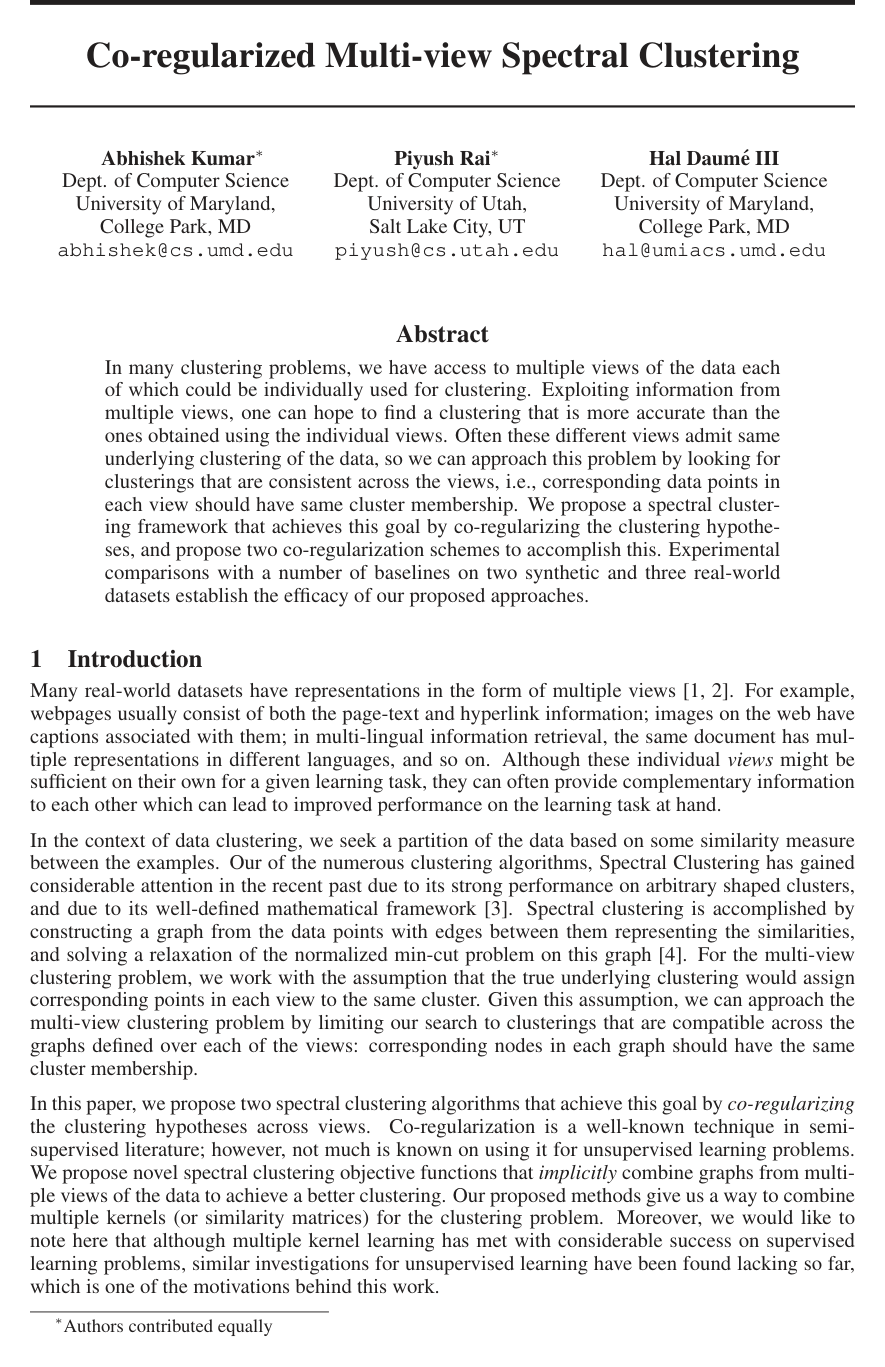
Co-regularized Multi-view Spectral Clustering
Abhishek Kumar, Piyush Rai, Hal Daumé
Why you should read this
Proposes a multi-view spectral clustering framework that co-regularizes graph Laplacians across different data representations to find consistent cluster assignments across diverse views.
In many clustering problems, we have access to multiple views of the data each of which could be individually used for clustering. Exploiting information from multiple views, one can hope to find a clustering that is more accurate than the ones obtained using the individual views. Often these different views admit same underlying clustering of the data, so we can approach this problem by looking for clusterings that are consistent across the views, i.e., corresponding data points in each view should have same cluster membership. We propose a spectral clustering framework that achieves this goal by co-regularizing the clustering hypotheses, and propose two co-regularization schemes to accomplish this. Experimental comparisons with a number of baselines on two synthetic and three real-world datasets establish the efficacy of our proposed approaches.
Added
2026-09-25
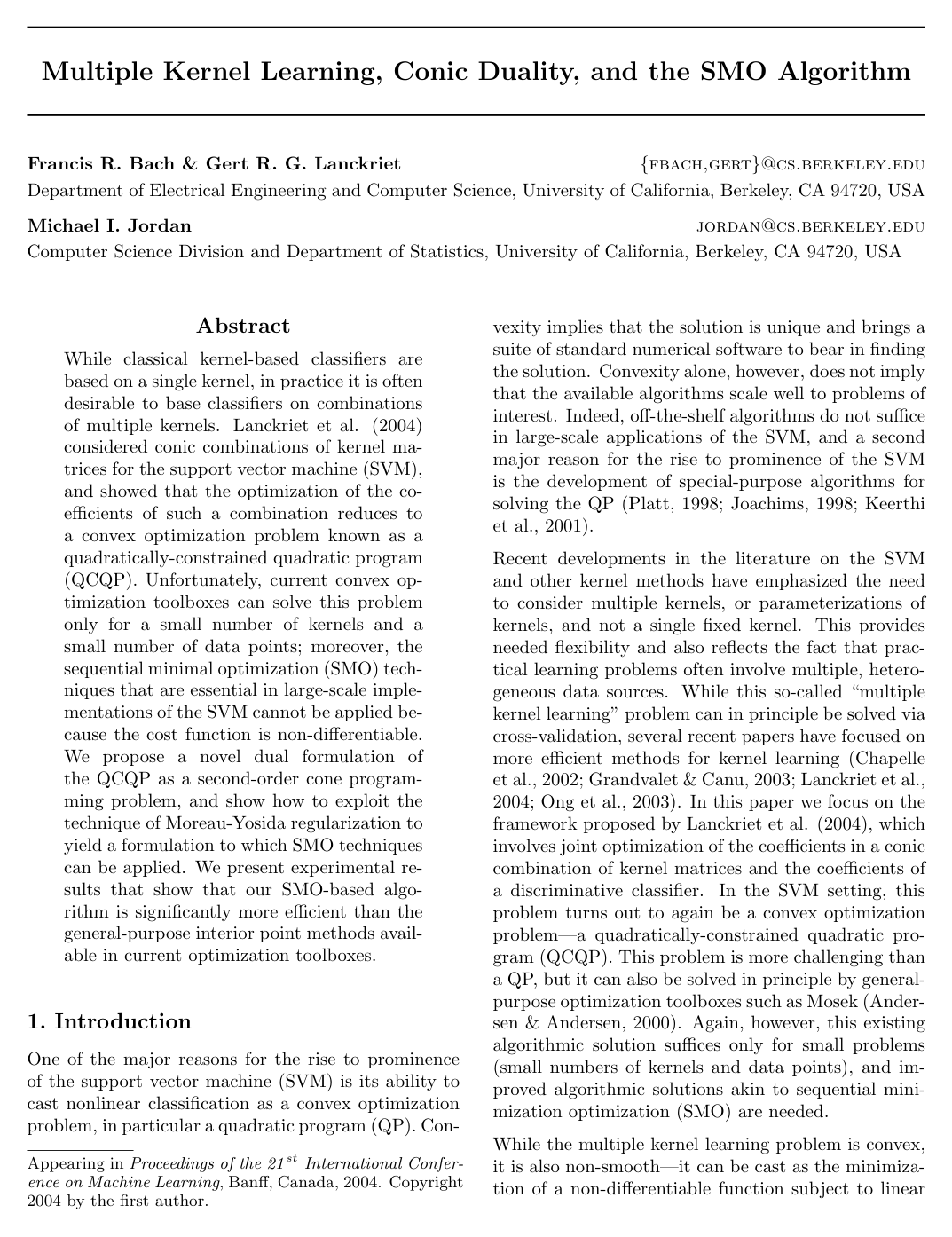
Multiple kernel learning, conic duality, and the SMO algorithm
F. Bach, Gert R. G. Lanckriet, Michael I. Jordan
Why you should read this
Proposes a conic duality framework for multiple kernel learning that combines second-order cone programming with Moreau-Yosida regularization to enable fast, scalable optimization using sequential minimal optimization algorithms.
While classical kernel-based classifiers are based on a single kernel, in practice it is often desirable to base classifiers on combinations of multiple kernels. Lanckriet et al. (2004) considered conic combinations of kernel matrices for the support vector machine (SVM), and showed that the optimization of the coefficients of such a combination reduces to a convex optimization problem known as a quadratically-constrained quadratic program (QCQP). Unfortunately, current convex optimization toolboxes can solve this problem only for a small number of kernels and a small number of data points; moreover, the sequential minimal optimization (SMO) techniques that are essential in large-scale implementations of the SVM cannot be applied because the cost function is non-differentiable. We propose a novel dual formulation of the QCQP as a second-order cone programming problem, and show how to exploit the technique of Moreau-Yosida regularization to yield a formulation to which SMO techniques can be applied. We present experimental results that show that our SMO-based algorithm is significantly more efficient than the general-purpose interior point methods available in current optimization toolboxes.
Added
2026-09-24
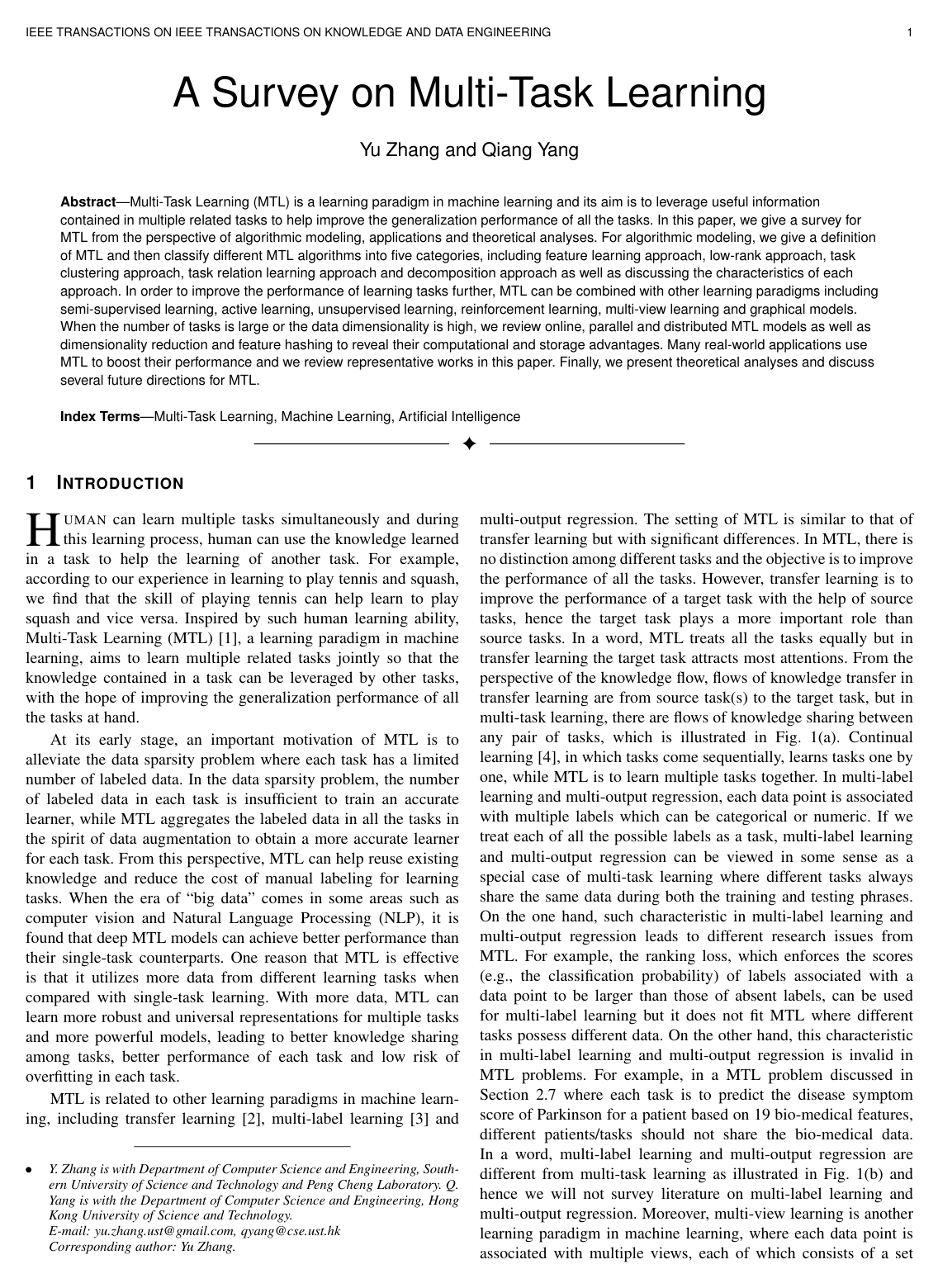
A Survey on Multi-Task Learning
Yu Zhang, Qiang Yang
Why you should read this
Classifies multi-task learning algorithms into five core modeling paradigms while reviewing theoretical foundations, computational scaling strategies, and integrations across diverse machine learning domains.
Multi-Task Learning (MTL) is a learning paradigm in machine learning and its aim is to leverage useful information contained in multiple related tasks to help improve the generalization performance of all the tasks. In this paper, we give a survey for MTL from the perspective of algorithmic modeling, applications and theoretical analyses. For algorithmic modeling, we give a definition of MTL and then classify different MTL algorithms into five categories, including feature learning approach, low-rank approach, task clustering approach, task relation learning approach and decomposition approach as well as discussing the characteristics of each approach. In order to improve the performance of learning tasks further, MTL can be combined with other learning paradigms including semi-supervised learning, active learning, unsupervised learning, reinforcement learning, multi-view learning and graphical models. When the number of tasks is large or the data dimensionality is high, we review online, parallel and distributed MTL models as well as dimensionality reduction and feature hashing to reveal their computational and storage advantages. Many real-world applications use MTL to boost their performance and we review representative works in this paper. Finally, we present theoretical analyses and discuss several future directions for MTL.
Added
2026-09-12